THE FIFTH PARAMETER: ISSUE 009: Beyond Procurement: Why Sign Language Artificial Intelligence Has Become a Public Policy Agenda

Beyond Procurement: Why Sign Language Artificial Intelligence Has Become a Public Policy Agenda
Artificial intelligence has become an increasingly significant component of contemporary public administration, reshaping how governments allocate resources, procure services, deliver public programs, and interact with citizens (Wirtz et al., 2019; Zuiderwijk et al., 2021). The rapid expansion of AI across the public sector has generated substantial scholarly interest in algorithmic governance, digital government, public value, and administrative innovation, reflecting a broader recognition that emerging technologies are transforming both the practice and institutions of government (Margetts & Dunleavy, 2013; Cordella & Bonina, 2012; Moore, 1995). Within this broader transformation, Sign Language Artificial Intelligence (SLxAI) has emerged as one of the most consequential developments in accessibility technology. Advances in computer vision, multimodal machine learning, and computational linguistics have substantially improved the ability of computational systems to recognize, generate, and translate signed languages, creating new opportunities to expand communication access for Deaf communities (Bragg et al., 2019). Consequently, scholarly attention has understandably focused on improving technical capability through increasingly sophisticated algorithms, larger datasets, and more advanced language models. At the same time, commercial investment has accelerated the development of AI enabled accessibility products, positioning Sign Language AI as an increasingly viable component of public service delivery.
Despite these advances, comparatively limited attention has been devoted to the institutional responsibilities that accompany governmental adoption of AI enabled accessibility technologies. Existing scholarship has made important contributions to artificial intelligence ethics, trustworthy AI, algorithmic accountability, disability policy, and digital government, yet these bodies of literature have largely evolved along parallel disciplinary trajectories (Jobin et al., 2019; Floridi & Cowls, 2019; Veale & Brass, 2019). Computer scientists have concentrated on technical performance and system design, legal scholars have examined regulatory implications, and public administration researchers have explored digital governance and public value. Relatively little research, however, has examined how these perspectives converge when governments procure artificial intelligence systems intended to fulfill accessibility obligations and mediate communication between citizens and the administrative state. This interdisciplinary gap becomes increasingly significant as public agencies evaluate AI enabled accessibility technologies for deployment within education, healthcare, workforce development, emergency management, judicial systems, and other essential public services.
The institutional adoption of Sign Language Artificial Intelligence fundamentally changes the nature of the policy conversation because government procurement is not merely an administrative transaction. Procurement represents an exercise of public authority through which democratic institutions allocate public resources, establish policy priorities, and shape the delivery of public services (Thai, 2001; Grandia & Meehan, 2017). As governments increasingly evaluate, procure, and deploy AI enabled accessibility technologies, technical performance becomes only one dimension of a broader governance challenge. Decisions concerning procurement integrity, administrative discretion, transparency, accountability, ethical implementation, and democratic legitimacy become equally important because they determine not only whether a technology functions, but whether its implementation advances the public interest while protecting civil rights and maintaining public trust (Denhardt & Denhardt, 2015; Bovens, 2007; Bryson et al., 2014). Accessibility technologies should therefore be understood not simply as software products or innovative procurement solutions, but as instruments of public governance that influence the relationship between citizens and the administrative state. This article argues that the continued integration of Sign Language Artificial Intelligence into public institutions marks an important inflection point in accessibility policy, requiring a corresponding shift in scholarly attention from technological capability toward public stewardship. It contends that the long term success of AI enabled accessibility will depend as much upon the quality of the institutions responsible for procuring, governing, evaluating, and sustaining these technologies as upon continued advances in artificial intelligence itself. Public administration, rather than computer science alone, therefore provides the conceptual and institutional framework through which Sign Language Artificial Intelligence should be understood, governed, and held accountable within democratic society.
I. Changing Conversations
Artificial intelligence has moved from the margins of public administration to an increasingly central role in the operation of contemporary government. Public agencies now employ AI across a broad spectrum of administrative functions, including fraud detection, emergency management, healthcare administration, workforce development, transportation planning, regulatory enforcement, and citizen engagement (Wirtz et al., 2019; Zuiderwijk et al., 2021). These developments have contributed to a growing body of scholarship examining digital government, algorithmic governance, and the transformation of administrative decision making in the twenty first century (Margetts & Dunleavy, 2013; Cordella & Bonina, 2012). What was once viewed as an emerging technology is increasingly understood as part of the institutional infrastructure through which governments allocate resources, implement policy, and deliver public services. Accessibility technologies have evolved within this broader transformation. Sign Language Artificial Intelligence (SLxAI), encompassing systems capable of recognizing, translating, generating, or otherwise facilitating signed communication through computational methods, has progressed from experimental laboratory research to an expanding commercial ecosystem supported by advances in computer vision, multimodal machine learning, and computational linguistics (Bragg et al., 2019). Yet despite this institutional evolution, much of the prevailing discourse continues to reflect the priorities of engineering rather than those of public administration. Scholarly publications understandably emphasize algorithmic performance, benchmark accuracy, dataset development, model optimization, and technical scalability, while commercial discussions frequently focus on innovation, market adoption, and product capability. These contributions have substantially advanced the technological maturity of the field. Comparatively less attention, however, has been devoted to the institutional responsibilities that arise when governments begin procuring and deploying AI enabled accessibility technologies as instruments of public service delivery (Veale & Brass, 2019; Jobin et al., 2019). The result is not a deficiency in technological innovation but an emerging need for governance scholarship capable of addressing how democratic institutions should oversee, evaluate, and sustain these systems over time.
Governmental adoption fundamentally changes the character of this conversation because procurement is neither a purely technical nor a politically neutral activity. Within public administration, procurement functions as a mechanism through which governments allocate public resources, establish policy priorities, exercise administrative discretion, and create enduring relationships with private organizations responsible for delivering public value (Thai, 2001; Grandia & Meehan, 2017). When agencies evaluate competing accessibility technologies, negotiate contractual obligations, establish performance expectations, and determine how AI systems will mediate communication between citizens and the state, they are exercising public authority rather than simply purchasing software. These decisions shape the implementation of disability rights, influence the distribution of accessibility resources, and establish the institutional conditions under which accountability will be maintained when technological systems inevitably encounter limitations or failure. Consequently, the introduction of Sign Language Artificial Intelligence into public institutions transforms what might otherwise appear to be a technical innovation into an emerging question of public governance. Considerations of transparency, procurement integrity, oversight, administrative ethics, democratic legitimacy, and public stewardship become inseparable from questions of algorithmic performance because they determine how governments fulfill their obligations to the communities they serve (Bovens, 2007; Denhardt & Denhardt, 2015; Bryson et al., 2014). This article therefore argues that Sign Language Artificial Intelligence should be understood not solely as an accessibility technology but as an emerging object of public policy. Its future will depend not only upon continued advances in machine learning, but equally upon the quality of the governance structures through which democratic institutions procure, implement, evaluate, and remain accountable for AI enabled accessibility throughout its operational life cycle.
II. The Evolution of Sign Language Artificial Intelligence
The development of Sign Language Artificial Intelligence may be understood as unfolding across three broad and interconnected stages that reflect changing technological capabilities, institutional priorities, and policy contexts. Although the boundaries between these stages are not absolute, they provide a useful analytical framework for understanding how SLxAI has evolved from an area of specialized computer science research into an emerging concern for public administration. This progression parallels broader developments in artificial intelligence, where advances in machine learning have increasingly shifted scholarly attention from questions of technical feasibility toward issues of governance, ethics, and institutional implementation (Wirtz et al., 2019; Zuiderwijk et al., 2021). The three-stage framework proposed here is intended not as a rigid historical classification, but as a conceptual model through which the changing relationship between technology and public governance may be examined.
The first stage was defined primarily by the pursuit of technical feasibility. Researchers sought to determine whether computational systems could reliably recognize, classify, interpret, and ultimately generate signed languages through advances in computer vision, pattern recognition, machine learning, and computational linguistics (Bragg et al., 2019). Significant effort was devoted to handshape recognition, gesture tracking, body pose estimation, facial expression analysis, and the linguistic modeling of signed languages, reflecting growing interdisciplinary collaboration among computer scientists, linguists, accessibility researchers, and Deaf communities. During this period, the central research question was straightforward: could machines meaningfully process signed communication with sufficient accuracy to support practical applications? Success was therefore measured primarily through benchmark performance, recognition accuracy, computational efficiency, and improvements in algorithmic capability. Institutional questions concerning governance, procurement, administrative accountability, and public policy received comparatively little scholarly attention because the technologies themselves remained largely confined to academic laboratories and experimental research environments. The primary objective was scientific validation rather than institutional deployment.
As computational capabilities matured, Sign Language Artificial Intelligence entered a second stage characterized by commercialization and market expansion. Improvements in deep learning architectures, multimodal foundation models, cloud computing, and large scale data processing substantially expanded the practical applications of AI enabled accessibility technologies. Research prototypes increasingly evolved into commercial products intended for deployment within education, healthcare, employment services, customer support, and other communication intensive environments. Venture capital investment, startup formation, and growing interest from established technology firms accelerated innovation while introducing new commercial incentives that increasingly influenced research priorities. Developers emphasized AI powered interpreting tools, avatar based communication systems, automated translation platforms, and multilingual accessibility services as scalable solutions to longstanding communication barriers. Public demonstrations and media coverage further expanded awareness of Sign Language Artificial Intelligence, contributing to expectations that AI would become an increasingly significant component of accessibility infrastructure. Yet commercialization also shifted the underlying logic of technological development. Decisions concerning product design, proprietary architectures, deployment strategies, competitive differentiation, and intellectual property became influenced not only by scientific objectives but also by market considerations. Accessibility technologies therefore entered an environment where innovation was increasingly shaped by commercial opportunity alongside accessibility outcomes.
A third stage is now emerging in which the defining characteristic is no longer technical innovation or commercial maturity, but institutional adoption. Governments, educational systems, healthcare providers, workforce development agencies, courts, emergency management organizations, and other public institutions are increasingly evaluating artificial intelligence as part of broader digital transformation strategies (Wirtz et al., 2019; Margetts & Dunleavy, 2013). In this context, Sign Language Artificial Intelligence is no longer simply an experimental technology or a commercial product awaiting market acceptance. It has become a candidate for public procurement, administrative implementation, and long term institutional integration. This transition fundamentally alters both the responsibilities associated with AI accessibility and the scholarly questions that accompany its deployment. Public agencies must determine how vendors should be evaluated, which accessibility standards should govern procurement, how contractual performance should be monitored, and what mechanisms will ensure accountability when AI mediated communication produces inequitable or unintended outcomes. Decisions that were previously confined to engineering teams and private firms increasingly become matters of administrative judgment subject to legal obligations, democratic oversight, fiscal stewardship, and public accountability (Thai, 2001; Bovens, 2007; Denhardt & Denhardt, 2015). The evolution of Sign Language Artificial Intelligence therefore represents more than a sequence of technological advances. It reflects a broader institutional transformation in which accessibility technologies increasingly become instruments of public governance. As governments assume the roles of purchaser, regulator, steward, and evaluator, the central questions surrounding SLxAI necessarily expand beyond algorithmic performance to encompass the governance structures through which democratic societies manage emerging technologies in the public interest.
III. From Technology to Public Administration
The institutional evolution of Sign Language Artificial Intelligence requires a corresponding evolution in the questions scholars and practitioners ask of these systems. Throughout the first two stages of SLxAI development, research was understandably dominated by engineering concerns involving algorithmic accuracy, computational efficiency, multimodal learning, and the technical feasibility of machine mediated signed communication (Bragg et al., 2019). These questions remain essential because accessibility technologies cannot fulfill their intended purpose without demonstrating reliable technical performance. Engineering disciplines therefore continue to make indispensable contributions by improving recognition accuracy, reducing computational error, optimizing model architectures, and expanding the capabilities of artificial intelligence. Yet governmental adoption introduces a second category of questions that engineering alone is not designed to answer. An algorithm capable of translating signed communication with remarkable precision offers no inherent guidance regarding whether it should be procured by a public agency, what ethical principles should govern its implementation, how procurement decisions should balance competing public interests, or who bears responsibility when technological limitations undermine equitable access to public services. Likewise, computer science does not seek to resolve questions concerning administrative transparency, procedural fairness, democratic oversight, institutional legitimacy, or the exercise of public authority because these issues fall within the domain of governance rather than engineering. The distinction is therefore not between successful and unsuccessful technology, but between technical capability and institutional responsibility. Once Sign Language Artificial Intelligence becomes embedded within governmental decision making and public service delivery, it enters an environment in which technical performance remains necessary but no longer sufficient.
For this reason, public administration provides the complementary institutional framework through which the next stage of Sign Language Artificial Intelligence should be examined. Public administration has long been concerned with the stewardship of public resources, the exercise of administrative discretion, the implementation of public policy, and the creation of public value through legitimate governmental institutions (Moore, 1995; Denhardt & Denhardt, 2015; Bryson et al., 2014). Rather than asking only whether a technological system is capable of performing a designated function, public administration asks whether its implementation advances the public interest while remaining consistent with democratic values, statutory obligations, ethical governance, and institutional accountability. This perspective is especially relevant within accessibility policy because decisions concerning communication access frequently involve competing public priorities, finite fiscal resources, legal mandates, and the protection of historically marginalized communities. Procurement officials, agency administrators, disability coordinators, legal counsel, and elected representatives routinely make judgments extending well beyond technical evaluation. They determine which accessibility needs receive priority, how competing vendors are assessed, what contractual safeguards should be incorporated into procurement, how performance should be monitored over time, and how citizens may obtain meaningful remedies when public systems fail to provide equitable access. Artificial intelligence therefore enters an administrative environment already governed by institutional norms, legal responsibilities, and democratic expectations that cannot be reduced to questions of computational performance alone.
Recognizing Sign Language Artificial Intelligence as an instrument of public administration also requires reconsidering the role of accessibility technologies within the administrative state. Infrastructure has traditionally been associated with physical assets such as transportation systems, utilities, and communications networks because these enable citizens to participate fully in economic and civic life. Increasingly, however, scholars have argued that digital technologies perform comparable institutional functions by mediating interactions between governments and the populations they serve (Margetts & Dunleavy, 2013; Cordella & Bonina, 2012). Online benefit systems, electronic health records, digital identity platforms, emergency notification systems, and automated public information services have become essential components of contemporary governance because they shape how citizens exercise rights and obtain access to public programs. Sign Language Artificial Intelligence is beginning to occupy a similar position within the accessibility ecosystem. When deployed by public agencies, these systems influence how Deaf citizens communicate with government personnel, participate in administrative proceedings, obtain critical information, and exercise rights guaranteed under disability law. Their significance therefore extends beyond software functionality to encompass the institutional architecture through which democratic governments deliver equitable public services. Like other forms of administrative infrastructure, AI enabled accessibility systems require sustained investment, procurement oversight, governance, maintenance, evaluation, and public accountability throughout their operational life cycle. Understanding SLxAI in this manner fundamentally reframes the policy conversation. The central challenge confronting governments is no longer simply how to build increasingly capable technologies, but how to govern those technologies in ways that strengthen institutional legitimacy, protect civil rights, and preserve public trust within democratic public administration.
IV. Procurement as Public Policy
Public procurement is commonly described as the administrative process through which governments acquire the goods and services necessary to fulfill their operational responsibilities. Although procedurally accurate, this description understates procurement’s broader significance within democratic governance. Public administration scholars have increasingly recognized procurement as a strategic instrument through which governments pursue policy objectives, stimulate innovation, allocate public resources, and shape relationships between the public and private sectors (Thai, 2001; Edler & Georghiou, 2007; Grandia & Meehan, 2017). Every solicitation, evaluation criterion, contract award, renewal decision, and performance requirement reflects governmental priorities while influencing the future direction of public investment. Procurement therefore extends well beyond purchasing. It determines which organizations become partners in delivering public services, establishes expectations for institutional performance, and communicates the values that will guide administrative decision making. Through procurement, governments not only acquire technology but also create governance relationships that influence markets, organizational behavior, and the long term capacity of public institutions to fulfill their obligations to citizens. Viewed from this perspective, procurement constitutes an exercise of public authority that deserves the same analytical attention afforded to legislation, regulation, and other formal instruments of public policy.
The governance significance of procurement becomes particularly apparent when examined through the lens of accessibility. Decisions concerning the acquisition of Sign Language Artificial Intelligence involve considerably more than technical comparisons among competing software products. They influence which communication models receive public investment, which accessibility approaches become institutionalized, and how governments ultimately fulfill statutory and ethical obligations to Deaf citizens under disability policy (United Nations, 2006; Jaeger, 2012). Vendor selection directly affects the quality of language access available within schools, healthcare systems, courts, workforce development agencies, emergency management organizations, and other public institutions where effective communication is essential to equitable participation. Procurement decisions likewise influence whether AI enabled accessibility complements existing human accommodations, supplements professional interpreting services, or inadvertently creates new barriers through inappropriate implementation. Because public contracts frequently involve substantial investments in software integration, training, maintenance, cybersecurity, and data infrastructure, procurement also creates forms of technological dependence that shape future administrative choices long after an initial contract has been executed. Governments therefore assume responsibilities extending beyond the identification of technically capable vendors. They must evaluate the broader institutional consequences of embedding particular technologies within administrative systems that citizens rely upon to exercise legal rights, obtain public services, and participate fully in civic life.
Perhaps most importantly, procurement establishes the governance architecture within which artificial intelligence will operate long before deployment begins. Contracts define performance expectations, accessibility obligations, reporting requirements, auditing procedures, data governance standards, monitoring mechanisms, and corrective actions that collectively determine how governmental oversight will be exercised throughout a technology’s operational life cycle. Decisions regarding vendor qualifications, evaluation criteria, independent verification, contract renewal, dispute resolution, and ongoing performance measurement create the institutional framework through which accountability is maintained after implementation. Governance therefore does not begin once artificial intelligence is deployed. It begins during procurement, when public agencies determine the rules, responsibilities, and oversight structures that will govern the technology for years to come. This observation carries particular significance for Sign Language Artificial Intelligence because opportunities to strengthen transparency, accountability, and institutional oversight become substantially more limited once contractual relationships and technical infrastructures are firmly established. The effectiveness, legitimacy, and trustworthiness of AI enabled accessibility systems will therefore depend not only upon advances in machine learning, but also upon the quality of the governance structures negotiated before those systems ever mediate communication between governments and the citizens they serve. Procurement should consequently be understood not as the administrative conclusion of technology acquisition, but as the institutional point at which public governance begins.
V. The Governance Gap
The emergence of Sign Language Artificial Intelligence within public institutions has revealed what this article describes as the Governance Gap. The term refers to the widening disparity between the rapid advancement of artificial intelligence capabilities and the comparatively limited development of institutional frameworks responsible for governing those capabilities once they enter the public sector. Over the past decade, scholarly and commercial attention has understandably concentrated on improving machine learning models, expanding multimodal datasets, refining computer vision techniques, and increasing translation performance. These efforts have accelerated the technical maturity of accessibility technologies and substantially expanded their potential applications. By comparison, far less attention has been devoted to the public institutions responsible for determining how these systems should be procured, evaluated, monitored, audited, and held accountable after implementation. The result is an imbalance in which technological innovation increasingly outpaces administrative preparedness. Governments possess growing opportunities to deploy artificial intelligence in support of accessibility while simultaneously confronting governance questions for which few established frameworks presently exist. The Governance Gap therefore does not describe a deficiency in engineering. Rather, it identifies an institutional challenge in which public administration has not yet developed governance structures capable of keeping pace with technological change.
Transparency represents one of the most immediate consequences of this governance imbalance. Democratic institutions derive legitimacy in part from their obligation to explain how public decisions are made, how resources are allocated, and how governmental authority is exercised. Artificial intelligence complicates these expectations because increasingly sophisticated systems often rely upon technical processes that are difficult for non specialists to interpret or independently evaluate. Yet transparency within public administration extends well beyond algorithmic explainability. Citizens are entitled to understand how vendors were selected, what procurement criteria were applied, which performance standards govern implementation, how accessibility claims were evaluated, and what evidence supports continued governmental reliance upon a particular system. Procurement documentation, contract records, audit findings, evaluation reports, and other administrative records therefore become essential components of AI governance rather than merely routine administrative artifacts. Without meaningful transparency throughout the procurement and implementation process, governments risk diminishing public confidence not because artificial intelligence is inherently opaque, but because the institutions responsible for its adoption fail to demonstrate how decisions affecting citizens were reached.
Accountability presents an equally significant governance challenge because artificial intelligence frequently disperses responsibility across multiple organizations and decision makers. When an AI enabled accessibility system produces inaccurate translations, denies meaningful communication access, or contributes to inequitable outcomes, determining responsibility becomes considerably more complex than identifying a technical malfunction. Vendors may argue that agencies configured the technology improperly. Public agencies may contend that contracted systems performed according to vendor specifications. Procurement officials may point to competitive evaluation procedures, while technical developers emphasize the statistical limitations of machine learning models. In such circumstances, responsibility risks becoming fragmented across contractual relationships and institutional boundaries, leaving affected citizens uncertain regarding where meaningful accountability resides. Effective governance requires precisely the opposite outcome. Administrative responsibility must remain identifiable throughout the procurement lifecycle, contractual obligations must clearly define vendor expectations, oversight mechanisms must permit independent evaluation of system performance, and institutional leaders must retain responsibility for ensuring that accessibility commitments are fulfilled. Artificial intelligence does not diminish governmental accountability. If anything, it heightens the obligation of public institutions to establish governance structures that preserve clear lines of responsibility despite increasing technological complexity.
Ultimately, the long term legitimacy of Sign Language Artificial Intelligence within the public sector will depend less upon technical sophistication than upon the quality of the governance institutions that surround it. Public trust is not generated solely through innovation, computational performance, or increasingly accurate translation models. Rather, trust emerges when citizens possess confidence that public institutions exercise authority fairly, transparently, consistently, and in accordance with established democratic principles. For Deaf communities, confidence in AI mediated accessibility will necessarily depend upon whether governments demonstrate responsible stewardship through rigorous procurement practices, independent oversight, meaningful stakeholder engagement, transparent decision making, and sustained accountability after deployment. A technologically sophisticated system governed poorly may generate considerably less public confidence than a less advanced system implemented within a robust framework of institutional oversight. The future acceptance of Sign Language Artificial Intelligence will therefore be shaped not only by advances in machine learning but by the willingness of democratic institutions to close the Governance Gap through deliberate, principled, and accountable public administration. In this respect, governance is not peripheral to accessibility innovation. It is the condition upon which enduring public trust ultimately depends.
VI. Reframing Accessibility Through Public Stewardship
The preceding discussion suggests that the principal challenge confronting Sign Language Artificial Intelligence is not simply the development of increasingly sophisticated technical standards, but the absence of a coherent institutional philosophy through which governments understand their responsibilities toward AI enabled accessibility. Existing scholarship in public administration has long emphasized stewardship as a defining obligation of democratic governance, extending beyond the efficient management of public resources to encompass the protection of the public interest, the preservation of institutional legitimacy, and the responsible exercise of governmental authority (Moore, 1995; Denhardt & Denhardt, 2015; Bryson et al., 2014). Drawing upon this tradition, this analysis argues that public stewardship provides an appropriate conceptual foundation for understanding the governance of AI enabled accessibility technologies. Whereas technology management is principally concerned with implementation, operational performance, maintenance, and system optimization, stewardship asks a fundamentally different set of questions. It asks whether governmental institutions have exercised their authority responsibly, whether public resources have been administered in ways that advance equitable outcomes, and whether institutional decisions strengthen democratic legitimacy and public trust over time. This distinction is especially important within accessibility policy because the consequences of governmental decisions extend well beyond software functionality. They influence how individuals experience education, healthcare, employment, emergency services, and civic participation through the institutions responsible for providing equitable communication access. Stewardship therefore shifts analytical attention from managing technology to governing its public consequences.
Viewed through this institutional perspective, Sign Language Artificial Intelligence becomes more than an innovative accessibility solution or an emerging digital service. It becomes an ongoing public commitment requiring continuous governmental responsibility throughout the technology’s operational life cycle. Stewardship does not conclude with the execution of a procurement contract or the successful implementation of a technological system. Rather, it requires public institutions to remain actively engaged through sustained performance monitoring, independent evaluation, institutional learning, and the continuous adaptation of governance practices as technological capabilities evolve. For Deaf communities, this principle carries particular significance because accessibility policy has historically been shaped by institutional decisions in which meaningful participation from affected communities has not always been consistently embedded. Responsible stewardship therefore extends beyond consultation during procurement. It requires continuing opportunities for Deaf citizens, disability advocates, interpreters, educators, researchers, and other stakeholders to participate in evaluating whether AI enabled accessibility systems continue to fulfill their intended public purpose. Such participation strengthens democratic legitimacy while contributing forms of experiential knowledge that cannot be generated through technical evaluation alone. Stewardship should therefore be understood not as a symbolic expression of governmental responsibility, but as an enduring institutional commitment grounded in ethical governance, administrative accountability, and continuous public engagement.
Reframing accessibility through the lens of public stewardship also requires reconsidering how governments define successful policy outcomes. Contemporary procurement systems frequently evaluate success according to measurable indicators such as acquisition costs, implementation schedules, contractual compliance, and operational efficiency. Although these metrics remain important components of responsible administration, they provide only a partial assessment of whether accessibility policy has achieved its broader public purpose. A procurement process may satisfy statutory requirements, remain fiscally responsible, and achieve contractual performance targets while nevertheless producing outcomes that weaken communication access, diminish institutional legitimacy, or fail to respond to the evolving needs of Deaf communities. Stewardship therefore expands the criteria through which policy success should be evaluated. In addition to technical performance and administrative efficiency, governments should consider whether AI enabled accessibility has strengthened equitable access, preserved transparency, maintained accountability, encouraged meaningful public participation, and demonstrated sustained institutional responsibility throughout the technology’s operational life cycle. These outcomes are fundamentally institutional rather than computational because they reflect the quality of governance surrounding artificial intelligence rather than the sophistication of the technology itself. Accessibility policy should therefore be evaluated not solely according to the efficiency with which governments procure artificial intelligence, but according to the degree to which democratic institutions govern those technologies in ways that protect civil rights, reinforce public values, and sustain public trust across successive generations of technological change.
VII. Toward the NCG Public Stewardship Framework
The preceding analysis suggests that existing approaches to public procurement, while well developed within their respective domains, do not fully address the governance challenges presented by Sign Language Artificial Intelligence. Traditional procurement scholarship has appropriately emphasized statutory compliance, competition, fiscal stewardship, contract administration, and value for money as essential components of responsible public acquisition (Thai, 2001; OECD, 2024). More recent contributions examining artificial intelligence procurement have expanded this discussion to include algorithmic fairness, cybersecurity, privacy protection, explainability, and technical risk management (NIST, 2023; European Commission, 2019; UNESCO, 2021). These developments represent important advances in AI governance. Nevertheless, comparatively limited attention has been directed toward the distinctive institutional questions that emerge when accessibility technologies become instruments through which governments fulfill civil rights obligations, mediate communication between citizens and public institutions, and implement disability policy. Accessibility technologies occupy a unique position within democratic governance because they influence not only administrative efficiency, but also equitable participation, procedural fairness, and the practical realization of legal rights. Existing procurement frameworks therefore provide valuable procedural guidance while leaving comparatively underdeveloped the broader governance considerations associated with AI enabled accessibility. This institutional gap suggests the need for a conceptual framework that integrates public procurement, public administration, disability policy, and artificial intelligence governance within a common analytical perspective.
Building upon this analysis, this article advances the NCG Public Stewardship Framework as an emerging conceptual model for examining the governance of AI enabled accessibility technologies within democratic institutions. Rather than reducing governance to a collection of independent compliance requirements, the framework conceptualizes responsible procurement as a system of mutually reinforcing institutional responsibilities operating throughout the technology’s lifecycle. Governance establishes the structures through which authority is exercised, responsibilities are assigned, and institutional oversight is maintained. Transparency ensures that procurement decisions, evaluation methodologies, implementation practices, and ongoing administrative actions remain subject to appropriate public scrutiny and democratic accountability. Accessibility extends beyond contractual compliance by requiring continuous assessment of whether technologies meaningfully improve equitable communication for the communities they are intended to serve. Procurement Integrity emphasizes ethical acquisition practices that preserve fairness, independence, accountability, and responsible stewardship of public resources from market engagement through contract completion. Public Trust represents the cumulative institutional outcome that emerges when these dimensions function cohesively over time. The framework therefore treats these five dimensions not as isolated evaluation criteria, but as interdependent components of a broader governance system in which weakness within one dimension inevitably influences the effectiveness of the others. Its purpose is not to create an additional compliance checklist, but to support principled institutional decision making throughout procurement, implementation, oversight, evaluation, and continuous organizational learning.
Although presented here in an early conceptual form, the NCG Public Stewardship Framework is intended to contribute to an emerging body of scholarship situated at the intersection of artificial intelligence governance, public administration, disability policy, accessibility governance, and democratic accountability. Existing research has understandably approached these domains from different disciplinary perspectives. Computer scientists have concentrated on technical capability, legal scholars have examined regulatory implications, disability scholars have explored accessibility outcomes and civil rights, while public administration researchers have focused on institutional performance, governance, and public value (Moore, 1995; Denhardt & Denhardt, 2015; Wirtz et al., 2019). As governments increasingly integrate artificial intelligence into accessibility policy, these perspectives can no longer be treated as independent conversations. The governance of AI enabled accessibility requires an interdisciplinary approach capable of integrating technical innovation with institutional responsibility. By positioning procurement as the point at which technological innovation becomes public governance, the proposed framework offers one possible foundation for advancing that integration. It is presented not as a definitive theory, but as the beginning of a continuing research agenda intended to stimulate scholarly dialogue, inform public sector practice, and support the development of more robust governance models for AI accessibility technologies. Future issues of The Fifth Parameter will examine each dimension of the framework in greater theoretical and practical depth, progressively refining its concepts through continued engagement with scholarship, policy, and practice.
VIII. Conclusion
The rapid evolution of Sign Language Artificial Intelligence represents more than another stage in the development of accessibility technology. It reflects a broader transformation in the relationship between technological innovation and democratic governance. Throughout the early stages of SLxAI research, scholarly attention was appropriately directed toward questions of technical feasibility, computational performance, and the linguistic challenges associated with machine mediated signed communication (Bragg et al., 2019). As commercialization expanded, additional attention was devoted to product development, market adoption, and the practical application of artificial intelligence within accessibility services. The growing involvement of governments, however, fundamentally changes the character of this discussion. Public agencies are no longer passive observers of technological innovation. They are becoming purchasers, implementers, regulators, evaluators, and long term stewards of AI enabled accessibility systems that increasingly influence how Deaf citizens communicate with public institutions and exercise rights guaranteed under disability law. This institutional transition requires a corresponding shift in scholarly perspective. Future discussions of Sign Language Artificial Intelligence cannot remain confined to measures of algorithmic performance, computational efficiency, or commercial innovation. They must also examine procurement as an exercise of public authority, governance as a condition of democratic legitimacy, stewardship as an enduring institutional responsibility, and accountability as an essential component of public trust. This article has argued that the next stage in the evolution of Sign Language Artificial Intelligence will depend as much upon the quality of public governance as upon continued advances in artificial intelligence itself.
The implications of this shift extend beyond Sign Language Artificial Intelligence alone. As governments increasingly integrate artificial intelligence into the delivery of public services, questions concerning accessibility, procurement, administrative ethics, and democratic accountability will become increasingly central to public administration scholarship. Building upon existing literature in AI governance, public procurement, disability policy, and digital government, this article has proposed the NCG Public Stewardship Framework as an initial conceptual model for examining these institutional relationships. Although presented here in an early form, the framework is intended to encourage continued scholarly dialogue concerning the governance of AI enabled accessibility within democratic institutions. Future research should further examine the practical application of stewardship principles across procurement, implementation, oversight, evaluation, and long term institutional learning while exploring how governance structures influence accessibility outcomes and public trust. Ultimately, the long term success of Sign Language Artificial Intelligence will not be determined solely by what increasingly sophisticated algorithms become capable of accomplishing. It will be determined by whether democratic institutions develop the governance capacity to procure, steward, evaluate, and sustain these technologies in ways that strengthen civil rights, reinforce institutional legitimacy, and advance the public interest. It is within that continuing evolution of public governance that the future of AI accessibility, and perhaps the future of accessibility policy itself, will ultimately be shaped.
References
Access Board. (2017). Information and communication technology standards and guidelines. https://www.access-board.gov/ict/
ADA National Network. (n.d.). Effective communication. https://adata.org/factsheet/communication
Barocas, S., Hardt, M., & Narayanan, A. (2023). Fairness and machine learning: Limitations and opportunities. MIT Press.
Benington, J., & Moore, M. H. (Eds.). (2011). Public value: Theory and practice. Palgrave Macmillan.
Blanck, P. (2014). eQuality: The struggle for web accessibility by persons with cognitive disabilities. Cambridge University Press.
Bozeman, B. (2007). Public values and public interest: Counterbalancing economic individualism. Georgetown University Press.
Bragg, D., Koller, O., Bellard, M., Berke, L., Boudreault, P., Braffort, A., Caselli, N., Huenerfauth, M., Kacorri, H., Verhoef, T., Vogler, C., & Ringel Morris, M. (2019). Sign language recognition, generation, and translation: An interdisciplinary perspective. Proceedings of the 21st International ACM SIGACCESS Conference on Computers and Accessibility, 16–31.
Bryson, J. M., Crosby, B. C., & Bloomberg, L. (2014). Public value governance: Moving beyond traditional public administration and the new public management. Public Administration Review, 74(4), 445–456.
Bovens, M. (2007). Analysing and assessing accountability: A conceptual framework. European Law Journal, 13(4), 447–468.
Cordella, A., & Bonina, C. M. (2012). A public value perspective for ICT enabled public sector reforms: A theoretical reflection. Government Information Quarterly, 29(4), 512–520.
Crawford, K. (2021). Atlas of AI: Power, politics, and the planetary costs of artificial intelligence. Yale University Press.
Denhardt, J. V., & Denhardt, R. B. (2015). The new public service: Serving, not steering (4th ed.). Routledge.
Dunleavy, P., Margetts, H., Bastow, S., & Tinkler, J. (2006). New public management is dead: Long live digital era governance. Journal of Public Administration Research and Theory, 16(3), 467–494.
Edler, J., & Georghiou, L. (2007). Public procurement and innovation: Resurrecting the demand side. Research Policy, 36(7), 949–963.
European Commission, High-Level Expert Group on Artificial Intelligence. (2019). Ethics guidelines for trustworthy AI. European Commission.
Floridi, L., & Cowls, J. (2019). A unified framework of five principles for AI in society. Harvard Data Science Review, 1(1).
Frederickson, H. G. (1990). Public administration and social equity. Public Administration Review, 50(2), 228–237.
Goggin, G., & Newell, C. (2003). Digital disability: The social construction of disability in new media. Rowman & Littlefield.
Grandia, J., & Meehan, J. (2017). Public procurement as a policy tool: Using procurement to reach desired outcomes in society. International Journal of Public Sector Management, 30(4), 302–309.
Hood, C. (1991). A public management for all seasons? Public Administration, 69(1), 3–19.
Jaeger, P. T. (2012). Disability and the internet: Confronting a digital divide. Lynne Rienner Publishers.
Janssen, M., & van der Voort, H. (2016). Adaptive governance: Towards a stable, accountable, and responsive government. Government Information Quarterly, 33(1), 1–5.
Jobin, A., Ienca, M., & Vayena, E. (2019). The global landscape of AI ethics guidelines. Nature Machine Intelligence, 1, 389–399.
Kroll, J. A., Huey, J., Barocas, S., Felten, E. W., Reidenberg, J. R., Robinson, D. G., & Yu, H. (2017). Accountable algorithms. University of Pennsylvania Law Review, 165(3), 633–705.
Lipsky, M. (1980). Street-level bureaucracy: Dilemmas of the individual in public services. Russell Sage Foundation.
Margetts, H., & Dunleavy, P. (2013). The second wave of digital era governance: A quasi-paradigm for government on the web. Philosophical Transactions of the Royal Society A, 371(1987), 20120382.
Mittelstadt, B. (2019). Principles alone cannot guarantee ethical AI. Nature Machine Intelligence, 1, 501–507.
Moore, M. H. (1995). Creating public value: Strategic management in government. Harvard University Press.
National Institute of Standards and Technology. (2023). Artificial intelligence risk management framework (AI RMF 1.0). U.S. Department of Commerce.
OECD. (2019). OECD principles on artificial intelligence. Organisation for Economic Co-operation and Development.
OECD. (2024). Recommendation of the Council on public procurement. Organisation for Economic Co-operation and Development.
Oliver, M. (1990). The politics of disablement. Macmillan.
Ostrom, E. (1990). Governing the commons: The evolution of institutions for collective action. Cambridge University Press.
Raji, I. D., Smart, A., White, R. N., Mitchell, M., Gebru, T., Hutchinson, B., Smith-Loud, J., Theron, D., & Barnes, P. (2020). Closing the AI accountability gap: Defining an end-to-end framework for internal algorithmic auditing. Proceedings of the 2020 Conference on Fairness, Accountability, and Transparency, 33–44.
Selbst, A. D., Boyd, D., Friedler, S. A., Venkatasubramanian, S., & Vertesi, J. (2019). Fairness and abstraction in sociotechnical systems. Proceedings of the Conference on Fairness, Accountability, and Transparency, 59–68.
Shakespeare, T. (2014). Disability rights and wrongs revisited (2nd ed.). Routledge.
Sunstein, C. R. (2018). The cost-benefit revolution. MIT Press.
Thai, K. V. (2001). Public procurement re-examined. Journal of Public Procurement, 1(1), 9–50.
United Nations. (2006). Convention on the rights of persons with disabilities. United Nations.
UNESCO. (2021). Recommendation on the ethics of artificial intelligence. United Nations Educational, Scientific and Cultural Organization.
U.S. Department of Justice. (2010). 2010 ADA standards for accessible design. U.S. Department of Justice.
U.S. Department of Justice. (2020). ADA requirements: Effective communication. ADA.gov.
U.S. General Services Administration. (n.d.). Section508.gov. https://www.section508.gov/
Uyarra, E., & Flanagan, K. (2010). Understanding the innovation impacts of public procurement. European Planning Studies, 18(1), 123–143.
Veale, M., & Brass, I. (2019). Administration by algorithm? Public management meets public sector machine learning. In K. Yeung & M. Lodge (Eds.), Algorithmic regulation (pp. 121–149). Oxford University Press.
Wirtz, B. W., Weyerer, J. C., & Geyer, C. (2019). Artificial intelligence and the public sector: Applications and challenges. International Journal of Public Administration, 42(7), 596–615.
World Wide Web Consortium. (2023). Web content accessibility guidelines (WCAG) 2.2. W3C.
Zuiderwijk, A., Chen, Y. C., & Salem, F. (2021). Implications of the use of artificial intelligence in public governance: A systematic literature review and a research agenda. Government Information Quarterly, 38(3), 101577.
Figure Plate
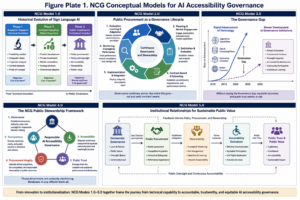
The conceptual models presented in Figure Plate 1 synthesize the principal arguments developed throughout this article. Rather than depicting independent concepts, the models collectively illustrate the progression of Sign Language Artificial Intelligence from technical innovation to an emerging domain of public governance. They demonstrate that the institutional challenges associated with AI enabled accessibility extend beyond algorithmic performance to encompass procurement, stewardship, transparency, accountability, and democratic legitimacy. Together, the models provide a conceptual foundation for understanding why public administration must increasingly occupy a central role in the governance of accessibility technologies.
Figure Plate 1. NCG Conceptual Models for AI Accessibility Governance. NCG Model 1.0 illustrates the evolution of Sign Language Artificial Intelligence from academic research through commercialization to institutional adoption within the public sector. NCG Model 2.0 conceptualizes public procurement as a continuous governance lifecycle extending beyond acquisition into implementation, monitoring, evaluation, and institutional learning. NCG Model 3.0 presents the Governance Gap, highlighting the divergence between rapid advances in AI capability and the comparatively slower development of governance institutions. NCG Model 4.0 introduces the NCG Public Stewardship Framework, positioning Governance, Transparency, Accessibility, Procurement Integrity, and Public Trust as mutually reinforcing dimensions of responsible AI accessibility governance. NCG Model 5.0 illustrates the institutional relationships through which democratic governance, public procurement, stewardship, accessibility outcomes, and public trust interact to produce sustainable public value.
Viewed collectively, the five models advance the central proposition of this article: the future of Sign Language Artificial Intelligence will be determined not solely by continued advances in machine learning, but by the quality of the institutions responsible for procuring, governing, evaluating, and sustaining these technologies. Together they form an integrated analytical framework that bridges artificial intelligence governance, public administration, disability policy, and public procurement while providing the conceptual foundation for the NCG Public Stewardship Framework introduced in this article. Subsequent issues of The Fifth Parameter will examine each model in greater theoretical and practical depth as part of an ongoing research agenda focused on AI accessibility governance.
Author Note
This article inaugurates a continuing research agenda examining the intersection of artificial intelligence governance, accessibility, public procurement, and public administration. Although significant scholarly attention has been devoted to the technical development of artificial intelligence and the ethical implications of algorithmic decision making, comparatively limited attention has been directed toward the institutional governance of AI enabled accessibility technologies within democratic government. The Fifth Parameter seeks to contribute to this emerging field by examining how governments procure, govern, evaluate, and sustain accessibility technologies that increasingly mediate interactions between citizens and the administrative state.
The conceptual models and analytical framework introduced in this article represent the beginning of an evolving body of scholarship rather than its conclusion. Subsequent issues of The Fifth Parameter will progressively examine the theoretical foundations and practical implications of AI accessibility governance through the lenses of public administration, disability policy, administrative ethics, public procurement, digital government, and democratic accountability. Collectively, these publications are intended to refine the proposed NCG Public Stewardship Framework, encourage interdisciplinary dialogue, and support the development of governance models that strengthen institutional legitimacy, protect civil rights, and promote trustworthy accessibility innovation within the public sector.
The long-term objective of this research agenda is to advance accessibility governance as a distinct area of inquiry within public policy scholarship while providing practical guidance for policymakers, procurement professionals, public administrators, accessibility leaders, and researchers responsible for governing emerging artificial intelligence technologies. As AI continues to reshape the relationship between governments and the communities they serve, the quality of public institutions will become increasingly important in determining whether technological innovation ultimately advances the public interest. It is within this evolving institutional landscape that The Fifth Parameter seeks to make its contribution.
Heather M. Grizzle
Founder and Principal Consultant, Novara Consulting Group LLC
Doctoral Research in Public Policy | Artificial Intelligence Governance | Accessibility Policy | Public Procurement