
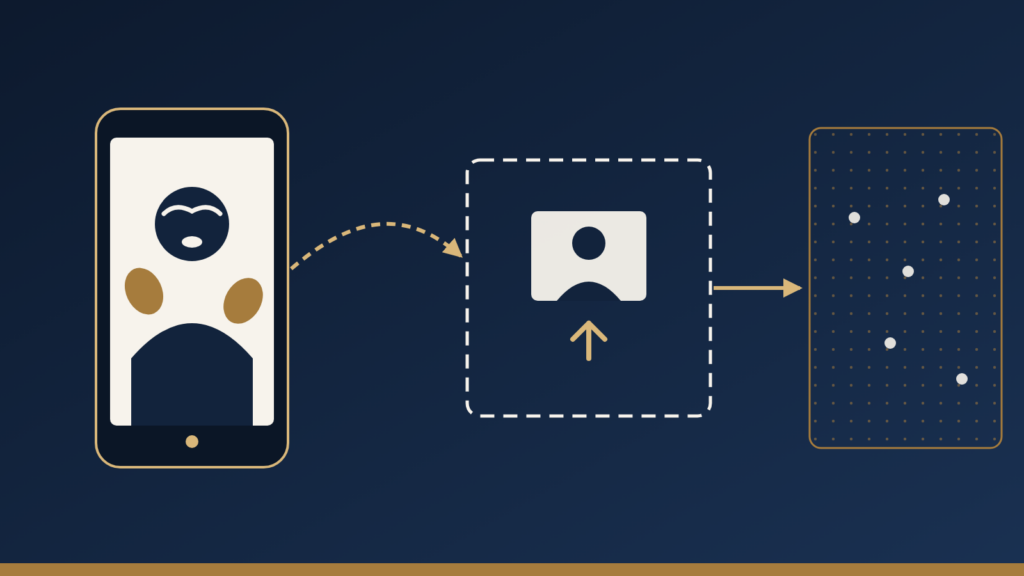
In September, The Corpus Question asked whose signing builds sign language AI, what those signers agreed to, whether they were paid, and whether they can take their faces back. That piece was about vendors. This one is about the rest of us, because the corpus no longer comes only from vendor studios. It comes from the upload box.
The upload box
Picture a Deaf small-business owner on a weekday morning. She runs a cleaning company, or a tutoring practice, or a little shop that sells hand-dyed yarn, and she has watched hearing competitors fill their feeds with slick AI video for a year. This fall she finally signs up for an AI course taught in ASL by Deaf instructors, designed for people like her. She learns to write a decent prompt. She builds a consistent character. Then comes the session she has been waiting for: making a sign language avatar. She props her phone against a coffee mug, records herself signing a welcome message for her website, opens a video model in her browser, and drags the clip into the upload box.
That drag is the moment this article is about. Nothing about it feels like signing a contract, and nobody in the room is thinking about one. But the clip she just uploaded holds her face, her hands, her regional signing, the way her eyebrows climb on a question and her mouth shapes an intensifier. It is a sample of a language, recorded at high resolution, attached to a name, an email address and a payment card. Under the terms she clicked through, it now sits on a server in Singapore or in a joint venture’s cloud, licensed to a company whose business is building better video models.
A trained model cannot hand a face back.
NCG
The courses are not the problem. The better ones teach real judgment about output: smooth, confident-looking motion is not the same as accurate meaning, a fluent reviewer checks the render against a real signing source, and throwing out a bad render counts as a win rather than a failure. That is the right lesson, and it is more than most vendors teach their own customers. But it is a lesson about what comes out of the machine. The corpus question is about what goes in, and what goes in is governed by a contract nobody in the room has read.
What Kling’s paper says
Kling is the video generation business of Kuaishou, one of China’s largest short-video platforms. It reports more than 60 million creators since its June 2024 launch, and in July 2026 it raised close to three billion dollars in a round that left Kuaishou holding about 68 percent[7]. The contracting entity is Kling AI Pte. Ltd. in Singapore. The terms are governed by Singapore law, disputes go to arbitration under the Singapore International Arbitration Centre, and the privacy policy says user data is stored on servers in Singapore and may be transferred elsewhere[2,3].
Kling at a glance
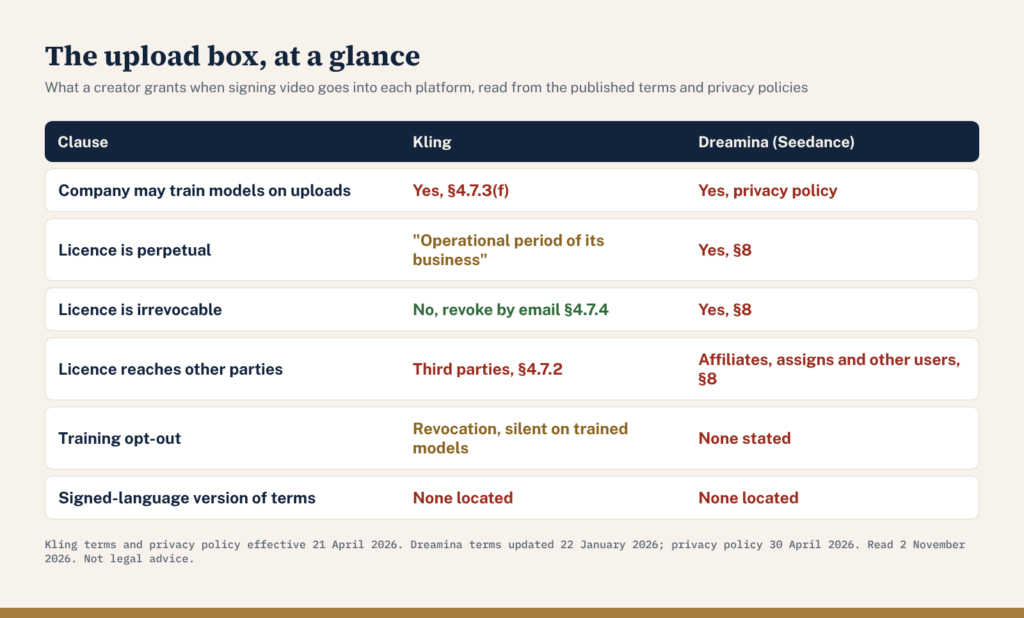
Section 4.4 tells users they own the intellectual property in their content, and section 4.6 says that using the service does not transfer any portrait rights a user holds. Those are real protections and they deserve to be read first. Then comes section 4.7. It grants Kling a “non-exclusive, royalty-free right and license” over content, defined to include both what a user uploads and what the model generates, running “during the operational period of its business.” Section 4.7.2 lets Kling use content for promotion, product upgrades and research, directly or by licensing it to third parties, and asks the user not to claim personal or property rights against that use. Section 4.7.3 then lists the purposes for which Kling may process input, and item (f) is the one that matters here.
create, test, improve, train, or otherwise develop the artificial intelligence or machine learning models
Kling AI Pte. Ltd., Terms of Service, section 4.7.3(f), effective 21 April 2026
Kling does offer a way out, which is more than many platforms do. Section 4.7.4 says a user who no longer wants Kling to keep using their content may “notify us to revoke the authorization by sending an email to support@kling.ai.” What the terms do not say is what revocation reaches.
The privacy policy adds a second tension. Section 1.A(2) says that for portrait features such as character face mode, Kling “may analyze the material you upload and upload the feature points,” described as vector points of the eyes, nose and mouth and contour lines. Section 1.A(6) then says Kling does not analyse facial recognition features or identify individuals from pictures, and does not “collect, share or store any face data.” A reader is left to reconcile a policy that uploads the geometry of a face with a policy that says it holds no face data. The policy never addresses training on inputs directly. It relies on a legitimate interest in “product development and internal analytics purposes” and states no retention period beyond “as long as necessary”[3].
What Dreamina’s paper says
Seedance is ByteDance’s video model. Its 2.0 release reached American users through CapCut and Dreamina in the spring of 2026, after a stretch in which viral clips misusing real people’s likenesses earned it the trade-press label of the most controversial AI video model in the world. During that rollout CapCut said it would restrict generation from images or videos containing real faces[6]. That restriction tells you the company understands how sensitive a face is. It does not tell you what happens to the face you upload once the restriction lifts. That is a question for the contract.
Dreamina’s terms, last updated 22 January 2026, name TikTok USDS Joint Venture LLC as the operator and California law as governing. Section 8 tells users that, as between them and the joint venture, they own their inputs and the outputs generated from them. In the same section they grant a licence that reaches well beyond the company.
You grant us (and our affiliates, successors, and assigns) and other users of the Platform a perpetual, irrevocable, worldwide, non-exclusive, transferrable, no-charge, royalty-free, and sub-licensable, right and licence to use your Assets for the purpose of providing the Services.
TikTok USDS Joint Venture LLC, Dreamina Terms of Service, section 8, updated 22 January 2026
The purpose limit at the end of that sentence is real and should be stated plainly. So should the rest of it: perpetual, irrevocable, sublicensable, and extended to every other user of the platform. The training permission sits in the privacy policy, last updated 30 April 2026, which says Dreamina may use information to “train and improve our technology, such as our machine learning models and algorithms,” and defines user content to include prompts, uploads and generated responses. There is no training opt-out. The only opt-outs offered cover marketing email, cookies and push notifications[4,5].
| Clause | Kling (Kling AI Pte. Ltd.) | Dreamina (TikTok USDS Joint Venture LLC) |
|---|---|---|
| Txoj cai tswj | Singapore with SIAC arbitration (sections 12 and 13.1) | California (section 13) |
| Licence over your upload | Non-exclusive and royalty-free for the operational period of its business; may license to third parties (4.7.1 and 4.7.2) | Perpetual and irrevocable and sublicensable; to the company and other users for providing the services (section 8) |
| Training on your upload | Expressly permitted (4.7.3(f)) | Permitted under the privacy policy |
| Way out | Revoke by email to support@kling.ai (4.7.4); silent on trained models | No training opt-out; delete content or account |
| What it says about faces | Uploads facial feature points for portrait features yet states it stores no face data | Detects face and body location; extracted features deleted after the service is provided |
| Who answers for the rights | The uploader warrants rights and carries liability (4.3) | The uploader may not upload content violating others’ publicity or privacy rights (section 5) |
| Accuracy | Output may not always be accurate (3.2(i)) | No promise outputs will be what you expect |
How the clause got here
None of this is new to ByteDance’s creator tools. In June 2025, CapCut drew wide coverage for terms reported to reach users’ voice, face and likeness whether or not a video was published. CapCut answered that the clause had not changed and applied only as far as necessary to provide the service[8]. Both of those things can be true at once, and that is the point. A clause written for selfie filters and dance trends now governs the recording of a language.
- June 2024Kling launches
Kuaishou opens Kling to creators.
- June 2025CapCut terms controversy
Coverage of CapCut terms reaching voice, face and likeness; CapCut says the clause is unchanged.
- 22 Jan 2026Dreamina terms updated
Perpetual, irrevocable, sublicensable licence to the company and other users.
- April 2026Seedance 2.0 reaches US users
Rolled out through CapCut with temporary limits on real-face generation.
- 21 Apr 2026Kling terms and privacy policy take effect
Training permitted under 4.7.3(f); revocation by email under 4.7.4.
- 30 Apr 2026Dreamina privacy policy updated
Training on user content permitted; no training opt-out.
- July 2026Kling raises about $2.8 billion
Kuaishou keeps roughly 68 percent.
- 27 Sep 2026Cov Lus Nug Txog Corpus
NCG asks whose signing builds sign language AI.
- Fall 2026AI courses for Deaf creators teach signing avatars
General-purpose video models become the classroom tool.
The face is still the data
The first Corpus Question made one argument that everything else hung on: in a signed language the face is not decoration around the message, it is part of the message[1]. Blur the face and you have not anonymised the signer. You have damaged the sample. This publication’s own sister series is named for that fact, the fifth parameter of a sign after handshape, location, movement and palm orientation.
- Non-manual markers
The grammatical work a signed language does with the face, head and body rather than the hands: raised or furrowed eyebrows marking question types, mouth morphemes carrying size, manner and intensity, eye gaze pointing to people and places set up in signing space, and head tilts and nods marking conditionals, topics and role shift.
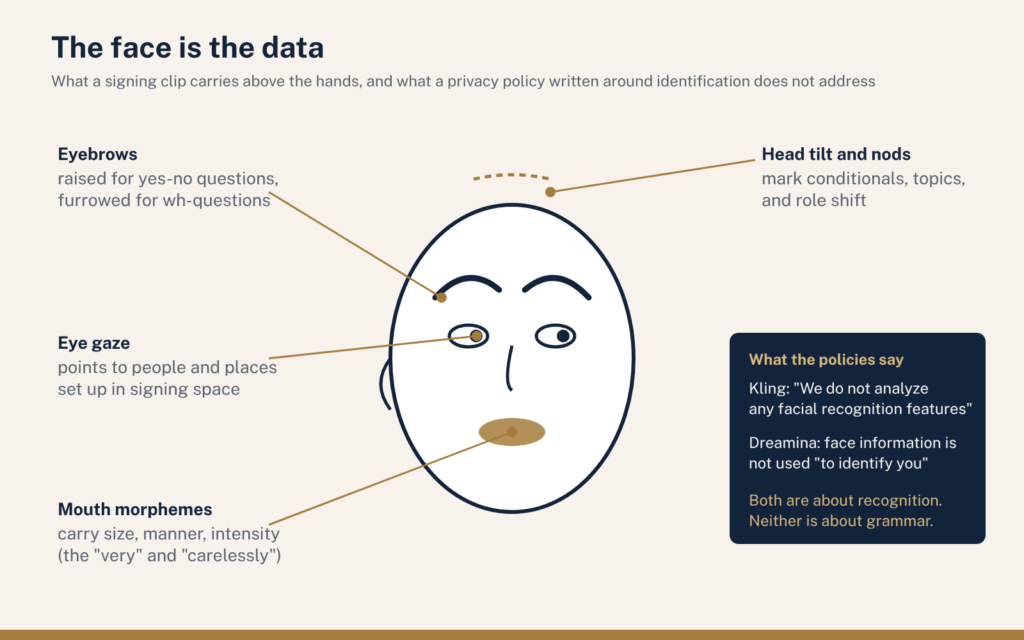
General-purpose video platforms were not built around that fact, and their documents show it. Their privacy language is written around identification: whether the company recognises who you are. Kling says it does not identify individuals. Dreamina says it does not use face information to identify you in your content. Those are statements about recognition. They say nothing about the grammatical content of a face, and grammar is what a sign language avatar needs. A model that learns to produce a convincing raised-brow yes-no question learned it from somebody’s raised brows. The question of whose, and on what terms, does not go away because nobody was “identified.”
| What the platform policies address | What a signing clip actually carries |
|---|---|
| Whether the company identifies who you are | The grammar your face produces while signing |
| Facial recognition features | Eyebrow, mouth, gaze and head movement as language |
| Extracted face features (Dreamina deletes them) | The full video, kept until you delete it, under an irrevocable licence |
| Your rights in your own content | The rights of every other signer in the clip |
The warranty moves the consent problem
Both platforms put the legal weight of the upload on the person who uploads. Kling’s section 4.3 has the user “warrant and undertake” that they hold the intellectual property rights in the input or have the owner’s authorisation, and makes them liable for losses if they do not. Dreamina’s terms bar users from uploading content that violates anyone’s rights of publicity or privacy, which puts the same question on the same person[2,4]. In the first Corpus Question, the consent gap sat inside vendor studios and scraped academic datasets. Here it moves to the individual creator, who is now both the signer and the party answering for every signer in the clip.
From phone to model weights
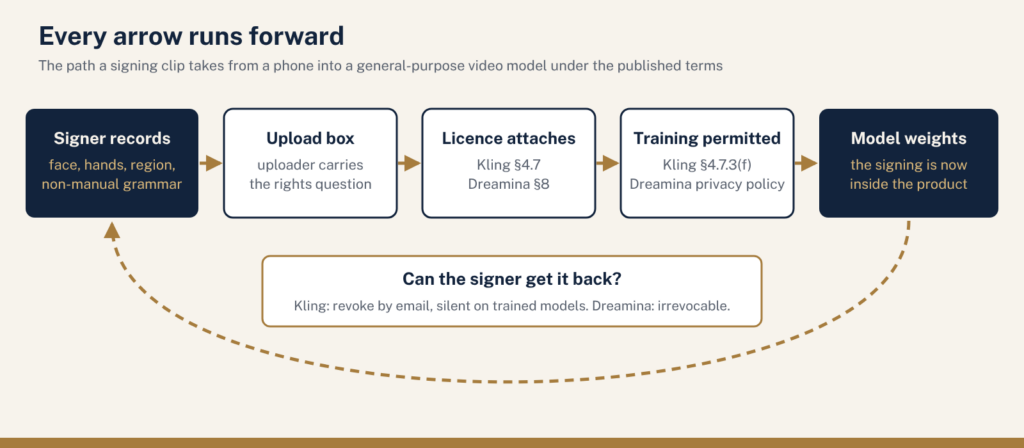
- Signer records
A phone captures face, hands, regional signing and non-manual grammar.
→ Upload box - Upload box
The uploader warrants, or is barred from violating, the rights of everyone in the clip.
→ Licence attaches - Licence attaches
Kling section 4.7 or Dreamina section 8.
→ Training permitted - Training permitted
Kling 4.7.3(f) or the Dreamina privacy policy.
→ Model weights - Model weights
The signing now shapes the product.
→ Can the signer get it back? - Can the signer get it back?
Kling: revoke by email, effect on trained models unstated. Dreamina: the licence is irrevocable.
That matters most in the step good courses rightly insist on. To check whether an avatar signed correctly, a fluent reviewer compares it against a real signing source. The easiest real signing source to grab is somebody else’s video: a friend’s vlog, a Deaf influencer’s post, an interpreter’s clip from a news conference. If that clip goes into the upload box as a reference, the creator has just answered for rights they almost certainly do not hold, on behalf of a person who was never asked, under a licence that may be irrevocable. Signing communities are small. The person in that clip is often someone the creator knows by sight, and someone a model’s output may come to resemble.
We located no signed-language version of either platform’s terms or privacy policy. A Deaf creator who wants to know what she agreed to has to read several thousand words of contract English, which is the barrier these courses exist to lower. Consent that is only available in a language the signer reads less fluently than the one being captured is consent in name only, and no one in this chain is currently responsible for fixing that.
critical risk · Uploading another person's signing as a reference
The uploader answers for rights they do not hold, the signer never agreed, and on Dreamina the licence cannot be withdrawn. NCG’s reading of the exposure, not a legal assessment.
high risk · Uploading your own signing to Dreamina
Perpetual, irrevocable, sublicensable licence extending to other users, with training permitted and no training opt-out.
medium risk · Uploading your own signing to Kling
Training permitted. Revocation by email exists, but what it does to a model already trained is unstated.
Accuracy literacy is not enough
The sign language AI conversation has spent two years arguing about output: whether avatars sign correctly, whether a hearing reviewer can tell, whether smooth motion fools buyers. That argument is necessary and it is far from won. But it has trained everyone, Deaf educators included, to look at the end of the pipe. Teaching a Deaf professional to reject a bad render while leaving the terms unread produces someone who can spot a broken avatar and still hand her own face to a training set without knowing it. AI literacy for signing communities has to include contract literacy, because the corpus question no longer belongs only to companies with studios and motion-capture rigs. It belongs to anyone with a phone and a free account.
The community would be buying back, through vendors and institutions, a capability it supplied for free.
NCG
There is a quieter commercial consequence too. Any sign language AI vendor that does not build its own model from scratch is building on, or fine-tuning from, models like these. If general video models get better at signing over the next two years, part of the reason will be the signing that Deaf creators uploaded while learning to use them, under licences that paid them nothing and that, in Dreamina’s case, cannot be withdrawn. The community would then be buying back, through vendors and institutions, a capability it supplied for free.
Before you upload signing
None of this means Deaf creators should stay away from AI video. It means the upload box deserves the same scrutiny as the render. Until platforms write terms that treat signed language as language, these are the practical steps.
- Read the clauses first
Before the first upload, read the licence and training clauses. For Kling that is terms section 4.7. For Dreamina it is terms section 8 and the privacy policy’s section on how information is used.
- Upload only your own signing
Do not use another signer’s video as a reference or a source, even for an accuracy check, unless that person has agreed in writing to it going into that specific tool.
- Check accuracy beside the screen, not inside the tool
Have the fluent reviewer compare the render against a source played on a separate screen, not one you upload.
- On Kling, revoke in writing
If you want your content out of further use, email support@kling.ai to revoke authorisation, keep a copy, and ask in writing whether revocation covers content already used for training.
- On Dreamina, assume it is permanent
Treat the licence on anything already uploaded as permanent. Deleting content or the account ends storage under the privacy policy; it does not undo an irrevocable licence.
- Teachers: put the terms in the lesson
Course designers should put a terms check in the same session as the accuracy check, and say out loud which clause governs the clip the class is about to upload.
What a buyer inherits now
The first Corpus Question ended with written questions for vendors. This piece adds the ones most procurement teams will not think to ask, because the risk no longer sits only in the vendor’s own corpus. An institution that would never accept a scraped dataset in a contract should not accept one laundered through a free account. The questions are cheap to ask in writing, and a vendor that cannot answer them has told you something about the rest of its documentation.
Ask the vendor in writing
- Which foundation or general-purpose video model sits underneath your avatar, and under which published terms was it trained?
- Has any signing in your pipeline, including references, test clips and evaluation material, ever passed through a consumer upload box?
- For every signer whose video shaped your model, can you show consent that was specific to training, offered in a signed language, and revocable?
- If a signer withdraws, what happens to the model, and who pays to retrain it?
Recommendation
The deeper fix is not a better checklist for individual creators. It is platforms writing a signed-language provision into their terms: training on signing only with separate, specific, revocable consent; that consent offered in a signed language at the point of upload; a stated answer to what revocation does to a trained model; and the face treated as grammar, not only as an identifier. Kling and ByteDance can write that clause. Until they do, every Deaf creator who drags a clip into the upload box is supplying a corpus on terms written for someone else.
Questions people will ask
Is NCG saying Kling or Dreamina has trained on Deaf people's signing?
No. This piece reads what the published documents permit. It makes no claim about whether any specific upload has been used to train any model. The documents say training may happen; they do not say whether it has.
Should Deaf creators stop using AI video tools?
No. The point is to treat the upload box with the same judgment good courses already teach about output: know which clause governs the clip, upload only your own signing, and keep accuracy checks outside the tool.
Does deleting my account fix it?
On Dreamina, deletion ends storage under the privacy policy, but the terms describe the licence as perpetual and irrevocable. On Kling, revocation by email exists, but the terms do not say what it does to a model already trained. Ask in writing and keep the answer.
Why does this matter more for signing than for other video?
Because in a signed language the face carries grammar. A clip of someone signing is a sample of a language tied to an identifiable person in a small community, and a model trained on it cannot return the face it learned from.
Cov chaw siv
- Grizzle, H. M. (2026, September 27). The Corpus Question. Novara Consulting Group. https://www.novaracg.com/2026/09/27/the-corpus-question/
- Kling AI Pte. Ltd. (2026). Terms of Service. Effective 21 April 2026. https://kling.ai/docs/user-policy
- Kling AI Pte. Ltd. (2026). Privacy Policy. Effective 21 April 2026. https://kling.ai/docs/privacy-policy
- TikTok USDS Joint Venture LLC. (2026). Dreamina Terms of Service. Updated 22 January 2026. https://dreamina.capcut.com/clause/dreamina-terms-of-service
- TikTok USDS Joint Venture LLC. (2026). Dreamina Privacy Policy. Updated 30 April 2026. https://dreamina.capcut.com/clause/dreamina-privacy-policy
- No Film School. (2026, April 9). Seedance 2.0: The Most Controversial AI Video Model in the World Just Landed in the US. https://nofilmschool.com/capcut-dreamina-seedance-2-0
- Ground News. (2026, July 3). Kuaishou shares jump after Tencent joins $2.8 billion raise for Kling AI subsidiary. https://ground.news/article/kuaishou-shares-jump-after-tencent-joins-28-billion-raise-for-kling-ai-subsidiary_5de253
- TechRadar. (2025, June 22; updated June 25). Popular video editing app CapCut made some changes to its T&C. https://www.techradar.com/pro/popular-video-editing-app-capcut-wants-to-use-any-content-you-produce-for-free-forever-heres-what-you-should-know