
The Placement Paragraph
Every IEP ends, in practice, with a decision about where. Where will the child spend her school day, in which classroom, with which teachers and which other children, and how much of it outside a regular class? The federal regulations call that decision the placement, and they require the IEP to explain the extent, if any, to which the child will not participate with nondisabled children in the regular class.2 Most IEP forms carry a section for it, usually headed something like least restrictive environment or placement justification, and most teams write a short paragraph there.
Pine Lake’s platform writes that paragraph too. For all six of the deaf and hard of hearing students part seven described, it wrote some version of the same text: “The student will receive special education and related services in the general education setting with supports and accommodations as described in this IEP. The team considered more restrictive placements and determined that the student’s needs can be met in the least restrictive environment, with access to nondisabled peers.”1 Part four’s audit found that the placement justification was among the sections least changed between the generated draft and the signed plan, coming through almost word for word in the recovered files.3
It is easy to see why the generator writes that paragraph. It is the most common placement paragraph in American IEPs, because most children with IEPs spend most of their day in regular classes, and the phrase “least restrictive environment” appears in nearly all of them. The paragraph is also, in a narrow sense, compliant: it names a setting, states that alternatives were considered and invokes the right principle. What it does not do, for any of the six children, is say what was considered, why it was rejected, and what the chosen setting means for the child’s ability to communicate with the people in it. For a deaf child, that last question is the whole question.
What the Law Means by Least Restrictive
The least restrictive environment requirement is often summarized as a preference for inclusion, and for most children that summary is close enough. The regulation is more careful. Each district must ensure that, to the maximum extent appropriate, children with disabilities are educated with children who are not disabled, and that special classes, separate schooling or other removal from the regular educational environment occurs only if the nature or severity of the disability is such that education in regular classes with the use of supplementary aids and services cannot be achieved satisfactorily.4 Each district must make available a continuum of alternative placements, including instruction in regular classes, special classes, special schools, home instruction and instruction in hospitals and institutions.4 And each child’s placement must be determined at least annually, be based on her IEP, be as close as possible to her home, and, unless her IEP requires another arrangement, be in the school she would attend if she did not have a disability; in selecting it, the team must consider any potential harmful effect on the child or on the quality of the services she needs.4
Read closely, those rules describe a judgment, not a default. The regular classroom is preferred when education there can be achieved satisfactorily. It is not preferred when it cannot. The continuum exists because, for some children, a setting further from the regular classroom is where an appropriate education can actually happen. And the team must weigh potential harmful effects, which for some children include the effects of being placed where no one can talk to them.
The 1992 Warning
The Department of Education made that last point explicitly for deaf children in 1992, in policy guidance on the education of deaf students. The guidance recognized that the least restrictive environment requirement had often been applied to deaf children as though it meant the regular classroom in every case, and it warned that, for some deaf children, a regular classroom placement made without regard to communication could isolate the child and could be the most restrictive placement of all.5 It directed teams to consider the child’s communication needs and preferred mode of communication, linguistic needs, severity of hearing loss, academic level, and social, emotional and cultural needs, including opportunities for interaction and communication with peers.5
Five years later, Congress wrote the core of that guidance into the statute as the deaf and hard of hearing special factor, the requirement part seven traced through Pine Lake’s six files.1 The special factor and the placement decision are connected by design. The special factor asks who the child can communicate with directly, in her language and mode. The placement decision decides who will be in the room. A placement made without answering the first question has not considered the harmful effect the regulation requires it to consider, because for a deaf child the most predictable harm of the wrong placement is a day spent without anyone to talk to.
Where Deaf Children Are Actually Taught
If placement for deaf children were the default the generated paragraph suggests, every state would look roughly the same. The National Deaf Education Data Index shows that they do not. For each state it has published at version 2.0, the Index records the federal count of school-age children whose primary disability is hearing impairment, and the educational environments in which they are taught.6
In Alabama, 546 of 795 school-age students with hearing impairment, about 69 percent, were in a regular class 80 percent of the day or more; 49 were in a separate school and 95 in a residential facility, where the pupils of the state’s Institute for Deaf and Blind in Talladega are counted. In Alaska, 93 of 138 were in a regular class most of the day and one was in a separate school. In Delaware, 139 of 253 were in a regular class most of the day and 86, about a third, were in a separate school, which is the Delaware School for the Deaf in Newark. In Hawaii, 94 of 185 were in a regular class most of the day and 41 in a separate school. In Louisiana, 608 of 876 were in a regular class most of the day and 67 in a separate school. In Nevada, which has never had a school for the deaf, 307 of 518 were in a regular class most of the day and none at all were in a separate school or residential facility. In New Jersey, 638 of 1,311 students aged five to twenty-one with an auditory impairment classification were in general education most of the day, 231 in a separate school and 3 in a residential facility.6
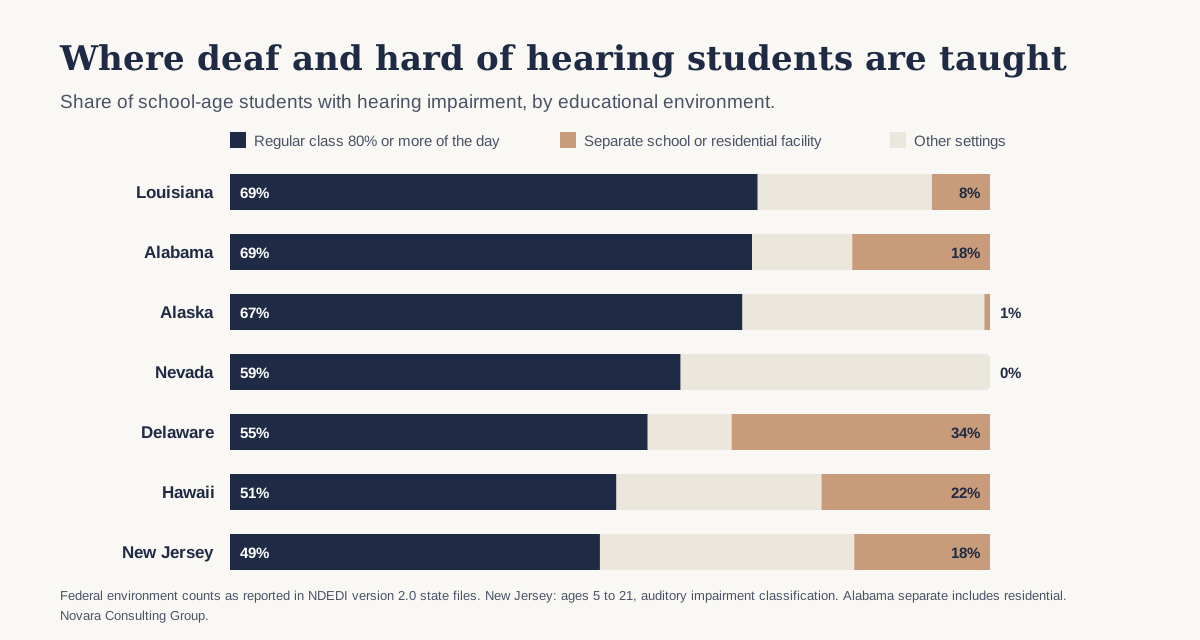
Those differences are partly about the children and partly about the states. A state with a long-established school for the deaf near its population center will place more children there than a state that never built one. A state that funds regional programs will place more children in special classes inside public schools. None of that is visible in a generated paragraph, which reads the same in Delaware, where a third of the children attend a separate school, as in Nevada, where none do. The data say placement for deaf children is a real decision that real teams make differently. The generator says it is a sentence.
The Courts and the Deaf Child’s Placement
The courts have treated it as a real decision for more than forty years, and some of the most important cases in special education law involve deaf children.
The first special education case the Supreme Court decided, Board of Education v. Rowley in 1982, concerned Amy Rowley, a deaf girl doing well in a regular classroom without a sign language interpreter. The Court held that the law required an education reasonably calculated to provide educational benefit, not one that maximized her potential, and that an interpreter was not required for a child who was passing from grade to grade.7 Part ten described how the Court raised that standard in Endrew F. in 2017.8 Rowley also said something about method that has shaped deaf education cases ever since: questions of educational methodology are for the states to resolve.
The Seventh Circuit applied that principle in Lachman v. Illinois State Board of Education in 1988. Benjamin Lachman was a profoundly deaf seven-year-old whose parents wanted him in his neighborhood school, in a regular classroom, with a full-time cued speech instructor. His district proposed instead a self-contained classroom for deaf and hard of hearing students outside his neighborhood, using a sign-based total communication approach, with part of his day mainstreamed. The court held that the district’s plan provided an appropriate education and that, once the law’s requirements were met, the choice between methods belonged to the educators, quoting Rowley that “questions of methodology are for resolution by the States.”9
The Ninth Circuit went further in Poolaw v. Bishop in 1995. Lionel Poolaw was a profoundly deaf thirteen-year-old whose earlier plans in several districts had included interpreters and instruction in American Sign Language. His district’s IEP team proposed placing him at the Arizona School for the Deaf and the Blind, 280 miles from his home. His parents refused. A hearing officer and the district court ordered the placement after an evidentiary hearing, and the court of appeals affirmed, holding that the district had followed the law’s procedures and that the placement was appropriate.10 A residential school far from home was, for that child, the placement the law required.
The Fifth Circuit came at the question from the other side in Flour Bluff Independent School District v. Katherine M. in 1996. Katie was a deaf student who had attended a regional day school program for deaf children in a neighboring district since she was a toddler, and who by third grade was in fully mainstreamed classes there with a sign language interpreter, a straight-A student on the honor roll. Her mother asked that she be transferred to her neighborhood school. The district refused. A hearing officer and the district court ordered the transfer, treating closeness to home as presumptive. The court of appeals reversed, holding that the placement-close-to-home requirement “is merely one of many factors for the district to take into account,” to be weighed against the district’s reasons for concentrating its services for deaf students in a regional program.11
| Case | The student | What the court held | |
|---|---|---|---|
| Board of Education v. Rowley (U.S. 1982) | Amy Rowley; deaf; doing well in a regular class without an interpreter | The law requires an education reasonably calculated to confer benefit; method is for the states | |
| Lachman v. Illinois State Board of Education (7th Cir. 1988) | Benjamin Lachman; profoundly deaf; parents sought neighborhood school with cued speech | The district’s self-contained total communication program was appropriate; methodology is for educators and states | |
| Poolaw v. Bishop (9th Cir. 1995) | Lionel Poolaw; profoundly deaf; district proposed a residential school 280 miles away | The residential placement was appropriate and was affirmed over the parents’ objection | |
| Flour Bluff ISD v. Katherine M. (5th Cir. 1996) | Katie; deaf; thriving in a regional program; mother sought neighborhood school | Proximity to home is one factor among many | not a presumption |
Those cases do not point in one direction, and that is their lesson. Courts have upheld a residential school over a family’s wishes and a regional program over a family’s wishes, and they have deferred to districts on method in both directions. What they have never done is treat placement for a deaf child as a matter that can be settled by a default. Each case turned on a record of what the team considered, why, and what the child needed. A generated paragraph that says more restrictive placements were considered, without saying which, why or what the child needed, is the opposite of the record those cases relied on.
Miguel Perez and the Aides Who Did Not Sign
The most recent deaf student to reach the Supreme Court shows what a placement looks like when the paragraph is fine and the reality is not.
Miguel Luna Perez enrolled in the public schools of Sturgis, Michigan, at age nine. He is deaf. The district placed him in regular classes and assigned him aides to help him access instruction. According to the case as reported when the Court decided it in 2023, the aides were not trained in sign language and were often absent. For years, Miguel’s grades were As and Bs, and his parents believed he was on track to graduate. Near the end of his last year, they were told he would not receive a diploma. His family filed an administrative complaint, and the district settled by agreeing to pay for him to attend the Michigan School for the Deaf. Miguel then sued under the Americans with Disabilities Act for damages for what he had lost. A unanimous Supreme Court, in an opinion by Justice Gorsuch, held that the IDEA’s requirement to exhaust administrative procedures did not bar his claim for compensatory damages, which the IDEA does not provide.12
Perez is usually discussed as a procedural case about exhaustion, and it is one. It is also a case about placement. On paper, Miguel’s placement was the least restrictive one: regular classes, with aides as supplementary support. Every year, a placement paragraph could have said, truthfully, that he was educated with his nondisabled peers to the maximum extent appropriate and that more restrictive settings had been considered. His grades supported that conclusion. What the paragraph would not have said is that the people assigned to give him access to those classes could not communicate with him, and that his grades, like the progress reports in part ten, were measuring something other than what he had learned.8
Run Miguel’s file through a placement generator and it would produce the Pine Lake paragraph, every year, with complete confidence. The paragraph would have been accurate about the setting and silent about the only fact that mattered: that a deaf child in a regular classroom with no one who signs is not included. He is present.
The records that would have shown the problem existed, or could have. Every district knows whom it assigns to support a deaf student and can know what qualification that person holds. Many districts record aide and interpreter attendance for payroll. A placement section that named the person giving Miguel access to his classes, recorded that person’s sign language qualification and noted how absences would be covered would have made the gap visible on the first page of his plan. Part five described the records a family can ask to inspect; a list of who interprets for a deaf child, with qualifications and attendance, is one of the most useful a family could request, and one a placement generator will never produce.13 The failure in Sturgis was not a failure of software. It was a failure to write down the one fact a deaf child’s placement depends on, and a generated paragraph makes that failure easier, not harder.
A deaf child in a regular classroom with no one who signs is not included. He is present.
A Separate Duty: Effective Communication
Perez turned on the Americans with Disabilities Act, and that statute matters for placement in a way many teams do not realize. The IDEA requires an appropriate education. Title II of the ADA separately requires public schools to ensure that communication with students with disabilities is as effective as communication with others, by furnishing appropriate auxiliary aids and services.14
The Ninth Circuit held in 2013, in K.M. v. Tustin Unified School District, that those duties are not the same. K.M. was a high school student with a hearing disability who asked for real-time captioning, a word-for-word transcription of what was said in class. Her district refused and offered other accommodations, and an administrative law judge found that her IEP provided an appropriate education under the IDEA. The court of appeals held that a district’s compliance with its IDEA obligations to a deaf or hard of hearing child does not necessarily establish compliance with its effective communication obligations under Title II, and sent her ADA claim back for decision.15 The following year, the Departments of Justice and Education issued joint guidance making the same point to every public school in the country: the Title II effective communication requirement “differs from the requirements in the IDEA,” and a school may have to provide aids and services that the IDEA alone would not require.16
For placement, that means a team has two questions to answer, not one. Is this setting the least restrictive in which the child can receive an appropriate education? And, in this setting, will communication with this child be as effective as communication with her classmates? A placement that answers yes to the first and has never asked the second is exposed, as Sturgis was, and the exposure is not limited to the remedies the IDEA provides. A generated placement paragraph asks neither question. It asserts the answer to the first.
Inclusion Through an Interpreter
It is worth being concrete about what the regular classroom is for a deaf child who signs, because the generated paragraph’s phrase, access to nondisabled peers, describes something that may not happen.
In a regular classroom, a signing deaf child’s access to everything said runs through one person: the educational interpreter. A good interpreter conveys the teacher’s lecture, the questions classmates ask, the instructions for group work and the jokes that set the tone of the room, a few seconds behind the speaker, and voices the child’s contributions back. Even a very good interpreter can convey only one stream at a time. When three classmates talk at once in a small group, the child gets one of them. When the teacher speaks while writing on the board, the child must choose between the interpreter and the board. The side conversations through which children make friends, the remark overheard in the hallway, the joke at lunch, mostly do not reach her at all. A deaf child in that classroom has access to the instruction, more or less, and much less access to the peers the least restrictive environment requirement exists to give her.
And that is with a good interpreter. Part seven described how widely the qualification for classroom interpreters varies among the states the Index has published, from no published qualification in Florida and Hawaii to national certification or a 4.0 score on the Educational Interpreter Performance Assessment in California, Minnesota, Nevada and Delaware.1 The Index found that Hawaii’s department of education had fifteen positions for educational interpreters at the end of 2024 and three were filled, while an estimated 81 students needed interpreting.6 Where the interpreter is underqualified, or missing, the regular classroom becomes, for a deaf child, what it was for Miguel Perez.
None of that means a signing deaf child should never be in a regular classroom. Many thrive there, with a qualified interpreter, a teacher who knows how to work with one, and planned time with signing peers and adults outside it. It means the quality of a deaf child’s inclusion depends on facts the placement paragraph does not mention: who interprets, how well, and what the child has besides the interpreter. A team that writes those facts down has considered the placement. A team that signs the generated paragraph has not.
What the Generator Cannot See
The placement paragraph has the same problem part seven found in the special factors, in a sharper form: the facts the decision depends on are not in the student’s file.1 A team deciding where a deaf child should be taught needs to know what options exist: the district’s own classrooms, any regional program, the state school for the deaf, its outreach services and any day or residential programs. It needs to know, for each option, who would be able to communicate with the child there, and how. It needs to know how far away each option is and what the trip would mean for the child. None of that is student data. It is the district’s knowledge of its own continuum, and the Index shows how thin that knowledge is on the public record.
Kentucky’s state school for the deaf, through its outreach arm, advises 152 of the state’s 171 districts, at no cost to them; the Index found that three districts name the school on their own websites. Alabama’s Institute for Deaf and Blind runs a statewide outreach service and ten regional centers; the Index found that not one local system names the outreach service on its website. Louisiana’s School for the Deaf is named by three of 162 units. Not one of New Jersey’s 696 public school units names the Katzenbach School, the state’s school for the deaf, on its own pages.6 Across the thirteen states published so far, 64 percent of the 5,035 school units read publish nothing at all about deaf or hard of hearing students.6
If a district’s own website does not mention its state’s school for the deaf, there is little reason to think the documents its IEP platform reads do. A generator asked to justify a placement can only weigh the options it has seen, and the options most deaf children’s teams most need to weigh are the ones least likely to appear in its inputs. It writes that more restrictive placements were considered because that is what placement paragraphs say. Nothing in its inputs tells it which ones exist.
Three Placements at Pine Lake
Three of Pine Lake’s six deaf and hard of hearing students faced real placement questions that year, and their teams’ answers show what the generated paragraph left out.
Nora’s team, after the hearing in part six and the ASL evaluation it ordered, had to decide whether her plan for bilingual instruction could be delivered at her home school, where her teacher of the deaf visited three mornings a week and no other child signed.17 The team considered three options: her home school with more time from the teacher of the deaf and a qualified interpreter; a half-day placement in the regional cooperative’s program for deaf and hard of hearing students, forty minutes away, where the teacher signs and six other children use ASL; and the state school for the deaf, two hours away. They chose the half-day regional program, with afternoons at her home school, and wrote down why: direct instruction in ASL and daily access to signing peers in the morning, her neighborhood friends and her sister’s school in the afternoon. They also wrote down the cost, which was eighty minutes a day on a bus, and how they would review it.
Mateo’s team faced the same choice at kindergarten and made a different one: full days in the cooperative’s classroom, because at five his language was growing fastest among signing peers, with a plan to revisit inclusion at his home school in first grade. Jordan’s team, considering her changing vision, added an option no generated paragraph would have named: the deafblind program at the state school for the deaf, where staff are trained to work with students who are both deaf and losing their sight. They did not choose it that year. They wrote it into her plan as an option to revisit each time her vision changed, with a visit scheduled for her and her mother in the spring.
Eli’s team faced the hardest version of the question, because Eli belongs to two populations that districts usually serve in different places. The platform, reading his eligibility as autism with a secondary hearing impairment, drafted a placement in the district’s program for students with autism, a well-run classroom with staff trained in his behavioral and communication supports and no one who signs. The regional deaf and hard of hearing program had signing staff and signing peers and no particular expertise in autism. Neither setting, as it stood, could serve all of him. His team spent two meetings on the question and chose the deaf and hard of hearing program, with weekly consultation from the autism program’s specialist and a paraprofessional trained in both his signs and his device, on the reasoning that a setting where he could communicate with the people around him was the foundation every other support needed. They could have reasoned the other way and been defensible. What would not have been defensible was the generated paragraph, which placed him in the autism program by default and did not mention that no one there could understand his signs.
In each case, the team’s placement section ran to a page. It named each option considered, what the child would have in each for language access, peers and instruction, why the team chose what it chose, and what the choice cost the child. The generated paragraph had been three sentences, the same for all three children, and none of those sentences would have survived a hearing officer asking which more restrictive placements had been considered and why.
When the Regular Classroom Is Right
None of this is an argument that deaf and hard of hearing children belong somewhere other than regular classrooms. Most of them are in regular classrooms most of the day, in every state the Index has published, and for many that is the right placement by any measure.6 Owen and Hannah, two of Pine Lake’s six, are examples.
Owen, the hard of hearing seventh grader from part seven, uses spoken English and hearing aids and does well in regular classes with a remote microphone system, captions and a seat chosen for acoustics.1 There is no signing program that would serve him better, because he does not sign, and a separate program for deaf students would remove him from the language and peers he has. His team’s placement section, after Pine Lake’s changes, said which supports made the regular classroom work for him, named the regional program as an option considered and rejected because its instruction is in ASL, and added a plan for him to meet other hard of hearing teenagers through a regional activity group, because the one thing his regular classroom does not give him is peers who share his experience of hearing.
Hannah, the eight-year-old with cochlear implants who reads above grade level, is in a regular third grade class, and her team’s placement section said why: spoken English is her language at school, her access in a quiet classroom is good, and her needs are for captions, a daily equipment check, strategies for group discussion and contact with other children who use hearing technology.1 It also said what would make the team reconsider: a decline in her ability to follow classroom discussion, or her own wish, as she gets older, to spend time in a signing environment, since she signs at home with her grandparents.
Those sections are short, and they are good, because they are about Owen and Hannah. The generated paragraph reached the same conclusion for both of them. It just could not say why, and so it could not say what would change it.
The State School Question
There is a larger pattern underneath Pine Lake’s three decisions, and the Index makes it visible. Across the states it has published, the separate and residential schools that once educated most deaf children are smaller, fewer and under financial pressure. California’s Fremont campus fell from 410 students in 2014 to 2015 to 264 in 2025 to 2026. Hawaii’s school enrolled 49 students in 2024 to 2025, down from 62 five years earlier. New Jersey’s Katzenbach School, according to the state budget, ended its residential program in 2026. Louisiana’s 2026 to 2027 budget merged its school for the deaf’s separate line into a single program with its school for the blind. Nevada never built one.6
Some of that decline reflects good things: earlier identification, better hearing technology, stronger programs in public schools. Some of it reflects the pull of the least restrictive environment requirement as it is often applied, and of the federal reporting that asks every state to measure, and set targets for, the share of students with disabilities taught in regular classes most of the day.18 A generator trained on plans written under that pressure will reproduce it, placing every child in the regular classroom by default, because that is where most plans place most children. For many deaf and hard of hearing children, that is the right place. For some, the 1992 guidance and the courts are clear that it is not, and a tool that cannot tell which is which will, at scale, move the second group toward the first without anyone deciding it should.
This piece takes no position on whether any particular state should keep, expand or close its school for the deaf. That is a question for each state, its Deaf community and its families. It takes the narrower position that the option must be visible to the team deciding a child’s placement, weighed on the record, and rejected, if it is rejected, for reasons about the child. A generated paragraph that says more restrictive settings were considered, when the team’s documents never named them, makes the decision for the child by leaving it out.
What a Family Can Ask For
Placement is the decision families most often feel was made before they arrived, and the rules give them more standing in it than many realize. The placement decision must be made by a group that includes the parents, and the parents must be members of any group that makes decisions on their child’s educational placement.19 If a family asks for a particular placement, such as a regional program or the state school, and the district refuses, the district must give the family written notice explaining what it refused, why, what options it considered and why it rejected them, and what evaluations, records or reports it relied on.20 That notice is the document a generated paragraph cannot replace, and a family that asks for a placement in writing is entitled to receive it.
If a family disagrees with a placement and files for a hearing, the child generally remains in her current placement while the dispute is pending, unless the family and the district agree otherwise.21 That rule protects children from being moved during a dispute, and it also means that a placement made carelessly can persist for the length of one. And if the problem is not the setting but communication within it, as it was for Miguel Perez, families have a second route: a complaint under the ADA, to the Department of Education’s Office for Civil Rights or the Department of Justice, or, as Perez confirmed, a lawsuit for damages that the IDEA cannot provide.12
None of those routes requires a family to know anything about AI. They require a family to ask, in writing, which placements were considered and why, and to keep the answer. When the answer is a generated paragraph, the family has learned something important: that no one has yet written down the decision.
What Pine Lake Changed
Dana’s changes to the placement section followed the pattern of the earlier parts. The platform would no longer draft the placement justification for any deaf or hard of hearing student. In its place, the form asked four things, each to be answered by the team in its own words: which placements on the continuum were considered, named specifically, including any regional program and the state school for the deaf; for each, what the child would have in language access, peers who share her language and mode, and direct instruction; why the team chose the placement it chose and what potential harmful effects it weighed; and, separately, how communication with the child in that placement would be as effective as communication with her classmates, and what auxiliary aids and services that would take.
To make the first question answerable, Pine Lake did something no student-level tool could do for it: it wrote down its continuum. The special education office now keeps a one-page list, updated each summer, of every placement option available to a deaf or hard of hearing student in the district and the region, with the language used in each, the distance from each building, the contact for the state school’s outreach service and for the state deaf-blind project, and the date each was last visited by someone from the district. The list is attached to every placement discussion. It is the district’s answer to the question its website never asked.
Distance is part of every one of those decisions, and the regulation’s preference for a placement as close as possible to home is real.4 For a deaf child, the time on a bus to a regional program or the nights away at a residential school are costs the team must weigh, along with what they do to the child’s relationships with her family and her neighborhood. The courts in Poolaw and Flour Bluff weighed those costs and reached opposite results for two different children.10 The point is not that distance never matters. It is that distance has to be weighed against language access, on the record, for this child, and the generated paragraph weighs nothing.
The platform still drafts placement logistics, such as transportation and schedules, once the team has decided. It drafts them well.
Present, or Included
Eleven parts in, the placement decision makes the series’ argument at the scale of a whole school day. It is also the decision where the cost of a default is easiest to see, because a placement is not a sentence in a document that a teacher can work around. It is the room a child sits in for six hours, every school day, for a year. The generated paragraph is not wrong about the law. It invokes the right principle, in the right words, and names the setting most children are in. What it cannot do is tell the difference between a deaf child who is included in a regular classroom and one who is merely present in it, because the difference lies in who in that room can talk to her, and that fact is not in her file.
Miguel Perez spent years present. His placement paragraph, if anyone had generated one, would have been flawless. The record is not the child, a setting is not a placement until someone has asked who in it can communicate with her, and least restrictive is a question about the child’s access, not about the room.
Questions for Governance Review
These questions are written for school boards, special education directors, state education agencies, vendors, state schools for the deaf and families. They are meant to be asked with real placement sections on the table.
- Ask the team to name every placement option it considered, including any regional program and the state school for the deaf.
- For each option, ask who your child could communicate with directly, all day, in her language.
- Ask how the placement meets the ADA’s effective communication requirement, separately from the IEP.
- Ask what qualification the person giving your child access in a regular classroom holds, and how it is checked.
- If your child’s grades look good but you are not sure she is learning, ask to see her work and to observe her class.
- Ask when the placement will be reviewed, and what would cause the team to revisit it sooner.
- If you want to visit the state school or a regional program, ask the district to arrange it.