
In Dodoma, Tanzania, a Deaf woman sat in a hospital waiting room while hearing patients were called ahead of her, until she gave up and went home. Deaf patients there report being sent to write their symptoms on paper, being asked to send their interpreter out of the room, and being treated for the wrong illness. A Tanzanian human rights report says Deaf patients admitted in critical condition face twice the risk of dying. The country has about 300 registered sign language interpreters. That gap is the market every sign language AI company says it exists to fill, and it is the one place the evidence says AI should not go first.
“As if I was not a human being”
Marietha Jonas is 24 and runs her own business in Dodoma. She lost her hearing when she was four. When she went to a health facility, she told The Chanzo, she waited while hearing patients were seen ahead of her, and eventually she left before her turn came. “I felt as if perhaps I was not a human being,” she said.
I read that sentence three times. I am DeafBlind, and I know the waiting room where your name gets called into the air and you are the only person who does not hear it. Most Deaf people know it. You learn to watch the door, watch the nurse’s mouth, watch the other patients for the moment someone stands. What Marietha describes is the step after that, the moment you decide the room was never built for you and walk out. Nobody records that as a medical event. It does not show up in any statistic about wrong diagnoses, because there was no diagnosis. There was just a young woman who went home sick.
There is a particular kind of tired that comes with that decision. It is not the tiredness of being sick, although she was. It is the tiredness of doing the hospital’s job for it: tracking every movement in the room, guessing which call might be yours, preparing the gestures and written words you will need when you finally reach a clinician, and knowing that the clinician may not have the patience for any of it. Hearing patients spend that energy getting better. Deaf patients spend it getting seen. When the energy runs out, people leave, and the health system records nothing, because from its point of view nobody was there.
The Chanzo story, by the Dodoma-based senior journalist Jackline Kuwanda, is a careful piece of reporting. It talks to Deaf residents, the Tanzania Association of the Deaf (CHAVITA), disability federations, two members of Parliament, and the head of quality assurance at the Dodoma Regional Referral Hospital. It does not mention artificial intelligence once. Neither does anyone in it. That absence is the point of this article.
What happens in the room
The individual accounts are worth reading slowly, because each one is a different way communication fails, and each one maps onto a promise the technology industry is making.
Ally Jumanne Malacha, a 40-year-old motorcycle taxi driver, lost his hearing at six after a quinine injection for malaria. He uses a hearing device and some speech, and doctors have doubted he is Deaf at all. One asked him, “How come I have spoken and you can hear?” He also described the other side of the problem: when a patient brings an interpreter for an HIV test, the interpreter has to hear everything, and confidential care stops being confidential.
Emmanuel Ntandu, a father of two, writes his symptoms on paper. It works for simple things. It does not work for complicated symptoms, and a written note is only as useful as the reader who can follow it.
Yusuph Mloli chairs CHAVITA’s Dodoma chapter and teaches. At a private hospital, a doctor asked his interpreter to leave the room and told him to write instead. When writing failed, he went to another hospital and received no treatment that day.
A member of Parliament, Nassriya Ally, described a nurse reading a Deaf patient’s abdominal pain as typhoid. She also told the story of a woman in Dar es Salaam named Joyce, who reportedly lost her baby after health workers misunderstood a complication during childbirth.
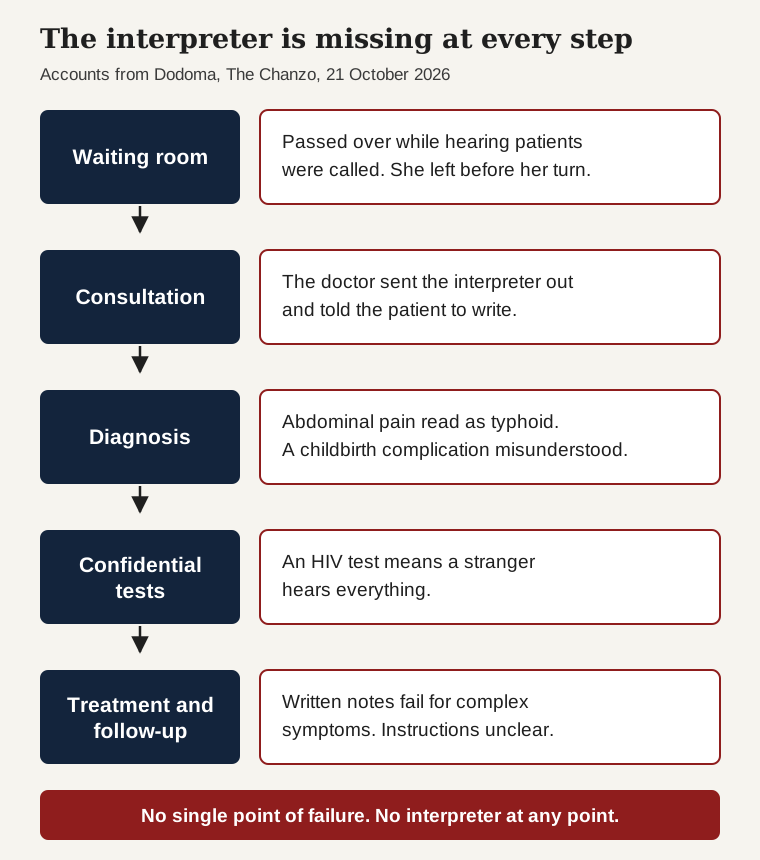
Put those accounts in order and they cover the whole visit. The waiting room, where you are not called. The consultation, where your interpreter is sent out. The diagnosis, where your pain becomes the wrong disease. The confidential test, where privacy depends on a stranger. The treatment, where instructions arrive in a language you cannot fully use. There is no single point of failure. The interpreter is missing from every step.
A community with its own institutions
It would be easy to read the Dodoma story as a story about helpless people. It is not. Tanzania’s Deaf community is organised, and has been for a long time. CHAVITA, the Tanzania Association of the Deaf, has regional chapters, including the Dodoma chapter whose chairperson speaks in this story. Interpreters have their own professional body, TASLI, the Tanzania Association of Sign Language Interpreters. DeafBlind Tanzanians have theirs too, TASODEB, the Tanzania Association of the DeafBlind. The language they share, Tanzanian Sign Language, is the language of a national community, not a collection of gestures.
I notice TASODEB in that list because I am DeafBlind myself. None of the accounts in The Chanzo describes a DeafBlind patient, and I will not guess at what those patients face in Dodoma’s hospitals. But the arithmetic is not hard to follow. If a hospital struggles to find any sign language interpreter, it is not going to find one trained in tactile or close-vision interpreting. Whatever the waiting room is like for a Deaf patient, it is harder for a DeafBlind one, and any technology sold into that room on the strength of a screen will reach her last.
What these organisations have asked for, in the reporting and in the public record around it, is consistent: interpreters in health facilities, paid posts for them, training for health workers, and protection for Deaf patients’ privacy. In April, The Citizen reported that the Deaf community was seeking Sh100 million to develop a medical sign language resource intended to protect patient confidentiality. That is a community designing its own infrastructure. It is not a community waiting for a product.
Twice the risk
The number that frames the story comes from a 2025 report by the Legal and Human Rights Centre, a Tanzanian rights organisation, titled “The Right to Life and Health for Special Groups.” According to The Chanzo, the report found that Deaf people face “twice the risk of dying when admitted to hospitals in critical condition” compared with hearing people.
I want to be careful with that figure, because careful is the whole job. The Chanzo cites the report but does not link it, and I could not obtain the report itself, so I cannot tell you its method, its sample, or whether the comparison controls for anything. It is a relative risk, not a death rate. Treat it as a reported finding from a credible national rights organisation, not as a measured constant.
What I can tell you is that it is not an outlier in kind. Everywhere researchers have looked, Deaf patients without language access get worse care, and the mechanism is the one the Dodoma accounts describe: a history that is never fully taken, symptoms that are never fully understood, and instructions that are never fully received. In critical care, every one of those failures costs time, and time is the thing a critical patient does not have.
Three hundred names in a database
The government’s answer, as reported, is a number. On 2 June 2025, Deputy Minister Hamis Mwinjuma told Parliament that 300 sign language interpreters had registered in a national database, that the government recognises sign language as an important means of communication, and that it has prepared a service structure for the profession and plans to strengthen training.
Three hundred registered interpreters is not three hundred interpreters in hospitals. The rest of the story explains the difference.
It is also not a new problem, and that matters for how anyone should read the AI pitch. A 2022 situational analysis by the UN Partnership on the Rights of Persons with Disabilities found that the provision of sign language interpreters in health and education in Tanzania “tends to be low largely due to the shortage of trained human resources,” compounded by “limited financial allocation in relevant sector budgets.” The same analysis records that the World Health Organization, back in 2011, described Tanzania as having some of the lowest numbers of trained sign language interpreters in the world, and notes the progress since, including an accredited sign language course at the University of Dar es Salaam. Its estimate for people of all ages with difficulty hearing, based on 2021 figures, runs above one million. Only some of them use sign language, so that is not a count of people who need an interpreter. But even a small fraction of it, set against 300 registered names, describes a gap that training batches of ten and twenty will take decades to close.
A shortage that has been documented for fifteen years is not an emergency that justifies a shortcut. It is a policy choice that has not yet been funded.
Training has happened, but in small batches: about ten people trained with funding from the Tanzania Communications Regulatory Authority, about twenty by the Dodoma Regional Referral Hospital, about five by Benjamin Mkapa Hospital, according to a former CHAVITA chair. Trained staff are not always placed where they are needed. The hospital lost interpreters during a government purge of “ghost workers.” And signers who do qualify often go into teaching, because, as MP Aisha Msantu put it in substance, there is no dedicated health post waiting for them. She asked the government to create one.
Dr Edmond Mgeni, who heads quality assurance at the regional referral hospital, gave the most honest institutional answer in the piece: “Our hospital provides this service, but the specialists are few.” The plan is to train more professionals. That is a workforce problem, and it has a workforce solution: posts, pay, placement and training, in that order.
Not only Tanzania
It would be comfortable for readers in rich countries to file this under development. The evidence does not allow it.
In April 2025, RNID and SignHealth published “Still Ignored,” a policy report on Deaf people and people with hearing loss in England’s National Health Service. Among the sign language users who responded, 67 percent said they had been denied a communication support professional, such as a British Sign Language interpreter, at some point. Fifteen percent of respondents had had to rely on their own children to interpret at an appointment. Fewer than one in five sign language users, 17 percent, agreed that Deaf people can trust the NHS. The report describes Deaf patients “left alone in hospital beds, unaware they are critically ill or dying.”
England has a national health service, an Equality Act, an Accessible Information Standard, a professional interpreting workforce and a large Deaf charity sector. It still produces Joyce’s story, and Marietha’s, and Yusuph’s. The difference between Dodoma and an English hospital is the size of the gap, not its existence. That is worth holding onto when a vendor says its product is for places where interpreters are not available, because by that definition the market is every hospital on earth.
The law is already written
Tanzania does not lack a legal duty. Section 26 of the Persons with Disabilities Act of 2010, as The Chanzo summarises it, guarantees people with disabilities access to quality health care without discrimination and requires health facilities to take appropriate measures to make their services accessible. Tanzania is also a party to the UN Convention on the Rights of Persons with Disabilities, which recognises the right to health on an equal basis with others in Article 25, requires accessible information and communication in Article 9, and in Article 21 commits states to recognise and promote the use of sign languages.
That is the same pattern I keep finding in the United States, where the Americans with Disabilities Act has required effective communication in hospitals for more than three decades. The duty exists on paper. What fails is the delivery: the budget line, the staffing plan, the person in the room. And delivery gaps are where a vendor’s pitch lands most easily, because a subscription looks cheaper than a post and faster than a training programme.
The pitch that will arrive next
Sign language AI is sold on scarcity. Read the launch materials and the same phrase keeps coming back: where interpreters are not available.
When Sorenson, one of the largest sign language interpreting and relay companies in the United States, bought OmniBridge and Hand Talk in January 2025, it said OmniBridge’s two-way sign-to-English technology was meant “particularly” for situations “where access to interpreters is not possible.” To its credit, the same release carried a commitment from its chief executive to “the essential role of human interpretation.” In April 2026, local reporting on Sorenson’s plan to launch ASL tools named the settings: stores, restaurants and airports. A coordinator at Boston Children’s Hospital’s Deaf and Hard of Hearing Program, shown the avatar, said there was “no facial expression in the video” and that she did not think it would work as a form of accessibility. Sorenson’s materials, as far as I have read them, do not sell these tools for hospital care. But the logic of “where interpreters are not available” does not stop at the hospital door, and a country with 300 registered interpreters is the purest version of that logic anywhere in the world.
Closer to Dodoma, the pitch already has a face. In October 2025, the Royal Academy of Engineering gave its Africa Prize for Engineering Innovation, and £50,000, to Elly Savatia, a young Kenyan founder, for Terp 360, an app from his company Signvrse that turns speech and text into Kenyan Sign Language through 3D avatars. The Academy says it was developed with Deaf and hard-of-hearing people and uses more than 2,300 locally recorded signs. Kenyan press coverage of the award reported that the team plans to expand into education, corporate and health care markets. It accepts Swahili input, and the company has said it plans to add other African sign languages. Nigeria’s Talksign launched real-time ASL translation models in May 2026.
I want to be fair to these founders. Terp 360 was built with Kenya’s Deaf community, and that is more than many Western products can say. A prize for engineering innovation is not a claim that the app is ready for a labour ward, and nobody has said it is. But the direction of travel is visible. A Swahili-capable avatar company with a regional plan and a stated interest in health care is a short distance, commercially, from a ministry in a neighbouring country with 300 registered interpreters and a budget line it has never filled. The question is not whether that conversation will happen. It is what the buyer will ask for when it does.
The people who have thought hardest about this draw the same line. New Zealand’s NZSL Board, in its October 2026 position on AI, says human support should remain “the primary option” in health, justice, education, emergencies and cultural settings. Kara Technologies, New Zealand’s own AI signing company, prohibits use of its service in medical and other high-stakes contexts in its terms. The oldest statement on the subject is the clearest. In 2018 the World Federation of the Deaf and the World Association of Sign Language Interpreters jointly cautioned against signing avatars as a replacement for human signers, with “particular concern” where information is live, complex or of significant importance to Deaf people’s lives. Among their reasons was one that settles the health care question on its own: avatars “provide a one way communication channel only from spoken to sign language and not vice versa.” The two bodies said avatars could be acceptable for pre-recorded, static information, such as where to check in or queue, as long as Deaf people advised on the signing and no interaction was required.
| What a consultation needs | What a signing avatar provides |
|---|---|
| Two-way conversation, in real time | One-way output from text or speech |
| A clinician who can follow up on the patient’s answer | A fixed rendering of what was typed or said |
| Signing that reads the patient’s confusion and adjusts | No view of the patient at all |
| Confidentiality bound by professional ethics | Whatever the vendor’s privacy notice allows |
| Medical vocabulary in the local sign language | A sign library built for general use |
| Accountability when meaning is lost | No named person in the room |
The disagreement is not about whether AI can help with a bus timetable. It is about whether a shortage of people justifies replacing them in the one room where a wrong sign can kill someone.
A train delay and an evacuation order can arrive on the same screen. The Board’s line says they are not the same kind of message.
Heather M. Grizzle, The Rules Came First, NCG, 28 October 2026
A medical consultation sits further along that line than an evacuation. It is two-way, it is not easy to check, and it is often the only route to care. There is also a failure mode in health care that avatars do not have, because in a consultation the machine is not only signing to the patient. It is translating the patient to the doctor.
A translation system can produce a sentence that is fluent, grammatical and entirely plausible while having no support in what the signer actually did, and because the sentence reads well, nothing about it announces the error.
Heather M. Grizzle, The Words Put in Your Mouth, NCG, 11 September 2026
Put that sentence in Dodoma. A Deaf patient signs her symptoms. A system produces a fluent English sentence. The nurse reads typhoid. Nobody in the room can tell the sentence was wrong, and it goes into the chart under the patient’s name. That is not a speculative risk. It is the nurse-and-typhoid story from the reporting, automated and made to look authoritative.
How this story reached me
This article almost started from a bad source, and I think that is worth telling you.
The Tanzania story came to me inside a roundup on a site called Locanucu, which describes itself as a localisation news publication. The page has no author, links almost none of its sources, runs on a blogging template with leftover interface text, and reads like it was assembled rather than reported. It paired the Tanzania reporting with a story about Sorenson naming four new executives, and it said the reshuffle was meant to speed the company’s integration of computer-vision AI. My own weekly news sweep repeated that framing before I checked it.
Sorenson’s actual press release, dated 13 October 2026, says no such thing. It names a Chief Growth Officer, a Chief Transformation Officer, a Chief Technology and Product Officer and a Chief Operating Officer, and it says the appointments support “growth, transformation and operational excellence.” AI appears only in the company boilerplate at the bottom. The AI motive was invented somewhere between the press release and the roundup.
| What the aggregator said | What the original sources say |
|---|---|
| Sorenson reshuffled its leadership to speed up AI integration | Sorenson’s 13 October release ties the appointments to growth and operations and does not mention AI in the announcement |
| The news was dated 21 October | Sorenson’s release is dated 13 October |
| Deaf patients face twice the mortality risk | The Chanzo attributes the finding to a 2025 LHRC report on patients admitted in critical condition, and does not link it |
| About 300 interpreters | 300 registered in a national database, per a June 2025 parliamentary statement, not a count of working hospital interpreters |
| No author, almost no links | A named Dodoma reporter interviewing named Deaf residents, officials and a hospital quality lead |
I wrote about this exact pathway in September, after watching a research claim lose its citation on its way into English.
The result is a figure with no denominator, no baseline and no document behind it, presented with more confidence than the original authors claimed.
Heather M. Grizzle, The Words Put in Your Mouth, NCG, 11 September 2026
It matters here for a plain reason. Procurement officers, hospital administrators and ministry staff increasingly meet stories like this one through summaries of summaries, many of them machine-written. An unsourced roundup that says “the market leader is pivoting to AI” next to “hospitals have no interpreters” is not neutral. It writes the purchase order’s justification before anyone has read the original reporting, which, in this case, contains no request for AI at all.
What would actually help
The people in The Chanzo’s story said what they need, and it is specific.
- Dedicated, paid sign language posts in health facilities, so trained signers have a reason to stay in health care instead of moving to teaching, as MP Aisha Msantu asked.
- Placement of the staff who have already been trained into the units where Deaf patients are seen, as the former CHAVITA chair described.
- More training for health professionals, which the regional referral hospital and the Itigi district medical officer both called for.
- Confidentiality rules for interpreted care, so a Deaf patient’s HIV test is not an open conversation, as Ally Jumanne Malacha described.
- A medical sign vocabulary built with the Deaf community. In April, The Citizen reported that Tanzania’s Deaf community was seeking Sh100 million for a medical sign language resource intended to protect patient confidentiality.
Where technology fits, in my view, is behind that list rather than in front of it. Remote video interpreting with qualified human interpreters can stretch a small workforce across more facilities. Machine tools may eventually help with one-way, low-risk information, such as waiting-room notices, appointment reminders and health education screens, which the reporting notes are currently inaccessible to Deaf patients. That is the NZSL Board’s line applied to a hospital: AI for the noticeboard, people for the consultation.
What any health buyer should require
Health buyers face a version of a problem I wrote about in September, when I looked at the AI assurance industry and what its certificates do and do not tell a buyer.
Everything else is a proxy, and proxies accumulate quietly until an institution believes it has bought evidence when it has bought paperwork.
Heather M. Grizzle, The Object of Assurance, NCG, 5 September 2026
A prize, a pilot, a partnership with a Deaf organisation and a launch video are all proxies. None of them is evidence that a Deaf patient in a specific hospital, in a specific language, with a specific condition, will be understood. These conditions apply to any hospital, ministry or health system considering sign language AI, in Tanzania, the United States or anywhere else.
Qualified human interpretation, in person or remote, MUST remain the primary route for consultations, consent, diagnosis, treatment instructions and any critical or emergency care.
A sign-to-text system MUST NOT write into a medical record in a Deaf patient’s name unless the patient has seen, in their own language, what it will record and can correct or stop it.
Any vendor MUST publish accuracy evidence from testing with Deaf users of the local sign language in clinical conditions, with critical errors reported separately from the average.
Any AI deployment MUST protect confidentiality at least as well as an interpreter bound by professional ethics, and MUST state where patient video and text are stored and which third-party services receive them.
Health budgets SHOULD fund interpreter posts, pay and placement before any AI subscription, and SHOULD count the effect on the Deaf and interpreting workforce as part of the cost.
Questions readers have asked
Is NCG saying AI has no place in health care for Deaf people?
No. One-way, low-risk information such as notices, reminders and health education may be reasonable uses, with human support available. The line is the consultation, the diagnosis, consent and critical care, where human interpretation stays primary.
Has anyone proposed AI for Tanzanian hospitals?
Not in anything NCG has read. The Deaf people and officials in The Chanzo’s reporting asked for interpreters, posts and training. This piece is about the pitch that scarcity tends to attract, before it arrives.
How reliable is the twice-the-risk figure?
It comes from a 2025 Legal and Human Rights Centre report as cited by The Chanzo. NCG could not obtain the report, so its method is unknown here. It is a relative risk for patients admitted in critical condition, not a general death rate.
Is Sorenson selling AI to hospitals?
Not in the materials NCG has read. Its 2025 acquisition release targeted situations where interpreters are not available and committed to human interpretation, and 2026 reporting named stores, restaurants and airports. Sorenson’s 13 October 2026 leadership announcement does not mention AI.
Is anyone selling AI signing for health care in East Africa?
Not in Tanzania, as far as NCG has found. Kenya’s Signvrse, whose Terp 360 app won the 2025 Africa Prize for Engineering Innovation, has said it plans to expand into health care markets, and NCG has seen no evidence of clinical testing. The point of this piece is to set the conditions before the conversation starts.
Why include the aggregator story?
Because it shows how a claim can gain an AI angle on its way to a decision-maker. Buyers should trace any claim about this technology back to its original source before relying on it.
Not a human being
Marietha Jonas did not ask for a better app. She asked, in effect, to be seen as a person in a waiting room. The most important thing a hospital can give a Deaf patient is not translation. It is someone in the room who understands her, whose job is to make sure she is understood back, and who is still there when the doctor asks the second question.
I keep thinking about the moment she stood up. Somewhere in that waiting room there was probably a screen, showing health education that no Deaf patient could follow. A few years from now there may be an avatar on it, signing about handwashing in a language close to hers. That would be a small good thing. It would not have called her name, and it would not have gone into the consultation with her when she got there.
Three hundred registered interpreters is not enough for a country of Tanzania’s size. The answer to that is more interpreters, paid properly and placed where patients are. Any technology that arrives in the meantime should have to prove, with evidence from Deaf patients, that it makes that room safer. Until then, the scarcity is not a reason to automate the consultation. It is the reason not to.
Ilaha
All sources were checked on 28 October 2026.
Kuwanda, J. (2026, October 21). Tanzania’s Deaf Community Calls for Sign Language Interpreters in Healthcare Facilities. The Chanzo.
Legal and Human Rights Centre. (2025). The Right to Life and Health for Special Groups. Cited as reported by The Chanzo; the report itself was not obtained.
UN Partnership on the Rights of Persons with Disabilities. (2022, November). Situational Analysis of the Rights of Persons with Disabilities: Tanzania. UNPRPD.
Rweyemamu, F. (2026, April 19). Tanzania’s deaf community seeks Sh100m for medical symbol journal to protect patient confidentiality. The Citizen. Cited from its published headline and summary.
RNID and SignHealth. (2025, April). Still Ignored: The fight for accessible healthcare. England policy report. PDF.
World Federation of the Deaf and World Association of Sign Language Interpreters. (2018, April 14). WFD and WASLI Statement on Use of Signing Avatars. PDF.
Royal Academy of Engineering. (2025, October 16). Kenyan innovator Elly Savatia named the 2025 Africa Prize for Engineering Innovation winner. Royal Academy of Engineering.
The Star. (2025, October 23). Kenyan creates first sign language app. The Star, Kenya.
NextBillion. (2026, May). Nigerian AI Startup Talksign Launches Real-Time Sign Language Translation Models. NextBillion.
Sorenson Communications. (2026, October 13). Sorenson Communications Poised for Growth with New Executive Leadership Appointments. Press release.
Sorenson Communications. (2025, January 28). Sorenson Communications Acquires OmniBridge and Hand Talk. Press release.
Boston Newsroom. (2026, April 21). Sorenson Communications Plans To Launch AI Tools for ASL Translation. Boston Newsroom.
Locanucu. (2026, October 21). The Real Cost of Language Access: Enterprise AI, Hospital Interpreting and the Talent Crisis. Unsigned aggregator; cited only as the example discussed.
NZSL Board. (2026, October). NZSL Board Position Statement on NZSL and AI. PDF.
United Nations. (2006). Convention on the Rights of Persons with Disabilities. Articles 9, 21 and 25.
Grizzle, H. M. (2026, October 28). The Rules Came First: New Zealand’s Sign Language Board Tells AI Who Decides. Novara Consulting Group.
Grizzle, H. M. (2026, September 11). The Words Put in Your Mouth: Sign-to-Text AI and Fluent Error. Novara Consulting Group.
Grizzle, H. M. (2026, September 5). The Object of Assurance. Novara Consulting Group.
Grizzle, H. M. (2026, October 8). Kara Technologies: The Pilot Is Governed, the Product Is Not Yet. Novara Consulting Group.