
Minnesota’s blind services rule names three things a blind entrepreneur has to show. My case has spent five months on steps that come before any of them, and State Services for the Blind is rewriting the rule right now.
The quiz
On October 23, 2026, I spent an hour on Zoom with my vocational rehabilitation counselor at Minnesota State Services for the Blind going over my answers to a self-employment quiz. I had rated myself on things like whether I enjoy setting goals and how much I care about accuracy, and in the meeting I explained how I arrived at each rating. I am DeafBlind. I hold a master’s degree that SSB helped pay for. I have run a management consulting firm since November 2024. Five months after I asked SSB to amend my employment plan to support that firm, the agency was still assessing whether “Management Analyst” was a suitable goal for me.
Near the end of the hour I asked again about two things I had been asking about since spring: an assistive technology evaluation and a date for my plan. The written summary I received afterward records the answer: “As discussed, the self-employment process involves multiple steps and takes time.”
As discussed, the self-employment process involves multiple steps and takes time.
SSB meeting summary, October 23, 2026
The same summary records a conversation about “the importance of being able to communicate your own background, qualifications, and expertise to prospective clients.” That is my job. I do it for clients every week, and I was doing it in that meeting.
I am writing this because SSB is rewriting its rules, and the public comment period closes December 18, 2026 [7]. The rule that governs self-employment is short and clear. What happens in practice is neither. The distance between the two is where blind Minnesotans lose months of their working lives, and the rulemaking is the place to close it.
What the rule says
Minnesota Rules, part 3325.0420, subpart 15, is the whole of SSB’s self-employment rule [1]. It says SSB may support an employment outcome of self-employment if three things are true. The person has written a business plan. The plan has been reviewed for feasibility by a representative of the Small Business Administration, a Small Business Development Center, or SCORE. And that review found the plan feasible. The subpart adds one protection for the person: SSB does not require them to take out a loan as a condition of support. That is the entire rule. It contains no workbook, no quiz, no required number of informational interviews, and no minimum period of assessment.
The design is a good one. It sends the hardest question, whether a business can work, to people outside the agency who review business plans for a living, and it leaves the counselor’s role where it belongs, in supporting the plan once it clears that review. A counselor does not have to become a business analyst, and a blind entrepreneur does not have to win over one person’s private sense of whether her business is a good idea.
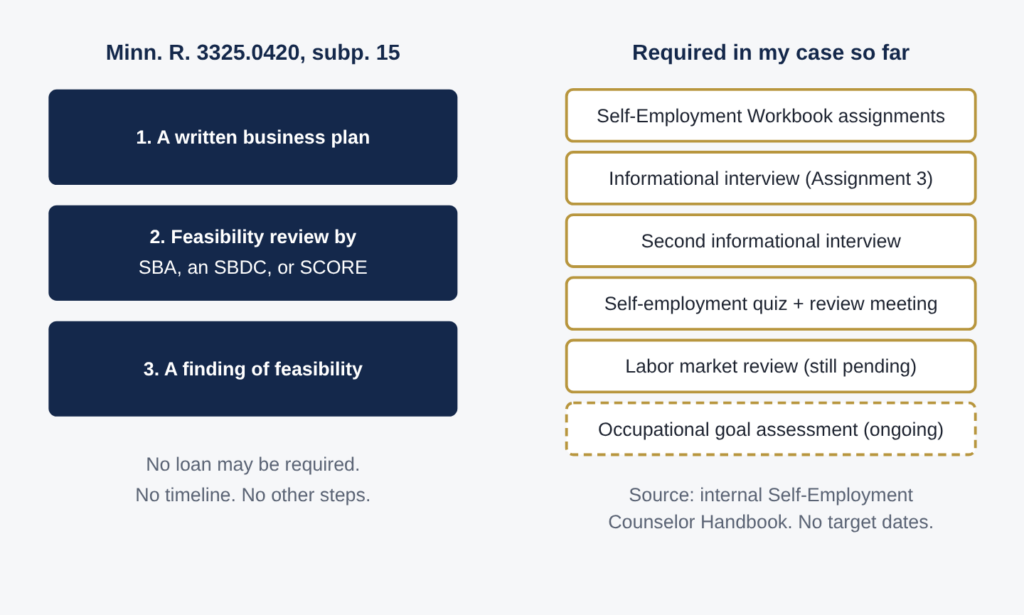
What the process looked like
In my case, the steps came from somewhere other than the rule. When I objected in September to being asked for a second informational interview, the answer I received was that the interview, the self-employment quiz, and further labor market review all come from an internal SSB document, the Self-Employment Counselor Handbook. I have asked for a copy of that handbook and for the authority in rule or federal regulation behind each requirement it adds. I have not received either.
The timeline is easy to lay out because I kept it in writing. On June 25, I sent a proposed amendment to my Individualized Plan for Employment, the IPE, for self-employment through my existing firm. The next day I was told it was “not something we want to rush.” On July 14, I submitted Workbook Assignments 3 through 7. On August 31, forty-eight days later, I was told they had not yet been fully reviewed, and in the same message I was asked for a second informational interview. I objected, and then I did it anyway on September 13, in writing, with an academic bioethicist who studies emerging technology’s impact on deaf and hard of hearing communities.
On September 22, I asked for four things: written meeting summaries, a complete list of the remaining assessment steps with target dates, a target date for the IPE, and an assistive technology evaluation referral made now, in parallel with everything else. I got the summaries, and they have come reliably since. The rest did not happen. On September 23 I was told, “I cannot establish a date for an IPE before the assessment.” The September 24 notes listed two next steps, the quiz and more labor market review, with no dates attached. My request for an AT evaluation, which I first made to SSB on April 24, was not mentioned.
I want to be fair about October. I missed the October 6 meeting because I was moving, and my counselor was out from October 9 to 20. I do not count those weeks against anyone. The record from June through September stands on its own, and so does the October 23 meeting, which reviewed the quiz, ran out of time before the labor market review carried over from September, and scheduled another meeting.
Fiiri xogta
| Qaybta | Days |
|---|---|
| AT evaluation request (April 24) | 188 |
| IPE amendment for self-employment (June 25) | 126 |
| Leadership follow-up promised September 8 | 51 |
| Workbook submission to partial review | 48 |
Same rule, different counselor, different outcome
This is not my first time through this, and the counselors matter here, so I will refer to them by letter. I came to SSB in 2018 with Counselor A. By 2019 my case was with Counselor B, and in April 2020 Counselor B denied graduate training, telling me I could pursue it “just not with SSB’s help.” I asked for a different counselor. A supervisor refused, and my case lapsed that fall.
I reapplied in 2022 and was assigned Counselor C. Over the next four years, SSB funded an HR certificate and then my master’s degree, which I finished in April 2026. Same rules. Same agency. Same person with the same disability asking for the same kind of help. When Counselor C left on June 2, 2026, my case went straight back to Counselor B, and services stopped again.
I tell this part not to make it personal but because it is the most important finding in the whole story. The rule did not change between 2020 and 2022, and it did not change again in June. The counselor changed. When a person’s access to a public program depends that heavily on which staff member she draws, the rule is not doing its job. Rules exist so that outcomes do not depend on the luck of the draw.
Why an assessment that never ends is worse than a no
If SSB denies a service, it has to say so. A denial is a determination, and I can ask for review of it under Minnesota Rules, part 3325.0478 [3], and under the federal review procedures in 34 C.F.R. 361.57 [6]. An open-ended assessment produces no determination at all. Each added step can be defended on its own. Taken together, they work like a no that never has to be said out loud, and so never has to be defended in front of anyone.
Federal vocational rehabilitation regulations point the other way. They require that services be provided through informed choice [5] and that an IPE be developed as soon as possible [4]. Minnesota’s own rule on IPE development, part 3325.0165, sits on top of that [2]. None of these provisions imagines an assessment whose end the person cannot see.
There is a cost, and it is not only mine. Every meeting in this process is paid for out of the same vocational rehabilitation funds that exist to get blind Minnesotans into work. Since June 2, my case has used counselor hours, supervisor time, and my own working days, and it has produced no purchased service, no AT evaluation, no decision on any request, and no plan. Money meant to get us working is being spent on process while we wait.
What the new rule should say
SSB is at the request-for-comments stage, before it publishes draft language. That is when public comment has the most room to shape what comes next. These are my proposals, and I will be submitting them.
- Requirements belong in the rule. Any step SSB requires before supporting self-employment should appear in Chapter 3325 or in a written policy handed to the person at the start, with its legal authority cited. A handbook the person cannot see should not be able to add requirements the rule does not contain.
- Put a clock on it. From a written self-employment request, SSB should have a set period, such as 90 days, to either refer the business plan for the feasibility review the rule already names or issue a written decision. Extensions should require the person’s written agreement, the same way federal rules treat initial IPEs.
- Every request gets a written answer. Requests for services, evaluations, training, and accommodations should receive a written decision within a set period, such as 30 days, with review rights stated on the page.
- Assistive technology should not wait. AT evaluations should run in parallel with any assessment of an employment goal, not behind it. A DeafBlind person should not need an approved business goal before SSB evaluates how she accesses information.
- A real right to change counselors. A written request for a different counselor should get a written answer, with reasons, within a set period. In 2020 my request got a refusal and nothing else.
How to comment
Comments are due December 18, 2026. SSB is taking them through the Court of Administrative Hearings comment page for the Minnesota Department of Employment and Economic Development’s request for comments, which requires creating a login. SSB’s announcement lists topics it is considering but says comments do not have to be limited to them [7]. If you have been through SSB’s vocational rehabilitation program, as a customer, a family member, or a provider, your experience is evidence, and this is where it counts.
I will keep going to meetings. I have filed a formal complaint with SSB leadership asking for a new counselor and for written answers with dates. The rule asks for three things, and I am ready to show all three. What I would like from SSB is a date.
Frequently asked questions about SSB self-employment
What does Minnesota State Services for the Blind require before it supports self-employment?
Minnesota Rules, part 3325.0420, subpart 15 sets three conditions: the person has written a business plan, the plan has been reviewed for feasibility by a representative of the Small Business Administration, a Small Business Development Center, or SCORE, and that review found the plan feasible. The same subpart says SSB does not require the person to take out a loan. The rule names no workbook, quiz, informational interview, or minimum assessment period.
Can SSB add steps that are not in Chapter 3325?
SSB counselors use an internal Self-Employment Counselor Handbook that adds steps such as workbook assignments, informational interviews, and a self-employment quiz. Those steps are not in Chapter 3325. A customer can ask in writing for a copy of the handbook and for the rule or federal regulation that authorizes each added requirement.
Is there a deadline for SSB to write an Individualized Plan for Employment?
Federal rules at 34 C.F.R. 361.45 require that an initial IPE be developed as soon as possible and no later than 90 days after the eligibility determination, unless the agency and the individual agree to a specific extension. Chapter 3325 sets no separate timeline for self-employment assessment or for amending an existing IPE, which is one of the gaps the current rulemaking could close.
How do I appeal or challenge an SSB decision?
A determination can be reviewed under Minnesota Rules, part 3325.0478, which covers review and mediation of determinations, and under the federal review procedures in 34 C.F.R. 361.57, which include mediation and an impartial hearing. Minnesota’s Client Assistance Project, run by Mid-Minnesota Legal Aid’s Disability Law Center, helps vocational rehabilitation customers with problems with their services at no cost.
Can I ask SSB for a different counselor?
Yes. Put the request in writing to the counselor’s supervisor or to SSB leadership, say why, and ask for a written answer by a specific date. The Client Assistance Project can help if the request is refused or ignored.
How do I comment on SSB's rule changes?
SSB is accepting comments through December 18, 2026, through the Court of Administrative Hearings comment page for the Minnesota Department of Employment and Economic Development’s request for comments. You need to create a login. Comments do not have to be limited to the topics SSB lists.
Tixraacyada
- Minnesota Rules, part 3325.0420, Conditions of Service, subpart 15, Self-employment. Office of the Revisor of Statutes. https://www.revisor.mn.gov/rules/3325.0420/
- Minnesota Rules, part 3325.0165, Development of Individualized Plan for Employment (IPE). Office of the Revisor of Statutes. https://www.revisor.mn.gov/rules/3325.0165/
- Minnesota Rules, part 3325.0478, Review and Mediation of Determinations. Office of the Revisor of Statutes. https://www.revisor.mn.gov/rules/3325.0478/
- 34 C.F.R. 361.45, Development of the individualized plan for employment. https://www.ecfr.gov/current/title-34/section-361.45
- 34 C.F.R. 361.52, Informed choice. https://www.ecfr.gov/current/title-34/section-361.52
- 34 C.F.R. 361.57, Review of determinations made by designated State unit personnel. https://www.ecfr.gov/current/title-34/section-361.57
- Minnesota Department of Employment and Economic Development, State Services for the Blind (2026). SSB rulemaking: request for comments, due December 18, 2026. https://mn.gov/deed/ssb/about/news/?id=1045-772210