
On 26 October, Meleia Michels, the Title VI and ADA coordinator for the Cincinnati/Northern Kentucky International Airport, wrote back to me about the AI signer on the terminal train screens. The signed announcements had been taken off the boarding screens. They would return only after a review had been successful, and that review, she wrote, “is intended to include Deaf ASL users as well.” I wrote about that as a win, and it is one. Two recordings showed a machine telling Deaf travelers their train was headed one way while the text above it said the other. One complaint went in, and within two weeks the screens went quiet. That is how accountability is supposed to work, and most of the time it doesn’t move that fast.
I keep rereading the end of her sentence, though. Deaf ASL users. Which ones, chosen by whom? Checking what, against what standard, for how many hours, and with what happening to their findings once they hand them in? And under all of those, the question that decides the rest: who is paying them? Nobody has said. I don’t read that as evasion. I read it as a question nobody in the room thought to ask, because in the business of AI signing, the person who checks the signing is the one line item that lives in nobody’s budget.
Everybody already agrees
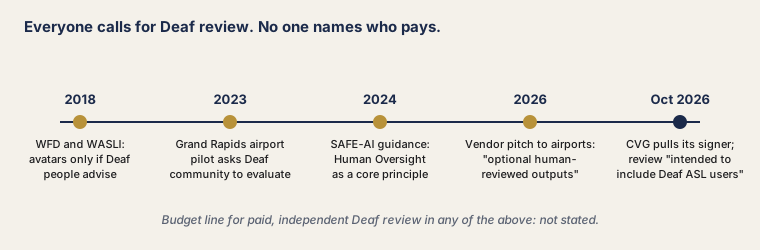
The need for a Deaf checker isn’t a new idea, and it isn’t mine. In 2018 the World Federation of the Deaf and the World Association of Sign Language Interpreters published a joint statement on signing avatars. It cautioned against using them as a replacement for human signers and allowed them for pre-recorded, static information only “as long as deaf people have been involved in advising on the appropriateness of the signed sentences.” It flagged live, complex and high-importance information, emergency announcements in particular, as a special concern. A train platform announcement is assembled on the fly from a data feed and carries information a traveler acts on in the next ninety seconds. It sits right on the line that statement drew eight years ago.
In 2024 the Interpreting SAFE-AI Task Force released its guidance on AI in interpreting, built on a CSA Research survey of more than 9,400 data points and a qualitative study led by an advisory group of nearly fifty people that included Deaf community members. Human Oversight is one of its five principles. The vendors say it too. Deaf AI, a Canadian company pitching airports a pilot through the Airport Consortium on Transformation, lists “optional human-reviewed outputs” among its features, without saying who the humans are. So the principle is settled across the community bodies, the interpreting profession and the industry itself: fluent Deaf people should check machine signing before the public relies on it. What none of these documents say is who funds the checking. The press release announcing the SAFE-AI guidance does not mention compensation at all.
What review looks like when it’s a favor
The closest thing I’ve found to a public record of Deaf review of an airport AI signer comes from Grand Rapids. Gerald R. Ford International Airport tested Signapse’s system through FLITE, its grant-funded pilot program for new air travel technology. In a February 2024 feature in Rapid Growth Media, a Deaf community education and advocacy coordinator, one of the first Deaf community members the airport asked to evaluate the system, described lag and glitches and then said: “I would say it’s 90% perfect.” The test ended in 2023, and the airport no longer uses the technology.
I’m not criticizing her. She was asked for her opinion and gave an honest one. But look at what that evaluation is. It’s an impression, from one person, reported in a news story. There’s no sample, no list of which announcements she saw, no definition of what counted as an error, and no way for anyone else to repeat it. The article doesn’t say whether she was paid. And ninety percent is a strange number to hear about a train platform. If one announcement in ten is wrong, a Deaf traveler has no way to tell which one, so in practice she can’t trust any of them. A hearing traveler who heard the wrong gate one time in ten would call the system broken.
That is what review looks like when it’s a favor. Someone in the community gets asked to take a look, she looks in whatever time she can spare, and her generosity becomes the evidence. The deployment gets to say Deaf people were consulted. The Deaf person gets nothing on the record that shows what she actually found, and the public gets a percentage nobody measured.
Two seconds
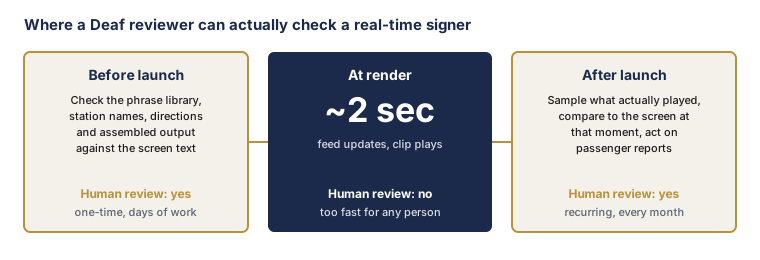
Signapse’s transport page says its translations are “generated within 2 seconds.” I believe it. That speed is the selling point, and it’s also why the checking can’t happen where most people picture it. No human reviews a signed announcement in the two seconds between the departure board updating and the clip playing on the platform. If review happens at all, it happens in two other places, and both of them cost hours.
The first is before anything goes live. Someone fluent checks the library the system draws from, the phrases and station names and directions, along with the logic that stitches them together, and then tests the assembled output against the text it claims to render, including the awkward cases: delays, platform changes, the train that skips a stop. The second is after launch. Someone samples what actually played on the platform, compares it against what the screen said at that same moment, and makes sure passengers have a way to report a mismatch that reaches a person with the authority to switch the system off.
The CVG problem may well live in that second place. In its letter, the airport said its internal team had been working with its contracted partners on “both input and connectivity accuracy of the platforms,” which points at the data links between the airport’s systems and the signing system rather than the signing vocabulary itself. A one-time review before the relaunch can’t catch a fault that shows up on some Tuesday next spring when a feed changes upstream. Only ongoing checking catches that, and ongoing checking means somebody’s hours, every month, for as long as the screens are on.
What the hours cost
It helps to put numbers on this, so here are some. Boston University publishes its rates for interpreting work, and a nationally certified Certified Deaf Interpreter starts at $60 an hour with a two-hour minimum. Take that as a floor for a fluent Deaf reviewer doing skilled language work. A modest pre-launch review, three Deaf reviewers each spending two working days on a set of announcements, comes to 48 hours, or $2,880 at that rate. That pays for the reviewing alone. It doesn’t pay for designing the test set, agreeing in advance what counts as an error and how serious each kind is, reconciling the places where reviewers disagree, or writing results up in a form someone else can check. Add those and a credible first review lands somewhere in the high four figures. Monthly sampling after launch costs less, but it never stops.
Those are illustrative figures, not a quote, and a real number depends on the deployment. Set them beside what they protect, though: a system playing to every Deaf traveler who boards a train, with no record that anyone fluent checked it. Next to the cost of the deployment, and next to the cost of answering a civil rights complaint, the review is cheap. What it lacks isn’t money. What it lacks is a home.
Three budgets and a gap
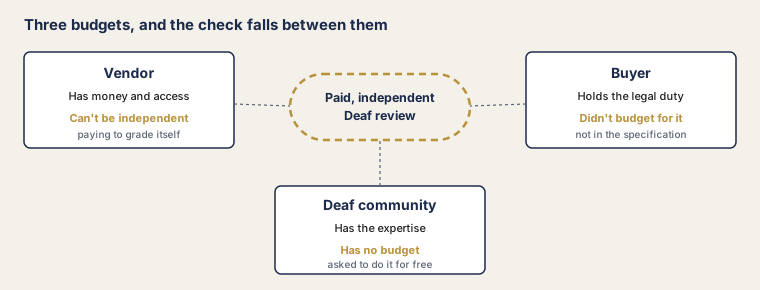
There are three places the money could come from, and each one has a reason it doesn’t. The vendor has money and access. Signapse raised £2 million in seed funding in 2024, £500,000 of it from Innovate UK, and says its platform is in use at airports and train stations in the UK and US. A vendor can and should test its own product. But a review paid for by the company being reviewed is quality control, not evaluation. The vendor picks the reviewers, picks the test set, and decides whether anyone outside the company ever hears the result. That’s the same reason NCG takes no money from sign language AI companies: you can’t evaluate the people paying you.
The buyer is the obvious payer, and the one with the legal obligation. Under Title II of the ADA and Section 504, the duty to communicate effectively with Deaf travelers belongs to the airport, not to the airport’s vendor. But buyers budget for the technology, the integration and the screens. Review isn’t in the procurement because nobody wrote it into the specification, and a requirement nobody specified is a requirement nobody funds. In Grand Rapids, the pilot money came through a grant program; the Deaf evaluation came from asking the community.
Which leaves the Deaf community, where the work lands by default. It has the expertise and none of the budget. When the vendor can’t pay for independence and the buyer didn’t plan for review, the job slides to whichever Deaf person is willing to look for free. That’s a tax on the people the system was bought to serve. It doesn’t buy independence either, because a favor carries its own quiet pressure to be kind about what you saw.
Putting the check in the contract
The long-term fix is boring, which is usually how you know it would work. Buyers write the review into the contract as its own line, funded separately from the vendor’s fee, carried out by reviewers the vendor doesn’t choose and doesn’t pay. The contract names the standard before launch, requires sampling after it, sends passenger reports to someone with the power to pause the system, and gives the reviewers an unconditional right to publish what they find. I laid out contract terms like these in the CVG piece. What’s still missing is money that doesn’t belong to anyone’s sales pitch, and a working example of paid, independent Deaf review that a procurement officer can point to and copy.
Paying for the first panel
Contracts change slowly, so I’m not waiting on them. I’m raising about $10,000 to fund the first paid panel of Deaf reviewers for NCG’s SLAT evaluations, the people who check whether AI signing means what it claims to mean before a buyer trusts it with the public. This week I asked twenty organizations, accessibility companies and disability rights law firms among them, to sponsor it at $1,000 each. Sponsors are named on the panel’s public record and get no say over findings. NCG takes no money from sign language AI companies or interpreting providers. NCG is a for-profit firm, so a sponsorship is something I invoice, not a donation.
The panel is being assembled now. It isn’t reviewing anything yet, and I’ll publish its membership and its method before it does, because a review nobody can inspect is just a more expensive favor. If your organization wants to be one of the ten that pays for it, email me at heather@novaracg.com.
When the signer comes back
At some point the AI signer will return to the train screens at CVG. When it does, the announcement will probably say the system was reviewed with Deaf ASL users. I hope that’s true, and I hope the review was good. The question I’ll be asking, and I’d ask every Deaf traveler and every advocate to ask with me, is short: who were they, what did they check, and who paid them? If nobody paid them, the review was a favor, and a favor isn’t evidence.
Drafted with AI assistance and reviewed by the author. Cost figures in “What the hours cost” are illustrative estimates, not quotes.