
Saturday, a bent cord
A cochlear implant is two pieces of hardware. One is surgically placed under the skin. The other sits on the outside of the head: a sound processor, a coil, and a thin cable between them that a child bends, tugs, sleeps on and drops a hundred times a week. Cables wear out. Every family with an implanted child knows the sound of the processor going quiet, and every one of them keeps a spare if insurance and luck allow it. Without that external piece working, the implant delivers nothing. The child is deaf again until the part arrives.
That is what happened to a boy I will call J. over a weekend this fall. His cord broke. A replacement was ordered. And on Monday morning, he went to school in a central Iowa district inside the Heartland Area Education Agency with no working implant. His mother wrote about it the same day, and she did not soften it.
Here is the part that matters. A few weeks earlier, J.’s district had suggested he did not need an American Sign Language interpreter, because he could hear and communicate well enough with his implant. On Monday, with the implant dead, the school called his mother to tell her there was no interpreter for him. His mother asked the only question that matters: how, today, is he supposed to get his education without either one?
Her answer was the one parents of deaf children arrive at sooner or later. A cochlear implant is a tool. It is not a guarantee of access. And she said what she wants: let him go to the Iowa School for the Deaf.
What the district said before the cord broke
The district’s position was not unusual, and it was not stupid. A child with an implant who is doing well in a quiet classroom can look, on a good day, like a child who needs nothing more. IEP teams see test scores, speech that is improving, a kid who answers when called on. The interpreter starts to look like a cost attached to a child who seems not to need it.
What that reasoning leaves out is the bad day. Implants fail. Batteries die mid-morning. Gyms, cafeterias, buses and group work defeat even a well-fitted processor. A plan that works only when every piece of hardware works is not an access plan. It is a bet, and on Monday the district lost it with someone else’s child.
Iowa’s own special education rule already tells IEP teams to plan for this. Under 281 IAC 41.324, which carries the federal IDEA special factors into Iowa rule, the team must consider the communication needs of a deaf or hard of hearing child, including the child’s language and communication mode and the opportunities for direct communication with peers and staff in that mode. A team that removes ASL access because the implant is working has answered that question for the days the implant works. It has not answered it for the days it doesn’t.
What the Iowa file shows about where he lives
The National Deaf Education Data Index released its Iowa state file, version 2.0, on October 31, 2026, for the 2024-25 school year. It reads every one of the 348 public school units in Iowa’s frame and records what each one publishes about serving deaf and hard of hearing students. It does not grade schools. It records what a parent, a reporter or a legislator can actually find.
Iowa is built differently from most states. Districts do not usually run their own deaf education programs. Nine area education agencies employ the teachers of the deaf and the audiologists and send them out to children in their home districts. All nine AEAs describe those hearing services on their websites. The districts, almost without exception, say nothing. Statewide, only 2 of 325 districts publish deaf or hard of hearing staff of their own: Des Moines, with a full program, and Dallas Center-Grimes, which employs its own interpreters.
Heartland AEA is the largest of the nine. The state’s own count, built under Iowa’s 2022 language milestones law, placed 885 of Iowa’s 3,269 deaf and hard of hearing learners from birth to 21 in Heartland in 2024-25. In the Heartland region, the file codes 53 school units. Forty-five of them publish nothing found. Three mention hearing services in passing. Two run a program. Three could not be read.
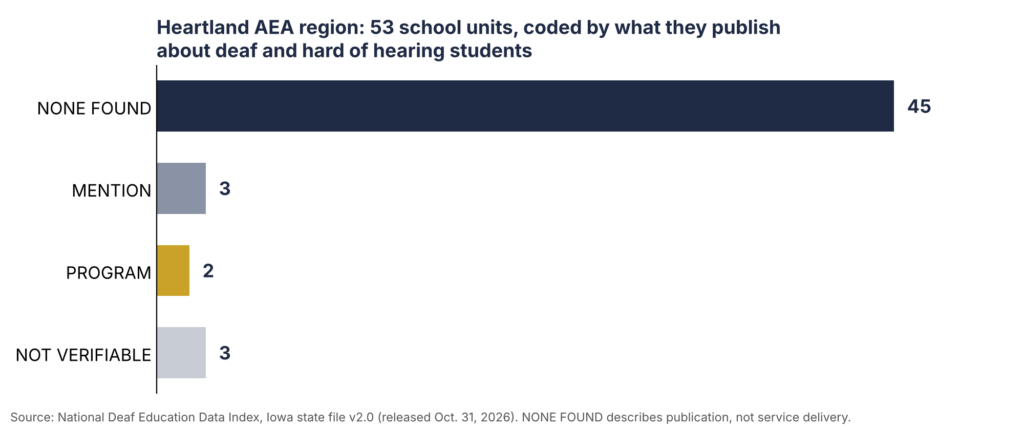
NONE FOUND is a statement about publication, not about service. A district that publishes nothing may still be paying for an itinerant teacher through its AEA. But publication is where a family starts. When a district’s website says nothing about deaf students, a mother has no published standard to hold it to, no named coordinator, and no stated plan for the morning the implant fails. J.’s district is one of the 45.
The count also shows something the district’s argument skips past. Of those 3,269 learners, 1,097 were on no education plan at all in 2024-25. The year before, it was 1,257. Iowa does not report its deaf students to the federal government by category, because the state does not sort children by disability. Its own count is the only place those children show up as deaf, and a third of them have no plan that would require anyone to do anything when their hardware fails.
The interpreter the school could not produce
When the school called to say it had no interpreter, it was not saying it could not find a warm body who knows some sign. It was saying something more specific, and more telling.
Every person interpreting in Iowa must hold a state license under Iowa Code chapter 154E. To be licensed, an interpreter needs national certification through NIC or RID, or a score of 3.5 or higher on the Educational Interpreter Performance Assessment. A temporary license runs two years, can be renewed once, and requires direct supervision. A paraprofessional who took a semester of ASL is not an option the law allows, and it shouldn’t be.
That standard is good for deaf children. It also means a district cannot conjure an interpreter on the morning it needs one. Access has to be arranged before the bad day: a licensed interpreter on staff or under contract, a standing agreement with the AEA, a backup written into the IEP. A district that has just argued the interpreter away has nothing to call on Monday. The phone call to J.’s mother was the plan working as designed.
The law already names the other door
Iowa has a school built for the situation J. was in on Monday. The Iowa School for the Deaf in Council Bluffs was founded in 1855. In 2023 the Legislature moved it from the Board of Regents to the Department of Education. It takes day and boarding students from preschool to age 21, teaches in American Sign Language and English, and costs families nothing. Boarding students go home every Friday at noon. The state auditor counted an average of 113 students there in fiscal year 2024, at about $108,904 each, and the Legislature appropriated about $11.7 million for the year that funded 2024-25.
The door into that school is a statute that reads like it was written in the 1870s, because it essentially was. Iowa Code 256.97 admits a child with “a hearing loss which is too severe to acquire an education in the public schools.” There is no decibel cutoff anywhere in Iowa law or on the school’s pages. Placement runs through the child’s resident district IEP team and the school’s referral process.
Read that test against Monday. The question is not how many decibels J. can hear with a working processor in a quiet room. The question is whether he can acquire an education in the public schools. On the day his district had neither a working implant nor an interpreter, the answer was no, and the district’s own phone call said so.
There is one more provision worth knowing. On the statute’s face, Iowa Code 299.22 still treats the state school as the deaf child’s default, excusing attendance there when the state school’s superintendent certifies that the child is being taught efficiently in the public schools. The Iowa file notes there has been no 2026 amendment to that language. Whatever its practical force today, it is a reminder that the law was written assuming the state school was where a deaf child went unless someone could show the local school was doing the job.
Why a tool is not a plan
None of this is an argument against cochlear implants. Many deaf children thrive with them, and many families choose them for good reasons. The argument is narrower and harder to dodge. A tool that fails is not the same as a plan that holds. An IEP that depends on one cable staying intact has a single point of failure, and the child is the one who absorbs it.
Deaf adults have been saying this for decades. Bilingual access, ASL alongside English and alongside whatever hearing technology a family chooses, is not a rejection of the implant. It is insurance against the morning the implant goes quiet, and it is full access on every other morning too. A child who signs and uses an implant has two ways in. A child who has had the interpreter argued away has one, and it broke on Saturday.
What a parent can ask for, in writing
J.’s mother does not need a theory. She needs a record. A few things are worth asking for in writing, because a written request creates a date and a duty to answer, and a phone call does not.
- A copy of the IEP and the prior written notice for any decision that removed or reduced interpreting services, including the reasons the team gave.
- A written explanation of what the district’s plan is for any school day when the implant is not working, and who is responsible for carrying it out.
- An IEP meeting to revisit communication needs under 281 IAC 41.324, with the Heartland AEA teacher of the deaf present.
- A referral to the Iowa School for the Deaf through the IEP team, with the district’s written response if it declines.
This piece is not legal advice, and a family in this position should talk with Iowa’s parent training center or a special education advocate before a meeting. But the documents above are the ones every later step depends on.
What this piece does not say
The child’s name has been changed and his district is not named, because a deaf child with an implant in a small district is identifiable from far less. The account of the weekend and the phone call is his mother’s, as she reported it publicly. The figures are from the National Deaf Education Data Index Iowa state file, version 2.0, which was sent to sixteen Iowa bodies, including the Department of Education, all nine AEAs and the Iowa School for the Deaf, before it was published. None of them responded during the correction window. NONE FOUND means a district publishes nothing; it does not mean a district serves no one, and it is not a finding about any individual child’s services.
Quellen
National Deaf Education Data Index. Iowa, state file 15, version 2.0, SY 2025 (School Year 2024-25), released October 31, 2026. DOI 10.5281/zenodo.23438424. https://www.ndedi.org/states/ia/v2.0/
Iowa Code chapter 154E (interpreter licensure) and 481 IAC 961.2 and 961.3, as recorded in the Iowa file.
Iowa Code 256.95, 256.97 and 299.22 (the Iowa School for the Deaf; admission; attendance), as recorded in the Iowa file.
281 IAC 41.111(4) and 41.324 (noncategorical eligibility; special factors for deaf and hard of hearing children), as recorded in the Iowa file.
Iowa Department of Education, ACHIEVE Deaf and Hard of Hearing Database counts for 2023-24 and 2024-25, as recorded in the Iowa file.
Office of Auditor of State of Iowa, average enrollment and cost per student at the Iowa School for the Deaf, fiscal year 2024, as recorded in the Iowa file.
Tips
Know something about a sign language AI system that the public should know? Send it to tips@novaracg.com. Every tip is read by me and kept confidential. If you work in the UK, writing to us is not by itself a protected disclosure under the Public Interest Disclosure Act 1998, so before you share employer information, check your options with Protect (protect-advice.org.uk), the free whistleblowing advice line.