
The distance is not only miles
Where I grew up, in Ellijay, Georgia, looking for work meant leaving. The jobs worth having were in Atlanta, and getting hired there meant learning to code-switch, to sound like someone who belonged in the room before anyone would look at what you could actually do. I have carried that lesson ever since. The distance between where people live and where hiring happens is never measured only in miles. It is measured in shifts you cannot miss, gas you cannot spare, childcare you cannot find on a weekday morning, and application systems that assume you already know how they work. It is measured in rooms that were never arranged with you in mind.
That distance is the problem WorkReadyMN is built around. Central Minnesota has employers who need people and people who need better work, often within a twenty-minute drive of each other. What is missing is not the jobs or the workers. It is the room where they meet, held at a time and in a way that ordinary working people can use.
When hiring moved to weekdays
In the 1980s and 1990s, hiring fairs commonly ran on weekends. Parents brought their kids, there was something for the kids to do, and the adults talked to employers face to face. Somewhere along the way the format shifted to weekdays and business hours. That schedule can work in a metro area with a deep bench of job seekers and a lot of flexible office work. In Greater Minnesota it asks a person who works hourly to give up a shift, and the pay that comes with it, for the chance to look for a better one. For someone who is also raising children, it asks even more.
A hiring event that only the already-flexible can attend is not a neutral event.
A hiring event that only the already-flexible can attend is not a neutral event. It quietly sorts out the people with the least room in their week, who are often the people a better job would help most. Moving the event to Saturday is not a gimmick. It is the most direct fix available for a scheduling barrier that nobody designed on purpose but that everyone has learned to live with.
What 169 Works! is
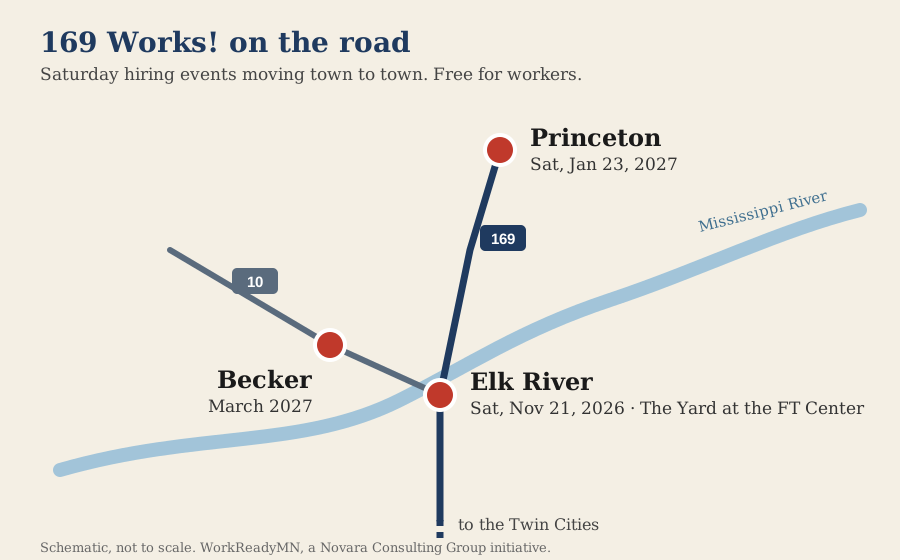
169 Works! puts job seekers in a room with employers who are actually hiring. The first event is Saturday, November 21, 2026, at The Yard at the FT Center in Elk River. The second is Saturday, January 23, 2027, in Princeton, and Becker follows in March 2027 at the Becker Community Center. The plan is to move town to town along the corridor rather than settle permanently in one place, and to return more often wherever people show up in numbers. A town that fills the room earns a monthly event. A town that fills it every month earns more than that.
The money works the way it should for a hiring event. Workers pay nothing to attend. Employers, training programs, and agencies pay for a table, and sponsors cover the rest. There is no per-hire commission, because a hiring event should not be financed by taking a cut of someone’s first paycheck or by turning a new hire into a fee the employer resents.
The rules employers agree to
Anyone who has walked up to a job fair table and been handed a brochure and told to apply online knows how little those tables can be worth. 169 Works! asks employers for two things that exist for the job seeker’s benefit.
First, every employer submits its current openings in advance, with the job title, location, pay range, shift, and requirements. A posted pay range lets a worker decide in thirty seconds whether a conversation is worth having, and it keeps the event honest about what is actually on offer. Second, every employer has someone on site who can interview or screen. The point of the day is for a person to leave with an interview, a screen, or an offer, not with a stack of URLs to try later from a phone.
These are low bars. They are also the bars that separate a hiring event from a marketing event, and they are what make it worth a worker’s Saturday.
Access is part of the product
If a person cannot get through the application, the opening does not exist for them, no matter how many times it is posted. 169 Works! treats access as part of what it sells, not as a courtesy. The events take walk-ins. They offer paper applications alongside online ones, provide computers and people to help fill out applications, use plain-language job listings and accessible forms, and provide ASL interpreters. Anyone who needs something else can ask ahead of time so it can be planned for, rather than discovered at the door.
This matters for disabled job seekers, and it matters for everyone else too. The worker who has not applied for a job in fifteen years, the one whose first language is not English, and the one whose phone is the only computer in the house all run into the same wall that a Deaf or blind applicant hits first. Building for the people who hit that wall hardest makes the room work better for the whole line.
A front door to apprenticeship
WorkReadyMN is meant to be more than a calendar of events. Over time it will serve as a local front door to Minnesota registered apprenticeship for the corridor. The Minnesota Department of Labor and Industry describes registered apprenticeship as an employer-driven, earn-while-you-learn model in which apprentices are paid by an employer while training on the job and completing related coursework [1]. Minnesota has been extending that model beyond the building trades; the state launched registered teacher apprenticeship in August 2024 [2].
For a worker in Princeton or Becker, the hard part is rarely deciding that apprenticeship sounds good. It is finding out which local employers sponsor one, what it pays, and who to call. A hiring event with apprenticeship sponsors and training programs at the tables answers those questions in an afternoon, in person, in the worker’s own town.
What we will report
These Insights are where WorkReadyMN will publish what actually happens. That means the unglamorous numbers: how many people came, how many employers showed up with real openings, how many interviews and screens took place, and how many people left with an offer or a concrete next step. It also means what employers learned about hiring in rural Minnesota on a Saturday, and what did not work.
A workforce program that publishes only its wins is not telling anyone the truth, and the employers, sponsors, and towns deciding whether to back the next event deserve the real picture. If the Saturday model underperforms, this is where that will be said first.
Employers hiring in the Elk River area can register for a table at https://www.workreadymn.com/events/169-works-hiring-event/. Job seekers do not need to register. Just come.
Tixraacyada
- Minnesota Department of Labor and Industry. Start an apprenticeship program. https://dli.mn.gov/business/workforce/start-apprenticeship-program
- Minnesota Department of Labor and Industry. Department of Labor and Industry awards grants to expand registered teacher apprenticeship programs. https://dli.mn.gov/news/department-labor-and-industry-awards-grants-expand-registered-teacher-apprenticeship-programs