
The platform, a month later
The terminal train at Cincinnati/Northern Kentucky International Airport runs the same loop it ran in October. It carries passengers between the main terminal and the concourses, and the platform screens still tell riders when the next car is due and where it is going. What has changed is what those screens show a Deaf rider. Until late October, a signed video ran beside the English text, generated by software and meant to carry the same message in American Sign Language. Today there is only the text.
That change is the outcome of a complaint, and the complaint began with a recording. A Deaf passenger who rides the train regularly filmed the platform screen while the English text said one thing and the signer said another. In one recording the text announced a train for the A and B gates while the signer sent riders toward baggage claim and ticketing, the opposite direction of travel. In a second, the signer named one concourse for a train serving the other.1 A hearing passenger who notices that kind of mismatch can listen to the overhead announcement and settle the question. A Deaf passenger has no third source. She has two official messages from the same operator on the same screen and has to guess which one is true while a door closes.
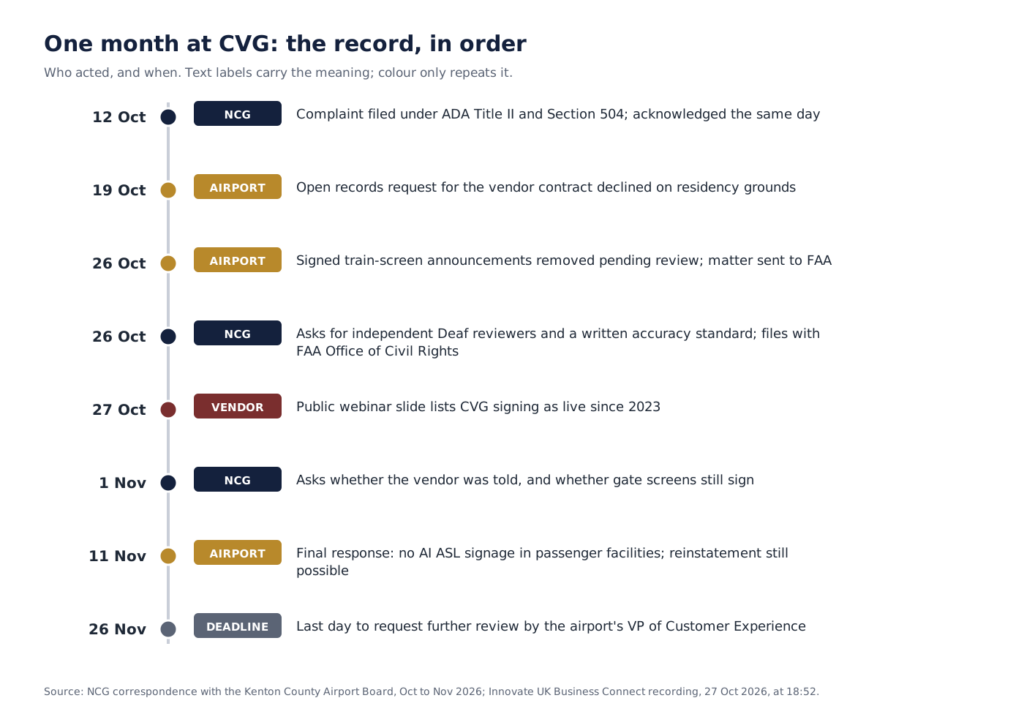
Novara Consulting Group filed a written complaint with the Kenton County Airport Board on 12 October 2026 under Title II of the Americans with Disabilities Act and Section 504 of the Rehabilitation Act as it applies to airport operators.2 It asked for three things: suspend the signed announcements on live wayfinding screens until each signed clip could be checked against the screen text it accompanies, explain what drives the signing and what was verified before it went live, and have Deaf ASL users review the signing before it returns, with a way for passengers to report a wrong announcement. On 11 November the airport sent what it called its final, formal response.3 This piece sets out what that response settles, what it leaves open, and why the open part is where the real governance question now sits.
What the airport did, and how quickly
The first thing to say about CVG’s handling of this complaint is that the airport acted before it finished deciding. Two weeks after the complaint arrived, its Title VI and ADA coordinator wrote that airport personnel had removed the signed announcements from the train boarding screens to review them for accuracy, that the internal team was working with its contracted partners on the input and connectivity of the platforms, and that the resource would return to service only after the review had been successful.4 The same letter said the review was intended to include Deaf ASL users and that the complaint and a statement of activity had gone to the Federal Aviation Administration.
That sequence matters. Many public bodies, faced with a complaint about a technology they paid for, keep it running while they investigate, on the theory that some access is better than none. CVG did the opposite. It treated a signed announcement that might be wrong as worse than no signed announcement, which is the correct reading of the law. Under 28 CFR 35.160, an auxiliary aid has to make communication as effective as the communication offered to everyone else.5 A signer that sends a passenger the wrong way does not meet that test at any error rate the passenger can detect, because the passenger cannot detect it. Taking the screens down was the only way to stop the airport from communicating something wrong to Deaf travelers through a contractor it chose.
The final response goes further than the October letter did. It states that, at this time, no additional AI ASL signage is available at CVG in the airport’s passenger facilities. The train screens were the deployment the complaint described. The final response confirms there is no other one running.
Two statements, two weeks apart
That last sentence settles a question NCG raised on 1 November, and in settling it, it sharpens another. On 27 October, the day after the airport told NCG the train-screen signing had been removed, the vendor that supplies it, Signapse, presented CVG to an audience of transport operators at an Innovate UK Business Connect webinar. Its deployments slide, at 18:52 of the public recording, listed CVG as providing ASL on the boarding gate screen plus live tram departure and safety information, with a status of live since 2023.6 NCG’s earlier analysis of that presentation, “Compared to Nothing,” set out why a slide like that matters to operators reading it: it tells them a deployment is running and, by implication, working.7
The airport has now said in writing that no AI ASL signage is running in its passenger facilities. Read together, the two statements leave only a few possibilities. Either the boarding gate signing described on the slide was switched off sometime between 27 October and 11 November, or it was not running when the slide was shown, or the slide described something other than what passengers could see. Each possibility is a fact the airport and the vendor can state plainly. None of them is a fact NCG can establish from outside, and this piece does not claim to know which applies.
What can be said is narrower and still important. The operator is the party with the legal duty to communicate effectively, and that duty does not pass to a vendor when the operator signs a contract. A public entity may not discriminate through contractual or other arrangements any more than it may discriminate directly.8 An operator in that position needs to know what its vendor is telling the market about its deployment, because the operator’s name is on it. NCG’s 1 November letter asked whether CVG had told Signapse that the signed train-screen announcements were removed pending review, and on what date. The final response does not answer that question.
The sentence that carries the future
Most of the final response is about the past. One sentence is about what happens next, and it deserves to be read slowly. The airport writes that its internal teams continue to review the ASL announcements that were on the train screens, that additional work, review and potential reinstatement will continue beyond the date of the letter, and that the review will continue to include communication with contracted partners and internal personnel, “as well as intended inclusion of Deaf ASL users prior to final reinstatement if that is the direction agreed upon by all groups involved.”3
The sentence can be read two ways, and the difference matters. On the first reading, the condition attaches to the Deaf review: Deaf ASL users will be included if the groups involved agree to include them. On that reading, the vendor, as one of the groups involved, holds something close to a veto over whether Deaf people check signed content made for Deaf people. On the second reading, the condition attaches to reinstatement: if the groups involved agree to bring the signing back, Deaf ASL users are intended to be included before it returns. That reading is kinder, and it may be the one the airport meant.
Even on the kinder reading, the sentence leaves the decisive question unanswered. It does not say whether the Deaf reviewers are one of the groups whose agreement is required. If they are, the sentence already contains the gate the complaint asked for, and saying so plainly would cost the airport nothing. If they are not, then Deaf review is an input to a decision made by the airport and its contractors, and the people the signing is for have a voice but not a vote. The October letter used firmer language. It said the resource would return “only after this review has been successful.”4 The final response does not withdraw that commitment, but it does not repeat it either, and the word “intended” now appears where a requirement would be expected.
This is not a complaint about tone. In accessibility procurement, the difference between consultation and a condition is the whole difference between a Deaf-led review and a Deaf-informed one. A review that the affected community can inform but cannot stop has the same structure as a vendor’s internal quality check with an audience. NCG’s Sign Language Access Trust work starts from the premise that independent validation of signed output by fluent Deaf signers is what separates a deployment that has been tested from one that has been demonstrated. The CVG letter is a live example of how easily that line blurs in ordinary administrative drafting.
What the record still does not show
Figure 2 sets the complaint’s requests and NCG’s follow-up questions against what the airport’s two letters say. The suspension was granted and widened. One of the follow-up questions was answered directly. Most of the rest are still open.
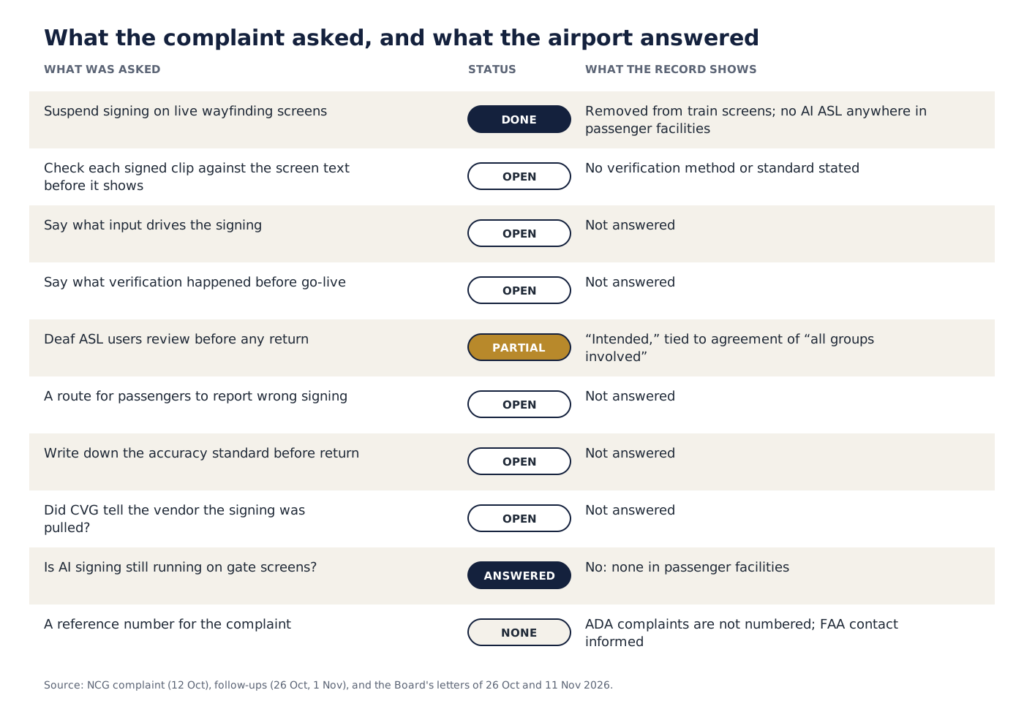
Three of the open items are worth explaining, because each one is a question any operator of AI signing should be able to answer before a passenger ever sees it.
The first is the input. NCG asked whether the signed announcement on the train screens is generated from the public address audio, from the display text, or from a scheduled trigger.2 The answer determines what kind of failure the recordings show. If the signing is generated from the same data that drives the text, a mismatch points to a translation or rendering fault. If it is generated from a separate source, such as a schedule or a library of pre-made clips triggered by an event, a mismatch points to a synchronisation or change-control fault, and the fix is a process fix rather than a model fix. The October letter’s reference to “input and connectivity accuracy” suggests the airport is looking at the second kind of problem.4 It has not said so.
The second is the verification that took place before the system went live. If the signed content was checked against the screen text by fluent signers before launch, the recordings show something that drifted afterward, and the question is why nothing caught the drift. If it was not checked, the recordings show what launch-day quality looked like, and the question is why the deployment was accepted. Either answer tells other operators something about what to require in their own contracts.
The third is a reporting route. The complaint asked for a way for passengers to report a wrong signed announcement. The rider who recorded the CVG platform did what she could: she filmed it and shared it. That is how the problem reached the airport, and it took a public video and a formal federal civil rights complaint to do it. A deployment that can only be corrected through that path has no working feedback loop. The airport’s letters do not mention one.
A complaint with no number
The final response also explains that ADA complaints at the airport are not assigned a reference number and are not submitted in the same way as Title VI complaints, and that the airport has communicated with its FAA compliance specialist about the concerns raised.3 NCG had asked for an FAA reference number on 26 October so the complaint could be followed.9
Nothing in the regulations NCG cited requires a reference number. The Department of Transportation’s Section 504 rules do require a recipient of federal financial assistance to designate a responsible employee and to adopt complaint procedures with due process standards that provide for prompt and equitable resolution.10 The airport has a coordinator, a procedure, and a further-review step, and it followed them. The practical point is simpler. A complaint with no number is harder to cite, harder for a federal reviewer to locate, and harder for the next complainant to connect to the last one. If a second Deaf passenger films a wrong signed announcement at CVG after the signing returns, there is no identifier that ties that complaint to this one. NCG filed its own complaint with the FAA Office of Civil Rights on 26 October, separately from the airport’s referral, so that the federal record does not depend on the airport’s internal filing.
The complaint’s records request ran into a similar wall earlier in the month. On 12 October NCG asked the Board, under the Kentucky Open Records Act, for the Signapse contract, the procurement file, testing records and complaint history. The Board declined on 19 October because NCG is not a Kentucky resident under KRS 61.870(10), and invited a resubmission under another residency category.11 The contract and testing records have not been produced. That means the public still does not know what the airport bought, what the vendor promised it would deliver, or what acceptance testing, if any, the contract required.
Why this counts as a win, and why it is not finished
It would be easy to read the last few sections as a list of grievances. That would misread what happened at CVG. A Deaf passenger recorded a public accessibility system giving wrong directions. A small firm wrote it up and filed it under the federal rules that govern airports. Within two weeks the airport took the signing off the screens, told the FAA, and said it would not bring the signing back until a review succeeded. Within a month it confirmed that no AI-generated ASL is running anywhere in its passenger facilities. The airport did not argue that some signing was better than none, and it did not keep the system running during its investigation. That is a better outcome than most accessibility complaints produce, and it was produced quickly.
The reason the matter is not finished is that a suspension is not a standard. The airport has decided that the old deployment should not run. It has not yet decided, at least not in writing, what a new deployment would have to prove before it runs. That is the decision that will determine whether the next Deaf rider on that platform gets accurate information, and it is a decision the airport is about to make with its vendor in the room. The complaint process is the one point where the public can ask for the terms of that decision to be written down before it is made rather than after something goes wrong again.
For that reason NCG used the further-review step the final response offered. On 11 November it asked the airport’s Vice President of Customer Experience to review the complaint and requested four things in writing: an accuracy standard written down before signed announcements return to any CVG screen, including a check of each signed message against the screen text it accompanies with mismatches suppressed and logged; review by fluent Deaf ASL users chosen independently of the vendor as a condition of any reinstatement, not an option; answers to the input and pre-launch verification questions; and notice to the complainant before any reinstatement, with a working route for passengers to report a wrong signed announcement once it returns.12 Under the airport’s procedure, the Vice President or a designee is to contact or meet with the complainant within fifteen calendar days of receiving the request, and respond in writing within fifteen days of that conversation.3
What reinstatement should require
The CVG record is useful beyond CVG because the gap it exposes is common. Operators that buy AI signing tend to write down what the system will do, and rarely what it must prove before it is allowed to do it. The list below is what NCG has asked CVG to adopt, written so that any airport, transit agency or public venue can use it before a signed announcement goes in front of a passenger, whether for the first time or after a suspension.
- A written accuracy standard for each message type, adopted before launch, that states what counts as a correct signed message and what happens when one is not correct.
- An automatic check that each signed message matches the text displayed beside it, with any mismatch suppressed rather than shown, and every suppression logged with its time and screen.
- A plain description of what drives the signing (live audio, display text, a data feed or pre-approved clips), and who approves each clip or template and when it was last reconciled with the text.
- Review of the signed content by fluent Deaf signers chosen independently of the vendor, whose sign-off is a condition of launch and of any reinstatement.
- A visible, accessible way for passengers to report a wrong signed announcement, routed to someone with the authority to switch the signing off.
- A contract term requiring the vendor to describe the deployment’s status accurately in public materials, and to update them when the operator suspends it.
- A complaint record that can be cited: a number, or at least a date and a docket the next complainant can reference.
None of these items is expensive, and none depends on the quality of any particular product. They are the procedural floor that lets an operator know whether the product is working. A vendor whose system is accurate has nothing to fear from any of them. A vendor whose system is not accurate is exactly the vendor these items are for.
The screen is quiet now
The platform screens at CVG are quieter than they were in October, and for Deaf riders that is an improvement, because the text on them is right. The question the airport now faces is whether the next version of the signing will be checked by the people it is for before it reaches them, or after. The final response leaves that question open. The further review is the place to close it, and the answer will be worth more to the next Deaf traveler on that platform than anything the vendor’s slide could say about it.
Sourcing note
This piece relies on NCG’s own correspondence with the Kenton County Airport Board’s Title VI and ADA coordinator between 12 October and 11 November 2026, and on NCG’s request for further review sent on 11 November 2026. Quotations from the airport’s letters are short and exact. The vendor presentation is session 4 of Innovate UK Business Connect’s Accessible and Inclusive Journeys Innovation Cafe, held online on 27 October 2026 and published on Vimeo; the deployments slide appears at 18:52. Where the airport’s wording admits more than one reading, both readings are set out and neither is attributed to the airport as its meaning. NCG does not know whether the boarding gate signing described on the vendor’s slide was running on 27 October, and this piece does not assert that it was or was not. Copies of the correspondence are available to the FAA on request.
Tips
Know something about a sign language AI system that the public should know? Send it to tips@novaracg.com. Every tip is read by me and kept confidential. If you work in the UK, writing to us is not by itself a protected disclosure under the Public Interest Disclosure Act 1998, so before you share employer information, check your options with Protect (protect-advice.org.uk), the free whistleblowing advice line.