

*An investor’s congratulations, three questions, and a line Signapse drew in its own words*
Picture a Deaf passenger on a station platform. The screen above her shows a digital signer, fluent and unhurried, telling her that her train is running late and has moved to another platform. Then the public address system crackles, and a member of staff, speaking off the cuff, tells everyone to stand well back from the edge. The people around her step away. The signer on the screen carries on with the timetable, because the warning was spoken and never typed into anything.
That scene is an illustration, not a reported event, and NCG knows of no case in which it has happened. It is drawn, however, from Signapse’s own account of how its rail signing works, which the company gave NCG on September 28, 2026, in answer to a question that began with an investor’s congratulations.
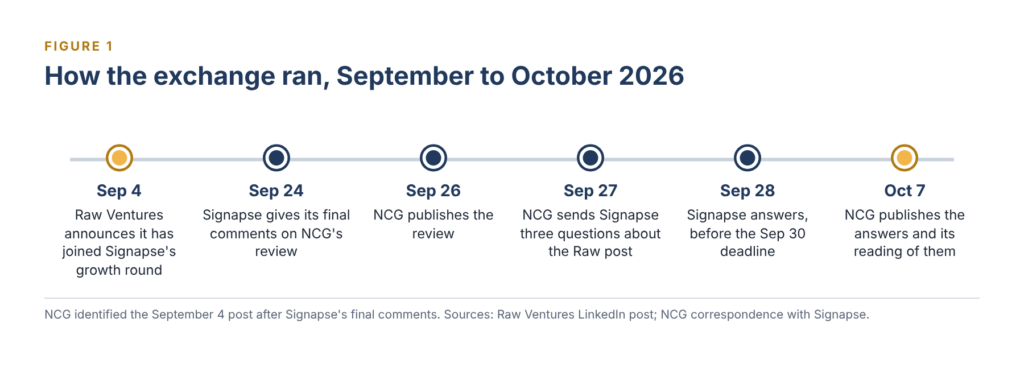
On September 4, Raw Ventures, a London venture capital firm, posted the kind of announcement investors write when they are pleased with a bet. It had joined Signapse’s latest growth round. “What we like most,” the post said, “is that it’s already out in the world,” and it named the places: UK rail, starting at Huddersfield with Network Rail; US airports, including Cincinnati; live broadcasting, through a partnership with SyncWords; and next, German Sign Language with G&L Systemhaus. It ended on the people. Around a third of the Signapse team, it said, “are Deaf or use BSL themselves, which is a big part of why the product actually works for the people it’s built for.”
An investor’s post is written to celebrate, not to brief a buyer, and this one deserves to be read in that spirit. Two of its sentences, though, landed on the questions NCG had spent September putting to Signapse: how the rail system actually works, and who inside the company can stop what its systems put in front of Deaf people. So NCG asked again. The answers, published here in full, put something new on the public record. They also draw, in Signapse’s own words, a line between the output that Deaf signers check before it ships and the output they do not.
A review that was already closed
By the time NCG saw Raw’s post, its review of Signapse was finished. Chief Executive Sally Chalk had given what she called the company’s final comments on September 24, and NCG published “Signapse: on the roadmap, not yet shipped,” two days later. Reopening a review every time something new surfaces would leave a vendor answering forever, so NCG follows a simple rule: material that appears after a vendor’s final comments is recorded separately, the vendor is offered a chance to respond, and the vendor may take it or leave it. On September 27, NCG wrote to Signapse, set out what this piece would say, and asked three questions, with a deadline of 5:00 p.m. UK time on September 30. The answer came back the next day from Ben Saunders, Signapse’s co-founder and chief scientist, who picked up the thread while Ms. Chalk was out of the office. NCG said it would publish his answers as given, and it has. Nothing here alleges misconduct by Signapse or by Raw Ventures.
What the rulebook says
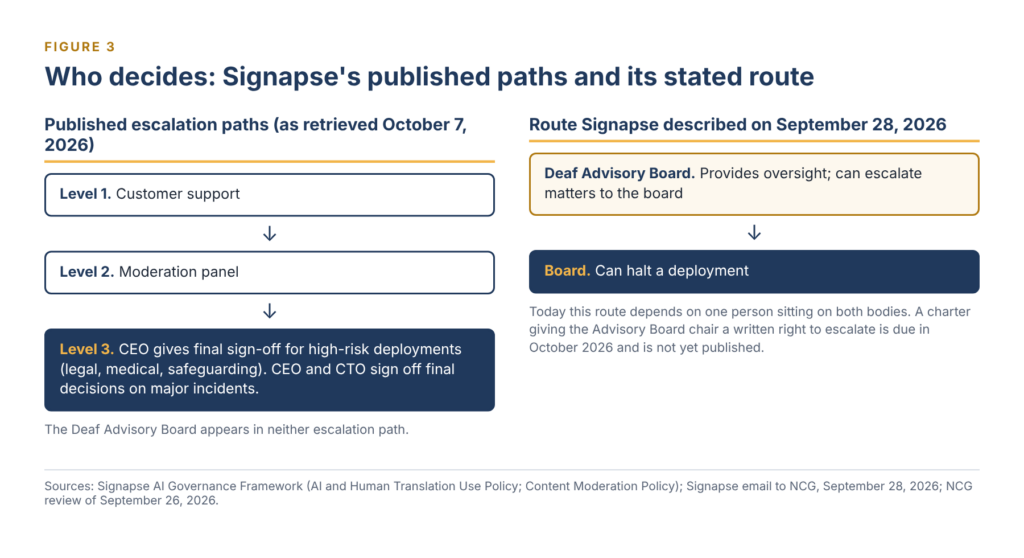
Signapse publishes more governance than most companies in its market, and it rewards a close reading, because the documents say plainly where authority sits. In its AI Governance Framework, as retrieved on October 7, 2026, the escalation paths climb through customer support and a moderation panel to the chief executive, who gives “final sign-off for high-risk deployments (legal, medical, safeguarding).” The Content Moderation Policy ends in the same place, with the chief executive and chief technology officer signing off “on final decisions for major incidents (e.g., service suspension, regulatory notification).” The Deaf Advisory Board does appear in the framework, in a list of roles, where it “provides oversight on community impact and cultural/linguistic accuracy.” It does not appear on either ladder, and the easy-read version of the framework does not mention it at all. Nothing in either version makes sign-off by Deaf signers a condition of release, and the Translation Quality Assurance Policy says of the company’s fastest output that “Instant AI is reviewed post delivery.” Read as written, the rulebook gives Deaf people a voice in Signapse’s governance and gives two executives the last word.
Signapse’s answers, in full
NCG asked three things. Does the rail system translate spoken platform announcements into BSL, or does it generate BSL from information entered into rail information systems? Is NCG’s reading of the escalation paths right, and does the Deaf Advisory Board, or any Deaf role at Signapse, hold a binding right to halt a deployment? And is there anything about the Raw investment, or Raw’s description of the company, that Signapse wants on the record? Mr. Saunders replied on September 28, 2026:
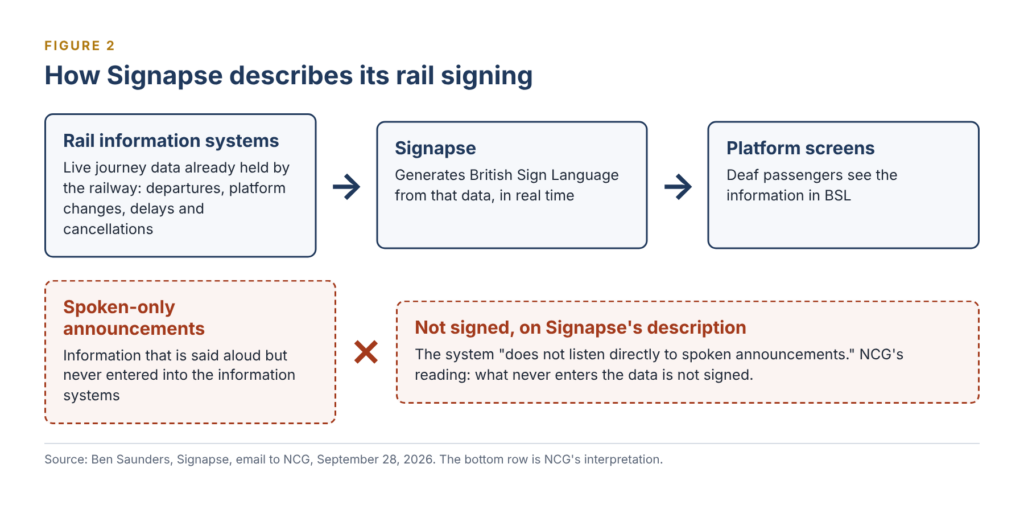
1. Rail deployment. Raw’s wording is correct, as our rail system does turn live announcements into BSL, but it does not listen directly to spoken announcements. It generates BSL by processing the live journey information already held in rail information systems, such as departures, platform changes, delays and cancellations, and shows it on platform screens. The BSL then gets translated in real-time, the same way the tannoy processes live announcements.
2. Escalation paths. Your reading of our AI Governance Framework is correct. The Deaf Advisory Board provides oversight and can escalate matters to the board, and the board can halt a deployment. In addition, every SignStudio translation is checked by Deaf native signers before release, and a translation cannot be released without their sign-off. That gives Deaf members of our team a binding right to stop output from going out.
3. Raw Ventures. We are pleased to have Raw Ventures join our growth round. Their post is their own summary for a general audience, and point 1 above gives the accurate description of the rail work. Their statement that around a third of our team are Deaf or use BSL is accurate.
That concludes our input to the addendum.
What follows is NCG’s reading of those answers against the public record. It is interpretation, labeled as such, and Signapse may respond to it.
The rail system reads data, not speech
Mr. Saunders defends Raw’s wording, and in one sense he is right: Deaf passengers on Signapse’s platforms do see live journey information in BSL. But the description he gives in the same breath is narrower, and far more useful to anyone buying the system. It “does not listen directly to spoken announcements.” It reads the structured data already sitting in the railway’s information systems, the departures, platform changes, delays and cancellations, and turns that into signing. There is a sound engineering case for building it this way. Structured data is predictable in a way that open speech is not, and a system that signs only what it can parse cleanly is less likely to sign something wrong.
The same design sets a boundary, and the boundary is where the platform scene at the top of this piece comes from. On Signapse’s own description, anything that exists only as speech, the improvised warning, the request to move along, the explanation for a delay that never makes it into the feed, is not signed. That is not a failing peculiar to Signapse. It is what a data-driven system does. But it means a rail operator buying the product is buying signed timetable information, not a signed public address system, and it should know exactly which announcements reach Deaf passengers and which still do not.
The Advisory Board can sound the alarm; the board pulls the brake
On authority, Signapse confirms what its documents show. The Deaf Advisory Board provides oversight and can escalate a concern to the board, and it is the board that can halt a deployment. The Advisory Board, in other words, can sound the alarm. It cannot pull the brake.
That matters more than it might seem, because of how the alarm currently travels. NCG’s September review recorded that the route from the Advisory Board to the investment board depends on a single person who sits on both, with no written rule guaranteeing it. Signapse has promised a charter, due this month, that would attach the right to escalate to the Advisory Board chair rather than to whoever happens to hold both seats. Until it is adopted and published, and until the published escalation paths are amended to include it, the Advisory Board’s line to the people who decide runs through one individual.
A stop right, stated for one product
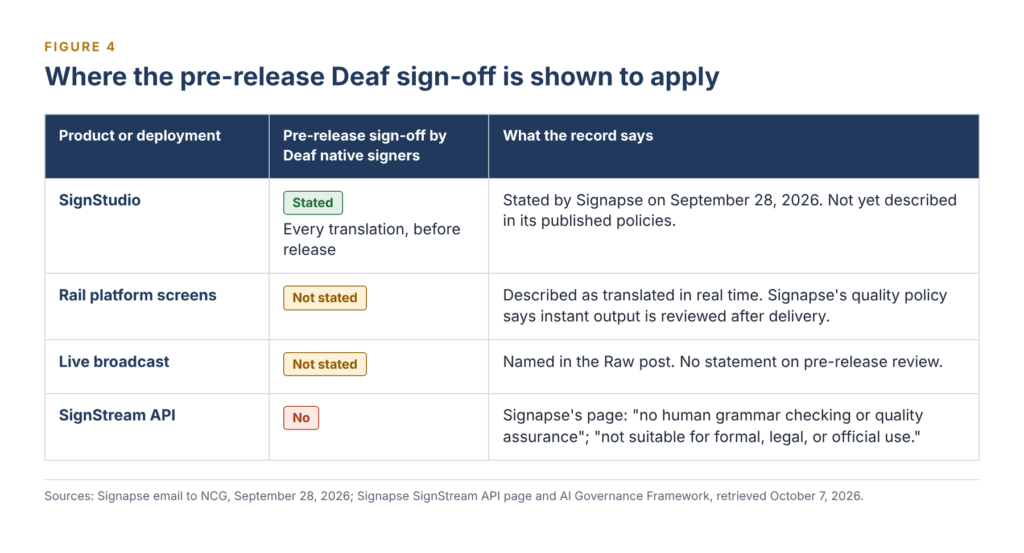
Then comes the most interesting sentence in the response, and the newest. “Every SignStudio translation,” Mr. Saunders writes, “is checked by Deaf native signers before release, and a translation cannot be released without their sign-off.” That, he says, gives Deaf members of the team “a binding right to stop output from going out.”
If SignStudio works that way, it is a real control, and a stronger one than anything Signapse’s published policies describe. A right to stop output before it ships is exactly the kind of Deaf authority most of this market lacks. NCG has not seen the procedure, and the framework as retrieved on October 7 speaks of Deaf staff reviewing output against scoring, not of a sign-off without which nothing is released. Signapse would do itself a favor by publishing it.
Read the sentence again, though, and notice its subject. It is SignStudio, the company’s reviewed product. Signapse’s own SignStream API page describes its real-time product in very different terms: “entirely AI-generated, with no human grammar checking or quality assurance,” and “not suitable for formal, legal, or official use.” The quality policy says instant output is reviewed after delivery, and Mr. Saunders describes the rail output as translated in real time. Signapse has not said whether the rail screens, or the live broadcast signing Raw celebrated, pass through the sign-off he describes. NCG traced the same boundary in September, in “Where We Have Control,” from the other direction, following a downloaded file out of the company’s reach. The picture from both sides is consistent. Where Signapse can slow down, Deaf signers check the work. Where the product is fast, on the record as it stands today, nothing shows that they do.
“Deaf or use BSL”
The response also confirms Raw’s figure: around a third of Signapse’s team are Deaf or use BSL. NCG does not dispute it. A company in which a third of the staff are Deaf or sign is uncommon in this market, and it is to Signapse’s credit. It is worth noticing the “or,” though, because it joins two groups that are not the same.
“Deaf or use BSL” counts a Deaf native signer and a hearing colleague partway through a sign language course in the same column. Between them sit hearing interpreters, hearing children of Deaf parents who grew up in the language, and staff at every stage of learning it. All of them may be valuable to the company. But fluency and lived experience are different things, and they do different work. Fluency bears on the quality of the signing. Lived experience bears on governance, because Deaf people are the ones who live with the output when it is wrong: on the platform, in the classroom, at the hospital front desk. A single figure that folds the two together cannot say which of them Signapse has a third of.
Signapse knows the difference, and Mr. Saunders’s own answer shows it. When he describes the check on SignStudio, he does not say staff who use BSL. He says “Deaf native signers.” That is the precise phrase, used where precision matters, and it is the right one. The team figure is looser, and it is offered by Raw, and confirmed by Signapse, as a reason the product works rather than as a statement about who decides.
Governance turns less on how many Deaf people work at a company than on how many of them hold the pen when the final decision is signed. Signapse’s published framework places final sign-off for high-risk deployments with the chief executive, and final decisions on major incidents with the chief executive and chief technology officer. It does not say whether Deaf people hold any of the roles that can stop a deployment, or whether they staff the review of the real-time products. Those questions have plain answers, and a buyer is entitled to them: how many of the third are Deaf, how many are native signers, and how many of them can stop something from shipping.
What a buyer should ask
Signapse has, in effect, told buyers where to look. Five requests follow, for Signapse or for any provider of real-time signing, before a contract is signed:
– Which products and deployments pass through pre-release sign-off by Deaf native signers, and the written procedure that makes that sign-off a condition of release.
– For rail, airport and broadcast deployments, whether any output is reviewed before display, how Deaf passengers or viewers report errors, and how quickly errors are corrected.
– For rail, which categories of announcement are signed and which, such as those made only by voice, are not.
– The adopted Deaf Advisory Board charter, with the date of board approval, and confirmation that the escalation right is written into the published escalation paths.
– How many Deaf people hold executive, board or final sign-off roles.
Three of the commitments recorded in the September review fall due this month: the conflicts register, the Deaf Advisory Board charter, and a standard written agreement for the Deaf people who take part in feedback sessions. NCG will return to the record after October 31 and will count each item as met only when the document itself is published or supplied. Signapse may respond to this piece, and any response will be published alongside it.
Sources
– Ben Saunders, co-founder and chief scientist, Signapse, email to NCG, September 28, 2026.
– NCG, email to Signapse, September 27, 2026 (notice and questions).
– Raw Ventures, LinkedIn post announcing its participation in Signapse’s growth round, September 4, 2026, retrieved October 7, 2026.
– Signapse, AI Governance Framework (AI and Human Translation Use Policy; Content Moderation Policy; Translation Quality Assurance Policy), retrieved October 7, 2026.
– Signapse, AI Governance Framework, Easy Read, retrieved October 7, 2026.
– Signapse, SignStream API, retrieved October 7, 2026.
– NCG, “Signapse: on the roadmap, not yet shipped,” September 26, 2026.
– NCG, “Where We Have Control: Signapse SignStream and AI Signing,” September 11, 2026.