

*In 2026 Alaska wrote a duty to support its program for the deaf into statute and recorded the cost as zero. The district that runs the state’s only school for the deaf cut it in both budget cycles.*
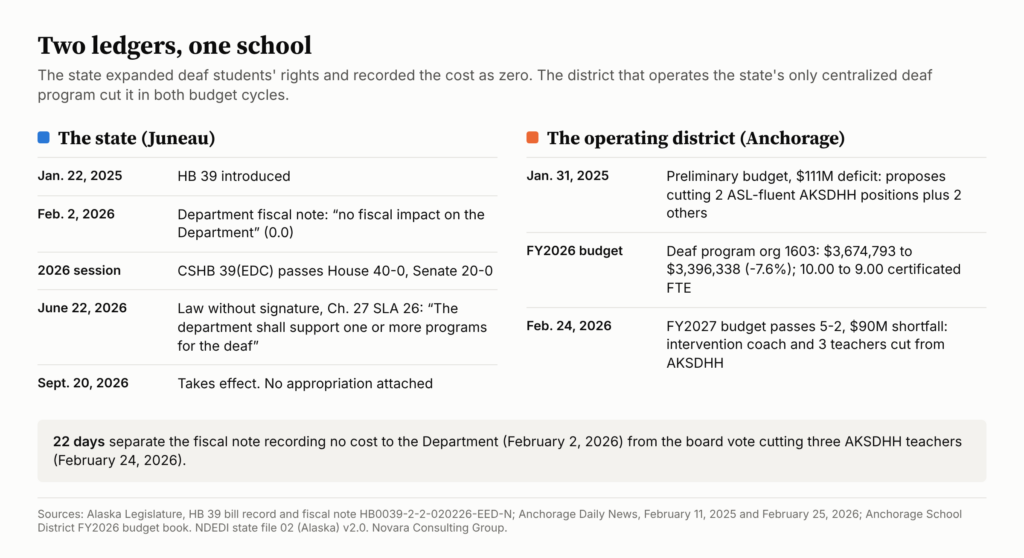
On February 2, 2026 the Alaska Department of Education and Early Development filed a fiscal note on the committee substitute for House Bill 39, the legislature’s deaf and hard of hearing education bill. The note describes the bill accurately. It says the legislation amends the state’s special education procedural-safeguards and least-restrictive-environment sections, that it “emphasizes parental choice, professional specialization, and state-level support for specialized programming,” and that districts will be required to give parents “comprehensive, neutral, and unbiased information” on hearing technology and communication methods. It then concludes, in a single line: “There is no fiscal impact on the Department from this bill.” Twenty-two days later, on February 24, 2026, the Anchorage School Board passed a budget against a shortfall reported at 90 million dollars, and in that budget, according to the Anchorage Daily News, “an intervention coach and three teachers were also cut from the Alaska School for the Deaf and Hard of Hearing.” The Alaska School for the Deaf and Hard of Hearing is the only centralized program for deaf students in the state. The bill that carried the zero fiscal note directs the Department, in the enacted text, to support it.
HB 39 passed the House 40 to 0 and the Senate 20 to 0, became law without the Governor’s signature on June 22, 2026 as Chapter 27 SLA 26, and took effect on September 20, 2026. Both of its fiscal notes are zero. The legislature’s support was unanimous, the Deaf community’s support was organized and documented, and the bill’s committee file carries letters from the Alaska Deaf Council and from the Governor’s Council on Disabilities and Special Education. None of that is in dispute. What the public record shows, read against the operating budget of the district that runs the state’s school for the deaf, is that Alaska expanded the legal rights of deaf and hard of hearing students in the same months that the institution those rights point toward was being cut, and that the state’s own fiscal instrument recorded the expansion as costing nothing.
The duty the statute created
HB 39 did not create a free-standing deaf education statute. It inserted new subsections into two existing sections of the special education article, AS 14.30. Into AS 14.30.272, the procedural-safeguards section, it added an informed-choice regime: a district must, “in collaboration with the department and to the maximum extent possible,” give the parents of a child who is deaf or hard of hearing, or suspected to be, neutral information on hearing technology, communication methods, services, and support and advocacy resources, must let the parents choose the communication method, and must deliver services through professionals trained in the method chosen. It added statutory definitions for the bilingual approach, cued speech, listening and spoken language, and total communication, and it requires the district to tell parents of these duties and rights.
Into AS 14.30.276, the least-restrictive-environment section, it added subsection (b), and subsection (b) is the part that matters for the fiscal record. Its first sentence reads: “The department shall support one or more programs for the deaf to be made available to deaf students in the state.” The subsection goes on to permit residential services in consultation with a nongovernmental organization serving deaf and hard of hearing people, and then writes into statute a mechanism that had previously lived only in regulation: a school district that operates a program for the deaf must submit an annual plan of operations to the Department for approval, carries every local special education duty for the students in it, and need offer transportation only to students who live in the district, while a district that places one of its own resident children in the program keeps its own special education responsibility for that child.
Read together, the two halves of the act place a mandatory verb on the Department (“shall support”) and a set of informational duties on every district. The fiscal note addresses only the Department’s side, and on that side it records nothing. Public evidence does not show what form the Department understands its support duty to take, whether financial, technical or supervisory, because neither the act nor the fiscal note defines it. What the record does show is that the only state-level cost estimate attached to the duty is zero.
Where Alaska keeps its school for the deaf
The zero is easier to understand once it is clear where Alaska’s school for the deaf actually sits, because it does not sit in the state budget. Under 4 AAC 33.070, a regulation in effect since February 24, 1988 whose operating-district provisions were added in 2010, Alaska’s “centralized program for the deaf” is not a state institution. It is a program operated by a school district, with state funding following the enrolled student to the operating district. The operating district is Anchorage, and the program is the Alaska State School for the Deaf and Hard of Hearing (AKSDHH), which reported 29 students from preschool through twelfth grade in February 2025, a staff of 25 fluent in American Sign Language, and a funded average daily membership in the district’s budget of 23.30. Those last two figures measure different things, a point-in-time headcount and an averaged funded membership, and they are carried side by side rather than reconciled.
Because the program is a district program, the state funds it the way it funds every other district service: through the AS 14.17 foundation formula. In the reference year the base student allocation was 5,960 dollars per adjusted average daily membership, raised to 6,660 dollars for fiscal year 2026 by HB 57 of the 2025 session. Special education is block funded through a special-needs factor of 1.20 applied to a district’s adjusted membership, with an additional weighting of thirteen for each intensive-needs student enrolled on the count date with an established individualized education program. Nothing in the formula is specific to deafness, and there is no line anywhere in the state budget for a school for the deaf. The one dedicated deaf-related appropriation the legislature made in 2026 was through a different bill, HB 246 (Chapter 45 SLA 26), which sets the allocation for the Special Education Service Agency, the statewide body whose Low Incidence Disabilities Outreach Program consults on deaf and hard of hearing students in districts that do not serve them directly. HB 246 funds the outreach agency. It does not fund the school.
The consequence of this structure is that the state’s only centralized deaf program is exposed to the fiscal condition of one city district, and in 2025 and 2026 that district was in structural deficit.
Two budget cycles
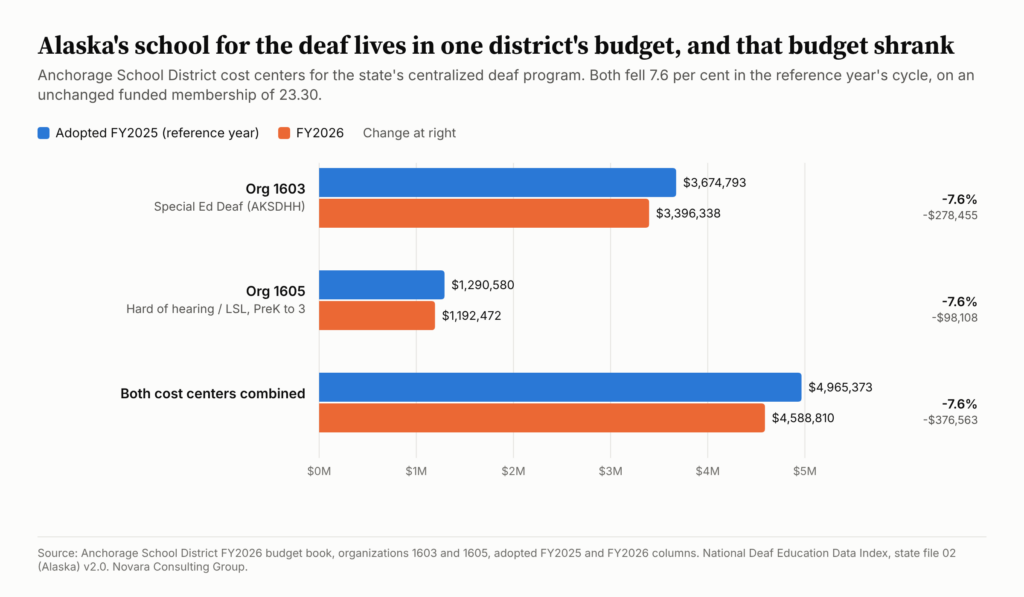
The Anchorage School District’s fiscal year 2026 budget book carries the program as two named cost centers and reports each against an adopted fiscal year 2025 column, which is the reference year of the NDEDI file. Organization 1603, “Special Ed Deaf,” which the budget describes as mandated to serve all deaf and hard of hearing students in the state whose individualized education program requires the centralized program, was budgeted at 3,674,793 dollars for fiscal year 2025 and 3,396,338 dollars for fiscal year 2026, a reduction of 278,455 dollars, or 7.6 percent, on an unchanged funded membership of 23.30. Its certificated staffing fell from 10.00 to 9.00 full-time equivalents. Organization 1605, the district’s hard of hearing and listening-and-spoken-language program for children from preschool through third grade, fell from 1,290,580 to 1,192,472 dollars, the same 7.6 percent. Together the two cost centers went from 4,965,373 dollars to 4,588,810 dollars, a combined reduction of 376,563 dollars, inside a district special education instruction total of about 99.3 million dollars.
The cycle that produced those figures began with the preliminary budget released on January 31, 2025, written against a structural deficit reported at 111 million dollars. It proposed to eliminate two full-time ASL-fluent positions at AKSDHH, a counselor and an intervention coach, along with an administrative assistant and a vacant paraprofessional position. The Anchorage Daily News reported organized pushback from the Deaf community, and the district’s own assistant director for special education, Clara Baldwin, put the cost in operational terms: “When we lose those positions, we lose fluent ASL professionals,” adding that “our students should not have to wait for an ASL interpreter to be arranged.” The superintendent, Jharrett Bryantt, described the reductions as a way “to buy ourselves time.” That reporting now sits in HB 39’s own committee file, which means the legislature had the Anchorage cuts in front of it while it considered the bill.
The second cycle did not reverse the first. On February 24, 2026, against the 90 million dollar shortfall, the board passed the fiscal year 2027 budget 5 to 2, closed three elementary schools, and, per the same newspaper, cut an intervention coach and three teachers from AKSDHH. The NDEDI file records the fiscal year 2026 reductions in dollars from the budget book; the fiscal year 2027 staffing reductions are recorded from contemporaneous reporting and will be carried in dollars when the district’s fiscal year 2027 book is read in the next cycle. On the record as it stands, the reductions accumulated across both years.
What the fiscal note did not price
A zero fiscal note is not, by itself, a scandal. Fiscal notes estimate the cost to the filing agency of the bill as written, and a bill that imposes duties on districts can legitimately carry a zero note for the Department. The difficulty with HB 39 is that it does not impose duties only on districts. Its operative sentence in AS 14.30.276(b) imposes one on the Department, and the Department’s own analysis names that duty (“state-level support for specialized programming”) before concluding that the bill has no fiscal impact on the Department. The note therefore records a judgment, not an oversight: that the Department’s statutory duty to support the state’s program for the deaf can be discharged at no cost.
Interpretation, marked as such: that judgment is consistent with the structure described above. If the program for the deaf is funded entirely through a district’s foundation-formula revenue, then “support” from the Department can mean approval of the operating district’s annual plan of operations, technical assistance, and continued formula payments, none of which requires a new appropriation. On that reading the zero is accurate. But the same reading means that the new statute changes nothing about the program’s exposure to the operating district’s budget, and the Anchorage record shows what that exposure looked like in practice. A legislature that wished the Department’s support to reach the program’s staffing would have needed a fiscal note that priced it. The record shows no fiscal note that did, and no amendment that attached a dollar.
The same unanimity that passed the bill makes the gap more conspicuous rather than less. Sixty legislators voted for a statute whose first operative sentence on programs for the deaf is a mandatory duty, with the reporting on the Anchorage cuts in the committee file and a departmental note telling them the duty was free. The Governor let the act become law without signing it. The district that runs the school was, in the same weeks, cutting its teachers.
A right to be informed, in districts that publish nothing
The informational half of HB 39 lands on a district layer that, on the public record, is largely silent about deaf education. The NDEDI v2.0 audit read every operating school district in Alaska in a rendered browser across two attempts on two calendar days, October 11 and 12, 2026. The frame is 54 districts, settled against the Department’s directory, the federal Common Core of Data 2024-25 universe and the Department’s October 1, 2024 child count, which agree; 53 are operating. Of those 53, five publish an identifiable deaf or hard of hearing program, classroom or staff role (Anchorage, Fairbanks North Star Borough, Kenai Peninsula Borough, Lower Kuskokwim and Matanuska-Susitna Borough). Eleven carry a mention that is not a program, usually the federal eligibility category list or a link to the Special Education Service Agency. Thirty-seven publish nothing at all. Under the index’s standing caveat, a NONE FOUND code is a statement about what a parent can find, not a claim that no service exists, and that distinction is exactly why it matters here: the duty HB 39 created is a duty to inform parents, and in 37 of 53 operating districts there is no public information to start from.
Juneau is among the 37. The capital city’s school district was coded PROGRAM in the index’s first edition and returned no deaf or hard of hearing reference of any kind across two thorough crawls in the rebuild, and it is now recorded as NONE FOUND with that reason on the row. The legislature that passed HB 39 unanimously sits in a city whose school district, on its public website, says nothing about how a deaf child would be served there.
Operator silence runs in the other direction as well. Outside Anchorage, no district in Alaska names AKSDHH as a place its deaf students may go. The districts that name any outside mechanism name the Special Education Service Agency or another resource, and the agency itself publishes no district caseload and no count of the deaf and hard of hearing students it reaches. The state’s one centralized program and its one statewide outreach program are, between them, almost absent from what the other 52 operating districts publish. A parent in a rural or island district who reads the new statute and then reads the district’s website will find a right to neutral information about communication options and, in most of the state, no public statement that any option exists.
What the state’s own instruments cannot see
The state’s data are precise about how many deaf and hard of hearing students there are and much less precise about who teaches them. The Department reported 148 students with a hearing impairment as their primary disability on October 1, 2024, among 20,578 students with disabilities, and 134 on October 1, 2025, among 20,500. The federal Section 618 file for 2024-25 ties exactly, resolving the 148 as 138 school-age students and 10 aged three to five, with one student reported as deaf-blind. Of the 138 school-age students, 93 spent 80 percent or more of the day in a regular class, 28 spent 40 to 79 percent, 16 spent less than 40 percent, one was reported in a separate school and none in a residential facility. Whatever AKSDHH is in the classroom, the federal environments instrument does not register Alaska as having more than one school-age student with a hearing impairment in a separate school; the record does not show which environment band the school’s students are reported in, and that is a question for the Department rather than an inference the index will draw.
The workforce record has a hole in the middle of it. The Department’s Part B personnel file for 2024-25 reports 3.38 full-time-equivalent interpreters, all fully certified, and 10.9 audiologists, and it has no category for teachers of the deaf at all, although districts plainly employ them: Lower Kuskokwim lists a deaf and hard of hearing teacher on its special education staff, and Matanuska-Susitna describes pullout instruction with a teacher of the deaf. HB 39 now requires services delivered “through professionals trained in the method chosen.” The state has no published count of the profession the statute most directly depends on. The interpreter standard is similarly loose at the point of entry: 4 AAC 52.255 requires that an educational interpreter be certified by the Registry of Interpreters for the Deaf or be enrolled and progressing in an approved program, with no Educational Interpreter Performance Assessment score threshold of the kind many states apply. A district may lawfully staff a deaf child’s classroom with an interpreter who has not yet met any numeric performance standard.
What would close the record
None of the gaps above requires new spending to make visible, and that is the point on which the record is most useful to the people who will act on it. Each is a publication decision. The Department could publish what it understands its AS 14.30.276(b) duty to “support one or more programs for the deaf” to consist of, and could publish the Anchorage district’s annual plan of operations for the program, which the statute now requires it to approve. It could add a teacher-of-the-deaf category to the state personnel file, so that the profession HB 39 relies on is counted. It could publish where AKSDHH students are reported in the federal environments data. The Special Education Service Agency could publish the number of deaf and hard of hearing students its outreach program reaches, by district. And each of the 37 districts that currently publish nothing could post the neutral information the statute now requires them to give parents, which would satisfy the act’s informational duty and the public’s ability to see it in the same step.
The harder question is the one the fiscal note answered without being asked. Alaska has placed its only school for the deaf inside one district’s operating budget and has now told its Department, by statute, to support that school. Whether “support” means a signature on a plan of operations or something that would have kept three teachers and an intervention coach in the classroom is a decision for the legislature and the Department. The record as of October 2026 shows which one it has been so far.
Method
This piece draws on the National Deaf Education Data Index state file 02 (Alaska), version 2.0, rebuilt October 11 to 12, 2026, with every load-bearing source captured and hashed. District codes come from rendered-browser reads of all 53 operating districts across two attempts on two calendar days, and they record public discoverability, not service delivery. The state file carries two record-only open items, the AS 14.07 powers text and the AS 14.30.350 definitions, which do not affect the findings here. NDEDI’s state release schedule is at ndedi.org.
Sources
– National Deaf Education Data Index, Alaska state file 02, version 2.0, SY 2025 (School Year 2024-2025), Novara Consulting Group LLC. Frame, coverage codes, counts, workforce, governance and fiscal record.
– Alaska Department of Education and Early Development, fiscal note HB0039-2-2-020226-EED-N on CSHB 39(EDC), OMB component 2796.
– Alaska State Legislature, HB 39, enrolled text (Chapter 27 SLA 26), amending AS 14.30.272 and AS 14.30.276; HB 246 (Chapter 45 SLA 26).
– Alaska Administrative Code, 4 AAC 33.070 (Alaska school for the deaf), from the Department’s filed register copy, and 4 AAC 52.255 (educational interpreters).
– Anchorage School District, FY2026 budget book, organizations 1603 (Special Ed Deaf) and 1605, adopted FY2025 and FY2026 columns.
– Jenna Kunze, Anchorage Daily News, “Small but loud Deaf community pushes back against proposal to cut ASL professionals in Anchorage School District budget,” February 11, 2025.
– Tim Rockey, Anchorage Daily News, “Anchorage School Board passes budget with closures and significant staff cuts,” February 25, 2026.
– Alaska Department of Education and Early Development, Section 618 Child Count by District, least restrictive environment and Part B personnel files, 2024-25 and 2025-26; U.S. Department of Education, IDEA Section 618 child count and educational environments file, 2024-25.
– Alaska Department of Education and Early Development, school funding overview, and Legislative Finance Division, Citizen’s Guide to K-12 Funding.