
Generative AI made it cheap to build alone. In sign language AI, that has turned the Deaf expert in the early conversation into the easiest person to drop, and the people who buy these products cannot see it happen.
The pattern
It usually starts well. Two or three people find each other early, before there is a product, a pitch deck, or even a name. One of them has the idea, or the lived experience, or ten years of knowing exactly where the last attempt went wrong. The others have energy and a laptop. There are long calls and longer email threads. Somebody says “we should build this together,” and for a few weeks everyone means it.
The person with the expertise does what experts do when they trust the room. They explain the problem all the way down, including the parts that are not obvious: the failure modes, the people who have to say yes, the reasons the easy version will not work, and the history of the last three teams who tried. They send links. They make introductions. They answer the follow-up questions at night because the momentum feels real and they do not want to be the one who slows it down.
Then the replies slow down. A meeting gets moved and never rescheduled. A message sits on read. Three months later a launch post appears on LinkedIn, and the product in it is recognizably the thing that was being discussed, built by one of the people who was on those calls, with no mention of anyone else. When the expert asks what happened, the answer, if one comes at all, is some version of “I ended up just building it.”
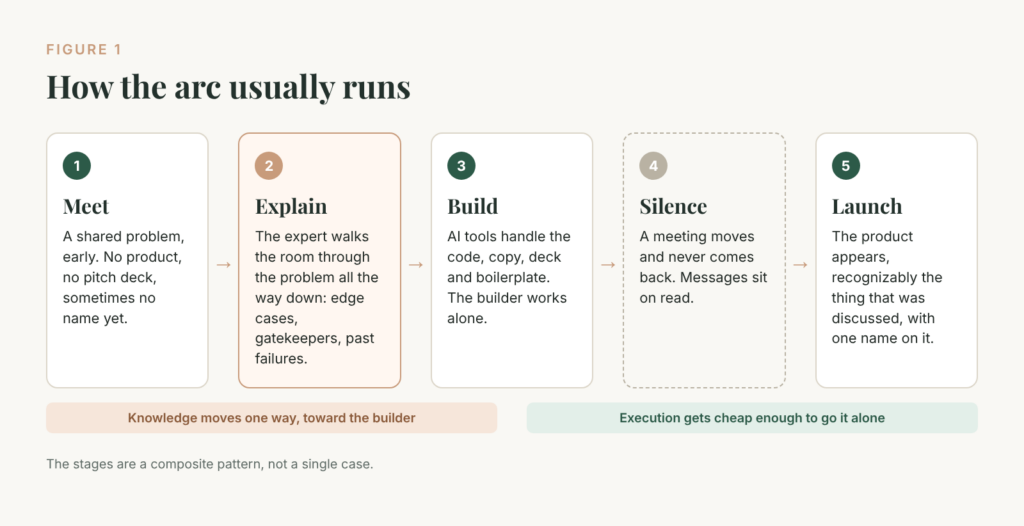
It is tempting to call this narcissism, and in the moment it feels like it. But a diagnosis is the wrong tool here. It makes the story about one bad person, and it lets everyone else off the hook, including the institutions that will later buy what gets built. What is happening is more ordinary than that, and more important, because it is structural. AI has changed what it costs to act alone, and a lot of people are discovering that in the middle of a collaboration.
Why it happens now
For most of the history of small ventures, collaboration was held together by necessity as much as by goodwill. The person with the idea could not write the code. The developer could not write the grant. The domain expert could not stand up a website, draft the terms of service, and produce a demo video in a weekend. Every partner was load-bearing, and everyone knew it. Leaving meant leaving the thing unbuilt.
Generative AI quietly removed a lot of that necessity. One person with a subscription can now produce the code, the copy, the slide deck, the legal boilerplate, and a passable logo. That is good news for people who have been shut out of building things, and I say that as someone who uses these tools every day to run a firm. But it has a side effect nobody planned for. Once the execution is cheap, the collaborator who brought the knowledge starts to look like overhead. The builder does the math, usually without saying it out loud: the expert told me what I needed, the machine can do the rest, and splitting credit or equity now looks like a cost rather than a necessity.
The early conversations make it worse, not better. The more generously an expert explains the problem, the more complete the builder’s notes become, and the easier it is to believe the knowledge has been transferred. A transcript of a good call reads like a specification. It is not one, but it feels like one, and that feeling is enough to make walking away seem reasonable to the person doing it.
A transcript of a good call reads like a specification. It is not one, but it feels like one.
What the builder walks away without
The problem with that math is that it counts the wrong thing. What an expert hands over in an early conversation is the part of their knowledge that fits into words on a first pass. What stays behind is judgment: knowing which of the twelve edge cases actually matters, which institution will refuse the product and why, which word in the marketing copy will get it laughed out of a community meeting, and what to do when the pilot goes sideways in month four. That knowledge is not in the notes because nobody knew to ask for it yet. It shows up only when the work meets reality, and by then the person who had it is gone.
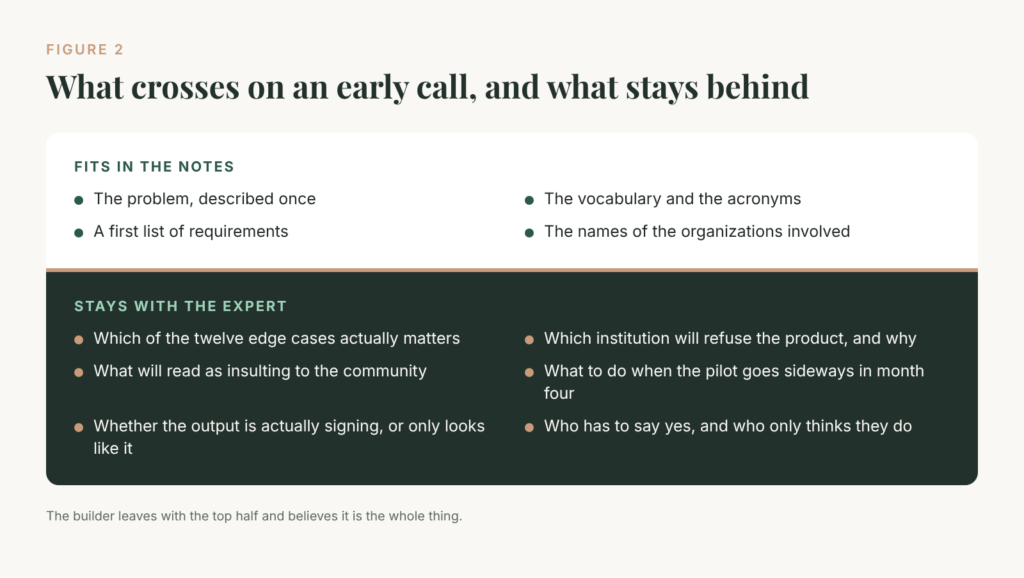
This is why so many of these solo launches look polished and land badly. The surface is right because the surface is what AI is good at. The decisions underneath are wrong because they were made by someone who heard the problem described once and mistook the description for understanding. The builder rarely connects the failure to the departure. From the inside, it looks like the market did not get it.
There is also a cost to the expert that does not show up anywhere. They spent unpaid hours, shared the thinking that differentiates them professionally, and now watch it circulate under someone else’s name. The next time a promising stranger asks for a call, they will be slower to say yes, and more guarded when they do. Multiply that across a field and the early-stage conversations that used to produce good work start drying up, which is a loss for everyone, including the next honest builder who needs that call.
Where it hurts most: sign language AI
In most fields this pattern costs someone credit and a few bad weeks. In sign language AI it costs a community its language. The field has a long habit of treating Deaf people as a source of input rather than as partners: signers recorded for datasets, Deaf consultants brought in for a pilot, a Deaf face on the advisory page. AI did not create that habit. It made the exit cheaper.
The research record shows how deep the habit runs. In 2024, five deaf and hard of hearing researchers, led by Aashaka Desai and including Maartje De Meulder, reviewed 101 recent sign language AI papers and found a field driven largely by hearing assumptions [1]. Most of the papers, 64 of them, justified their work by “perceived communication barriers,” a framing the authors argue oversimplifies Deaf experience, and the field as a whole lacked Deaf leadership.
A separate set of best practices from Neil Fox, Bencie Woll and Kearsy Cormier at UCL’s Deafness, Cognition and Language Research Centre puts the remedy plainly: Deaf people should be involved “from the earliest planning stages and throughout the project” [2]. The phrase that matters there is the second half. Being consulted at the front and released at the back is not involvement. It is extraction with a thank-you note.
The early conversation is exactly where that involvement is easiest to drop. A hearing founder meets a Deaf linguist, an interpreter trainer, or a DeafBlind user who knows what tactile access requires. The calls are rich. The founder learns that facial grammar carries meaning, that regional variation is real, that a signing avatar can be fluent on the surface and wrong in ways only a native signer will catch. Then the founder goes off and builds, confident they now understand the problem, and the one person in the room who could tell whether the output was actually signing is no longer in the room. What ships is a product that looks like access to the people buying it and reads like noise to the people it was built for.
Why it matters past bad manners
It would be easy to file all of this under etiquette: people should be nicer, credit should be shared, ghosting is rude. All true, and none of it is the main problem. The main problem is that the departure is invisible to everyone downstream, and the people downstream are the ones making decisions.
A procurement officer at a transit agency, a school district, or a state commission sees the finished product. They see a polished demo, a website that says “developed with input from the Deaf community,” and maybe a list of advisors. What they cannot see is whether that input was three calls in the spring of the founding year with people who have not spoken to the company since. The claim is technically true. It is also exactly the kind of claim that lets an institution believe it has done its diligence when it has not.
When the product fails in front of Deaf users, the institution owns the failure, the vendor points to its advisory page, and the community that was consulted once and dropped gets to watch its name used as a credential. That is why this belongs in governance, not just in conversations about professional courtesy. Who is involved now, in what role, and with what authority over the output is a fact about the product. It should be asked for and checked like any other fact a buyer relies on.
What to do about it
For experts, the lesson is not to stop sharing. Early conversations are still where good work starts, and refusing all of them is its own kind of loss. The lesson is to treat the second conversation differently from the first. The first call is a handshake. By the second, there should be something in writing, even a one-page email, that says what is being shared, what role you are being offered, and what happens to your contribution if the project goes forward without you. Paid advisory time is not greedy; it is the clearest signal that the other side understands what they are receiving. And keep a dated record of what you contributed and when. It costs nothing, and it is the only thing that will matter if your work turns up later under someone else’s name.
For buyers, the fix is a set of questions, asked every time a vendor claims community involvement.
A vendor with real involvement will answer in a day. A vendor running on the memory of three calls in its founding year will change the subject, and that tells the buyer what it needs to know.
For builders, the honest version is simple. If AI let you build it alone, say so, and say who taught you what you know. Going solo is not the offense. Disappearing on the people who made it possible, and then borrowing their credibility to sell the result, is.
References
- Desai, A., De Meulder, M., Hochgesang, J. A., Kocab, A., and Lu, A. X. (2024). Systemic biases in sign language AI research: A Deaf-led call to reevaluate research agendas. Proceedings of the LREC-COLING 2024 Workshop on the Representation and Processing of Sign Languages. https://arxiv.org/abs/2403.02563
- Fox, N., Woll, B., and Cormier, K. Best practices for sign language technology research. Universal Access in the Information Society, 24, 69 to 77. https://www.ucl.ac.uk/brain-sciences/dcal-research-briefs/how-can-sign-language-technology-research-improve-fox-woll-cormier-2025