
Three days ago I wrote that one complaint got an airport to take its AI signer down. That piece covered what happened at the Cincinnati/Northern Kentucky International Airport, known as CVG, between the day a Deaf passenger’s video showed an AI-generated ASL announcement sending travelers the wrong way and the day the airport pulled those announcements off its terminal train screens. This piece is the next entry in the same record. On the same day CVG pulled the screens, I filed the complaint directly with the Federal Aviation Administration’s Office of Civil Rights as well. Today the FAA wrote back.
I am publishing its answer, and the state of every open question, for a plain reason. Civil rights complaints about AI signing are new, and almost nobody outside the agencies knows how they move. Deaf people who see a machine signer get something wrong deserve to know what happens when they report it, how long it takes, which office decides, and where the traps are. The only way to show that is to keep the record in public as it happens, including the parts that are not wins yet.
What the FAA said
The reply came from the FAA’s Airport Investigations and Strategic Planning Program. It cites the Department of Transportation’s rulebook for civil rights complaints, DOT Order 1000.18, the External Civil Rights Complaint Processing Manual, and then explains what that rulebook means for this case:
“You indicated that you have already filed a complaint with CVG. Consistent with DOT guidelines, we cannot open a complaint if the same matter is already under investigation. However, following notification of the conclusion of the investigation, including the reconsideration process, if you believe there are outstanding issues under the ADA or Section 504 requirements, you may re-file a complaint with our office, within 60 days. Any subsequent FAA investigation will not be a de novo investigation of the same facts and FAA will not conduct a new hearing.”
FAA Office of Civil Rights, Airport Investigations and Strategic Planning, October 29, 2026
It closes with the line that matters most for the bigger picture: “We will share with the compliance review team your request to review the AI-generated ASL displays.”
Read quickly, that can look like a brush-off. It is not. The FAA is not deciding against the complaint, and it is not closing anything. It is saying that the airport’s own investigation comes first, that the federal door stays open after it ends, and that the broader question I raised, whether airports that use machine-generated sign language should be held to any verification standard at all, is going to the part of the FAA that reviews airports’ compliance rather than single complaints.
Two tracks, not one
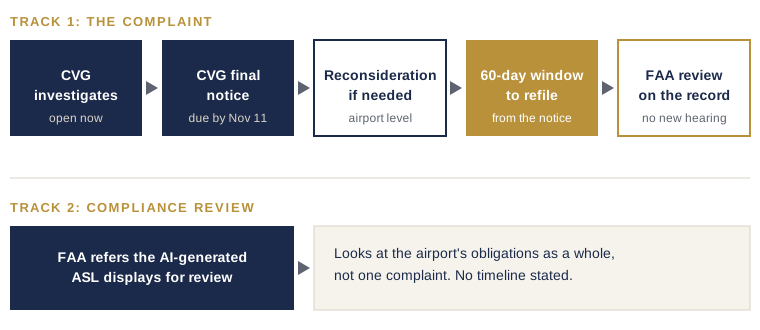
The FAA’s answer splits this matter into two tracks that run on different clocks.
The first is the complaint itself. CVG’s Title VI/ADA Coordinator is investigating it under the airport’s published procedure. On October 26 the coordinator wrote that the complaint would be processed as an ADA complaint rather than a Title VI complaint, that a copy and a statement of activity had been forwarded to the FAA, and that I would receive a final notification of the results thirty calendar days after the complaint was submitted. I filed on October 12, so that notice is due by November 11. Once it arrives, and once any reconsideration is finished, the FAA’s sixty-day window opens. If ADA or Section 504 issues are still outstanding, I can refile with the FAA inside that window.
The second track is the compliance review referral. Compliance reviews look at whether an airport sponsor is meeting its obligations as a whole, not whether one complainant was wronged. The FAA did not give that track a timeline, and I do not expect one. What matters is that the question of AI-generated signing on passenger information displays is now in front of the people whose job is to ask it of airports generally.
The sentence that changes how this has to be done
One phrase in the FAA’s reply deserves more attention than the rest: “Any subsequent FAA investigation will not be a de novo investigation of the same facts and FAA will not conduct a new hearing.”
De novo means from the beginning. If I go back to the FAA after CVG concludes, the FAA will not start over. It will look at what is already in the file: my complaint, CVG’s statement of activity, CVG’s findings, and whatever was said in writing along the way. That makes the airport-level record the record. Anything that is not written down now, at the airport stage, may never be in front of anyone who can act on it later.
This is the part of the process I most want other Deaf complainants to understand, because it cuts against instinct. When an airport does the right thing quickly, as CVG did by pulling the signed announcements within two weeks, the natural response is relief and silence. But a suspension is not a standard. The screens can come back. If they come back without a written accuracy rule, and if nobody asked for one in writing before the investigation closed, there is nothing for a federal reviewer to measure the return against. That is why my October 26 reply to CVG thanked them for the suspension and then asked two questions in writing: whether the Deaf ASL users in the review will be fluent signers chosen independently of the vendor, checking meaning and not just playback, and whether CVG will write down the accuracy standard the announcements must meet before they return. As of today, those questions have not been answered. They are in the record either way.
Where every ask stands
For the record, here is the status of everything I have asked for, from CVG and from the FAA, as of October 29, 2026.
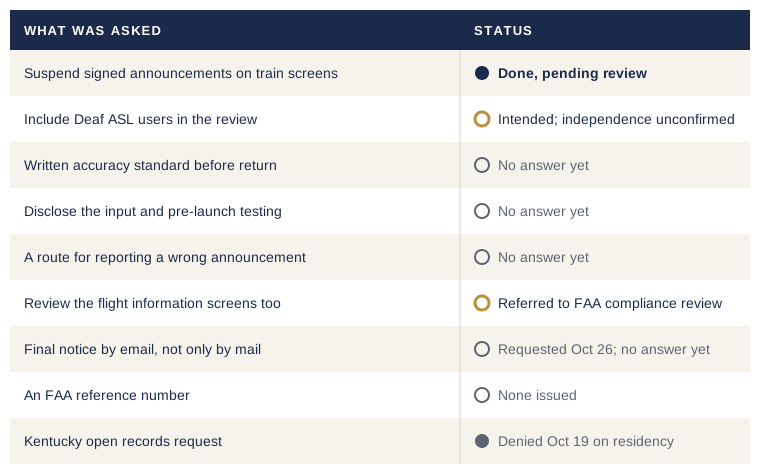
The suspension is the one clear result, and it is real. A Deaf passenger who rides that train no longer has to watch a signer say something different from the text above it. CVG has also said the review “is intended to include Deaf ASL users,” which is more than most deployers of AI signing have ever promised. But intended is not confirmed, and the people doing the reviewing matter as much as the review. A Deaf reviewer picked by the vendor and asked whether the video plays is not the same check as a fluent Deaf signer chosen independently and asked whether the sign means what the screen says.
The flight information screens are the gap I most want closed. CVG’s October 26 letter covers the train boarding screens only. Signapse’s own published materials describe its ASL at CVG on flight information screens and announcements as well. I asked the FAA to confirm whether those displays use the same input and checking process and whether they were reviewed. The FAA’s reply routes that question to compliance review rather than answering it, which is the right office for it, but it means the scope question is still open.
The Kentucky open records request, for the Signapse contract, the procurement file, testing records and complaint records, was denied on October 19 because Novara Consulting Group is not a Kentucky resident under the state’s open records law. That denial does not touch the civil rights complaint, but it does mean the documents that would show what testing happened before launch are still not public.
The timeline so far
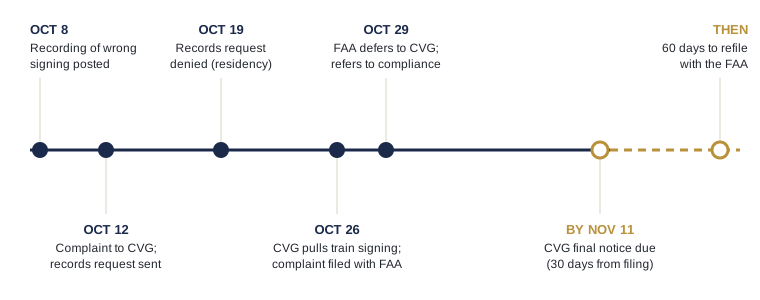
Seen on a line, the speed is striking in both directions. From filing to suspension took fourteen days, which is fast for any public body and faster than I expected. From suspension to a written standard, the step that would make the fix durable, the clock has not started. The next fixed date is November 11, when CVG’s final notice is due. Everything after that runs on the sixty-day window the FAA described.
What this teaches anyone filing next
I said on October 26 that I intend to file civil rights complaints about AI signing deployments wherever they put Deaf people at risk, not only at CVG. This exchange with the FAA is the first map of how that works for airports, and it holds a few lessons worth writing down for the next person.
File with the airport first, and in writing. The FAA defers to the airport sponsor’s investigation, so the airport’s Title VI or ADA coordinator is the first real decision-maker, and the airport’s own complaint procedure governs the timing. Ask for the airport’s procedure, and ask for the final notice by email if email is the format you can read.
Make the record complete at the airport stage. Because a later FAA review is not de novo, anything you want weighed later has to be in the file now: the recordings, the exact screen text against the exact signing, the specific remedy you are asking for, and every follow-up question in writing. A phone call that resolves something informally may help in the moment and leave nothing behind for the review that comes after.
Ask for a standard, not just a suspension. Pulling an AI signer is a remedy. Writing down what it must do before it comes back is governance. The second is what protects the next Deaf traveler, and it is the thing least likely to happen unless someone asks for it in so many words.
Watch the dates. The sixty-day refiling window starts when the airport’s investigation concludes, including reconsideration. Miss it and the federal door closes. For this matter, I am counting from the day CVG’s final notice arrives.
Raise the pattern separately from the incident. The FAA routed the general question, whether airports deploying machine-generated sign language should meet any verification expectation, to compliance review rather than treating it as part of one complaint. That is the right home for it, and it suggests that the systemic question and the individual incident are best raised as two distinct asks from the start.
What comes next
CVG’s final notice is due by November 11. When it arrives, I will publish it here alongside this record, note which of the open requests it answers, and decide within the sixty-day window whether any ADA or Section 504 issues remain for the FAA. If the signed announcements return to the train screens before then, I will ask CVG in writing what standard they were checked against, and record the answer.
None of this is glamorous. It is dates, letters, and the patience to ask the same question twice in writing. But that is how the record gets built, and the record is the thing that outlasts any single fix. The machine signer at CVG got something wrong in public. The least the public process can do is get the paperwork right.
This is a case record kept for documentation and is not legal advice. Earlier entry: I Filed One Complaint. An Airport Took Its AI Signer Down.