
A Folder on the Kitchen Table
Nora’s mother did not read part four. She heard about it on a Tuesday evening in November, in a meeting room at the regional parent center, where an advocate named Teresa had set up a projector and a plate of grocery store cookies and was walking eleven parents through what she called the one-file audit. Teresa had been an IEP case manager for nine years before she came to the center, and she explained the idea the way she would have explained it to a colleague. The district’s tool writes a draft. Somebody edits it, or does not. The plan you signed is the draft after whatever happened to it. If you can get the draft, you can see what happened.
Most of the parents in the room had a folder with them, because Teresa had asked them to bring one. Nora’s mother had the IEP the district had signed in October, the one part one described: six signatures, a present levels statement that called her daughter significantly delayed in receptive and expressive language, and a special factors section that said Nora would use an interpreter as needed.1 She had read it many times since. She turned to the parent concerns section while Teresa was talking, because Teresa had said that was the place to start, and she read it as if it belonged to someone else.
It had two paragraphs. The second was the note the team had added at the meeting, after she said that Nora was not delayed in American Sign Language and was the most fluent signer in her family. The note now read, “Parent reports that Nora communicates well using ASL at home.” That was a gentler sentence than the one she had said, but it was recognizably hers. The first paragraph was not. It read, “Nora’s parents would like her to continue making progress in reading and writing and to build confidence participating in class. They are pleased with the supports Nora receives and appreciate the team’s efforts.” She had not said that. She had not said anything like it. She had come to the meeting worried that the supports were wrong.
She asked Teresa, during the break, who would have written a paragraph like that. Teresa looked at it for a while and said she did not know, and that this was the reason for the letter. Nora’s mother wrote it at her kitchen table that night, from Teresa’s template, and sent it to the district by email the next morning, with a copy by certified mail because Teresa told everyone to do both.
The Letter
The letter asked for seven things. Each one rests on a rule that already exists, and none of them requires the district to agree that AI is a problem. The point is to make a district answer in writing, item by item, questions it has usually never been asked.
The first four items are about the draft. The right underneath them is the one parts two and four relied on: a parent may inspect and review any education records relating to her child that the district collects, maintains or uses for identification, evaluation, placement or the provision of a free appropriate public education, and the district must comply without unnecessary delay, before any IEP meeting, and in no case more than forty-five days after the request. The same rule gives her the right to a response to reasonable requests for explanations and interpretations of the records, the right to have a representative inspect them, and the right to copies if failing to provide copies would effectively prevent her from exercising the right at all.5 Asking for the inputs, item three, follows from the same right and from the notice a district must send when it proposes a plan, which has to describe each evaluation procedure, assessment, record or report the district used as a basis for the proposal.6 If a generator was fed last year’s IEP and a reading benchmark to produce this year’s, those are the records the proposal was built on.
The last three items are the ones families rarely know about, and they are the ones that make the letter hard to brush aside. Every district must give a parent, on request, a list of the types and locations of education records it collects, maintains or uses.7 Every district must keep a record of the parties who obtain access to a child’s records, other than parents and authorized employees, with the date and the purpose.8 And under the federal privacy regulations, a school may not destroy any education records while a request to inspect and review them is outstanding.9 That last sentence matters more than its length suggests. Part four found that Pine Lake’s vendor kept generation logs for ninety days and then purged them.4 A district whose vendor purges on a schedule, and which receives a request on day sixty, cannot let the purge run on day ninety. NCG’s reading is that a district must tell the vendor to hold the record, because a record held for the district is a record the district maintains.
| Request | Rule | What the district has to do |
|---|---|---|
| Was AI used and where | 300.613(b)(1) explanations and interpretations | Answer a reasonable question about the records |
| The draft as generated | 300.613(a) inspect and review | Produce it before the meeting and within 45 days if it is an education record |
| What went into the tool | 300.613(a) and 300.503(b)(3) | Produce the records the proposal was based on |
| Any change record | 300.613(a) | Produce it if it exists or say that it does not |
| List of record types and locations | 300.616 | Provide the list on request |
| Record of access | 300.614 | Show who outside the family and staff has seen the file and why |
| Preserve everything | 99.10(e) | Destroy nothing while the request is open |
The Clock
A request like this starts two clocks, and parents should know which one is running. The outer limit is forty-five days. The inner one is the next IEP meeting, because the district must let the parent inspect the records before any meeting about the IEP, whenever that falls.5 By asking for a meeting in the same letter, Nora’s mother moved the deadline to whatever date the district scheduled. A parent who wants the draft before a plan is revised should always ask for both.
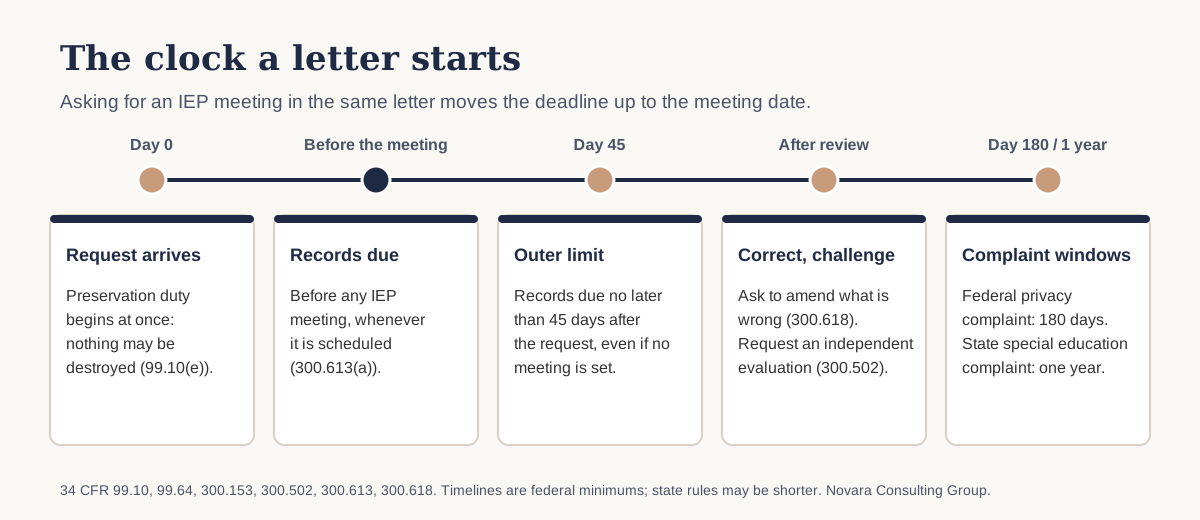
The preservation duty starts the moment the request arrives. It is the cheapest protection a family has and the one most likely to be lost by accident, because the people who would need to act on it, the vendor’s support team or a teacher with a personal account, are not the people who open the mail. A district that receives a request and does nothing about it may find, by the time it looks, that the draft has aged out of a log nobody remembered. The regulation does not excuse that. It is written to the district, and it applies to records the district maintains whether the server is in the building or in a vendor’s cloud.
Is the Draft a Record at All?
Everything in the letter depends on one question that no court has answered: whether a machine-generated draft of a child’s IEP is an education record. The federal definition has two parts. An education record is a record directly related to a student and maintained by an educational agency or institution, or by a party acting for the agency or institution.10 The first part is easy. A present levels statement about Nora is directly related to Nora. The second part is where families have lost before.
The leading case on the word “maintained” is not about special education. In Owasso Independent School District v. Falvo, the Supreme Court held in 2002 that papers graded by classmates were not education records while they passed from hand to hand. The Court wrote that the word “maintain” suggests records “kept in a filing cabinet in a records room at the school or on a permanent secure database,” and it described education records as institutional records kept by a single central custodian, such as a registrar.11 Districts have relied on that language ever since to resist requests for staff email. In S.A. v. Tulare County Office of Education, a federal court in California held in 2009 that emails about a student were not maintained records because of their “fleeting nature,” unless the district printed them and placed them in the student’s file. The Ninth Circuit followed similar reasoning in an unpublished decision, Burnett v. San Mateo-Foster City School District in 2018. A federal court in Pennsylvania took a somewhat wider view in 2017, holding that emails may be education records if the school kept copies as part of its record filing system intending to maintain them.12
The question has not settled. In 2025 the Nevada Supreme Court first held that emails stored in a district’s archive were maintained records because a record is maintained when it is stored on an institution’s secure database or storage system, then withdrew that opinion and replaced it with one holding that an email becomes an education record only when the district takes “affirmative and intentional steps” to treat it as an institutional record and stores it with a designated person in a designated place.13 The federal privacy office closed a twelve-year-old complaint against a Wisconsin district in April 2025 without deciding whether the emails at issue were education records, and wrote that “the Department has not adopted the holding in Tulare or similar cases,” adding that it hoped to issue guidance or regulations in the foreseeable future.14 Colorado’s state complaints officer, applying the same cases to a request under the special education records rule, held in 2024 that emails are education records only where the district takes some action to maintain them.15
A family reading those cases could conclude that the draft is out of reach. NCG reads them differently, for three reasons. The first is what the document is. An email about a child is correspondence that sits beside the record. A generated present levels statement is the first version of the record itself, and in most of the files part four examined, most of its words became the signed plan. The second is where it is stored. A draft generated inside the district’s IEP platform lives in the system that holds every signed plan the district has, which is as close to the Supreme Court’s “permanent secure database” as anything in a school. The third is who holds it. A vendor processing student data under a district contract is a party acting for the district, and the district may share records with it only because it keeps direct control over how the vendor uses and maintains them.16 A district cannot claim that control when it wants to share the data and disclaim it when a parent wants to see the result.
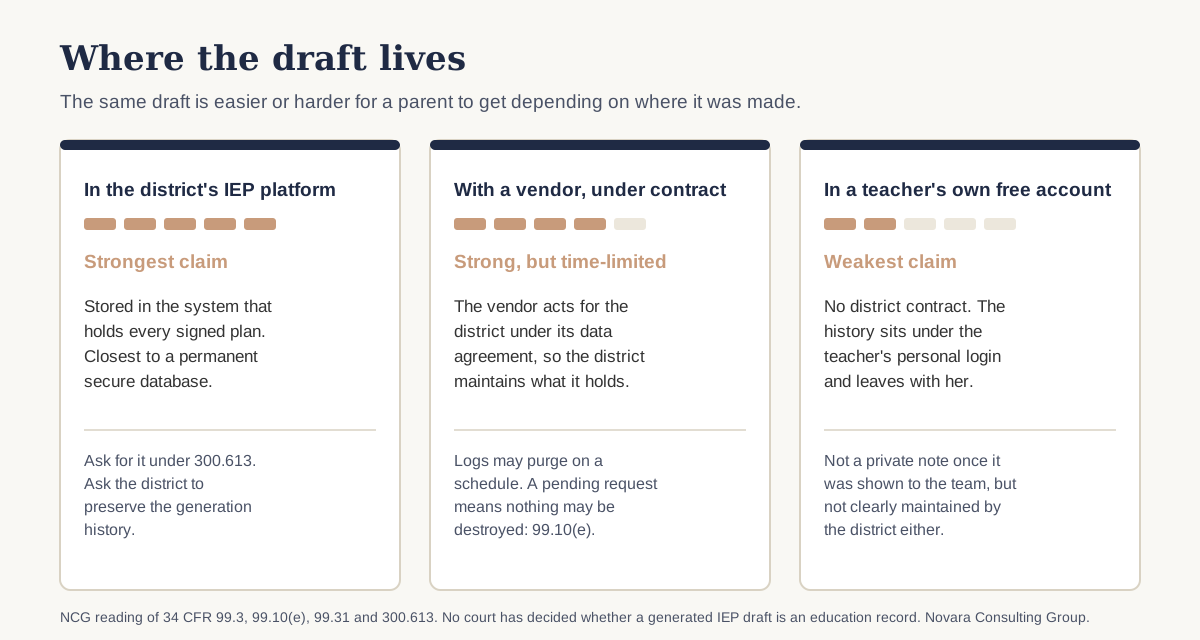
That reasoning reaches two of the three places a draft can be. It does not reach the third. Part four found that nine of Pine Lake’s twelve recoverable drafts were sitting in case managers’ own free accounts, made outside any district contract.4 Part four also explained why such a draft does not fit the exclusion for a teacher’s private notes, because it was shown to a team and read aloud at a meeting.4 But escaping the exclusion is not the same as being maintained. A company with no contract with the district is not acting for it, and a history under a teacher’s personal login is not the district’s database. Under the narrower cases, a parent asking for that draft may be told, with some legal support, that the district does not have it. NCG thinks a hearing officer looking at a plan built from that draft would be unimpressed by the answer, but it is an honest statement of where the law is weakest.
There is an uncomfortable incentive in this, and districts should see it before their lawyers point it out. If a draft is only an education record when the district treats it as one, a district can keep its drafts out of reach by never doing so: never exporting them, never filing them, never saying where they live. The Nevada test, read cynically, rewards a district for keeping no record. That strategy has two problems. It cannot be applied once a request has arrived, because nothing may be destroyed while the request is outstanding.9 And a district that adopts it is choosing to have no evidence of its own review, which is the evidence it will want most if a family ever claims the plan was decided before the meeting.17
What Pine Lake Sent
Pine Lake answered on the eighth day, and the answer came from Dana herself. The week before, after the audit part four described, she had written to her superintendent asking for a retention clause and an instruction that drafts already sitting in personal accounts be exported to each student’s file.4 Nora’s draft had been recovered during the audit from the vendor’s logs, which still held it only because her meeting had been recent, and Dana had it placed in Nora’s file. That is the only reason the answer to item two was yes.
Dana’s letter went item by item. Yes, the platform’s drafting feature had been used for the present levels, annual goals, special factors and parent concerns sections of Nora’s October IEP, in the district’s account. The draft was attached, with its generation date, two days before the meeting. The inputs were attached as well: last year’s IEP, the fall reading benchmark, two writing samples and the quarter’s progress notes. No change record existed, because the platform kept only the latest saved text, and Dana said so in a sentence. In its place she attached the section-by-section comparison her data coordinator had prepared during the audit, and offered to walk through it in person, which is the explanation the rule entitles a parent to ask for.5
Item five turned out to be the most revealing. Pine Lake’s list of record types and locations had last been revised in 2019. It named the cumulative file, the special education platform, the health office, the counseling office and transportation. It did not mention generation logs, vendor exports or anything held in a staff member’s own account, because none of those had existed when it was written. Dana sent the 2019 list and a revised one dated that week. Item six showed the parties who had obtained access to Nora’s records that fall: the vendor’s support analyst, on the day of the audit export, for the stated purpose of producing it. Item seven was confirmed in one line.
This is what a good answer looks like, and it is worth saying plainly that most families will not get one. Pine Lake could answer because it had audited a week earlier for its own reasons. A district that had not would have had to find the draft from a standing start, in a log that might already be gone or an account it did not control, under a deadline.
What the Draft Showed Her
Nora’s mother sat with Teresa at the parent center and laid the generated draft beside the signed plan. It took less than an hour, because there was so little to find.
The present levels statement in the draft and the present levels statement in the plan were the same, except that “4th grade” had become “fourth grade” and one benchmark score had been corrected. The sentence about significant delays in receptive and expressive language was in both. The special factors section in the draft read, “The team has considered the student’s language and communication needs. The student will continue to receive services as outlined in this IEP, including an interpreter as needed.” The signed version was identical. The communication plan it referred to as attached was the one part four found, dated two years earlier.4
The parent concerns section answered the question she had asked Teresa at the break. The first paragraph, the one about being pleased with the supports, was in the draft word for word, generated two days before she walked into the room. The second paragraph, her note, was not in the draft, because it was added at the meeting. The generator had written her concerns before she arrived, and the team had kept them and put hers underneath.
Then she read the inputs. Everything the generator had been given was in English: an IEP from the year before, itself carried forward, a reading benchmark, two writing samples and progress notes written by teachers who do not sign. Nothing in the pile came from anyone who had watched Nora tell a story. The draft had described the child in the data because there was no other child in the data to describe.
The generator had written her concerns before she arrived, and the team had kept them and put hers underneath.
Correcting What Can Be Corrected
The records rules give a parent a second right beyond inspection, and the letter had made it usable. A parent who believes information in her child’s records is inaccurate, misleading or in violation of the child’s privacy may ask the district to amend it. The district must decide within a reasonable time. If it refuses, it must tell the parent of her right to a hearing, conducted under the federal privacy procedures by an official with no direct interest in the outcome. If the hearing goes against her, she may place a statement in the record explaining why she disagrees, and the district must keep that statement as long as it keeps the record and disclose it whenever it discloses the record.18
The parent concerns paragraph is the cleanest use of that right this series has found. It does not ask anyone to revisit a professional judgment. It says the record attributes words to a parent that the parent did not say, which is a question of fact, and the draft proves it. Nora’s mother asked that the generated paragraph be removed, that the section record what she had said at the meeting in her own words, and that the change be dated. Pine Lake agreed within two weeks. It took no hearing and no lawyer, and the corrected section is now the only part of Nora’s plan that a person can be shown to have written.
The language finding was a different matter, and Teresa was careful to say so. The amendment right reaches information that is inaccurate or misleading. A team’s conclusion that a child has a language delay is presented as a professional judgment drawn from evaluation data, and a district can fairly say that it does not erase a judgment because a parent disagrees with it. If Nora’s mother pressed it as an amendment, the most likely end point was a hearing she would lose and a statement in the file.
The better route ran through the evaluation. Federal rules require that assessments used to evaluate a child be provided and administered in the child’s native language or other mode of communication, and in the form most likely to yield accurate information about what the child knows and can do, unless it is clearly not feasible.19 For a child who is deaf or hard of hearing, the team must also consider the child’s language and communication needs and opportunities for direct communication in the child’s language and communication mode.20 The draft’s inputs showed that the finding of significant language delay rested on English-only data. Nothing in the record showed that Nora’s language had ever been assessed in ASL. A parent who disagrees with a district’s evaluation may ask for an independent educational evaluation at public expense, and the district must then, without unnecessary delay, either pay for it or file for a due process hearing to show its own evaluation was appropriate.21
So the second letter Nora’s mother sent was shorter than the first. It said that she disagreed with the evaluation underlying the present levels finding of language delay, because it did not assess Nora in American Sign Language, and that she was requesting an independent educational evaluation of Nora’s language by an evaluator fluent in ASL, at public expense. Teresa helped her find two such evaluators within driving distance, which in some states would not have been possible at all.
The Families Without a Dana
The answer Nora’s mother got was the answer a district gives after it has already looked. At Pine Lake, part four found that eight of twenty sampled drafts were gone for good.4 A parent of one of those eight children, sending the same letter, would get a different reply: the tool was used, the draft no longer exists, there is no record of changes. That reply is disappointing, and it is still worth having. It establishes in writing that a machine drafted the plan, that the district kept nothing from which anyone could tell what a human did to it, and on what date the district said so. If the family later argues that the plan was effectively decided before the meeting, the district will have conceded the facts that make the argument hard to answer.17
A family whose request is ignored, or answered late, has places to go that do not require a lawyer. A complaint to the federal Student Privacy Policy Office must generally be filed within 180 days of the violation or of when the family knew or should have known of it, and a state special education complaint may raise violations that occurred up to a year before it is filed.22 Several states also have their own student privacy officers. New York’s ruled in June 2026 that emails from a parent to a school, directly related to a student and maintained by the school, are education records, which shows that state offices are willing to read the definitions for themselves.23 None of these forums has yet decided a case about a generated draft. The first family to bring one will be writing on a blank page, which is an argument for bringing it carefully and for bringing it soon.
Deaf parents and parents of Deaf children face one more barrier, and the rules already address it. A district must take whatever action is necessary to ensure a parent understands what happens at an IEP meeting, including arranging an interpreter for a parent who is deaf,24 and the written notice of a proposed plan must be provided in the parent’s native language or other mode of communication unless that is clearly not feasible.6 A Deaf parent who asks for the explanations and interpretations the records rule promises is entitled to receive them in a language she can use. That matters most for the families with the most reason to ask, because the special factors and the communication plan are the sections part four found most often generated and signed unchanged.4 It matters, too, because those families often cannot find out from the outside who serves Deaf students at all. The National Deaf Education Data Index found that sixty-four percent of school units in its first thirteen published states say nothing in public about deaf and hard of hearing services.25 A records request is one of the few tools a parent has that works even when the district’s website is silent.
Before the Letter Arrives
A district does not need to wait for a parent to do the work Nora’s mother did. Four things make the letter easy to answer. Revise the list of record types and locations so that it names where AI drafts are made and kept, including any staff accounts the district permits. Decide, in policy, that a generated draft used to develop an IEP is filed with the student’s record, which under the narrowest reading of the cases is what makes it a maintained record. Write down, now, what the district will tell a vendor on the day a records request arrives, so that the preservation duty does not depend on someone remembering a ninety-day log. And say in the written notice of a proposed IEP that a drafting tool was used and which sections it drafted, which costs nothing and answers the first item of every letter before it is sent.
Dana’s Decision
The second letter reached Dana on a Thursday. She read it twice and then did what she had done after part three: she closed her door and read Nora’s file again, this time with the inputs beside it. The finding of significant delay in receptive and expressive language had first appeared in an evaluation report written three years earlier, by a speech-language pathologist who had since left the district, from assessments administered in spoken and written English with an interpreter present. Every IEP since had carried it forward. The generator had carried it forward this year in fresh, correctly dated sentences, which is what part four said generators do.4 There was no ASL assessment anywhere in the file.
Dana’s choice is narrow and has a deadline written into the regulation: pay for the independent evaluation, or file for a hearing and defend an evaluation she now has reason to doubt, without unnecessary delay either way.21 She has not decided. Pine Lake’s counsel has asked for a meeting. What she knows, and could not have known two weeks earlier, is how much of Nora’s plan was written by a person, because a parent asked and the district, this once, could answer.
The series began with a file in a district office describing a child who does not exist. Five parts in, the child’s mother has read it, found the paragraph someone wrote in her voice, had it taken out, and asked for the one thing the file has never contained, which is an account of her daughter in her daughter’s language. None of that required new law. It required a letter, a deadline the law already sets, and a district that had kept what it made. The record is not the child, a draft is not a decision, and a right to inspect a record nobody kept is not yet a right.
- Send the request in writing, by email and by certified mail, and keep both.
- Ask for an IEP meeting in the same letter, so the records are due before the meeting.
- Ask whether AI drafted any part of the plan, in which tool and in whose account.
- Ask for the draft as generated, with its date, and for everything entered into the tool.
- Ask for any record of changes, the district’s list of record types and locations, and the record of access.
- Ask the district to preserve everything, including records a vendor holds, while the request is open.
- Ask that any item that does not exist be named in writing.
- Compare the draft with the signed plan, starting with the parent concerns section.
- Ask to amend anything the record attributes to you that you did not say.
- If a finding rests on testing that did not use your child’s language, request an independent educational evaluation.