
Twenty Files on a Monday
Dana read part three on a Friday afternoon, in her office at Pine Lake, with the door closed. She is the district’s director of special education, twenty-two years in the field, and she was the one who signed the platform renewal that part two walked through. Pine Lake serves about 5,400 students, 740 of them on an IEP. Her case managers had been pressing the drafting button since the October after the spring release. By her technology office’s count, 312 of last year’s IEPs had been started with it.
The sentence that kept her in the office past five was near the end of part three: the draft is probably a record the district must be able to produce, nobody has required it, and nobody has promised it.3 Dana did not think her staff were rubber-stamping anything. She had watched some of them work. She had also signed a renewal whose only promise was that “all generated content is subject to review and approval by district staff,” and she realized she had no way to show a single instance of that review happening. If a parent asked on Monday, she would be answering with her confidence in her people. That is a good thing for a director to have. It is not evidence.
So on Monday morning she asked her data coordinator, Ray, for a list of every AI-assisted IEP from the last school year, and had him pull twenty of them at random, the way the state’s monitors pull files when they visit. Then she added every AI-assisted IEP for a child who is deaf or hard of hearing, because that is where part one had found the failure most likely to hide. There were six. Nora’s was one of them.
What follows is what an audit like Dana’s looks like, measure by measure, and what it can and cannot tell a district. The numbers belong to a fictional district. The questions belong to every district that has turned these tools on.
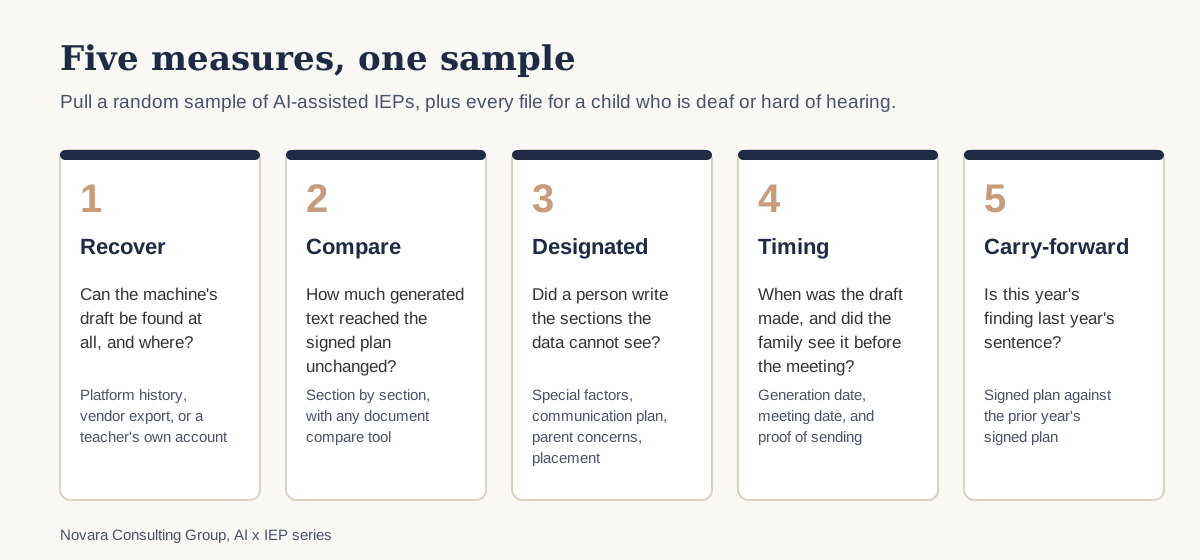
The First Measure: Can Anyone Find the Draft?
The first question took Ray most of Monday, and the answer reshaped the rest of the week.
Pine Lake’s IEP platform generates the draft inside the student’s record, which part three described as a real advantage: the data never leaves the system that will hold the signed plan.3 It is also where the draft disappears. When a case manager edits a generated section and saves, the platform keeps the edited text. It does not keep the version the machine wrote. Ray asked the vendor’s support line whether the generated text could be pulled from logs. The answer, after two days, was that generation logs are kept for ninety days for troubleshooting and then purged. Of the twenty sampled files, three had been generated recently enough. The vendor exported those three without charge, to its credit, and said it could not do more.
That should have been the end of it. It was not, because several case managers mentioned, when Ray asked, that they did not always use the platform’s button. Some preferred a free drafting tool they had signed up for themselves, which they found faster for present levels and goals. They drafted there and pasted the result into the platform. Their drafts were still sitting in their own account histories, under their own logins, dated. Nine of the twenty sampled files had been drafted that way, and the case managers handed over all nine without hesitation.
So Dana’s recoverable drafts came from two places, and the larger one was outside the district entirely. Twelve of twenty could be recovered: three from the vendor’s short-lived logs, nine from teachers’ personal accounts. Eight were gone. Part three described this split as a finding about vendors: for three of the five products it read, the draft lands in a teacher’s own account or a Google Doc rather than in the district’s system.3 At Pine Lake it turned out to be a finding about the district. The only reason most of the evidence still existed was that teachers had gone around the district’s tool.
The recovery measure matters before any other because of what part one and part two said about records. A district must let parents inspect and review any education records relating to their child, before any IEP meeting and no more than forty-five days after they ask.4 NCG’s reading, set out in part two, is that a machine-generated draft used to develop a child’s IEP is such a record.2 Ray’s Monday turned that reading into a practical problem. If a parent asked for the draft of one of the eight lost files, the honest answer would be that it no longer exists, and the district never decided that it should not.
The nine drafts in personal accounts raise a question the earlier parts did not reach. A district may hear that a teacher’s own drafting history is her working notes, not a school record. Federal privacy rules do exclude one category from education records: notes kept in the sole possession of the person who made them, used only as a personal memory aid, and not shown or revealed to anyone except a temporary substitute.5 A draft that was pasted into a proposed IEP, shown to a team and read aloud at a meeting does not fit that description on any reading NCG can find. The exclusion protects a teacher’s scribbled reminder. It does not convert the first version of a child’s plan into private property because of where it was typed. This is NCG’s reading, and no court has addressed it, but a district that relies on the opposite view is betting a hearing on it.
The only reason most of the evidence still existed was that teachers had gone around the district’s tool.
There is a second problem with those nine files, and it is not legal. A teacher’s personal account belongs to the teacher. If she leaves Pine Lake, the history leaves with her. If she deletes it, or the free tier shortens what it keeps, it is gone. One vendor told NCG in its response to part three that every generation in its tool is saved as generated, with its inputs, until the teacher or district deletes it.6 That is better than ninety days. It still leaves the only copy of a district’s evidence in a place the district does not control and cannot hold.
The Second Measure: What Reached the Signed Plan Unchanged
With twelve drafts in hand, Ray did the comparison the slow way, and it turned out not to be slow. He opened each generated draft and the signed IEP side by side in the district’s word processor, used its compare documents feature, and recorded, section by section, roughly what share of the generated words had come through to the signed plan untouched. A section where the case manager fixed a grade level and a date counted as mostly unchanged. A section rewritten from the evidence counted as changed. Each file took him about forty minutes.
The point of measuring by section, rather than by whole document, is that sections are not equal. Part one argued that the parts of an IEP where the district’s data is least likely to describe the child are the parts a human has to write: present levels findings, the special factors, any communication plan and the placement.1 A case manager who leaves the generated accommodations list alone and rewrites the present levels has done the review that matters. A case manager who does the reverse has not, even if her total edits look the same.
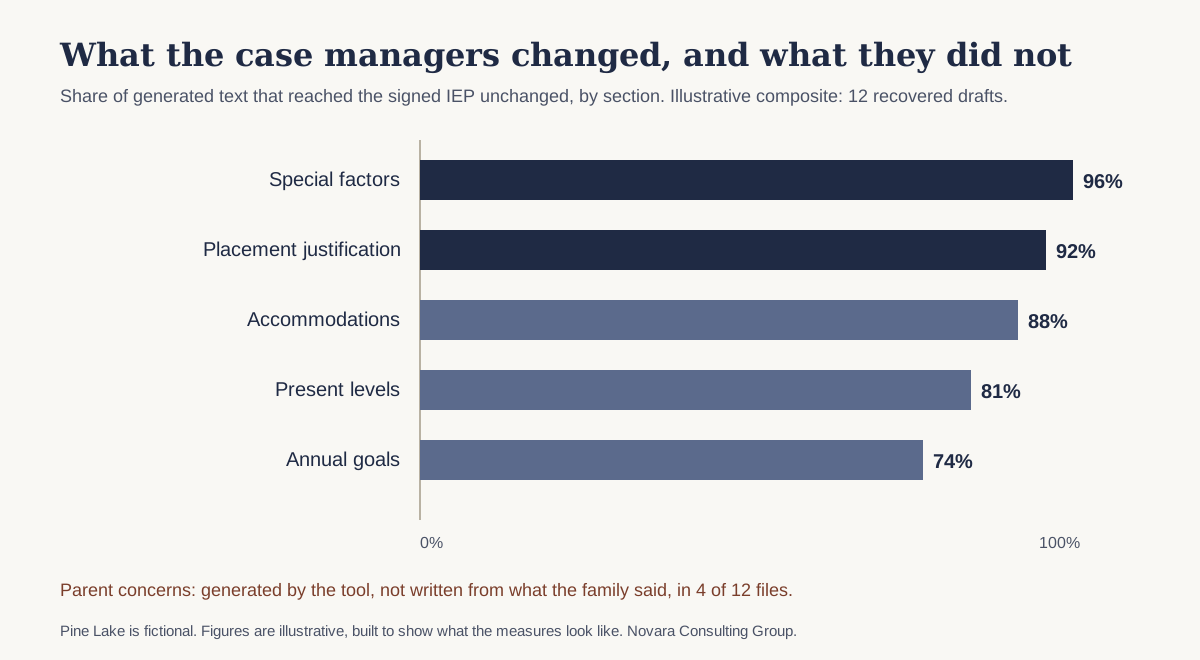
Pine Lake’s pattern, which is invented here but is the pattern part one predicted, ran backwards. Annual goals changed most, because case managers know goals are what the team argues about and what a parent reads first. Present levels changed less. Accommodations changed less still, mostly by deletion of items that did not apply. The special factors section, the consideration a team must give to a deaf or hard of hearing child’s language and communication needs,7 came through almost word for word. So did the paragraph explaining why the child’s placement was the least restrictive appropriate one.
Ray also found something nobody had looked for. In four of the twelve recovered files, the tool had generated text for the section that records the parents’ concerns for enhancing their child’s education. The text was reasonable. It said things a parent might say. In none of the four had the parent said it. Each case manager had kept the generated paragraph and planned to adjust it at the meeting, and in each file the signed version matched the draft. A section that exists in an IEP so that the family’s voice is in the document had been written, in a third of the recovered files, by the software.
The Third Measure: The Sections the Data Cannot See
The third measure is the narrowest and the most important, and for a district with Deaf and hard of hearing students it is the one that can carry legal weight on its own. It asks a yes or no question of a short list of sections: did a person write this, from what the team knows about this child, or did it come from the generator?
Part two proposed that a contract require human entry in four places: the deaf and hard of hearing special factors, any communication plan required by state law, the qualifications of any interpreter or communication specialist, and the placement.2 Pine Lake’s contract had no such clause, so Dana treated the list as an audit standard rather than a contract term. Ray added the parent concerns section, after what he had found.
Then they read the six files for Deaf and hard of hearing students, all of them, not a sample. Four of the six drafts were recoverable. In all four, the special factors statement had come from the generator and reached the signed plan essentially unchanged. In three of the four, it read as a sentence that would fit any child with a hearing loss: that the team had considered the student’s communication needs and that the student would continue to receive services as outlined. Nora’s said the same. It did not mention American Sign Language, the language Nora tells her lunchroom stories in. It did not say whether she had access to peers or adults who sign, which is one of the things the regulation tells the team to consider.7 The state Pine Lake sits in requires a written communication plan for a Deaf child, as several states do.8 Nora’s file referred to one as attached. Ray found the attachment. It was dated two years earlier.
None of this proves that Nora’s team did not discuss her language at the meeting. They may have discussed it at length. What it shows is that the document the district will defend, the one a hearing officer reads, records no such discussion, and that the words it does contain were written by software before anyone in the room had said a thing. Part one described how a team can be found to have predetermined a child’s program when the decision was effectively made before the parents arrived, which courts treat as a denial of the parents’ right to participate.9 A special factors statement generated in advance and signed unchanged is not predetermination by itself. It is the kind of evidence a family’s attorney would use to argue it.
The Fourth Measure: Who Saw the Draft, and When
The fourth measure is about time, and it is the easiest to collect. For each recovered draft, Ray recorded when it was generated, when the IEP meeting was held, and whether the family received the draft before the meeting.
The generation dates were where a careful reader would expect them: a median of two days before the meeting, and in five files, the same day. The family had received a draft before the meeting in three of the twenty files. In the other seventeen, the parents met the proposed plan on a screen, as it was read aloud.
This measure connects directly to the three questions part one suggested families ask in writing before a meeting, including whether they can see the draft a few days ahead.1 It also connects to the standard a plan is held to. An IEP must be reasonably calculated to enable a child to make progress appropriate in light of the child’s circumstances,10 and a parent is the team member most likely to know those circumstances. A draft written two days before the meeting and first shown to the family during it gives the person who knows the child best the least time to correct the account of her.
There is a well studied reason this matters more with generated text than with a tired colleague’s draft. People reviewing a fluent, finished-looking recommendation from an automated system tend to accept it, check it less, and miss its errors, and the effect is stronger when they are busy.11 A parent handed a polished page at a table of professionals is in that position. So is a case manager with three meetings that afternoon. Time is the cheapest correction there is, and the audit shows whether the district is giving any.
The Fifth Measure: Last Year’s Sentence
The last measure is the one that most complicates the story, and it should. Ray compared each signed plan in the sample with the same child’s signed plan from the year before, looking for sentences in present levels that were identical.
He found them in seven of the twenty files. That number alone means little, so Dana asked him to do the same comparison for twenty files from the year before the district turned on the drafting feature. He found identical present levels sentences in six of those.
This is the strongest case for the tools, and part one made it before any critic could: plenty of IEPs were copied forward and signed without anyone looking at the child long before any model was involved.1 An audit that finds high unchanged rates in AI-assisted files has not proven that AI caused thin reviews. It may have found the same thin reviews the district always had, now produced faster and in better prose. Dana’s comparison suggested that at Pine Lake carry-forward was roughly where it had been, which is not the same as acceptable.
What the generator changes is not whether a weak review is possible. It is what a weak review produces. A copied-forward human IEP usually looks copied forward: the dates are stale, the grade level is wrong, the reader can tell. A generated IEP that carries forward last year’s finding does it in fresh, confident, correctly dated sentences. Nora’s present levels finding of significant delays in expressive language had been carried, generated and signed for three years. Nothing in the document’s surface suggested it was old. Only the comparison did.
Reading the Numbers Honestly
An audit like this invites two misreadings, and a district should guard against both before it shares the results with anyone.
The first is treating a high unchanged rate as proof of rubber-stamping. A generated accommodations list that is right does not need editing. A case manager who reads a present levels draft carefully, checks it against the evaluation and finds it accurate has done a review that leaves no trace in the comparison. The numbers point to where a district should look. They do not tell it what it will find. Dana’s next step was not a memo to her staff about their numbers. It was a conversation with the four case managers whose special factors sections had come through unchanged, to ask what had happened at those meetings. Two had discussed language and communication at length and had not thought to write it down. Two had not discussed it.
The second misreading is the opposite: concluding that because the audit cannot prove a review failed, it proves nothing. It proves three things. It shows whether the district can produce the record a parent is entitled to ask for. It shows which sections of its IEPs are being written by software and signed without change. And it shows whether the designated sections, the ones that require knowledge of a particular child, are being written by a person. Those are facts about the district’s process that it did not have before, and they are the same facts it would need in a due process hearing, gathered calmly and in advance instead of under subpoena.
| Measure | What it shows | What it cannot show |
|---|---|---|
| Recover the draft (12 of 20) | Whether the district can produce the record a parent may request | Whether the missing drafts were reviewed well |
| Compare by section (special factors 96% unchanged) | Which sections software is effectively writing | Whether unchanged text was checked and found accurate |
| Designated sections (4 of 4 Deaf files generated) | Whether a person wrote what the data cannot know | What the team said aloud but did not record |
| Timing (family saw draft in 3 of 20) | Whether the family had time to correct the account | Whether the family would have wanted it |
| Carry-forward (7 of 20 versus 6 of 20 before AI) | Whether this year’s finding is last year’s sentence | Whether AI made carry-forward worse |
Who Else Can Run It
Dana ran the audit because she was worried. The method does not depend on a worried director, and three other people are positioned to use it.
The first is the state. Under federal special education regulations, every state must monitor how its districts implement the law, with a primary focus on improving results for children and on the requirements most closely tied to those results.12 State monitors already pull samples of IEP files and read them against compliance items. Adding two questions to that review costs almost nothing: was any part of this IEP generated, and if so, can the district produce the draft and show who wrote the special factors and the parent concerns? The first year’s answers would tell a state more about how AI drafting is actually used in its districts than any survey. Several states have already issued guidance to districts on AI and IEPs.13 Monitoring is how a state finds out whether that guidance left a record.
The second is the family. A parent can run a one-file version of this audit with nothing but a written request. Ask, before the meeting and in writing, whether any part of the proposed IEP was drafted with AI, and ask for that draft under the right to inspect and review records.4 If the district produces it, compare it with the proposed plan. The parent concerns section is the place to start, because the parent is the one person who knows for certain whether she said it. If the district cannot produce the draft, that answer is itself worth having in writing. Parent centers can teach this in an evening, and the families of Deaf children have the most reason to ask, because the special factors and the communication plan are the sections this audit most often finds untouched.
The third is the vendor. Part two’s seventh clause asked vendors to provide, on request, a report comparing generated drafts with final documents by section.2 Everything Ray did by hand in a week is something a platform that generates the draft could do in a minute, if it kept the draft. A product that stores every generation already holds half of the comparison. In its response to part three, one vendor offered to talk with NCG about what such a report should include, which is the right instinct.6 Common Sense Media’s 2025 assessment of AI teacher assistants singled out IEP generation as among the most concerning features in the category.14 A vendor that ships the audit report with the drafting button will have the strongest possible answer to that concern: not a promise that teachers review, but a way to show it.
What It Costs
The objection a district will raise first is time, so here is Pine Lake’s, which is a fair estimate for a district its size. Pulling the sample and recovering what could be recovered took Ray a day, most of it waiting on the vendor and asking colleagues. The comparisons took about forty minutes per file, or a little over a day for twelve. The Deaf and hard of hearing files took an afternoon. Dana’s conversations with case managers took two hours. Call it two to three working days of a coordinator’s time and a morning of a director’s, once a year, with no purchase and no new software. The compare feature Ray used is in every word processor a district already licenses.
The larger cost is the one the audit reveals rather than the one it incurs. At Pine Lake, eight of twenty drafts were already gone, which means that for a large share of last year’s AI-assisted IEPs the district has no way to answer a records request that part two argued it is obliged to answer. The fix is not expensive, but it is contractual: a retention clause at the next renewal, an instruction to staff about where drafts may be made, and a decision about what happens to drafts in personal accounts. The federal destruction rules already require a district to tell parents when information it collected is no longer needed and to destroy it on request.15 A district cannot follow that rule for a record it does not know it has.
Dana’s Memo
On Friday, a week after she read part three, Dana wrote three paragraphs to her superintendent and her business manager. The first reported what the audit had found, with the numbers and the caveats, and without naming any case manager. The second asked for three things: a retention clause and the comparison report at the next platform renewal; a written instruction that IEP drafts be generated only in the district’s licensed tool, with drafts already sitting in personal accounts exported to the student’s file; and a rule that the special factors, any communication plan, the parent concerns and the placement be written by a person at or after the meeting, not generated before it. The third paragraph said she would run the audit again in the spring, and every year after, and report the results to the board alongside the other special education compliance figures it already receives.
None of that changes the platform. Dana’s case managers will keep pressing the button, and they should. The tool gives them back evenings, and nothing in this series has argued that a human writing alone would do better. What changes is that Pine Lake will know, a year from now, whether the review it promised is happening, and it will be able to show anyone who asks.
Part one ended with a file in the district office describing a child who does not exist, beside a girl in a lunchroom telling a story with her whole body. Three parts later, the same file has an audit trail. It shows that the description was generated, that it was carried forward, that no one wrote her language into the special factors, and that her parents met the plan on a screen. That is not a happy finding. It is a true one, and it is the first document in Nora’s file that a person made by looking at what the others actually say. The record is not the child, a draft is not a decision, and a review that leaves nothing behind is not yet a review.
- List every IEP from the last school year that was started with an AI drafting tool, in any account, and draw a random sample of twenty.
- Add every AI-assisted IEP for a child who is deaf or hard of hearing, outside the sample.
- For each file, record where the generated draft can be recovered, if anywhere.
- Compare each recovered draft with the signed IEP, section by section, and record the share of generated text that came through unchanged.
- For the special factors, any communication plan, interpreter qualifications, parent concerns and placement, record whether a person wrote the section.
- Record when the draft was generated, when the meeting was held, and whether the family received the draft first.
- Compare present levels with the prior year’s signed IEP and record identical sentences, then do the same for a sample from before AI drafting began.
- Talk with the case managers behind the files that stand out, before drawing conclusions.