
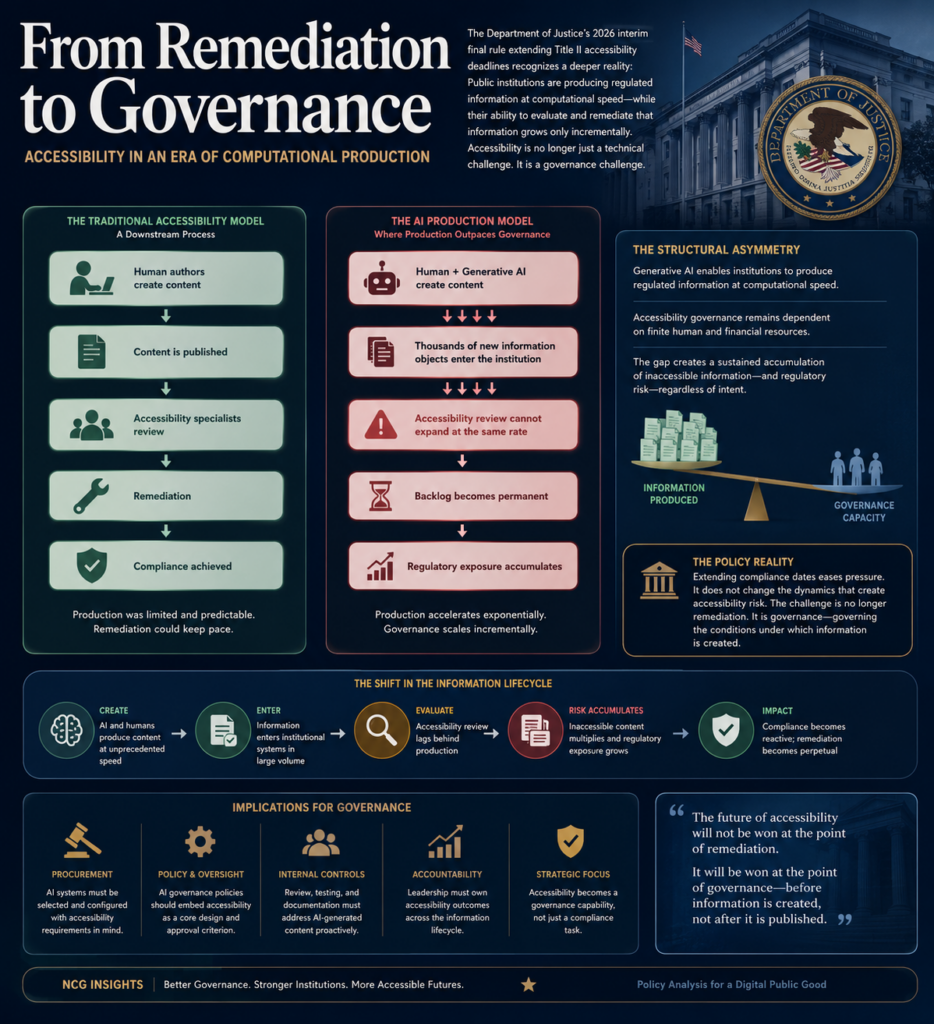
For nearly three decades, digital accessibility has been understood primarily as a remediation problem. Organizations create information, accessibility professionals identify barriers, and documents, websites, applications, or multimedia are subsequently modified until they satisfy applicable legal and technical standards. This model has shaped institutional practice because it reflected the practical realities of information production. Public entities generated information at a pace that allowed accessibility review to remain a downstream activity. Compliance depended principally upon whether organizations devoted sufficient personnel and resources to correcting accessibility defects after publication.
The Department of Justice’s April 2026 interim final rule suggests that this administrative model is beginning to fail. Most discussion surrounding the rule has focused on its extension of the Title II compliance dates established under the Department’s 2024 web and mobile accessibility regulation. That attention is understandable. Institutions had organized substantial compliance efforts around the original implementation schedule, making the postponement an immediate operational concern. Less attention has been given to the Department’s explanation for the delay. Read carefully, that explanation reveals a governance problem extending well beyond accessibility compliance itself.
Two Institutional Realities
In explaining the interim final rule, the Department identifies two institutional realities that, when considered independently, appear relatively unremarkable. Public entities are increasingly adopting generative artificial intelligence to produce information subject to Title II accessibility requirements. At the same time, existing accessibility technologies and available personnel are insufficient to remediate inaccessible content reliably at institutional scale. Neither observation is particularly controversial. Together, however, they describe a structural condition that fundamentally alters the administrative environment in which accessibility law now operates.
The Asymmetry Between Production and Oversight
The significance lies not in artificial intelligence itself but in the asymmetry it introduces between organizational production and organizational oversight. Generative systems permit institutions to produce regulated information at computational speed. Reports, correspondence, educational materials, public notices, web content, policy manuals, forms, presentations, and visual media can now be generated in quantities that would previously have required weeks or months of human effort. The administrative systems responsible for evaluating accessibility, however, have not experienced a comparable transformation. Accessibility review continues to depend principally upon trained personnel, manual quality assurance, specialized remediation software, procurement oversight, and finite institutional budgets. Production scales exponentially. Governance continues to scale incrementally.
Production scales exponentially. Governance continues to scale incrementally.
This asymmetry has important implications for regulatory compliance. Accessibility has traditionally functioned as a downstream control because the volume of information requiring evaluation remained within the practical limits of human review. Institutions could reasonably expect accessibility specialists to identify defects before legal exposure accumulated beyond manageable levels. Generative artificial intelligence disrupts this assumption by expanding the quantity of regulated information without producing a corresponding increase in institutional review capacity. Accessibility professionals are therefore placed in the position of responding continuously to expanding production rather than governing the conditions under which that production occurs.
Remediation as Symptom
Viewed from this perspective, remediation begins to resemble a symptom rather than a solution. The central policy question is no longer whether inaccessible documents can eventually be corrected after publication. Rather, it is whether organizations can continue relying upon post-production remediation as their primary compliance strategy when information creation increasingly exceeds the capacity of accessibility programs to evaluate it. Every additional deployment of generative systems widens the distance between the rate at which information is produced and the rate at which accessibility assurance can reasonably be performed. Compliance therefore becomes progressively reactive, focusing institutional attention on correcting existing accessibility failures while new content continues to accumulate.
What Delay Does Not Change
The Department’s interim final rule implicitly acknowledges this institutional dynamic without directly addressing its governance implications. Extending compliance dates may reduce immediate administrative pressure, but it does not alter the mechanisms through which accessibility risk is created. Delayed enforcement changes the calendar. It does not change the architecture of organizational decision-making. Institutions continue adopting technologies that increase information production while leaving accessibility governance substantially unchanged. Consequently, inaccessible content continues to accumulate not because organizations intentionally disregard accessibility obligations, but because the administrative systems responsible for governing accessibility remain calibrated for a pre-generative information environment.
The resulting regulatory exposure should therefore be understood less as a question of technical compliance than as a question of information governance. Institutions are increasingly challenged not by isolated accessibility defects but by the inability of existing governance structures to manage the velocity, scale, and complexity of AI-assisted information production. The traditional compliance model presumes that accessibility can be inspected into organizational outputs after they are created. That presumption becomes progressively less defensible as production accelerates beyond the practical capacity of downstream review.
Governance Mechanisms as Accessibility Controls
This distinction carries implications extending well beyond the Department’s current rulemaking. Accessibility governance has historically emphasized standards, remediation workflows, technical conformance testing, and corrective action. Those activities remain necessary, but they are no longer sufficient. Organizations increasingly require governance mechanisms capable of influencing information production before inaccessible content enters institutional systems. Procurement decisions, AI governance policies, approval workflows, human oversight requirements, documentation standards, audit mechanisms, and accountability structures become central accessibility controls rather than ancillary administrative considerations.
A Broader Transition
The Department’s explanation therefore points toward a broader transition in accessibility administration. The defining institutional challenge is not simply producing accessible information. It is governing AI-enabled information production before accessibility failures become embedded within organizational operations. In that respect, the future of accessibility compliance may depend less upon faster remediation than upon replacing remediation as the primary organizing principle of accessibility governance.