
Kentucky runs the oldest publicly funded school for the Deaf in the country, and its outreach consultants advise nearly every district in the state. Almost none of those districts say so. This is what a family finds when it goes looking, and what the state’s own records show about why.
A search that comes back empty
Erin Calloway found out her daughter was deaf on a Tuesday in March, in an audiologist’s office in Florence, a few miles south of the Ohio River. The newborn screening at the hospital had flagged it, the follow-up confirmed it, and by the time Junie was four months old the word on the paperwork was “profound.” The audiologist was kind and fast. She talked about hearing aids and a cochlear implant evaluation, handed Erin a folder from First Steps, the state’s early intervention program, and said someone would call.
Someone did. A First Steps coordinator came to the house, then a speech therapist, and for two years the family’s life organized itself around appointments. Nobody in the family signed. Erin’s husband downloaded an app. Junie, at eighteen months, pointed at everything and watched faces with an intensity that made strangers in the grocery store uncomfortable.
When Junie turned three, early intervention ended and the school district took over, because that is how the law works: a child’s services move from the health department’s program to the local schools on the third birthday. Erin did what any parent does now. She opened the Boone County Schools website and looked for the page that would tell her what the district offers deaf children.
There was no such page. The National Deaf Education Data Index read every page of that district’s site it could reach in September 2026, twice, once with an automated reader and once in a full browser, and found nothing specific to deaf or hard of hearing students anywhere on it. No program, no teacher of the deaf, no interpreter, no mention of hearing loss beyond what was absent. And Boone County is not a small district with one deaf child. On the state’s own December 2024 count it had 20 students whose primary disability was hearing impairment, more than any other Kentucky district that publishes nothing about them.
Erin did not know any of that. What she knew was that the page she was looking for did not exist, and that the person who could tell her what to ask for was not named anywhere she could find. She did not know that about a hundred miles south, on a hill in Danville, the state had been running a school for children like Junie for two hundred and three years, or that the same school employed consultants whose job was to drive to districts like hers and help. Her district had almost certainly used them. It just never said so.
Two hundred years on the same hill
The General Assembly established the Kentucky School for the Deaf on 10 April 1823, which makes it, in the school’s own words, “the very first school for the Deaf to be supported by public funds.” It sits in Danville, in the Bluegrass south of Lexington, on a campus it has occupied in some form ever since. For generations of Deaf Kentuckians, a school like this one has been the place where a child first meets other people who sign, and first learns that what everyone around her called a disability is also a language and a community.
The school still serves children from age three to twenty-one, from preschool through high school and career technical education. Placement there runs through the child’s home district: “Placement at KSD is determined by an ARC panel and requires evaluations, typically performed by the home district, KSD and/or KSD Outreach.” Kentucky calls its IEP team an Admissions and Release Committee. Attendance is free for any Kentucky resident by statute, and about 70 percent of students live on campus in a weekly model, arriving on Sunday evening and going home on Friday.
The school is smaller than its history. How much smaller depends on which state record you read, and the records do not agree. The School Report Card counts 62 students for 2024-25. The Kentucky Center for Statistics, reading the December 1 count, puts the school at 99 in 2018-19 and 74 in 2024-25. The state auditor, using the school’s own data, reports 77. On any of them, the school serves fewer than a hundred of the 724 Kentucky students identified with hearing impairment. The rest, the great majority, are in their local districts. That is where Junie will most likely go to school, and that is why what those districts publish matters.
The school describes its approach in fragments rather than a stated policy. Its mission commits it to “equipping Deaf and Hard of Hearing students with linguistic, academic, social, and transition skills,” and its values include providing “experiences across settings to promote social and academic language development in ASL and English.” That is an ASL and English bilingual identity, stated in pieces. It publishes no standalone language philosophy.
The consultants nobody names
The school has a second job, and it is the one that should have reached Erin first. Kentucky law makes the school “the Statewide Educational Resource Center on Deafness,” charged to “provide technical assistance and resource services to local school districts, parents, and other agencies or organizations serving children and youth who are deaf and hard of hearing.” The 2026-2028 state budget repeats the designation. The work is done by KSD Outreach, a team of educational consultants spread across the state, and it is free to districts.
The state auditor’s special examination of July 2025 measured how far that work reaches. KSD Outreach served 139 districts in 2020-21, 138 the next year, and 152 in each of the two years after that. The consultants help with “evaluations, educational programming, classroom adaptations, interpreting, communication, hearing technology supports, and meaningful inclusionary practices.” A job posting aligns their territories with the regional cooperatives in eastern Kentucky. In plain terms: when a district in the mountains has one deaf child and no teacher of the deaf, a consultant from the state school is the person who shows up.
Then the Index went looking for that service on the districts’ own websites. Three districts name the school anywhere. Boyle County, which shares Danville with it, carries a joint child find notice in the school’s name. Casey County lists the school as a placement option. Rowan County describes a partnership. Two of the nine regional cooperatives name it too: the Central Kentucky Educational Cooperative lists the school as a member, and the Greater Louisville Education Cooperative advertises its Family Learning Vacation, held at the school on 6 June 2026 and “open to all Kentucky families who have children with hearing loss, ages birth to high school seniors.”
That is the whole list. Danville Independent, the district in the town that has hosted the school for two centuries, does not name it on any page the Index read. And the school’s own website does not publish a list of the districts it serves, so a family cannot look it up from that end either.
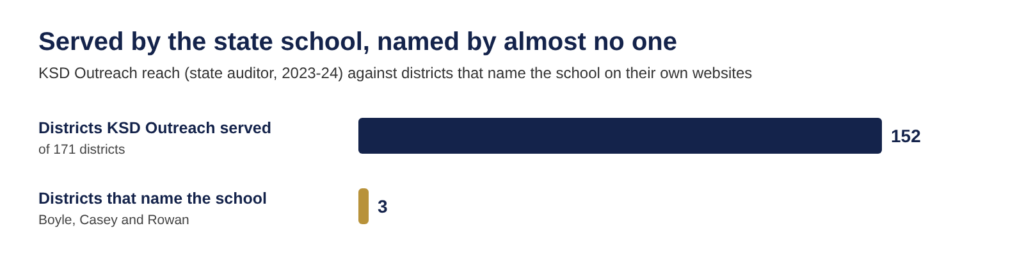
A service that reaches 89 percent of the state’s districts is named by under 2 percent of them. The Index’s reading of that, marked as interpretation, is that Kentucky’s deaf education infrastructure works almost entirely out of sight. It is paid for, it is real, and a family can find it only if someone tells them it exists.
I am DeafBlind, and I went to a school for the deaf myself, so I know how much of deaf life has always run on who you happen to know: another parent, a Deaf adult, an audiologist with a phone number. That network is real and it is generous. It is also why families who are not connected to it wait longer. When the public record is silent, the network is the only door, and not every family is standing near it.
The school’s outreach arm runs one more program worth naming. The Language Deprivation Intervention Program is two statewide consultants working on “consistent and adequate access to a fully accessible language during critical early developmental years” through “early access to sign language, spoken language with supports, or bilingual approaches.” Two people, for the whole state. Junie is exactly the child they exist for. Nobody on any page Erin could find told her they were there.
Where Kentucky’s deaf children are
Kentucky publishes more usable deaf education data than most states the Index has read, and it deserves credit for that. Its School Report Card files count students with disabilities by primary category, district by district, with hearing impairment as its own column. On 1 December 2024 the state counted 724 students whose primary category was hearing impairment and 28 under deaf-blindness, among 117,820 students with IEPs. Small numbers are hidden to protect privacy: district rows add up to 650 visible students, and 74 sit in 51 suppressed cells.
That count is what makes this measurement possible. In most states the Index can say what districts publish, but not how many deaf children those districts hold. In Kentucky it can say both, and set them side by side.
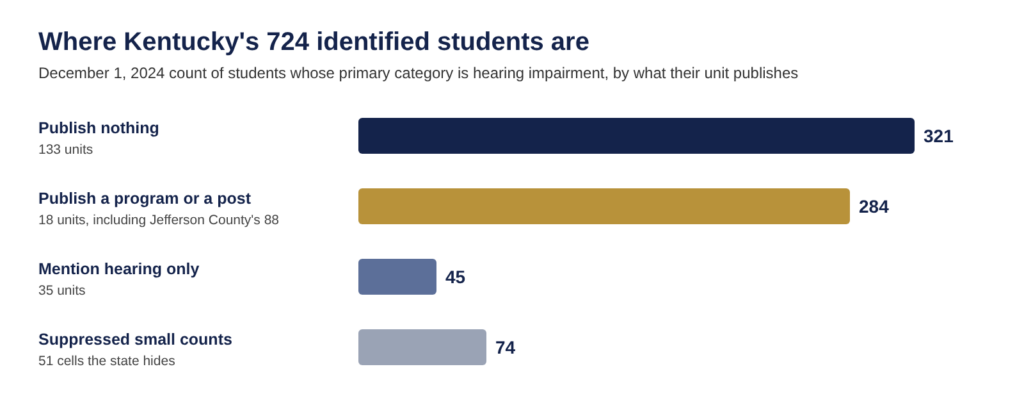
The Index read 186 units in all: 171 districts, the two state schools, the university laboratory district at Eastern Kentucky University, three other state-operated units, and the nine regional special education cooperatives. One hundred thirty-three of them publish nothing about deaf or hard of hearing students on any page read, and they hold 321 of the identified students. Thirty-five mention hearing only in passing, usually one line in a list of disability categories, and they hold 45. Eighteen publish a program or a deaf-specific staff position, and they hold 284.
That last number needs a caution, and it is a large one. Jefferson County, the state’s largest district, has 88 identified hearing-impaired students and publishes no deaf and hard of hearing program page of its own. Its students count in the publishing group because the state lists the Heuser Hearing and Language Academy, a private listening and spoken language preschool in Louisville, as one of the district’s schools, and the district hosts a page for it with a name, an address and no description at all. Read without that one row, the share of identified students in a unit that publishes a program falls from 39.2 percent to 27.1.
The other end of the chart has names. Eight districts each have ten or more identified hearing-impaired students and publish nothing a family could find: Boone (20), Scott (16), Kenton (13), Daviess (12), Pulaski (11), Knox (11), Floyd (11) and Laurel (10). Boone and Kenton sit across the river from Cincinnati. Scott is just north of Lexington. Floyd and Knox are in the eastern mountains, Pulaski and Laurel in the south, and Daviess is Owensboro, on the river at the far western end of the state. The silence is not regional. It is statewide.
None of this says those districts serve their deaf students badly. The Index measures what a family, a researcher or a legislator can see, and a district that publishes nothing may be doing excellent work. But Erin, sitting at her kitchen table with Junie on her lap, cannot see it. Neither can a family thinking about moving to Boone County, or a legislator asking where the state’s deaf children are taught.
What a family does find
The eighteen units that publish something are worth looking at closely, because what they publish tells you what a good page could look like and how rare one is.
Only one district publishes what a parent would recognize as a full program description. Fayette County, which is Lexington, describes a continuum: itinerant teachers of the deaf and hard of hearing and educational audiologists serving neighborhood schools, and site-based programs in three communication approaches, auditory-oral, cued language, and total communication including “American Sign Language (ASL), picture systems, sign-supported speech, fingerspelling, gestures, communication devices, and amplification technology,” with “interpreting and transliteration services on a regular, ongoing basis” and “DHH adult communication models.” Even Fayette does not name which schools host the three programs or say how a family chooses among them. But a parent reading it would know what to ask for.
Bullitt County, south of Louisville, publishes a department page titled “Deaf and Hard of Hearing & Visually Impaired Instruction” that names each teacher of the deaf and the schools she serves, and a separate page naming six interpreters. Here is the strange part. An automated reader could not see that page; only a full browser could. Earlier versions of the Index, and the first pass of this one, recorded Bullitt as publishing nothing. The same was true of five other districts whose staff pages appear only when a browser builds them. The Index marks this as interpretation too: in Kentucky, the difference between a district that seems to say nothing and one that names a teacher is sometimes a difference in how its website was built. A family on a phone with a slow connection may not see what a researcher with a full browser does.
Most of the rest publish a single person on a staff list. An itinerant hearing impaired teacher in Breathitt County. A sign language interpreter in Fulton. “1 hearing impaired teacher” in Henry County. An “EDUCATIONAL INTREPRETER I,” spelled that way, in Muhlenberg. A teacher of the deaf in Woodford. Those lines are real and they matter, and they are also, in most cases, the entire public record of a district’s deaf education. The file put it this way: Kentucky districts that publish a deaf and hard of hearing service publish a person.
The regional cooperatives, which many readers would expect to carry the work, mostly do not publish it either. One of them convenes the field: the Southeast/Southcentral Education Cooperative’s calendar lists a “September Cadre for Deaf/Hard of Hearing Teachers,” held on 8 September 2026 at its London office, and its cadres page names teachers of the deaf among the groups it brings together. That is a cooperative gathering the region’s teachers, not a cooperative serving children, and the file codes it that way. The other cooperatives publish nothing deaf-specific on the pages read.
Who runs the school
If you were trying to fix the silence, you would start by asking who is in charge of the institution at the center of it. In Kentucky that question has a statutory answer and a practical one, and they are different.
The law that governs the school is one sentence long. KRS 167.015: “The Kentucky School for the Blind at Louisville, Kentucky, and the Kentucky School for the Deaf at Danville, Kentucky, shall be managed and controlled by the Kentucky Board of Education.” The department runs both schools through a Division of State Schools inside its Office of Special Education and Early Learning, and the money is a line inside the department’s own budget.
A second statute, KRS 167.017, enacted in 1982, describes a superintendent for the school, appointed by the Commissioner of Education on the recommendation of a six-member search committee that includes the Kentucky Association of the Deaf, the alumni association, the faculty, a parent and the school’s advisory board. In practice there is no separate superintendent. The department’s own publication of May 2023 states that the Commissioner “serves as superintendent of KSD,” and the search then under way was for a principal. The pages the Index read in August 2026 listed an interim principal reporting to the Director of State Schools.
The school’s advisory board, created in the same 1982 law, must by statute have a majority of members who are deaf or hard of hearing. Its function is to “act in an advisory capacity,” and the school describes it as working “in a non-decision making capacity.” The school does not print the members’ names, and no 2026 meeting was listed when the file was compiled.
The Deaf community has tried to change this. In the 2025 and 2026 sessions, five bills and resolutions would have changed how the school is governed. Two would have tightened the superintendent appointment. Two would have created a task force to study models including “an independent board of education structure.” The fifth, House Bill 528 of 2026, went furthest, creating a Kentucky School for the Deaf Board with real authority. All five died, most in committee without a vote.
The state auditor’s 2025 examination, ordered by the legislature, found that “more than 44% of KSD teachers and staff are dissatisfied with the support KBE provides to the school,” and observed that the department’s procurement processes “present challenges” for the state schools. In the year since, the Index found no later audit touching the school, and the minutes of the legislature’s Interim Joint Committee on Education from September 2025 through August 2026 do not mention it at all.
The money that follows the child
Here is the part of Kentucky’s record that should surprise people who follow deaf education funding, because it is better than almost anywhere else.
Kentucky’s school funding formula, called SEEK, adds money to a district’s funding for each identified student with a disability, and it weights that money by severity. Students in the highest tier bring their district 2.35 times the base amount, on top of the base itself. In fiscal 2026 the base was $4,586. Hearing impairment and deaf-blindness sit in that highest tier. So when Junie enrolls in Boone County, the state’s formula sends the district a little over ten thousand dollars a year more than it would for a hearing child, specifically because she is deaf.
No other state the Index has read attaches a named, elevated weight to a deaf child this way. There is one caution: the regulation that sets the weights names no disability categories, and the tier lists appear in a Legislative Research Commission report and in the department’s own operating documents. But the practice is clear, and it means the money to serve Junie exists. What does not exist is any public record of what Boone County does with it.
The state school is funded separately, as a line inside the department’s State Schools budget. The enacted 2026-2028 budget gives it $12,829,100 for fiscal 2027 and $14,374,100 for fiscal 2028, against $11,921,091 actually spent in fiscal 2025. The budget describes the school in one sentence: it “provides educational services to deaf children who cannot be served by local school districts.” Capital money runs through named projects, including $8 million in bonds for classroom building upgrades in 2024-26 and electrical and lighting upgrades in 2026-28.
The first year
Go back to Junie’s first months, because that is where Kentucky’s record is weakest.
Kentucky’s newborn screening law is solid. Every facility that delivers babies “shall provide an auditory screening for all infants,” and positive results are forwarded within 24 hours. The state’s early intervention program, First Steps, treats hearing loss as an automatic qualifying condition. On paper, Junie’s path from the hospital screening to services is direct.
The numbers say most children do not travel it. The CDC’s most recent annual summary of state newborn hearing screening, for 2022, shows Kentucky screening 97.6 percent of 49,658 births and identifying 54 children with permanent hearing loss. Twenty-eight were diagnosed before three months, which is good. Eight were enrolled in early intervention at all, 14.8 percent, against 60.3 percent nationally. None had a signed early intervention plan before six months of age, against 40.9 percent nationally. The earlier years are not better: in 2019, of 59 children identified, one was enrolled. These are Kentucky’s own submissions as the CDC reports them, and no Kentucky page the Index read explains them.
Those first months are when a deaf baby either gets access to a language or does not. Many states responded to that window over the past decade by passing language acquisition laws, often through the LEAD-K campaign, requiring the state to track deaf children’s language milestones. Kentucky has no such law. What it has is the Language Deprivation Intervention Program, the two consultants at the state school. The Index marks this as interpretation: a program, where other states have a statute.
For deafblind children the picture is harder still to read. Kentucky’s federally funded Deaf-Blind Project, at the University of Kentucky, counted 192 children on the 2024 national deafblind census, but only 16 of them were reported under the deaf-blindness category in their IEPs; 124 were reported under multiple disabilities. The state’s own count of students in the deaf-blindness category on the same date was 28. Those are different populations measured under different definitions, and a family has no way to know which number describes their child.
Interpreters at the river
When Junie starts school, if her family chooses sign language, she will need an educational interpreter, and Kentucky changed the rules for those interpreters in 2025.
Kentucky licenses interpreters, and its law has no exception for schools: a K-12 interpreter needs a license like anyone else. Until 2025, a passing score on the Educational Interpreter Performance Assessment, the test built for classroom interpreting, could lead to a full license. Under the rule in force since February 2025, it cannot. A full license now requires national certification, and a new school interpreter works under a temporary license with a plan of supervision for up to five years while working toward it, or ten years for an interpreter who is deaf or hard of hearing. Interpreters already licensed under the old route keep their licenses as long as they renew.
The file records that as a finding without judging it. Requiring national certification raises the bar. It also narrows the pipeline in a state that, by the federal personnel count for 2023-24, had 83.25 full-time interpreter positions in its schools, and only one accredited interpreter education program, at Eastern Kentucky University, which describes itself as “the only CCIE accredited interpreter training program in Kentucky, and one of only 15 nationwide.”
That narrowing is sharpest where Junie lives. Boone and Kenton counties sit on the Ohio River across from Cincinnati, a large interpreting market. A freelance interpreter based in Ohio who wants to take school work in northern Kentucky has to meet Kentucky’s licensing requirements, national certification included, for what might be a few assignments a month. The border is a few minutes’ drive. In licensing terms it is much wider.
The teacher side is less visible still. Kentucky certifies teachers of deaf children under a credential titled “Hearing impaired,” with a version for “Hearing impaired with sign proficiency.” The state’s approved program search returns two providers for it, and a search for the word “Deaf” returns nothing, because that is not what the certificate is called. How many teachers hold that certificate, or work under it, the state does not publish; its staffing files count teachers but not certification areas.
Choosing without a map
Somewhere in the next year, Erin and her husband will sit in an Admissions and Release Committee meeting and help decide where Junie goes to school. Kentucky offers them, in principle, three choices, and no document anywhere that helps them choose.
The first is their home district, Boone County, whose website says nothing about what it offers. The second is the state school in Danville, a hundred miles away, residential from Sunday to Friday, free by law. The third is the one private program in the state, the Heuser Hearing and Language Academy in Louisville, the former Louisville Deaf Oral School, founded in 1948 through a joint sponsorship of the Woman’s Club and the Kiwanis Club of Louisville. Heuser describes itself in terms of speech-language pathologists and audiologists and names no sign language. In its own words, it has “partnered with Jefferson County Public Schools (JCPS) and the surrounding Kentucky school districts to provide services for eligible children who are DHH at no cost to the families,” and offers families who are not placed there “a sliding tuition scale option.” The agreement behind that partnership is not published anywhere the Index read.
No entity in Kentucky publishes criteria or a decision framework for choosing among those three. That absence appears in every state the Index has read, and it holds here.
Kentucky’s courts and voters have closed most of the other doors. The legislature created tax-credit education savings accounts in 2021, and the state Supreme Court struck them down in December 2022 under the constitution’s rule that no money be raised “for education other than in common schools” without a vote of the people. In 2024 the people voted, on Amendment 2, and said no, 64.79 percent to 35.21. In February 2026 the court struck the state’s charter school funding law, and no charter school has ever opened in Kentucky.
One door opened in 2026, from Washington. The legislature elected Kentucky into the new federal scholarship tax credit, overriding the governor’s veto in March, and the Secretary of State signed the paperwork with the IRS on 22 July 2026 and filed a regulation for scholarship granting organizations. Nothing in the statute or the regulation requires reporting on which students, with which disabilities, use the scholarships. Whether a deaf child ever uses one will not be knowable from public data.
What the record cannot answer
Kentucky’s record is better than most, and it still leaves a family, and the state’s own legislators, unable to answer basic questions.
The state has not published educational environments by disability since its December 2022 count. Whether Kentucky’s deaf students are in general classrooms most of the day, in separate classes, or at the state school is not public for the last two school years. Two state records for the same date disagree on how many deaf students there are, 724 in the School Report Card file and 703 in the Kentucky Center for Statistics file, and the second says of itself that its data “may not be comparable to data published in other reports.” The state school’s enrollment is printed four different ways by four instruments. And the list of districts the school’s outreach consultants serve, the single most useful document a family like Erin’s could have, is not published by anyone.
Back in Boone County
Here is how the story usually ends, in the version the public record predicts.
Junie’s ARC meeting is held in a conference room at her future elementary school. The district’s special education staff are kind and competent. One of them mentions, almost in passing, that the district works with a consultant from the state school, and that she has been out to observe Junie at preschool. It is the first time Erin has heard of KSD Outreach. Later that week, at a family event a friend told her about, she meets a Deaf woman who went to school in Danville, who signs to Junie for twenty minutes while Junie watches with her whole body, and who gives Erin the name of the language consultant at the school. Erin calls. The consultant knows exactly who Junie is.
None of that is a failure of the people involved. The district staff did their jobs. The consultant did hers. The Deaf woman at the family event did what the Deaf community has always done for families who wander in. The failure is that every useful thing Erin learned, she learned by chance, from a person, after the decision points had already started arriving. The state paid for the service, the formula paid for her daughter, the law named the school as the center of it all, and none of it was written down anywhere she could find it on the night she went looking.
Kentucky has built more of a deaf education system than most states. It has the oldest school, a statewide outreach team, a funding formula that recognizes deaf children by name, and a child count that lets anyone see where the children are. What it has not done is tell families any of that. The cheapest fix in this whole file is a list of districts on a web page, and a sentence on each district’s own site saying who to call.
Questions Kentucky is positioned to answer
1. Which 152 districts did KSD Outreach serve in 2023-24, and will the school or the department publish that list so families in those districts know the service exists?
2. How are Kentucky’s identified deaf and hard of hearing students placed, by setting, in December 2023 and December 2024?
3. Who serves the identified deaf students in Boone, Scott, Kenton, Daviess, Pulaski, Knox, Floyd and Laurel counties, and could each district say so on its own site?
4. What agreement sets the terms under which Jefferson County places students at the Heuser Hearing and Language Academy?
5. What explains the 2022 early intervention figures, and what has changed since?
6. Will the superintendency that KRS 167.017 describes be filled as the statute provides?
7. How many teachers hold or work under the Hearing impaired certificate, and in which districts?
The full Kentucky file covers every district, cooperative and state body, each row with its source link, retrieval date and method, and is available under the Index’s licensing terms. Corrections are welcome and are published with the next version.
Quellen
KRS 167.015, 167.017, 167.150, 167.220, 164.4785, 216.2970 and 309.301; 201 KAR 39:030 and 39:070; 702 KAR 3:270; 16 KAR 2:010 and 4:020; 30 KAR 1:060; Kentucky Auditor of Public Accounts, special examination ordered by 2024 HB 825, 1 July 2025; Budget of the Commonwealth 2026-2028, Volume I; Kentucky School Report Card datasets, students with disabilities, 2024-25; Kentucky Center for Statistics child count public access file and technical notes, 2018-19 to 2024-25; Kentucky Department of Education, Child Count and Educational Environment, December 2022; Kentucky Department of Education, May 2023 publication on the KSD principal search; 2025 SB 214, HB 532, SCR 76 and HCR 28, and 2026 HB 528 and HB 1; Interim Joint Committee on Education minutes, September 2025 to August 2026; Kentucky Supreme Court opinions of 15 December 2022 and 19 February 2026; 2024 certified general election results, Amendment 2; Kentucky Secretary of State, release of 22 July 2026; CDC, EHDI annual data summary, 2022; National Center on Deaf-Blindness, 2024 national child count report; IDEA Section 618 personnel data, 2023-24; Kentucky School for the Deaf website, including its enrollment, mission and advisory board pages; Greater Louisville Education Cooperative, Southeast/Southcentral Education Cooperative and Central Kentucky Educational Cooperative websites; Fayette County Public Schools and Bullitt County Public Schools special education pages; Heuser Hearing Institute website; Eastern Kentucky University ASL and English Interpretation program page; National Deaf Education Data Index, Kentucky state file 17, v2.0, compiled 24 September 2026, with its verification trail.
Heather M. Grizzle is the founder of Novara Consulting Group and principal investigator of the National Deaf Education Data Index. She is DeafBlind.