
In the spring of 2024 a Deaf woman who had worked for Intuit for five tax seasons, earned a bonus every year and joined its accessibility team, applied for a promotion and was sent a video interview. She asked for human captioning. According to her complaint, she got a suggestion to switch on subtitles that were not there, and a few months later a rejection telling her to “practice active listening.” In January 2025, the federal agency that enforces disability law in hiring took down the guidance that described exactly this kind of problem. This piece is about why her claim survives anyway, and why every employer using automated assessment should be reading it as their own risk file.
A video interview with no captions
The complainant is known in the filings as D.K. She is Deaf and Indigenous. She started at Intuit as a seasonal tax associate in late 2019, moved up to tax expert lead for three seasons, earned a bonus each year, and in 2023 joined the company’s accessibility team. In the spring of 2024 she applied to become a seasonal manager. In June, Intuit asked her to complete a video interview on HireVue’s platform.
She did what the law expects a disabled applicant to do. She asked for an accommodation in advance, specifically CART, which is real-time captioning produced by a trained human captioner. She did not ask for an interpreter. She asked for the one thing that would let her read the instructions and questions accurately. According to the complaint, Intuit did not provide CART and told her the platform had subtitles she could turn on. When she opened the interview, there was no subtitle option. She fell back on her browser’s automated captions, which the complaint says were less accurate still, and parts of what was spoken in the interview were not captioned at all.
In August she received an automated rejection. In September she received feedback by email. It recommended that she “practice active listening,” give “more concise and direct answers,” and practice explaining tax concepts clearly. Read that list again with the facts in mind. A Deaf applicant who was denied captions was told, in writing, to listen better.
On 19 March 2025 the ACLU, the ACLU of Colorado, Public Justice and Eisenberg and Baum LLP filed a complaint on her behalf with the Colorado Civil Rights Division and the EEOC, alleging violations of the ADA, Title VII and the Colorado Anti-Discrimination Act. Intuit said the allegations were “entirely without merit” and that it provides reasonable accommodations to all candidates. HireVue’s chief executive said the complaint rested on “an inaccurate assumption about the technology used” and that Intuit did not use a HireVue AI-based assessment for this interview. These are allegations and denials. An agency will decide whether there is cause.
Here is what matters for every employer reading this, regardless of how that turns out. Whether or not an algorithm scored her, the claim does not depend on proving one did. It depends on a request, a response and an outcome, all of which live in the employer’s own records.
What came down in January
The federal retreat started in the first week of the new administration. On 20 January 2025, Executive Order 14148 revoked the previous administration’s AI order, Executive Order 14110. Three days later, Executive Order 14179, Removing Barriers to American Leadership in Artificial Intelligence, directed agencies to review and roll back actions taken under the revoked order.
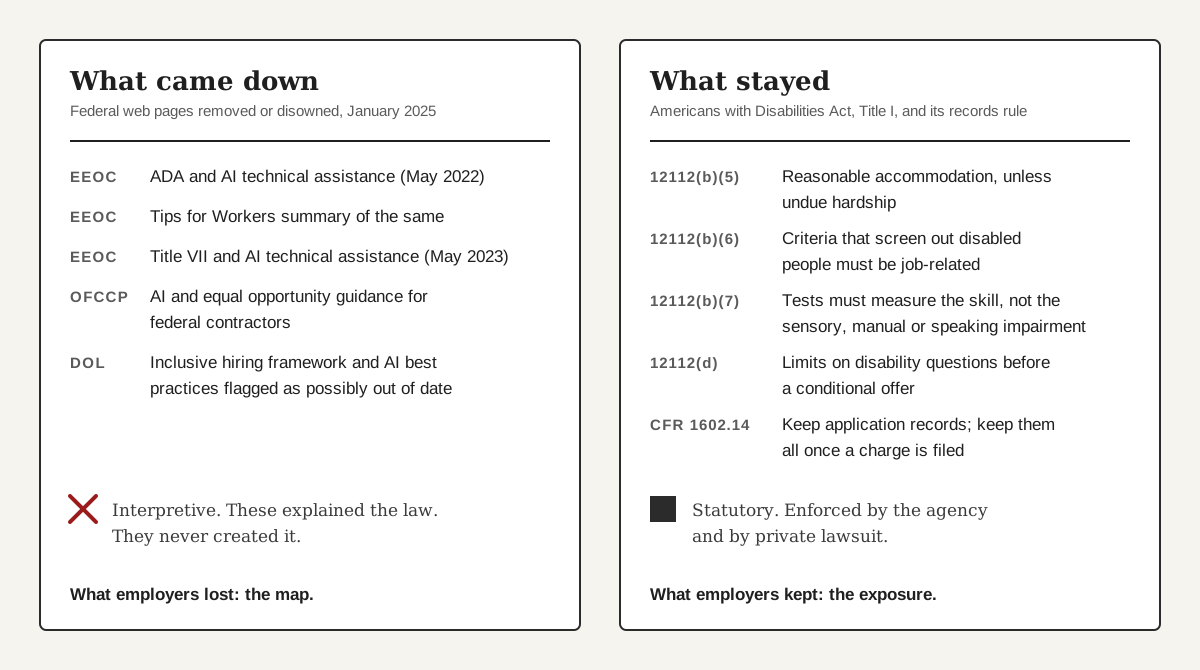
The employment consequences arrived within days. On 27 January the EEOC removed its AI materials from its website: the May 2022 technical assistance document on the ADA and the use of software, algorithms and artificial intelligence to assess applicants and employees, its companion Tips for Workers summary, and the May 2023 document on Title VII and AI selection procedures. The Office of Federal Contract Compliance Programs removed its guidance on AI and equal employment opportunity for federal contractors. The Department of Labor flagged that the AI and Inclusive Hiring Framework, published in September 2024 by the Partnership on Employment and Accessible Technology, and its own October 2024 AI best practices, may no longer reflect current policy.
A lot of commentary read those removals as good news for employers, a sign that exposure had dropped. That reading confuses guidance with law, and it is worth slowing down on why.
Guidance is not law
A technical assistance document is the agency explaining how it reads a statute and how it plans to use its enforcement discretion. It is useful. It is also optional, in the sense that it creates no obligation of its own and its disappearance extinguishes none. The obligation comes from Congress.
The Americans with Disabilities Act was signed in 1990. Its Title I prohibits discrimination against qualified people with disabilities in hiring, promotion and every other term of employment, and the specific duties that matter here have sat in the statute since the beginning. Section 12112(b)(5) requires reasonable accommodation unless it would impose an undue hardship. Section 12112(b)(6) prohibits qualification standards, tests and selection criteria that screen out people with disabilities unless they are job-related and consistent with business necessity. Section 12112(d) restricts disability-related questions and medical examinations before a conditional offer.
Then there is Section 12112(b)(7), which reads as though it had been written for automated video interviews thirty years early. It makes it discrimination to fail to “select and administer tests concerning employment in the most effective manner to ensure that, when such test is administered to a job applicant or employee who has a disability that impairs sensory, manual, or speaking skills, such test results accurately reflect the skills, aptitude, or whatever other factor of such applicant or employee that such test purports to measure, rather than reflecting the impaired sensory, manual, or speaking skills.” In plain English: if your test is supposed to measure tax knowledge, it is not allowed to end up measuring whether the candidate can hear.
The records rules did not move either. In April 2025 the Uniform Guidelines on Employee Selection Procedures, at 29 C.F.R. Part 1607, still told users of selection procedures to keep records of adverse impact and, where it existed, evidence of validity. The EEOC’s recordkeeping rule at 29 C.F.R. § 1602.14 still required employers to keep application records and, once a charge is filed, to keep everything relevant until the matter is finally resolved.
The exposure remains. The map is gone.
So what did January actually remove? Not liability. It removed notice. Employers lost the one document that told them, in plain language, which of their practices the agency considered risky and why. The exposure is exactly where it was. The map that showed where it was buried is gone, and an employer navigating without it is more likely to walk into it, not less.
Why the bias audit misses disability
The standard industry answer to algorithmic risk in hiring is the bias audit, and the standard metric is the four-fifths rule from the Uniform Guidelines. You compare the selection rate for one group to the rate for the most-selected group, and a ratio below 80 percent is treated as evidence of adverse impact. New York City’s Local Law 144, enforced since July 2023, requires an annual independent bias audit of automated employment decision tools and public posting of the results. Vendors increasingly hand those results to buyers as proof the product is safe.
For disability, that apparatus is the wrong instrument, and the problem is structural rather than a matter of doing the audit carefully. Group impact testing needs categories that are stable, known, mutually exclusive and large enough to compare. Race and sex roughly meet those conditions. Disability fails all four. It is so varied that one category means very little: a Deaf applicant, a blind applicant, an applicant with a motor disability and an applicant with a psychiatric disability share almost nothing in how they interact with an assessment. It is often undisclosed, because applicants have no duty to identify themselves and every reason not to. It is usually rare within any single requisition, so even where people do disclose, the numbers are too small to compare. And the ADA’s unit of analysis is the person, not the group. A screen-out claim asks whether a criterion tends to exclude an individual with a disability. A failure-to-accommodate claim asks what happened when one person made one request.
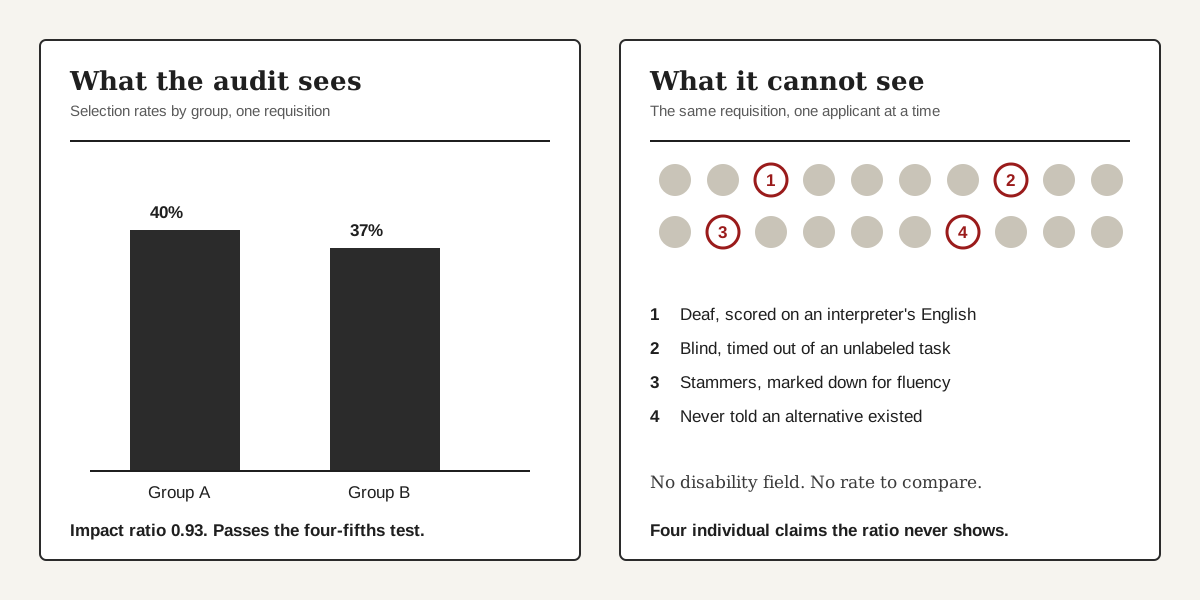
The consequence deserves to be said plainly. An automated selection system can pass every bias audit ever run on it, post an impact ratio comfortably above 0.80 for every category measured, and still be excluding disabled applicants one at a time, in ways that are individually actionable and statistically invisible. A bias audit is not evidence of ADA compliance. Presenting it as such, which is now routine in vendor sales material, does something worse than fail to help. It builds a documented record that the employer relied on an assurance that never addressed the risk.
The same caution applies to the claim, repeated in nearly every pitch deck, that algorithms reduce human bias and therefore level the playing field for disabled candidates. It may be true for some kinds of bias. There is no public evidence base showing it for disability, and the way these systems work points the other way. A model scores how closely a candidate resembles a distribution learned from past successful candidates. On the dimensions these systems most often measure, such as speech rate, fluency, eye contact and facial expression, disability is what being outside that distribution looks like.
Three obligations, not one
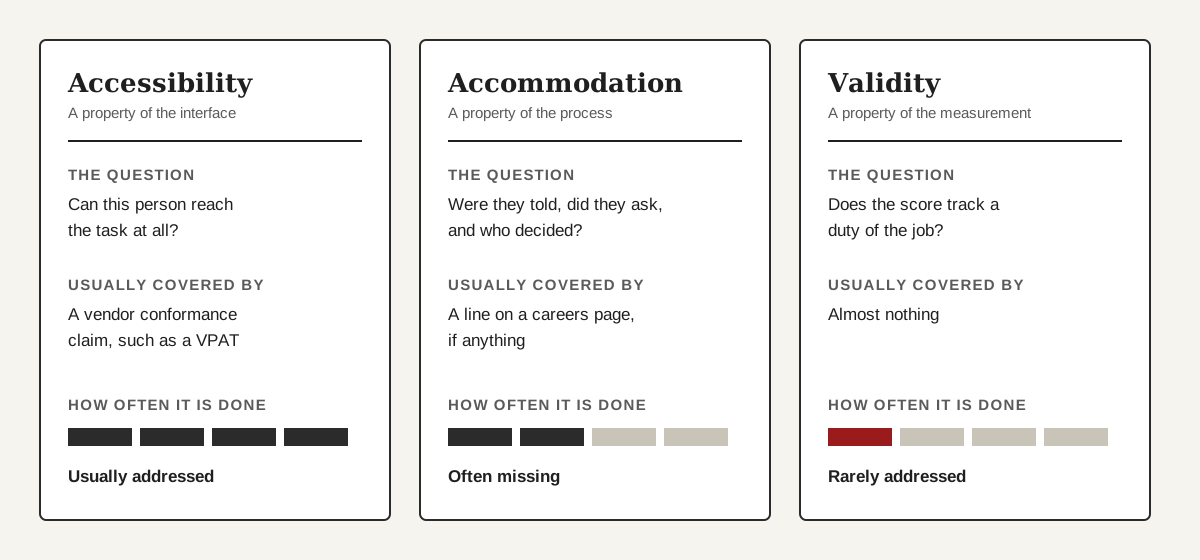
Most of the current conversation collapses three separate duties into one, and the compliance programs it produces tend to close one gap while leaving two open.
Accessibility is a property of the interface. Can the platform be used with a screen reader? Is the audio captioned? Can the timer be extended? These questions decide whether the candidate can reach the task at all. This is the layer most organizations have handled, usually by collecting a vendor’s conformance report and filing it.
Accommodation is a property of the process. Candidates have to be told, before the assessment starts, that modifications are available. A request has to start an interactive process, not trigger a form rejection. Someone with authority has to decide. And there has to be an alternative pathway that does not quietly penalize the person who used it. A platform can be technically accessible in every respect and still generate a failure-to-accommodate claim, because nobody told the applicant an alternative existed. D.K.’s case sits squarely here. She knew to ask. The question is what the process did with the asking.
Validity is a property of the measurement. Does what the system scores correspond to an actual requirement of the job? This is the layer almost nobody has touched, and it is where automated video and speech assessment is most exposed. If a system scores fluency, articulation rate, response latency, prosody, facial affect, or something labeled “communication” or “engagement,” the employer should be able to say which duty of the job requires that attribute and what evidence supports it.
The research on speech technology makes the validity gap concrete. Published studies document large word error rate disparities in automated speech recognition for speakers whose speech falls outside the training data, including Black speakers, speakers with atypical or disordered speech and deaf speakers. The University of Illinois launched its Speech Accessibility Project in 2022 precisely because the training data for those voices barely existed. The D.K. complaint cites research finding that several recognition systems performed about ten times worse for deaf and hard of hearing speakers. When a transcript like that becomes the input to a score, the score inherits every error.
I sign ASL, so I know the next problem from the inside. When I communicate through an interpreter, the English anyone hears is the interpreter’s English. The word choices are theirs. The pauses while they process what I signed are theirs. The places where they compress a long signed answer into a short spoken one are theirs. Put that through an automated interview and the system attributes all of it to me: the vocabulary, the latency, the “conciseness.” The tool produces a number with my name on it. It is not measuring me. Under Section 12112(b)(7), that is not a technicality. That is the exact harm the statute names.
The state layer, as of April 2025
Federal retreat does not clear the field, and in April 2025 the state calendar already mattered for planning. Illinois House Bill 3773, signed on 9 August 2024, amends the Illinois Human Rights Act to bar discriminatory use of AI across the employment lifecycle and to require notice when it is used, effective 1 January 2026. Colorado Senate Bill 24-205, signed on 17 May 2024, imposed duties on developers and deployers of high-risk AI systems used in consequential decisions, employment included, effective 1 February 2026, though the governor asked for revisions when he signed it and amendment looked likely. Virginia’s House Bill 2094, which would have built a similar framework, was vetoed on 24 March 2025. New York City’s Local Law 144 remained in force.
The direction of travel was already visible. The states were moving toward notice and disclosure rather than substantive duties of care. The safest planning assumption was that the obligations regulators would actually impose would be about saying what you do, and that the obligation to prove what you did would arrive through litigation instead. As the update below shows, that assumption held.
Was jetzt zu tun ist
None of what follows requires outside help. An existing human resources function can do all of it.
- Inventory every system that touches a selection decision
Include résumé parsing, ranking, knockout questions, chat-based prescreening and automated video or speech assessment. Include features switched on by default inside your applicant tracking system. Those are the ones people forget.
- Write down what each system measures and why the job needs it
For each tool, name the construct it scores and the documented job requirement it corresponds to. Where there is no answer, the tool is scoring an unvalidated criterion, and Section 12112(b)(6) applies.
- Tell candidates about alternatives before the assessment starts
The notice belongs on the assessment itself, before the first question, not on a careers page and not after a candidate has already failed.
- Pull every accommodation request tied to an automated assessment in the last 24 months
Record what was asked, who decided, what was provided and what happened to the candidate. This file will be produced in any charge. Read it before someone else does.
- Ask the vendor for validation evidence, in writing
Ask for validation for each scored construct, and for accuracy data broken out by speech and communication characteristics, including interpreted and captioned interviews. Keep the answer, including a refusal. A refusal is evidence of what the employer knew.
- Keep the scores and the configuration
Retain each score and the system configuration in force at the time of each decision for the full preservation period. A score computed to produce a ranking and then thrown away cannot be explained later.
- Put the bias audit in its place
Treat audit results as evidence about the categories they measured and nothing else. Do not present them as evidence of ADA compliance.
Eighteen months later
I wrote the original version of this piece in April 2025. Rereading it in October 2026, the thesis has held, and the federal retreat it described has gone much further than it predicted.
From guidance to statute alone, January 2025 to October 2026
- 27 Jan 2025EEOC removes its AI guidance
The 2022 ADA document, the Tips for Workers summary and the 2023 Title VII document come down. OFCCP removes its AI guidance.
- 19 Mar 2025Complaint filed against Intuit and HireVue
Filed with the Colorado Civil Rights Division and the EEOC on behalf of D.K. No public outcome as of this update.
- 23 Apr 2025Executive Order 14281
Restoring Equality of Opportunity and Meritocracy directs agencies to deprioritize disparate impact enforcement.
- 30 Sep 2025EEOC closes disparate impact charges
Pending charges resting solely on disparate impact are administratively closed, with right-to-sue notices to follow.
- 11 Dec 2025Executive order targets state AI laws
Ensuring a National Policy Framework for Artificial Intelligence creates a federal AI Litigation Task Force and names Colorado’s law as an example.
- 1 Jan 2026Illinois HB 3773 takes effect
Notice and anti-discrimination duties apply. Implementing rules proposed in May 2026 were postponed in June.
- 14 May 2026Colorado replaces its AI Act
SB 26-189 drops the duty of care and impact assessments in favor of notice, explanation and records, effective 1 January 2027.
- 22 Jun 2026ADA claim against Workday survives
A federal court lets an amended ADA claim over Workday’s screening tools proceed in Mobley v. Workday.
- 16 Oct 2026Uniform Guidelines rescission goes to White House review
The EEOC sends a final rule rescinding 29 C.F.R. Part 1607 for review, with an effective date projected for January 2027.
The biggest change is to the Uniform Guidelines themselves. In April 2025 I described them as still in force, and the four-fifths rule as the industry’s default metric. In June 2026 the Justice Department’s Office of Legal Counsel issued an opinion concluding that the Uniform Guidelines rest on an unconstitutional reading of Title VII as applied to disparate effects alone. On 16 October 2026 the EEOC sent a final rule rescinding its version of the Guidelines to the White House Office of Information and Regulatory Affairs, with the regulatory agenda projecting a January 2027 effective date. The Labor Department’s contractor version is being removed separately, and the Office of Personnel Management has already pulled Uniform Guidelines references out of federal hiring rules.
That sounds like the floor falling out. For Title VII disparate impact claims, it is a real shift in how the agencies will behave. For the disabled applicant, it changes far less than it appears to, and the reason is the whole argument of this piece. The four-fifths rule never worked for disability. Its rescission removes a tool that could not see disabled applicants in the first place. Section 12112(b)(5), (b)(6), (b)(7) and (d) are not regulations and are not up for rescission. Neither is the record retention duty in 29 C.F.R. § 1602.14, and neither is the right to sue. If anything, the employer who used to point at a passing audit now has even less to point at.
Rescinding the four-fifths rule removes a tool that could not see disabled applicants in the first place.
The states went exactly where the April 2025 version said they would. Colorado held a special session in August 2025 that pushed its start date to 30 June 2026, then in May 2026 replaced the law entirely. The new statute, SB 26-189, strips out the duty of care and the impact assessment requirement and puts disclosure in their place: notice before automated decision technology is used in a consequential decision, an explanation after an adverse one, and three years of records. Enforcement belongs to the attorney general, and existing anti-discrimination law still applies. Illinois’s law took effect on 1 January 2026, but the state’s human rights department postponed its implementing rules in June 2026, so employers have a notice duty without settled instructions on how to meet it.
| Jurisdiction | As of April 2025 | As of October 2026 |
|---|---|---|
| Illinois | HB 3773 signed; effective 1 January 2026 | In effect; IDHR rules proposed May 2026 and postponed June 2026 |
| Colorado | SB 24-205 effective 1 February 2026; amendment expected | Replaced by SB 26-189; disclosure and records only; effective 1 January 2027 |
| Virginia | HB 2094 vetoed 24 March 2025 | No comprehensive AI employment law |
| New York City | Local Law 144 bias audits in force | Still in force; audits still measure race and sex categories |
And the prediction that proof would arrive through litigation is playing out in court. In Mobley v. Workday, a federal judge in California certified an age discrimination collective in May 2025, and on 22 June 2026 refused to dismiss an amended ADA claim alleging that Workday’s screening tools could infer health status from signals such as medical leave. That case was not built on a bias audit. It was built on what the tools did to individual applicants.
What the withdrawal changed, and what it didn’t
Artificial intelligence can widen access to work for disabled people, and it already has. Real-time captioning, speech-to-text and adaptive interfaces open doors that were closed a decade ago, and the OECD’s 2023 review of AI and disability in the labour market documents those gains. They come from assistive uses, where the technology serves the person. They do not carry over automatically to evaluative uses, where the technology measures the person. Arguing from the first to the second is the central analytic mistake in this field, and vendors make it in almost every pitch.
The guidance that came down in January 2025 changed what employers are told. It did not change what employers owe, and eighteen months of further retreat have not changed it either. The employers who will be able to defend their hiring decisions are not the ones that bought the most sophisticated tool or posted the most reassuring audit. They are the ones that can say what their systems measure, why it matters to the job, what happened when a candidate asked for something different, and who decided. D.K. asked for captions. Every employer using automated assessment should be able to answer, from its own records, what it would have done with that request.
Quellen
American Civil Liberties Union, ACLU of Colorado, Public Justice and Eisenberg and Baum LLP, Complaint of Discrimination on behalf of D.K. against Intuit and HireVue, filed with the Colorado Civil Rights Division and the EEOC, 19 March 2025 (redacted). HR Dive, “AI hiring software was biased against deaf employees, ACLU alleges in ADA case,” March 2025. Americans with Disabilities Act of 1990, Title I, 42 U.S.C. § 12112(b)(5), (b)(6), (b)(7) and (d). 29 C.F.R. Part 1607, Uniform Guidelines on Employee Selection Procedures; 29 C.F.R. § 1602.14. U.S. EEOC, The Americans with Disabilities Act and the Use of Software, Algorithms, and Artificial Intelligence to Assess Job Applicants and Employees, EEOC-NVTA-2022-2, 12 May 2022, removed 27 January 2025. Executive Order 14148, 20 January 2025; Executive Order 14179, 23 January 2025; Executive Order 14281, Restoring Equality of Opportunity and Meritocracy, 23 April 2025; Executive Order, Ensuring a National Policy Framework for Artificial Intelligence, 11 December 2025. Franczek P.C., “EEOC to Close All Pending Disparate Impact Investigations by September 30, 2025,” 26 September 2025. DirectEmployers Association, “EEOC Sends UGESP Rescission to OIRA, with a January 2027 Effective Date in Sight,” 23 October 2026. Illinois House Bill 3773, signed 9 August 2024; Seyfarth Shaw, on the Illinois Department of Human Rights’ postponed rulemaking, June 2026. Colorado SB 24-205, signed 17 May 2024; Colorado SB 26-189, signed 14 May 2026, as summarized by Seyfarth Shaw and Goodwin Procter. Virginia HB 2094, vetoed 24 March 2025. New York City Local Law 144 of 2021. Mobley v. Workday, Inc., No. 3:23-cv-00770 (N.D. Cal.), order of 22 June 2026, as reported by Duane Morris LLP. OECD, Using AI to Support People with Disability in the Labour Market, 2023. University of Illinois Urbana-Champaign, Speech Accessibility Project, launched 2022.