
*A small pilot run with care, and a product being readied for places where the stakes are far higher*
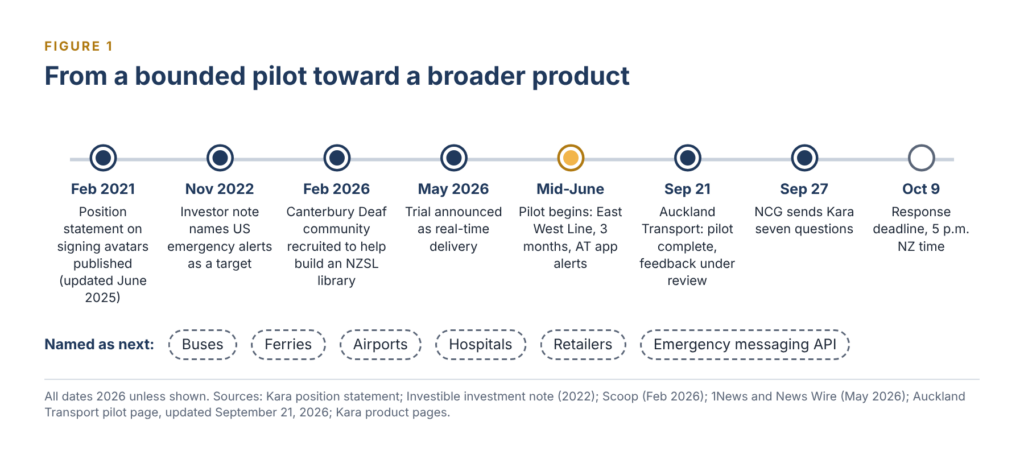
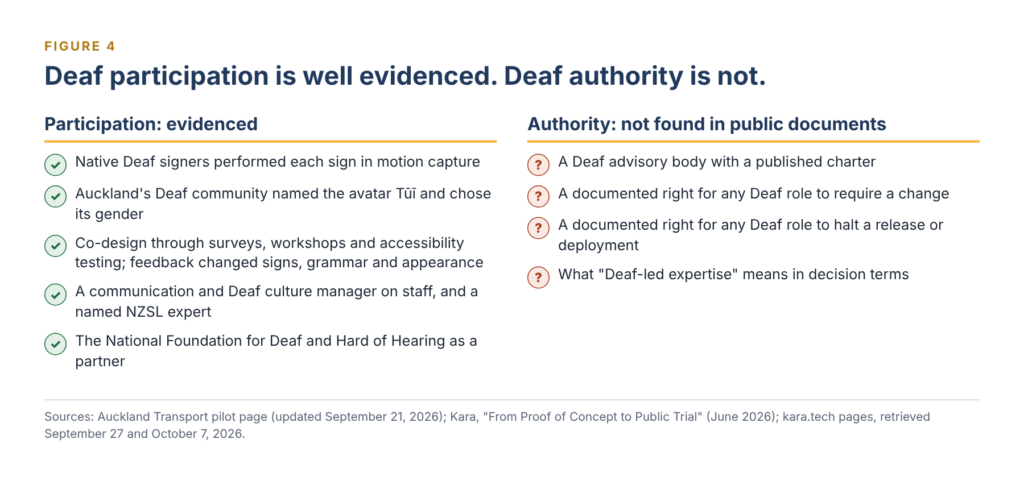
In the middle of June 2026, passengers on Auckland’s East West Line who opened the Auckland Transport app began to see something new. When a train was delayed or cancelled, a digital signer told them so in New Zealand Sign Language. Her name is Tūī, and no marketing team chose it. Auckland’s Deaf community named her, and chose her gender, at the Auckland Deaf Festival the year before. The signs she uses were performed by native Deaf signers wearing motion-capture sensors, one sign at a time, and Deaf people tested her and changed her: her sign choices, her grammar, her facial expressions, even the color behind her.
The pilot ran for three months, on one line, under the eye of a public transport authority that said in advance it would review the results before deciding anything more. On September 21, Auckland Transport posted that the pilot was complete. “We’re reviewing the feedback from the pilot,” its page says. “We’ll use what we’ve learned to look at future improvements and whether we can expand the service.” Of all the deployments of sign language AI that NCG has examined, none has been more carefully bounded than this one.
The trouble is not the pilot. It is everything the pilot is meant to lead to. Kara Technologies, the Auckland company that built Tūī, and the transport authority have named buses, ferries, airports, hospitals and retailers as possible next steps, and the company already offers signed emergency messaging through an API. Inside the pilot, Kara was governed by a public authority’s scope, timeline and review. Outside it, the product is governed by Kara’s own published documents. This piece reads those documents, and it finds a company whose practice, in one carefully watched place, is ahead of its paperwork everywhere else.
Wie dieser Bericht entstanden ist
NCG reviews sign language AI providers by one method, the one applied to Signapse in September. It reads what a company publishes, puts specific questions to it in writing, sends the company NCG’s understanding of any answers before publication, and publishes the result with every statement tied to a date and a document. On September 27, 2026, NCG sent Kara a pre-publication record and seven questions, addressed to its chief executive, Dr. Arash Tayebi, and to the colleagues named as contacts while co-founder Farmehr Farhour was away. The deadline was 5:00 p.m. New Zealand time on October 9. Kara did not respond by the deadline. Nothing in this piece alleges misconduct, and none of it is legal advice.
A pilot done properly
It is worth being precise about what Kara and Auckland Transport got right, because it is rare. The authority’s page names the product, Kara Auto Translate, which it describes as “an AI-powered system that can convert written English into NZSL video content within minutes.” It explains how the sign library was built, says plainly that the pilot was limited to one line for three months, and treats expansion as a decision still to be made. Kara’s own account of the trial, published in June, describes co-design through the authority’s accessibility group, with community surveys, workshops and testing that changed the product. That is evidence of participation coming from two directions, the vendor and the buyer, which is more than NCG has found for almost any other provider.
Kara has also put its position in writing. Its statement on signing avatars, first published in 2021 and updated in June 2025, engages directly with the World Federation of the Deaf and the World Association of Sign Language Interpreters, accepts their concerns about linguistic quality and live use, and commits that Kara has “no aspiration to ‘replace’ sign language interpreters in live settings.” It names emergency announcements as a suitable use “until a sign language interpreter is ready.” Few companies in this market argue with their critics in public. Kara does, and a buyer should give it credit for that.
The terms say no; the pages say yes
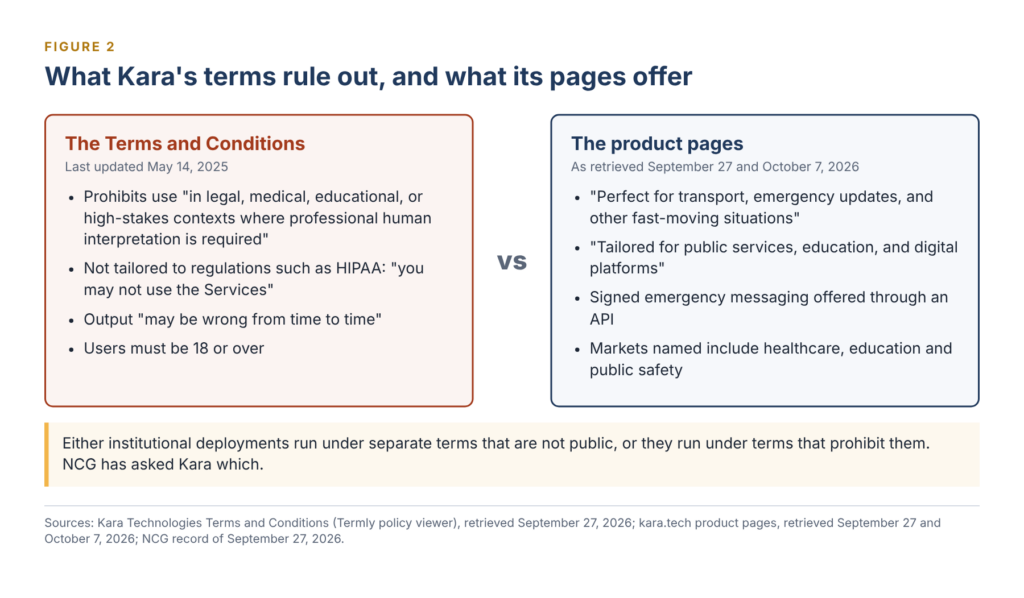
Kara’s Terms and Conditions, last updated May 14, 2025, are unusually candid about the product’s limits. They say its output “may be wrong from time to time” and that it “is not a substitute for professional interpreting services in contexts where precision or human judgment is critical.” Among the prohibited uses they list “using the service in legal, medical, educational, or high-stakes contexts where professional human interpretation is required.” They state that the services are not built to comply with industry rules such as HIPAA, “so if your interactions would be subjected to such laws, you may not use the Services.” And they restrict use to adults.
Kara’s AI Translation page, as retrieved on October 7, 2026, says something else. It calls the product “perfect for transport, emergency updates, and other fast-moving situations,” and describes solutions “tailored for public services, education, and digital platforms.” An emergency instruction is the highest-stakes message a signed language system can carry. A document that rules out high-stakes, medical and educational use cannot be the one governing an emergency alert, a hospital deployment or a school. Either Kara’s institutional customers sign separate terms that are not public, or they are using a product under terms that forbid what they are using it for. NCG has asked Kara which.
Where the words go
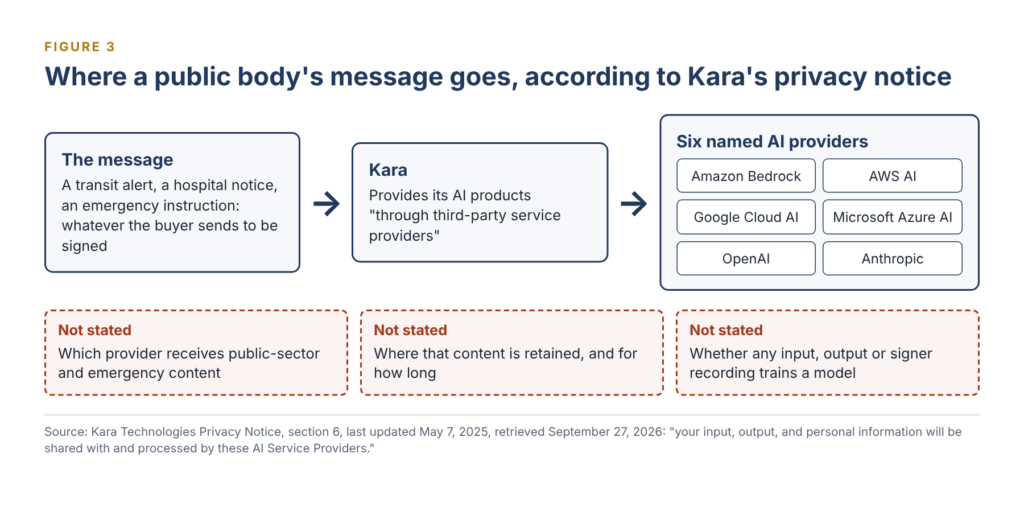
The terms are not the only document that reads as a template. Kara’s privacy notice, last updated May 7, 2025, says the company does not process sensitive personal information, while its own disclosure table records that it collects images, audio and video recordings. Its most consequential paragraph is section 6. Kara provides its AI products “through third-party service providers,” it says, and names six: Amazon Bedrock, Amazon Web Services AI, Google Cloud AI, Microsoft Azure AI, OpenAI and Anthropic. “Your input, output, and personal information will be shared with and processed by these AI Service Providers.”
For a sentence about a delayed train, that hardly matters. For a hospital notice, a benefits letter or an emergency instruction, the input is the very content a public body is sending to Deaf residents, and the notice does not say which of the six providers receives it, where it is kept, or whether any of it is used to train anyone’s models. A public buyer would not accept that answer about any other data it sends to a contractor, and it should not accept it here.
The people inside the avatar
Tūī’s signs came from people. Auckland Transport’s page says it directly: “Native Deaf signers perform each sign while wearing MoCap sensors that record hand shapes, movements, facial expressions and body movement.” Public reporting describes a library of more than 10,000 signs, and in February 2026 Kara recruited Canterbury Deaf community members to help build a national NZSL digital library and review avatar prototypes. Kara’s technology page says its avatars are “built using real sign language data.”
Nothing Kara publishes says who those signers are in role terms, what they agreed to, whether and how they are paid, or whether they can withdraw their recordings. That last question has an edge here, because Kara also offers custom avatars with selectable age, ethnicity, gender and facial features. Whether one person’s movement can be recombined into a figure of a different ethnicity or gender, and whether the person was asked, is not answered in anything public. The privacy notice does not mention motion-capture recordings or likeness at all. And the terms contain the same template feedback clause NCG found in Signapse’s: anyone who sends Kara “any question, comment, suggestion, idea, feedback, or other information about the Services” assigns it to the company, “without acknowledgment or compensation.” Whether that clause reaches the Deaf people who give feedback in Kara’s consultation sessions depends on what they signed, which is not public. Signapse, for comparison, publishes a royalty policy for signers whose likeness appears in its products. NCG could find no equivalent at Kara.
Participation, not yet authority
On Deaf involvement, Kara’s record is stronger than most. Deaf people performed the signs, named the avatar, tested it and changed it. The company employs a communication and Deaf culture manager, works with a named NZSL expert, and partners with the National Foundation for Deaf and Hard of Hearing. Its product page describes the service as combining AI “with Deaf-led expertise.”
What the public record does not show is power. There is no named Deaf advisory body, no published charter, and no document saying whether any Deaf person at Kara can require a change or stop a release when they disagree with the commercial side of the company. Being asked is not the same as being able to say no. In a single pilot, watched by a public authority and its accessibility group, the gap may not matter much, because the authority holds the brake. In a hospital or an emergency system, sold under Kara’s own documents, it matters a great deal. NCG has asked what “Deaf-led” means in decision terms.
What nobody has measured yet
Kara describes its output as “expressive, accurate, and culturally thoughtful,” delivered “with integrity and accuracy.” It publishes no figure, method, sample or denominator behind those words, and NCG has located no independent evaluation of Kara Auto Translate’s signing. Auckland Transport’s page also says nothing about whether anyone checks an alert before it reaches the app. The page describes the review of the sign library, not of the messages.
There is one way this could change soon, and it is the most hopeful thing in the record. Auckland Transport is reviewing the pilot’s feedback. If it publishes that analysis, and if the analysis measures whether Tūī’s signing was accurate rather than only whether passengers liked her, it would be the first independent evaluation of deployed sign language AI output that NCG has found anywhere. The authority has not said whether it will publish, or what it measured.
The same question, in a different country
The September review of Signapse and NCG’s follow-up on its rail signing ended on a single question: who can stop the output before it reaches a Deaf person? Kara answers part of it differently. Its rail work, like Signapse’s, turns written text into signing rather than listening to speech, and its pilot was more tightly bounded in public than any Signapse deployment NCG has reviewed. But the documents that will govern Kara’s product once it leaves the pilot are thinner than Signapse’s. The question is the same on both sides of the world. Only the evidence differs.
Was ein Käufer fragen sollte
A buyer considering Kara for anything beyond a transit disruption alert should ask for four things before signing:
– The terms that will actually govern the deployment, with the high-stakes prohibition either removed on a stated basis or kept and honored.
– A data-flow statement naming which AI providers receive the buyer’s content, where it is stored, for how long, and whether it trains any model.
– The agreements with the Deaf signers whose motion capture built the avatars, or a published policy equivalent to one, including consent, payment and withdrawal.
– The Auckland Transport pilot analysis, or the buyer’s own equivalent evaluation of signing accuracy, before any emergency or medical use.
Kara’s response
NCG put seven questions to Kara Technologies on September 27, 2026, with a deadline of 5:00 p.m. New Zealand time on October 9. Kara did not respond by the deadline. Its answers, if it sends them, will be published here.
Quellen
– Auckland Transport, “NZSL AT Mobile app alerts pilot,” last updated September 21, 2026, retrieved October 7, 2026.
– Kara Technologies, Terms and Conditions, last updated May 14, 2025, retrieved September 27, 2026.
– Kara Technologies, Privacy Notice, last updated May 7, 2025, retrieved September 27, 2026.
– Kara Technologies, “Position statement on the use of signing avatars,” February 16, 2021, updated June 2, 2025, retrieved September 27, 2026.
– Kara Technologies, AI Translation page, retrieved October 7, 2026; Hybrid Translation, Technology and Patents pages, retrieved September 27, 2026.
– Kara Technologies, “From Proof of Concept to Public Trial,” June 12, 2026, retrieved September 27, 2026.
– 1News, “AI avatars to deliver real-time NZ sign language translations,” May 8, 2026.
– Scoop, “Be Heard: Canterbury Deaf Community Asked To Help In Creation Of NZSL Digital Library,” February 13, 2026.
– Investible, “Investment Notes: Kara Technologies,” November 7, 2022.
– NCG, pre-publication record and questions sent to Kara Technologies, September 27, 2026.
– NCG, “Signapse: on the roadmap, not yet shipped,” September 26, 2026.
– NCG, “Signapse: A Stop Right, Stated for One Product,” October 7, 2026.