
A notepad, a text thread, and an idea
Confidence Ugolo’s idea started the way a lot of accessibility products start: a friendship that kept running into a wall. According to Techpoint Africa’s profile of Thatsign, published November 12, Ugolo had a deaf friend in his neighbourhood [6]. At first the two of them passed a notepad back and forth, and later they moved to text messages. Somewhere between paper and phone, Ugolo started wondering whether a machine could close the rest of the gap. Around 2024 he began researching the technology, the financing and the cloud services a sign language tool would need, and he enrolled in an applied computing programme at the University of South Wales to learn the AI skills he did not yet have.
Friends and family paid for the hardware. By early 2026 a small version of the prototype was running on a local server. The product is called Thatsign, it belongs to Ugolo’s Lagos and London company Techies Africa [5], and the team expects it to go live around mid-2027. It turns spoken or typed English into British Sign Language video, and it turns a person’s signing back into text or speech. The people it is built for are hearing parents and the deaf children they are trying to talk to.
This piece is not written to knock down a self-funded team that has not yet received outside money. Thatsign is a prototype that, by the profile’s count, knows thirteen everyday signs. It is not running on a national rail network or in an airport terminal. What earns it a full NCG Insight is not its size but its target. Most sign language AI on the market today sells itself into settings that vendors and buyers call low stakes: delay announcements, gate changes, marketing videos, website banners. Thatsign is aimed at the dinner table. For a deaf child, the dinner table is not low stakes. It is where language arrives on time or doesn’t arrive at all.
The profile’s headline statistic makes the point without meaning to. Citing the UK’s National Deaf Children’s Society, Techpoint reports that more than nine in ten deaf children are born to hearing parents. Most of those parents do not sign when their child is diagnosed. Whatever tool they reach for in those first years becomes, whether anyone intends it or not, their first sign language teacher. That is the standard this article holds Thatsign to, and it is a higher standard than the one most sign language AI has been asked to meet.
What Thatsign is, as of November 2026
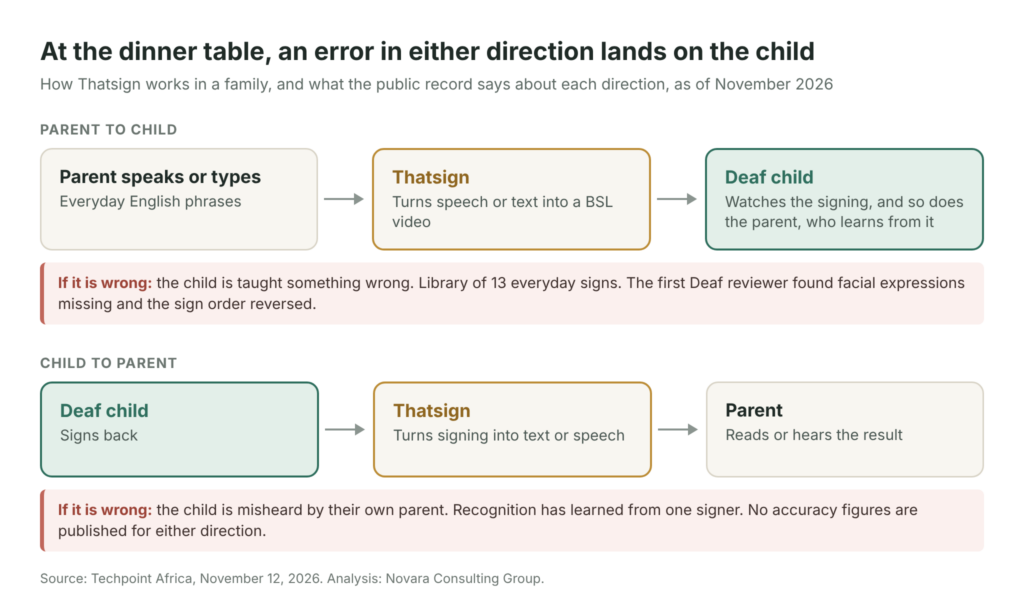
The product works in two directions. A parent speaks or types, and Thatsign plays the phrase back as a BSL video for the child. The child signs, and Thatsign turns that signing into text or speech for the parent. Techpoint describes the hope that the parent gets better at signing over time by watching the output. Ugolo told the outlet that Thatsign is not meant to replace trained signers or tutors, and that its job is to help families in the hours when a tutor is not there. The team says BSL is the starting point, with American Sign Language and Nigerian Sign Language planned next.
The vocabulary is small and the team says so. Techpoint reports that the tool currently knows thirteen everyday signs, built from more than 300 videos recorded in-house. The sign-to-text direction works, but it has learned from one signer so far. The team plans to record more deaf signers, including signers from different regions, since London BSL and Welsh BSL are not the same, and to hire professional signers once there is money to pay them. Ugolo leads the work with Joel Omojefe and Morrison Hodley alongside the engineering team, while David Asiru, Naomi Ogbonna and Peace Kanu handle partnerships and pilot planning.
The business model has three layers. Families get a free tier with basic words and limited daily use, and a subscription unlocks more words and longer use. After pilots, the team hopes councils and charities will pay so that families can use Thatsign free or at a discount, with prices varying by country. Businesses that build Thatsign into their own workflows would pay a subscription. The team is starting with families. Ugolo has applied to accelerators and funding programmes but has not received funding yet, and current costs come from friends and family.
One more fact matters for what follows. The Techpoint profile frames Thatsign as a family tool. The Thatsign listing on the Techies Africa site frames it more widely, under the tagline “Sign language for daily life: from the family dinner to the doctor’s office,” and lists medical appointments and school lessons among the settings it is meant for [5]. The site marks the product as coming soon.
What Thatsign gets right
Start with the data, because that is where much of this industry goes wrong first. Techpoint reports that the team began by testing with publicly available BSL material, and that Ugolo recognised it could not simply be used in a commercial product. So the team switched to recording its own signs in-house. That sounds like a small decision. It is not. The largest public BSL collection, the BBC and Oxford dataset known as BOBSL, was released by BBC R&D under a non-commercial licence [2], and its own documentation describes it as available for non-commercial research only [1]. Across the field, the line between “publicly available” and “licensed for a product” gets blurred all the time. Earlier this year another Nigerian and UK startup, Talksign, told TechCabal that its first model was trained on WLASL2000 [4], a dataset NCG has written about before because of its academic-use licence and the absence of signer consent. Thatsign looked at the same shortcut and walked the other way. A team running on family money chose the slower, more expensive road, and that deserves to be said out loud.
The second thing Thatsign gets right is that it listened, and changed course. Techpoint reports that the first outside reviewer, a certified first-language BSL user with about thirty years of signing behind them, found two problems in the early videos: the facial expressions were missing, and the sign order was reversed. A representative of a UK deaf organisation raised the same facial expression concern after a demo. Ugolo also reported feedback on finger visibility, the angle of the hands against the body, lighting, background and video quality. The team paused recording new phrases while it worked on those problems. In a market where vendors often answer Deaf criticism with a press release about community partnership, a team that stops production to fix what Deaf reviewers flagged is doing the basic thing correctly.
The third is candour. Ugolo told Techpoint the product is not meant to replace trained signers or tutors. He named a competitor, Signapse, and conceded that it is ahead on conference and broadcast plans. He was open about having no funding and a thirteen-sign library. None of that is a governance framework, and none of it settles whether the product is safe for the job it is aimed at. But a team that is plain about where it stands is a team that can be held to a standard, and that is a better starting point than most of what NCG reviews.
The dinner table is not low stakes
Go back to what that first Deaf reviewer found: no facial expressions, and the sign order reversed. In an announcement product, those are accuracy problems. A delay notice signed in English word order with a blank face is worse access than it should be, but the traveller still gets on the next train. In a family product the same two problems mean something else, because the output is not only being read. It is being copied. Thatsign’s own pitch is that the parent learns to sign by watching it. If the videos put signs in English order and leave the face flat, then what the parent learns is English order and a flat face, and that is what the child sees at home every day.
Facial expression is not decoration in BSL or any other signed language. It is grammar. The face marks questions. It marks negation. It changes the meaning of a verb, shows how big or how intense something is, and tells the watcher where one clause ends and the next begins. NCG named its first publication series The Fifth Parameter for this reason: handshape, location, movement and orientation are only four of the parameters, and the fifth, the non-manual channel, is where machine signing has failed most consistently. A tool that teaches parents signs without the face is teaching them a language with its grammar removed.
Now consider who is on the other side of the table. A deaf child of hearing parents depends on the people around them for language in a way no other child does. If the adults sign, the child has a language. If the adults sign badly, the child gets a broken model. If the adults rely on a phrase tool and never go further, the child gets a phrasebook. Deaf education researchers and Deaf communities have spent decades documenting what happens to children who do not get full language early, and none of it is low stakes. A product that sits in that gap, even with the best intentions, is sitting in the most developmentally sensitive spot in any Deaf person’s life.
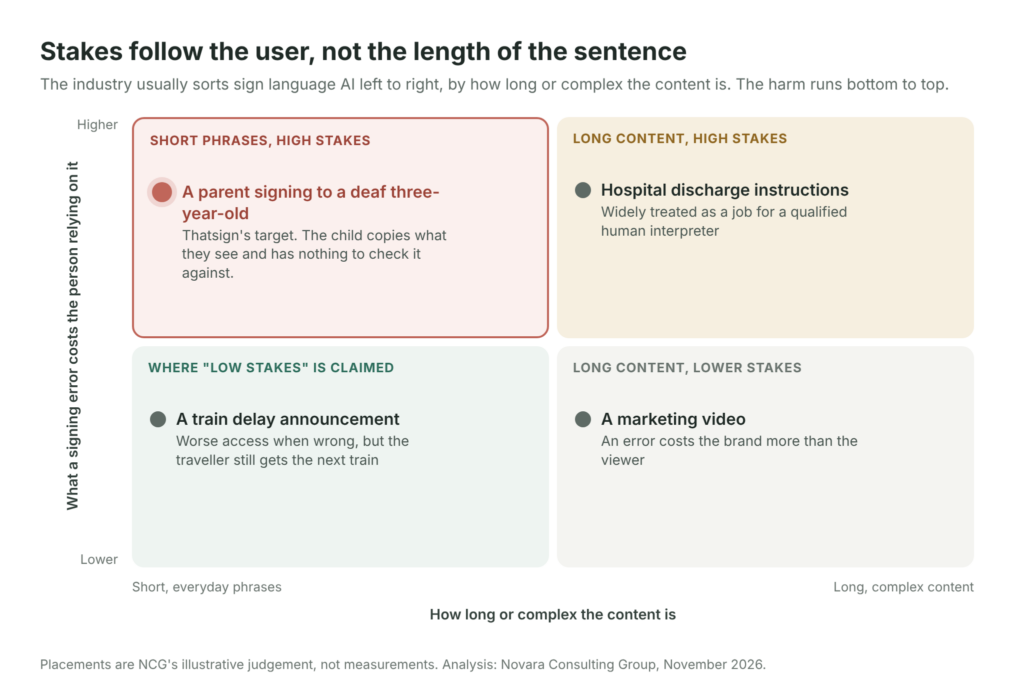
Stakes should follow the user, not the length of the sentence.
This is where the industry’s usual risk language breaks. Vendors and buyers tend to sort sign language AI by the content: short, predictable phrases are low risk, long and complex ones are high risk. Thirteen everyday signs would land in the low-risk pile every time. But the right question is not how long the sentence is. It is who is relying on the output, what they will do with it, and what happens to them if it is wrong. By that measure, a two-word phrase from a parent to a three-year-old can carry more weight than a full paragraph on a station screen. Stakes should follow the user, not the length of the sentence.
Who checks the signing
Ugolo told Techpoint that every sign is approved by a Deaf BSL consultant. That is the right instinct, and it is also where the public record stops. The profile does not say how many consultants there are, who they are, whether they are paid, or whether their approval can stop a sign from shipping. It does not identify any member of the named team as Deaf. None of those gaps proves anything is wrong. They are the questions any buyer would have to ask, because “a Deaf consultant approves it” can mean a paid Deaf linguist with veto power or a friend who glances at a clip, and the sentence reads the same either way.
The reviewers quoted in the profile show the same problem from another angle. Jephthah Adeleke, a deaf teacher, rated the prototype nine out of ten, called the signing clear and smooth, and said he would consider using it with loved ones. He suggested adding a way to sign and get written answers back, and Ugolo said that feature already exists and that Adeleke may have tested only the speech-to-sign side. The second named reviewer, Whitney Wey, is not deaf, has no deaf relatives, and has experience caring for people with a range of disabilities. She called the speed of turning short text into signing promising. Neither reviewer did anything wrong. The issue is what counts as evaluation. A hearing reviewer can judge whether a tool is fast and easy to use. She cannot judge whether the signing is correct, and a review of speed sitting beside a review of signing quality, with no difference marked between them, is how weak evidence starts to look like strong evidence.
The weakest link is the direction the profile spends the least time on. Thatsign’s sign-to-text side, Techpoint reports, has learned from one signer. Recognition trained on one signer has not seen how other people sign, and nothing in the profile suggests it has seen how children sign. Children do not sign like adults: their signing is still developing and full of the variations any learner produces. At the dinner table, that is the direction where the child is talking. If the tool misreads a child, the parent gets the wrong message from their own kid and has no way to know it. A speech-to-sign error teaches the child something wrong. A sign-to-text error means the child is misheard. Both land on the child.
The profile reports no accuracy figures, no test sizes and no benchmarks for either direction. Feedback is qualitative and informal, which is normal for a prototype at this stage. It is not normal for a product that will ask councils and charities to fund it, and that is the line Thatsign plans to cross.
Metered language
Freemium is the default business model for consumer apps, and a team with no funding has to make money somehow. That is not the problem. The problem is what freemium means when the product is a child’s access to their parent. Techpoint describes the free tier as basic words with limited daily use, and the paid tier as more words and longer use. Read that from the child’s side of the table. The number of things a parent can say in sign, and the number of minutes in a day they can say it, would depend on whether the household pays. A meal-planning app can ration recipes. A language tool for a deaf child is rationing conversation.
The questions here are concrete, and none of them is answered yet. What happens when a family hits the daily limit in the middle of a conversation? Which words sit behind the paywall, and who decided that? When a family stops paying, does the vocabulary the parent has been leaning on disappear overnight? None of these are reasons to give the product away for free. They are reasons to design the free tier around what a child needs every day, not around what nudges a parent to upgrade.
The council and charity layer changes the picture again. Thatsign’s plan is to run pilots, then ask councils and charities to fund families. The moment a council pays, Thatsign stops being a consumer app and becomes a public purchase, with public money behind it and a public body vouching for it to families. That is where NCG’s procurement work lives, and it is where the evidence standard gets set. A council that funds a sign language tool for deaf children on the strength of an informal pilot has, in effect, endorsed it as fit for the job. Parents will reasonably read that endorsement as a promise. Whoever designs those pilots, and decides what counts as success, is deciding the bar for every family that follows.
From the family dinner to the doctor’s office
The press profile and the company website do not describe the same product. Techpoint presents Thatsign as a family tool for the hours when a tutor isn’t around. Techies Africa’s site promises sign language “from the family dinner to the doctor’s office” and lists medical appointments among the places it belongs. A thirteen-sign library is nowhere near ready for a doctor’s office, and the team almost certainly knows that. But marketing lines become buyer expectations, and buyer expectations become deployments. A clinic short on interpreters that sees “doctor’s office” on a vendor page is the buyer most likely to try it there. If the product is not for medical settings, the safest thing the company can do is say so in its marketing and in any contract, before somebody puts it between a deaf patient and a diagnosis.
Then there is the data, and this time it is children’s data. A camera-based sign language tool for families records a child’s hands and face. In a signed language the face carries grammar, so the face is not incidental footage the system could do without. It is part of the input. The Techpoint profile says nothing about how Thatsign handles that video: whether it is stored, where, for how long, whether it is used to train the model, and whether a family can have it deleted. The team does say it plans to record more deaf signers to grow the dataset. Families deserve to know whether their own child’s signing is part of that plan, and to say no to it.
There are working examples of other choices. When Google DeepMind launched its sign-to-text model in Gboard and Live Transcribe this August, it said the system sends only pose landmark coordinates to the server and lets the original video be discarded right away [3]. That is one company’s claim, not an audit, but it shows privacy can be designed in from the start rather than bolted on after a council asks. Under UK law, an online service likely to be used by children also has to meet the Information Commissioner’s Office children’s code. A prototype on a local server doesn’t face that yet. A subscription product sold to families in 2027 will.
What a council or charity should ask before mid-2027
Thatsign’s plan runs through pilots with councils and charities, so those buyers will set the bar. These are the questions NCG would want answered in writing before any public body funds a family sign language tool, Thatsign or anyone else. Figure 3 shows how far the current public record goes toward answering them.
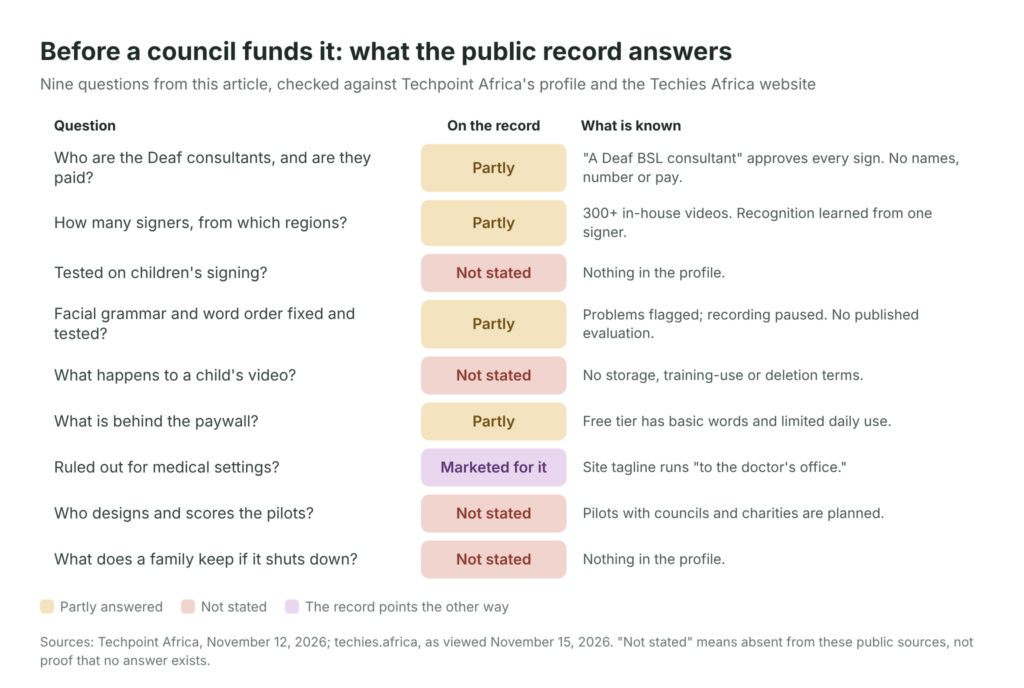
- Who are the Deaf consultants, how many are there, are they paid, and can they block a sign or a release?
- How many signers are in the recording set, from which regions, and are any of them first-language signers who grew up with BSL?
- Has the sign-to-text side been trained and tested on children’s signing, and if not, what is the plan before children use it?
- Does the output now carry facial grammar and BSL word order, and what independent evaluation by Deaf first-language users shows it, with how many testers and how many phrases?
- What happens to a child’s video: is it stored, where, for how long, is it used to train the model, and how does a family delete it?
- What is withheld from the free tier, and what happens when a family hits the daily limit or stops paying?
- Is the product intended for medical, school or legal settings? If not, is that written into the marketing and the contract?
- Who designs and scores the pilot, what counts as success, and will the results be published?
- If the company folds or the product is withdrawn, what does a family keep?
A vendor that can answer most of these clearly is a vendor worth piloting. A vendor that can’t answer them yet is not a bad actor. It is simply not ready to be bought with public money for deaf children.
The notepad never taught anyone the wrong word order
Thatsign is earlier, smaller and more honest about its data than much of what NCG reviews. Its team turned down a licensing shortcut that others have taken. It stopped production when Deaf reviewers told it the signing was wrong. Those are real points in its favour, and if the product reaches families in 2027, they will be part of the reason it deserves a fair hearing.
But good instincts at the prototype stage are not the same thing as evidence at the purchasing stage, and a family tool for deaf children needs the second. The usual risk framing in this industry would wave Thatsign through as low stakes: short phrases, everyday words, a parent at home. That framing has it backwards. The shorter the phrase and the younger the child, the more the signing has to be right, because the child has nothing to check it against.
The story Thatsign tells about itself begins with two neighbours and a notepad. The notepad was slow and clumsy, and it could never carry the warmth of a real conversation. But it never taught anyone the wrong word order, and it never left a face out of the grammar. Whatever replaces it at a deaf child’s dinner table has to clear at least that bar.
Riferimenti
- Albanie, S., Varol, G., Momeni, L., Bull, H., Afouras, T., Chowdhury, H., Fox, N., Woll, B., Cooper, R., McParland, A., and Zisserman, A. (2021). BBC-Oxford British Sign Language Dataset. arXiv:2111.03635. https://arxiv.org/abs/2111.03635
- BBC Research and Development. (2021). BBC-Oxford British Sign Language Dataset (BOBSL) released under a non-commercial licence. https://bbc.in/3HIlw6v
- Google DeepMind. (2026, August). Putting sign language AI into users’ hands. https://deepmind.google/blog/putting-sign-language-ai-into-users-hands/
- Adoyi, J. (2026, February 16). Nigerian-UK startup launches AI tool translating sign language to speech and text. TechCabal. https://techcabal.com/2026/02/16/talksign-launches-real-time-sign-language-translation-model/
- Techies Africa. (2026). Techies Africa: Cross-continental digital infrastructure, Thatsign listing. Viewed November 15, 2026. https://techies.africa/
- Techpoint Africa. (2026, November 12). 9 in 10 deaf children are born to hearing parents. Thatsign wants to bridge the communication gap. https://techpoint.africa/feature/thatsign-to-bridge-communication-gap/
Tips
NCG welcomes confidential tips about sign language AI deployments, procurement decisions and vendor practices, including how training data is collected, how signers are paid and how products are tested, at tips@novaracg.com. For readers in the United Kingdom: writing to NCG is not, by itself, a protected disclosure under the Public Interest Disclosure Act 1998. If you are considering whistleblowing about your employer, independent advice is available from Protect at protect-advice.org.uk.