
On 12 October I filed one ADA complaint against Cincinnati/Northern Kentucky International Airport. Fourteen days later the airport wrote back to say it had taken its AI sign language announcements off the terminal train screens, and that they will not return until they pass a review that includes Deaf ASL users. The vendor never answered my question, and Kentucky would not release the contract. The complaint got results.
A train, a screen and a signer
CVG is built like a lot of American hub airports. You land at a concourse or check in at the main terminal, and somewhere between the two you go underground and ride a train. The ride is short, a few minutes at most, but the decision you make on the platform is the one that decides whether you reach your gate or end up at baggage claim with your connection boarding somewhere above you. So the platform is wired for one job: telling you which train is coming and where it is going. There is a screen with the next train and its destination, and there is the public address system saying the same thing out loud.
For a hearing traveler that information arrives twice, in two forms, at the same moment. If the screen is hard to read from where you are standing, the voice fills the gap. If the voice is garbled by an echoing tunnel, the screen fills it. Nobody designed that redundancy as an accessibility feature. It is simply how airports talk to people, and it works so well that most travelers never notice they are cross-checking two sources every time they board.
A Deaf traveler gets one of those two. The public address system is noise she cannot use, so the screen carries the whole job. I know that platform logic from the inside. I am DeafBlind, with a form of retinitis pigmentosa that takes away my vision above eye level, and airports mount their most important information exactly where airports assume eyes go, overhead. Every trip through a terminal is a negotiation with signage that was placed for someone else’s body. When an airport adds anything that puts information in a form I can use, I notice, and I am grateful for it.
That is what CVG set out to do. Through its partnership with Signapse, a company that builds AI sign language for transport and public spaces, the airport added an American Sign Language signer to its screens. Signapse’s own case study describes ASL on flight screens, in high-traffic areas and on the terminal train, with departure and safety information for passengers moving between the terminal and the concourses. On the train platform, beside the written announcement, a signer named Max would deliver the same information in ASL. The airport’s stated hope was to ease anxiety for Deaf passengers. On paper, it was exactly the kind of thing I have spent my career asking institutions to do.
The trouble with a second channel is that it has to say the same thing as the first. Two sources that agree are redundancy. Two sources that disagree are a problem the traveler has to solve on her own, on a platform, with a train arriving.
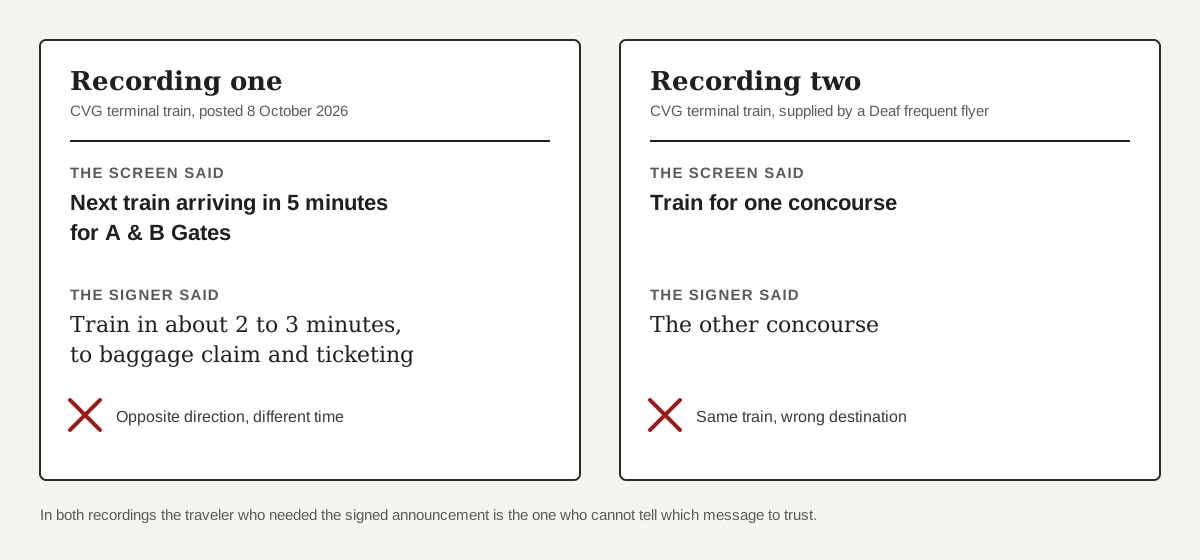
The demo that showed the error
The first recording did not come from a frustrated passenger. It came from a product demonstration. On 8 October a video posted on LinkedIn showed Max on the CVG train screen as an example of the technology at work. I watched it the way I watch every sign language AI demo, which is twice: once for the signing, and once for everything around the signing.
The second watch is where it fell apart. The screen text read “Next train arriving in 5 minutes for A & B Gates.” Max, in clear and fluent-looking ASL, announced a train arriving in two to three minutes for baggage claim and ticketing. Different time, different destination, opposite direction of travel. The signing itself was not the problem. If you watched only the signer, it looked polished. The problem was that the signer and the screen were giving a Deaf traveler two different trains, and the video had been posted as a showcase.
That detail matters more than it seems. A demo is the moment a vendor is most confident in its product, the clip it chooses to show the world. If the showcase carried a contradiction that nobody caught before it was posted, then nobody was checking the signed output against the screen it played on, not on the platform and not in the marketing. I published “The Sign Said Something Else” that day. The argument was narrow on purpose: I did not claim the AI could not sign. I claimed that nothing in the system appeared to confirm that the signed announcement matched the written one before both reached a live screen, and that a wayfinding message without that check is a liability, not an accommodation.
One recording is an incident, though. Systems fail. Clips get mapped wrong and get fixed. I said in that first piece that I could be looking at a one-off, and I meant it.
The second recording
Four days later Henri Grau sent me another one. Henri is Deaf, flies through CVG often, and rides that train as an ordinary passenger. In the public conversation that followed the first article he shared a recording of his own, made on the same platform. In it the signer named Concourse A for a train that was serving Concourse B.
Henri was generous about it. He said the signed announcement was nice to have while waiting, and that the mismatch was probably a minor glitch that could be fixed. I took that seriously, because he is a Deaf man who uses that train and I am not. And for him, it probably is minor. He knows the airport. He knows which concourse his flight leaves from. He can watch Max say the wrong thing, shrug, read the text and get on the right train. The signer costs him nothing when it is wrong because he never needed it to be right.
But accessibility is not measured by the traveler who could manage without it. It is measured by the one who could not. Picture the Deaf woman connecting through Cincinnati for the first time, forty minutes between flights, a gate letter on her boarding pass and no idea which way the train runs. She is the person the signer was installed for. She is also the person least able to tell when it is wrong. For her it is not a glitch. It is the airport, on its own screen, in her own language, pointing her the wrong way.
Before I worked on sign language AI, I worked in quality assurance problem management at the American Red Cross, doing root cause analysis on quality issues that kept coming back. The first rule of that work is that you do not treat a repeat as bad luck. One defect is an event. Two defects of the same kind, with different specifics, in the same system, within days, is a process telling you something. The first recording was a wrong time and the opposite direction. The second was the wrong concourse on the same line. Those are not the same mistake made twice. They are two different mistakes of the same type, and the only thing they share is that nothing caught either one. That is what a missing control looks like. I wrote it up as “The Check Is Still Not There” and published it on 12 October, and then I decided that writing about it was not enough.
Why I filed instead of waiting
Articles change minds slowly. A deployed system on a live platform changes nothing until someone with authority over it decides to act, and the people with that authority at CVG had no obligation to read NCG’s Insights page. A complaint is different. An airport that takes federal money has a published civil rights procedure, a named coordinator, deadlines and a duty to forward complaints to the FAA. A complaint is the one document the airport cannot leave unread.
The law was not a stretch. Title II of the Americans with Disabilities Act requires a public entity such as an airport board to ensure that communication with people who are deaf is “as effective as communication with others,” and the regulation at 28 CFR 35.160 builds its whole effective communication standard on that sentence. The Department of Transportation’s Section 504 rules for airport operators, at 49 CFR 27.71, require terminal information systems to get the same information to passengers with hearing loss that everyone else receives. A hearing traveler at CVG got the right train from the screen and the voice. A Deaf traveler watching Max on those two days got the wrong one. That is the gap the law exists to close.
I wrote the complaint on 12 October, the same day as the second article, and sent it to the Kenton County Airport Board’s Title VI coordinator. I named the two recordings as two acts, cited both regulations, and filed it on behalf of the Deaf travelers who rely on those announcements. I asked the Board to process it under its published procedure, including the referral to the FAA. Then I asked for three specific things, because a complaint that only says “this is bad” gives an institution nothing to do.
First, suspend the signed announcements on live wayfinding screens until the Board can show that each signed clip is checked against the current display text before it plays, and that disagreements are suppressed and logged. Second, tell me in writing what input drives the signed announcement on the train screens, and what verification, if any, took place before the system went live. Third, have the announcements reviewed by Deaf ASL users before they return, and give passengers a way to report a wrong one. I offered both recordings and a written analysis and said I would cooperate fully with the Board and with the FAA.
The Board acknowledged the complaint that afternoon and asked for a mailing address so it could send notices by post as well. That was the last I heard from the airport for two weeks.
Three doors, and the one that opened
The complaint was not the only door I knocked on that week, and the difference between the three is the most useful thing in this story for anyone who buys or regulates these systems.
The first door was the vendor. Before publishing the second article I put one question to Signapse and to CVG: what input drives the signed announcement on the train screens, the public address audio, the display text or a scheduled trigger? It is the question that decides where the fault lives, and the vendor is the party that knows the answer without investigating anything. Signapse’s chief executive replied the next morning that “CVG are investigating the issue and we will be in touch with an update once it is resolved.” It was courteous, and it answered nothing. Two weeks later no update has come, and the question is still open.
The second door was public records. The same day I asked the Kenton County Airport Board, under the Kentucky Open Records Act, for the Signapse contract, the procurement file, and the testing and complaint records. Those documents would show what CVG bought, what it was promised about accuracy, what it tested before go-live and whether anyone had already reported a wrong announcement. On 19 October the Board declined, because Kentucky’s statute extends its right of access to Kentucky residents and NCG is in Minnesota. A public airport’s contract for a public accessibility system is, for now, out of my reach on a residency technicality. The third door was the civil rights complaint, and it is the one that opened.
| Route | Sent | Response | Result |
|---|---|---|---|
| Question to the vendor | 12 October | Promise of an update (13 October) | No answer to the question; no update since |
| Kentucky open records request | 12 October | Declined on residency grounds (19 October) | No records released |
| ADA Title II and Section 504 complaint | 12 October | Acknowledged same day; follow-up 26 October | Signer removed from train screens; review with Deaf ASL users; referred to FAA |
Look at what that table says about accountability for this technology right now. The vendor, who knows how its product works, did not explain it. The transparency law, which exists so the public can see what its institutions buy, did not apply to me. The only mechanism that produced action was federal civil rights law, the oldest and bluntest tool in the box, and it worked because the airport had a legal duty to respond to it.
And look at who could use it. The route that worked required someone who knew which regulations to cite, had the time and the written English to draft a formal complaint, and was willing to put her name and her company’s name on it. I live more than seven hundred miles from that platform. A Deaf traveler standing on it, watching Max send her the wrong way, had no button to press, no code to scan, no number to text and no sign telling her who to tell. The recordings reached the airport because people posted them online and someone outside the airport turned them into paperwork. That is a win for Deaf travelers at CVG. It is also proof that the system had no way of hearing from them on its own.
Fourteen days
CVG Airport Authority personnel have removed the signed announcements on our train boarding screens to review them for accuracy.
CVG Airport Authority, 26 October 2026
On 26 October CVG’s Title VI/ADA Coordinator, Meleia Michels, wrote back. Her letter says the airport’s internal team has been working with its contracted partners on “both input and connectivity accuracy of the platforms,” and that CVG “will return this resource back to service only after this review has been successful.” It says the review “is intended to include Deaf ASL users as well.” It says a copy of the complaint and a statement of activity have gone to the Federal Aviation Administration, that the matter will be processed as an ADA complaint rather than under Title VI, and that a final notification of the investigation’s results will follow thirty days after filing, which puts it around 11 November.
I read it three times, because I have filed enough accessibility complaints in my life to know what the usual answer looks like. The usual answer is a thank-you, a promise to look into it, and a final letter months later explaining that the institution’s practices comply with the law. This was not that. An American airport took an AI accessibility system out of service, on its own screens, fourteen days after one written complaint. It did not wait for a lawsuit, a news story, a federal finding or a second complaint. It did not argue that the signer was helpful on balance. It accepted that a wayfinding announcement that is sometimes wrong should not be running while anyone works out why, and it committed to putting Deaf ASL users into the review that decides whether it comes back.
That is the call NCG asked airports to make on 12 October, almost word for word, and CVG made it. The airport deserves real credit. So does Henri, whose recording turned one incident into a pattern. So does whoever posted the first video, even though that was not what they meant to do.
It is also a loss, and I will not pretend otherwise. Max did more than wayfinding. Deaf travelers at CVG who were used to seeing welcome and safety information in ASL on that platform now see text only. Some of them liked having him there, and their view counts. The point of the complaint was never to get rid of signed announcements. It was to make sure that when a Deaf traveler sees one, she can act on it. A screen that shows text only is a step back in access. It is also, for the first time in this story, an honest screen.

| Zapytanie | What CVG has done | Still open |
|---|---|---|
| Suspend signed announcements on live wayfinding screens | Removed from train boarding screens pending review | Whether the signer remains on other screens |
| Check each clip against the live display text and log mismatches | Reviewing input and connectivity accuracy with its partners | Whether a check is built and what it logs |
| Disclose what input drives the signer and what was verified before launch | Not yet answered | Expected in the final notice |
| Deaf ASL users review before return | Review intended to include Deaf ASL users | Who they are and what they judge |
| A passenger route to report a wrong signed announcement | Not addressed yet | Whether one is added |
What “input and connectivity” points to
CVG’s letter does not say what failed, and I do not know. What follows is interpretation, not a finding, and I will say so plainly so nobody mistakes it for one. But “input and connectivity accuracy” is the first official signal of where to look, and it points away from the signing itself and toward the plumbing around it.
A signed announcement on a train platform is the last step in a chain. Something in the airport’s systems reports the train’s status. Something selects or builds the signed clip that matches it; as far as Signapse’s public material describes its transport product, that means choosing from pre-built signed content mapped to announcement triggers rather than translating speech live. Something then sends that clip to a particular screen at a particular moment. The written text beside it may come down a completely separate branch of the same chain, from a different system with its own timing.
If those branches fall out of step, or one of them is working from stale data, or the clip is routed to the wrong screen, every component can behave exactly as designed and the passenger still sees two different messages. The signing can be flawless. The text can be correct. The traveler is still standing between them. That is why the first article said the failure was not in the signing but in the absence of a check, and CVG’s wording fits that reading better than any other.
The fix is not exotic. It is the kind of control any safety-minded engineer would put on a wayfinding system: before a signed clip plays, the system confirms that it says the same thing as the text on that screen, same train, same time, same destination. If it does not, the clip is held back and the mismatch is written to a log that a person has to review. The traveler sees one message, and it is right. The airport gets a record of every time the two branches disagreed, which is exactly the record nobody had for those two days in October.
Where the check belongs on a train platform screen
- Train status changes
The airport’s system reports which train is coming and where it goes.
→ Screen text updates - Screen text updates
The written announcement on the platform screen changes.
→ Signed clip selected - Signed clip selected
The signing system picks or builds the ASL announcement, possibly from a different input.
→ Clip matches the screen? - Clip matches the screen?
The reconciliation check: same train, same time, same destination.
Yes → Play the signed clipNo → Suppress and log - Play the signed clip
The Deaf traveler gets one message, and it is right.
- Suppress and log
Text only for that announcement, and a record someone has to review.
The joint nobody demos
If the fault sits in input or connectivity, it lives in the joint between the vendor’s product and the airport’s systems, and that joint is the one place a sales demo never shows. A vendor can film flawless signing in a studio. It can show a buyer a library of beautiful clips. What it cannot show in a pitch meeting is what happens when its system is wired into a real airport’s train data, with that airport’s delays, outages, schedule changes and edge cases. The passenger only ever meets the deployed system. That is why a polished demo proves nothing about a platform screen in Cincinnati, and why the question I asked Signapse matters more than any question about handshapes.
Signapse’s own 2024 case study of the CVG deployment is a good example of how the field talks about itself. It describes where the ASL appears and quotes the airport’s hope of easing anxiety for Deaf passengers. It says nothing about how the signed output is checked against the information it is supposed to carry, who reviews it, or what happens when it is wrong. That silence is not peculiar to one company. In NCG’s review of public evidence from sign language AI vendors for the SLAT Index, we have not found a vendor that publishes an independent evaluation of its signed output as deployed, and we have found almost no routes by which a Deaf user can report a wrong output and see it corrected. CVG is what that gap looks like when it reaches a platform.
That puts the burden where it belongs, on the buyer’s contract. An airport cannot rely on a vendor’s marketing to tell it whether the integration works, and it cannot rely on its own staff, most of whom do not sign, to notice when the signer is wrong. It has to write the check, the review and the reporting route into the terms before go-live, and it has to decide in writing who owns the joint.
What “successful” has to mean
CVG has promised that the signer returns only after a successful review. Everything now depends on that word. A review that confirms the clips play, the screens light up and the vendor is satisfied would put the same fault back on the platform with a new stamp of approval, and the next Deaf traveler sent the wrong way would have even less reason to doubt it.
The most important condition is who does the judging. “Deaf ASL users” can mean a lot of things. It can mean fluent Deaf signers recruited independently, given the screen text and asked whether each announcement means exactly the same thing. It can also mean one Deaf employee of the vendor nodding at a demo. Deaf review is not a box to tick. A hearing engineer cannot tell whether a signed clip names the right concourse, and a vendor cannot grade its own output and call it a review. The people who rely on the announcement have to be the ones who decide whether it is right, and they have to be free to say no.
The second most important condition is that “successful” gets written down before the signer comes back. Without a standard, success is whatever the airport and the vendor agree it was. With one, anyone outside the airport can check.
| Condition | Why it matters | How CVG could show it |
|---|---|---|
| Each clip checked against the live display text before it plays | Stops the exact failure in both recordings | A description of the check and a sample of its mismatch log |
| Fluent Deaf signers independent of the vendor | A vendor grading its own output is not a review | Who the reviewers are and how they were chosen |
| Reviewers judge meaning not playback | A clip can play perfectly and say the wrong thing | The test script and what counted as a pass |
| A written accuracy standard before return | Gives the word successful a definition someone outside can check | The standard itself published with the outcome |
| A passenger reporting route on the platform | Catches the failure the review misses | A posted route with a named owner and response time |
When I answered the 26 October letter I put the two hardest of these to CVG directly: whether the Deaf reviewers will be fluent signers chosen independently of the vendor, checking the signed content against the meaning of each announcement and not only whether it plays, and whether CVG will write down the accuracy standard the announcements have to meet before they return. I also asked for the final notice by email and for the FAA’s reference number.
None of this asks CVG to give up on signed announcements. AI signing on airport screens is not unacceptable in itself, and plenty of Deaf travelers want more ASL in public spaces, not less. I am one of them. It has to be evidenced, and the evidence that matters is simple: it says what the screen says, every time, on the screen where it plays.
This is not about one airport
CVG is not the only operator showing AI signed announcements. Signapse has published case studies of other US airport deployments, including Gerald R. Ford International in Grand Rapids, and other vendors are selling into transit, stadiums and public buildings. I am not saying those screens have the same fault. I have no recording from them. I am saying that every one of them can be asked the CVG question, and every Deaf traveler using them deserves to know the answer.
So that is what I am going to do. I intend to put the same question to US operators running AI signed announcements on wayfinding screens: is each signed clip checked against the live screen text before it plays, and is every mismatch logged? Where the answer is yes, with a log to show it, I will say so publicly. Where it is no, or where nobody answers, the complaint process that worked at CVG exists everywhere a public entity takes federal money.
That is not a campaign against AI signing. It is the ordinary accountability every other piece of public wayfinding already lives under. A departures board that twice showed the wrong gate would come down the same day. A signed announcement deserves the same standard, because the people reading it deserve the same trains.
What happens next
The final notice is due around 11 November. When it arrives I will publish what it says, including whatever it reveals about what drives the signer and what went wrong. Signapse’s promised update remains open, and any response from Signapse or CVG will be published in full, as with the earlier pieces in this series. The records request is not finished either. The contract and the testing file still matter, because they will show what CVG was promised before the first Deaf traveler stepped onto that platform, and whether anyone checked.
For now the screen at CVG shows text only. A Deaf traveler stepping onto the platform tonight gets one message, in English, and it is the same message everyone else gets. That is less than she was promised. It is more than she had on 8 October, when the airport’s own showcase sent her the wrong way. The next step is making sure that when Max comes back, he says what the screen says.
Źródła
CVG Airport Authority, Title VI/ADA Coordinator, acknowledgment to NCG, 12 October 2026, and follow-up letter, 26 October 2026. Kenton County Airport Board, open records response, 19 October 2026. Signapse, email from the chief executive to NCG, 13 October 2026. Signapse, “How CVG Airport used AI to provide live updates in American Sign Language,” 6 March 2024. 28 CFR 35.160; 49 CFR 27.71; KRS 61.870(10). NCG, “The Sign Said Something Else,” 8 October 2026, and “The Check Is Still Not There,” 12 October 2026.