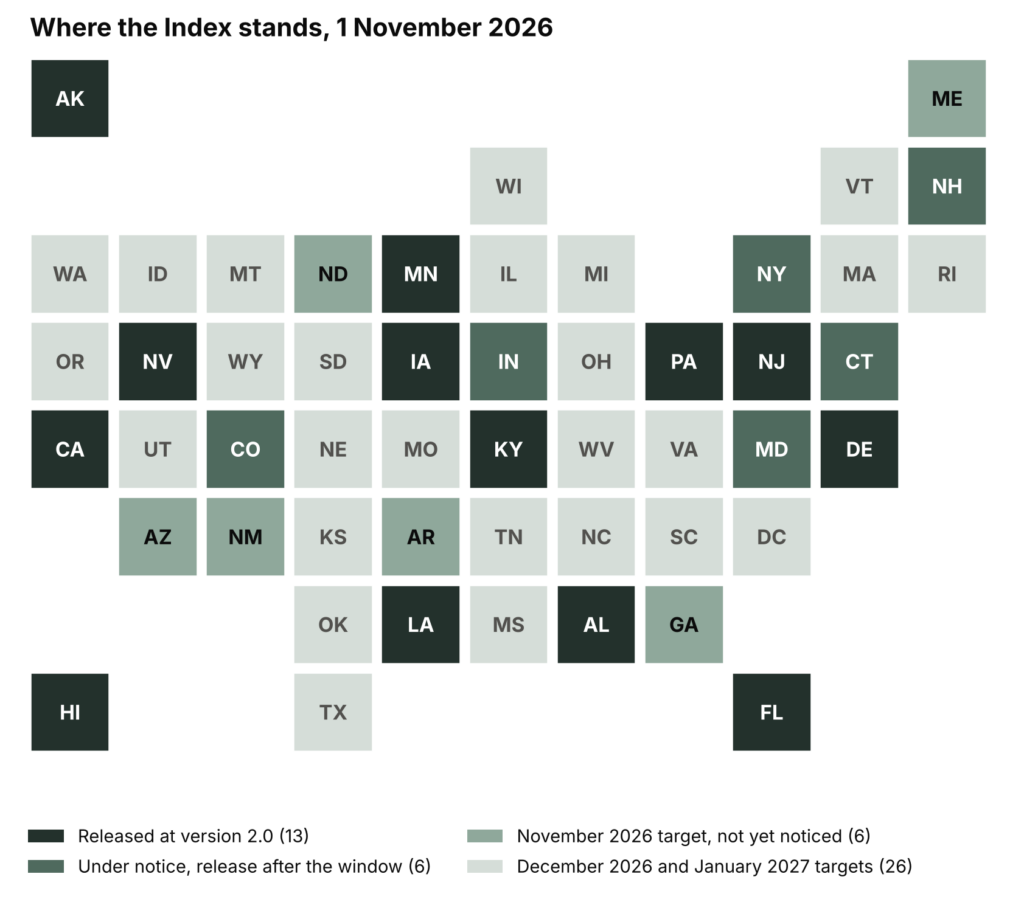
On 28 September 2026 the first five state files reached release form, and on 31 October the thirteenth went public. In between, every one of them was sent to the state department of education, the state school for the deaf, the commission or council that speaks for deaf citizens, and whichever other body the file names, with a letter saying what the file claims about them and ten business days to answer. This is the first public accounting of what that process produced. It is written for the parent, the school board member, the legislative analyst and the reporter who has heard of the Index and wants to know what is actually in it now, what is not, and what comes next.
The short version is that the Index has crossed from a promise into a record. A family in Mobile, Fairbanks, Fresno, Wilmington, Jacksonville, Hilo, Council Bluffs, Danville, Baton Rouge, Faribault, Reno, Newark or Pittsburgh can open a state file today and read what their state counts, what it spends, what the public record says about where deaf children are taught, and what their own district publishes about it. The longer version, which is the rest of this piece, is what those thirteen files found when read together, and what the next three months look like.
What version 2.0 means
Every file on the site today carries the number 2.0, and the number is doing real work. The first files the Index released, in August and September of this year, were built to an earlier method. They read the same websites and the same child counts, but their workbooks lacked sections that later files carried, their fiscal detail was uneven, and they were released before the notice procedure existed. Rather than leave two generations of file side by side, the program decided in late September to bring every file to one standard before it went any further. Version 2.0 is that standard.
A version 2.0 file is built on one reference year, the 2024 to 2025 school year, with the December 2024 child count as the baseline and the state fiscal year that funded that school year as the money. It reads every unit in the state’s own list of local education agencies, so the frame is the state’s, not ours. It codes each unit on one of four findings: the unit publishes a program or a deaf education post of its own, the unit mentions hearing only in passing, the unit publishes nothing on the subject, or the unit could not be read after two attempts on different days. It carries a workbook, a narrative report, an evidence supplement, a verification trail, a manifest of every page read with its hash, and an archive status for every source. Each file is deposited at Zenodo under a reserved DOI before notice goes out, so the version that was noticed is the version that can be cited.
Then comes the part that makes the Index different from a survey. Before release, the file is sent to the bodies it names, under a standing procedure the program calls STD-005: a letter from notice@ndedi.org to the department of education, the state school, the commission, and any other body whose published statement the file quotes, with the full file attached and ten business days to answer, counted less federal holidays. A reply that identifies a published document the compiler missed changes the file. A reply that offers an opinion, a meeting or a promise of data later is recorded and changes nothing at this version. Silence is recorded too. The window is not extended on request, and the dates are published on the calendar the day the notice goes out.
The thirteen, state by state
The files are not uniform, because the states are not. Thirteen states turned out to have at least five different ways of organizing where a deaf child goes to school: a state institution with its own board, a state school run as a unit of the department of education, a school that belongs to one local district and serves the whole state, a private chartered school paid by the public, and no school at all. What follows is each state as its file describes it, in the order of the file numbers, with the figures that matter most to a family, a board member or an analyst trying to understand their own state against the others.
Alabama (file 01)
Alabama runs one state institution for deaf and blind children and educates everyone else locally. The Alabama Institute for Deaf and Blind in Talladega, founded in 1858, is a body corporate with its own board of trustees: the Governor, the State Superintendent and thirteen appointees confirmed by the Senate. Under that board sit the Alabama School for the Deaf, the Helen Keller School for pupils with sensory loss and additional disabilities, the E. H. Gentry adult facility, a statewide outreach service that sends specialists into the public schools, ten regional centers from Birmingham to Tuscaloosa that served 9,049 children and adults in fiscal 2025, and the state deafblind project, which counted 281 children on 1 December 2024. Alabama residents pay nothing for tuition, room, board or the buses home. The School for the Deaf teaches in American Sign Language from preschool and also runs a listening and spoken language department of its own.
The money is the Institute’s, not the deaf school’s. The Education Trust Fund gives the Institute 85.6 million dollars for the year beginning October 2026, deaf and blind together, with no deaf-only line anywhere in the act; the Examiners of Public Accounts audit the Institute every year and found four findings in fiscal 2025, one of them 264,967 dollars in questioned costs on the federal special education cluster. Beside the Institute’s line the state pays 8.5 million dollars a year for licensed interpreters and teachers of the deaf in the local systems, names a private spoken language school, the Woolley Institute, in a line of its own at 1 million dollars, and has committed 28.5 million dollars in bond premium to a North Alabama campus in Decatur. Alabama’s new education savings accounts, the CHOOSE Act, carry 86.25 million dollars in 2026 to 2027 at 7,000 dollars per student, with the first 500 awards reserved for students with special needs; nothing in the program reports whether any of them are deaf.
The state counted 842 students with hearing impairment in October 2024 and 874 a year later, 150 of them at the Institute. Of the 795 of school age, 546 were in a regular class 80 percent of the day or more, 49 in a separate school and 95 in a residential facility, which is where the Talladega pupils are counted. Alabama publishes that count by school system, so the Index can run its publication measure: 100 of the 842, or 12 percent, sit in a local system that publishes a program of its own. Those systems are five. Mobile County operates the Callahan School for the Deaf and Blind, a separate school of its own, with 56 identified pupils; Shelby County names a Deaf and Hard of Hearing department, with 27; DeKalb, Calhoun and Jackson counties each name a teacher of the hearing impaired, with 11, 4 and 2. Fifty-six systems mention hearing impairment, mostly as a category on an eligibility list, and eighty-eight publish nothing on the pages read. Four could not be read on either day.
Two things stand out when the file is read whole. The Institute’s outreach service advises public schools across the state, and not one local system names it on its own website; one system, Tuscaloosa City, names an Institute preschool class as a placement, and that is the entire published connection between the state’s deaf institution and the 153 systems it serves. And Alabama has 92 interpreters working in its schools, every one of them fully certified under the state’s general interpreter licensure law, which applies in schools as everywhere else, with 19 educational audiologists beside them. The state has no language development law of the LEAD-K type on the record, and no in-state preparation program for teachers of the deaf that the file could find.
Alaska (file 02)
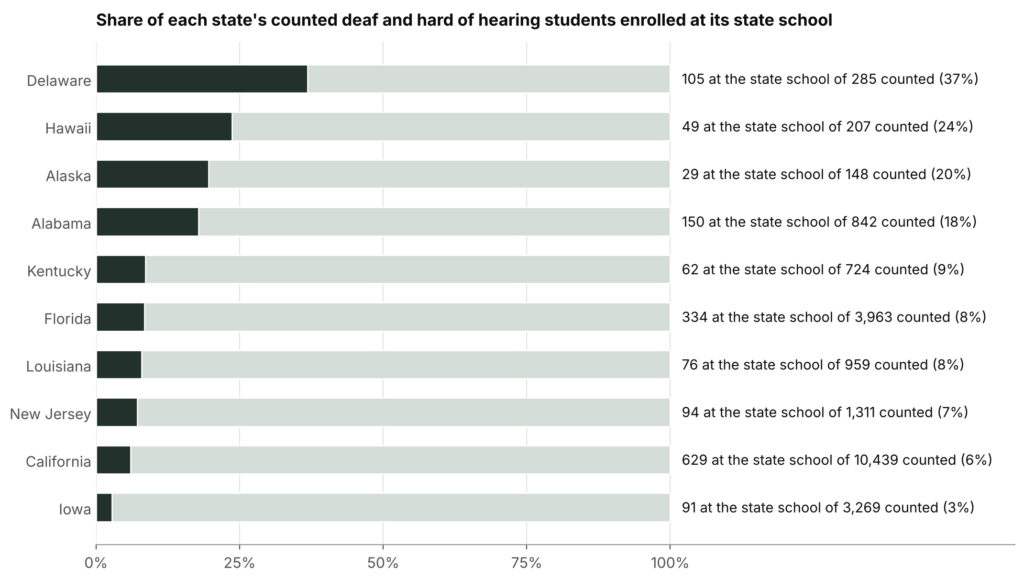
Alaska is the first of the thirteen with no separate state school. Its school for the deaf is a program inside the Anchorage School District, the Alaska State School for the Deaf and Hard of Hearing, which teaches in both American Sign Language and spoken and written English and reported about 29 students, ages 3 to 21, in February 2025. Anchorage runs a second, smaller program for hard of hearing children taught through listening and spoken language. Both are funded through the Anchorage operating budget, 3.67 million dollars and 1.29 million dollars in 2024 to 2025, not through any state line; when a child from another district enrolls, the state’s foundation formula money follows the child to Anchorage under a regulation, 4 AAC 33.070, and no tuition changes hands.
That arrangement has a consequence the file records plainly. In the same year that the Legislature passed HB 39, a deaf education rights law that gives parents a right to neutral information on hearing technology and communication methods and a choice of communication mode, with no money attached, the district that runs the state deaf school cut the program’s certificated staff from ten to nine and its non-certificated salaries by 13.4 percent, in the middle of deep district deficits. The state separately funds a statewide outreach agency, SESA, whose low incidence program serves deaf and hard of hearing students in the districts, and four districts, Bering Strait, Dillingham, Iditarod and Nome, name SESA on their own pages as the way the service reaches them.
The state counted 148 students with a hearing impairment as their primary disability on 1 October 2024 and 134 a year later. Of the 138 of school age, 93 were in a regular class 80 percent of the day or more, one was in a separate school, and none in a residential facility. Alaska publishes that category only to a statewide total; the count by district suppresses small cells, which in Alaska is most cells, so the Index cannot say which districts the 148 are in. Alaska requires a school interpreter to be certified by the Registry of Interpreters for the Deaf or enrolled and progressing in a program that meets the state’s standard, and its personnel file reports 3.38 full-time interpreters and 10.9 audiologists. It carries no teacher-of-the-deaf category at all, though districts plainly employ them: Lower Kuskokwim and Mat-Su name the role on their own sites.
Of the 54 districts, five publish a deaf program or deaf staff: Anchorage, Fairbanks, Kenai, Lower Kuskokwim and Mat-Su. Eleven mention hearing somewhere. Thirty-seven, most of them small and rural, publish nothing, which the file is careful to say does not prove there is no service, only that the public cannot find one. There is no private school with a deaf program in the state, no voucher and no education savings account.
California (file 05)
California runs one state school on two campuses, Fremont in the north and Riverside in the south, both operated by the Department of Education inside a division that also runs the School for the Blind and three diagnostic centers. The two campuses enrolled 629 students in 2024 to 2025, and the decade behind that number tells two different stories: Fremont fell from 410 in 2014 to 2015 to 279, and 264 in 2025 to 2026, while Riverside held, from 355 to 350 and 358. Against that, the state counted 10,439 students as Deaf or Hard of Hearing in 2024 to 2025, 2,483 in the Deaf category and 7,956 in Hard of Hearing, plus 77 with deaf-blindness. So fewer than one in sixteen is at the state school. The Legislative Analyst’s Office estimated in 2016 that the state spends more than 400 million dollars a year on about 14,000 deaf and hard of hearing students, and no figure since has replaced it.
The state schools are funded through three budget lines, 78.1 million dollars inside Proposition 98, 50.0 million outside it and 11.5 million for lease revenue debt service and lottery, all of which also cover the School for the Blind and the diagnostic centers, with 14.7 million dollars of capital outlay in 2026 to 2027. Everyone else is funded through the census-based special education formula, AB 602, at a base rate of 896.90 dollars per unit of attendance paid to the regional bodies called SELPAs, with an extraordinary cost pool on top and 1.47 billion dollars of federal special education money flowing through. California publishes the Deaf and Hard of Hearing counts by local agency, with small numbers hidden, and it publishes each category’s classroom setting: of the Deaf category, 627 were in a regular class 80 percent of the day or more, 714 were in a regular class less than 40 percent, and 657 were in a separate school or other setting; of the Hard of Hearing category, 5,594 were in a regular class most of the day. It has also published, every year since 2016 to 2017, the report on young deaf children’s language development that SB 210 requires.
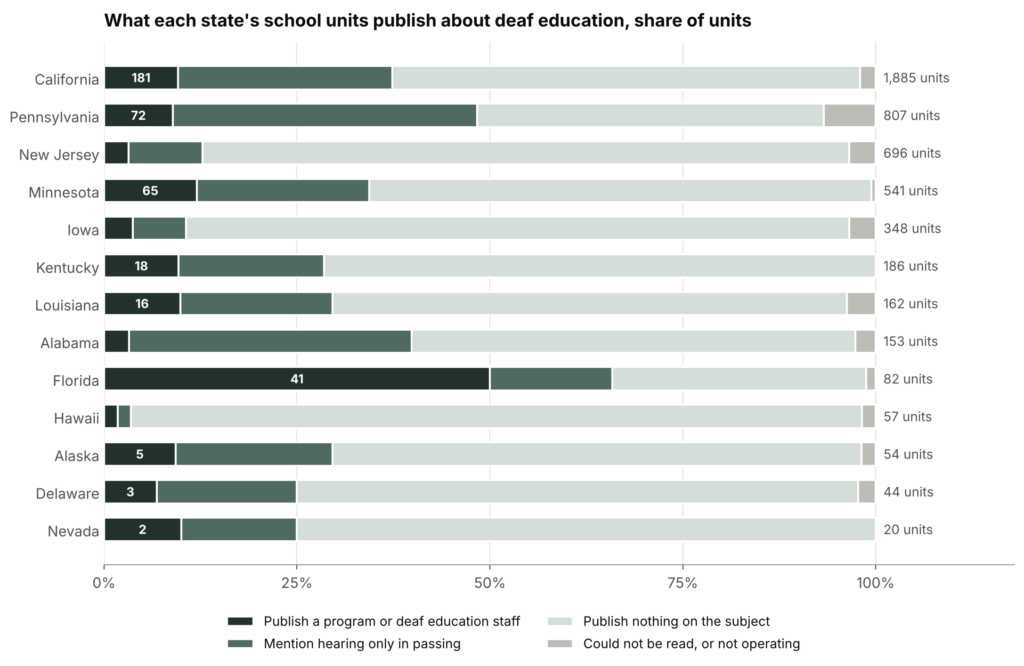
This file read the website of every one of 1,885 local bodies: 935 districts, 58 county offices of education, charter schools, and the SELPAs. Of them, 181 publish a program or a staff position for Deaf and hard of hearing students, 523 mention hearing in passing, 1,143 publish nothing, one no longer operates, and 37 could not be read after two tries and await a person’s review. The published programs sit mostly with the regional layer: 42 of 58 county offices publish one, against 60 of 935 districts. A small district’s own website most often says nothing, 362 of 514 elementary districts, and in thirteen counties no local body publishes a program at all. The publication measure comes out at 4,011 of 10,439, or 38 percent, in units that publish a program and print their count.
California sets a classroom interpreter standard, RID certification or a 4.0 on the EIPA, and reports 694.58 interpreters and 196.62 audiologists in its schools. Three community colleges run interpreter preparation programs, Ohlone, American River and Golden West. What the state does not publish is a placement framework: no state document tells a family how to choose between the state school, a county program, a SELPA program and a district one. Four private listening and spoken language schools operate in the state, and the three state schools together are described by the department as serving “approximately 900” pupils, a figure the Index carries beside the certified counts rather than in their place.
Delaware (file 08)
Delaware is the state where the deaf school belongs to a school district. The Delaware School for the Deaf in Newark, founded in 1929 and known for most of its life as the Margaret S. Sterck School, is a school of the Christina School District, which also runs the Statewide Programs for the Deaf, Hard of Hearing and Deaf-Blind: an outreach service for every district in the state, an early learning program that takes children from eighteen months, a deaf-blind program, an educational audiologist and a transition program. The school counted 105 students in September 2025, every one of them funded in the state’s “complex” unit category, which generated 40.38 units; it teaches in American Sign Language and English and keeps a weekday residence hall for students from the southern half of the state.
The money runs through Christina. The state’s budget names the school in a small line each year, 146,400 dollars for the residence, contracts and a preschool summer program, while the main funding comes through the ordinary unit formula and through tuition that Christina bills to itself and to other districts, 21.7 million dollars in the budget unit for fiscal 2026. The building was paid for by the state at a 100 percent share, 38.9 million dollars between 2007 and 2010, and the Auditor attested to it. Delaware has no voucher or education savings account; its choice program is inter-district and charter choice. The state’s high-cost route is Unique Alternatives, 9.6 million dollars for private and out-of-state placements at a 70 percent state share.
The federal count for fall 2024 found 285 Delaware children with a primary classification of hearing impairment, 253 of school age and 32 in early childhood, and 50 who are deaf-blind. Of the 253, 139 were in a regular class most of the day and 86 were in a separate school, which is to say at the school in Newark. That is the only count there is: Delaware stopped publishing its own count by disability category after 2017 to 2018, when it printed 201. The open data portal carries a single students-with-disabilities flag, the environment tables are by age and race, and the unit count is by unit category. So the Index cannot say which districts the 285 are in, and the publication measure does not run.
What the state does publish is a strong set of rules around the child. Delaware’s placement regulation requires a district to expressly consider the child’s communication mode, a sufficient number of language peers, deaf adult models and direct language access to teachers; hearing impairment and deaf-blindness are two of the state’s four birth-mandate classifications, so a district owes a free appropriate public education from birth; and American Sign Language is a world language by statute. An interpreter needs a bachelor’s degree and either RID certification or a 4.0 on the EIPA, with no provisional tier. Teacher of the deaf is a designated critical-need area for 2025 to 2027, and the state has no in-state program to prepare one, nor one for interpreters that the file could find, and one educational audiologist statewide. Of the 41 districts and charters and three related schools read, Christina publishes as operator, Appoquinimink publishes an itinerant service, and Caesar Rodney lists a single specialist; eight mention the subject in a list; the rest publish nothing, and none names the state school as its provider. The 2022 newborn screening data carry one more number worth knowing: of 292 infants who did not pass the screen, 240 were lost to follow-up.
Florida (file 09)
Florida has run a state school for deaf and blind children in St. Augustine since 1885. The Florida School for the Deaf and the Blind is its own state agency with its own board of trustees and its own line in the state budget, 68.3 million dollars in 2024 to 2025 and 80.3 million in 2025 to 2026, with 13.5 million dollars of capital on top. Its deaf and hard of hearing membership was 334 in 2024 to 2025 out of 512 total, and its parent-infant program served 626 children from birth to five. The school’s own admission rule says a deaf child must also be able to feed and dress with help, must not have a severe intellectual disability, and must not show an autism-like profile.
The state counted 3,963 students with hearing loss as their main exceptionality in 2024 to 2025, so more than nine in ten are in their districts. Florida publishes that count by district, with groups under ten hidden: 3,878 visible across 46 units, 23 suppressed cells. It does not publish where they are placed, but the federal file does, and shows 2,733 in a regular class most of the day, 124 in a separate school and 205 in a residential facility. Money follows the exceptionality through the Exceptional Student Education Guaranteed Allocation inside the funding formula, 1.29 billion dollars statewide. The state also pays private listening and spoken language programs directly, 2.5 million dollars a year under the auditory-oral statute, and pays for any private placement through the Family Empowerment Scholarship for Students with Unique Abilities, which 115,428 students used in 2024 to 2025 at a cost of 1.17 billion dollars; nobody publishes how many of them are deaf.
Florida is the state where the districts say the most. Of 82 units, forty-one publish a program or a staff position for deaf and hard of hearing students, thirteen mention hearing only in a list, twenty-seven publish nothing, and one has no schools yet. The publication measure comes out at 3,681 of 3,963, 93 percent, the highest of the thirteen. Five units each have ten or more identified deaf students and publish nothing. The regional network the department funds, the FDLRS associate centers, is named by fifteen units on their own pages, and a sweep of all 745 charter schools found none that publishes a deaf program, department or staff position.
The workforce findings run the other way. Florida sets no qualification for classroom interpreters; it reports 550.6 of them in its schools. The University of North Florida runs the state’s one accredited interpreting program and Flagler College its one teacher of the deaf program. And the Auditor General has found three times in six years, in 2020, 2023 and 2026, that the state school’s staff do not meet the school’s own sign language standard: as of July 2025, 357 employees were required to reach a Sign Language Proficiency Interview level, 229 had, and 42 had not taken or retaken the assessment. No state document tells a family how to choose between the state school, a district and a private program.
Hawaii (file 11)
Hawaii runs its public schools as one statewide district, so no money moves between districts for a deaf student and there is no local layer to publish anything. The state’s one school for deaf, hard of hearing, blind and deafblind children is the Hawaii School for the Deaf and the Blind in Honolulu, a department school where teaching is in American Sign Language and English, with a free dormitory and paid flights for children from the other islands. It enrolled 49 students in 2024 to 2025, down from 62 in 2019 to 2020; in 2022 to 2023 it had 53 pupils and 16 classroom teachers, 57 percent economically disadvantaged and 32 percent English learners. The department budgeted about 4.1 million dollars for it that year and spent about 3.9 million.
The state counted 207 students with hearing impairment as their main disability in fall 2024, 185 of school age and 22 in early childhood, and one who is deaf-blind. Of the 185, 94 were in a regular class most of the day and 41 were in a separate school, which is the Honolulu school. Hawaii prints that number only for the state as a whole; the complex areas and the charter schools have no row, so the publication measure cannot run. Eligibility is by decibel: deaf is a loss averaging more than 70 decibels in the speech frequencies, hard of hearing is 26 to 70. There are no vouchers or education savings accounts, because the state constitution bars public money for private schools.
The workforce numbers are the file’s headline. The department has fifteen positions for educational interpreters; at the end of 2024 three were filled, one on Oahu and two on Hawaii island, while an estimated 81 students needed interpreting. The state’s list of credentialed sign language interpreters named twelve people living in Hawaii in June 2026, ten on Oahu, two on Hawaii island and none on Maui or Kauai. Hawaii has no interpreter training program; the working group that studied it in 2024 recommended one at the University of Hawaii at Manoa, and the three 2026 bills to fund an interpreting degree died in committee. No rule sets a qualification for interpreters who work in classrooms, no credential exists for a teacher of the deaf, and no program in the state prepares one. About 2,800 residents use American Sign Language.
Of the 57 units in the frame, the department publishes as the one program, one complex area mentions the subject, and none of the forty charter schools, the only public schools outside the department, says anything on its website about serving deaf or hard of hearing students; one charter that operated in 2024 to 2025, Kamalani Academy, has since closed. Families can find support through the Comprehensive Service Center in Honolulu, the Department of Health’s early intervention and newborn hearing screening programs, which identify 50 to 60 infants a year, and the Hawaii and Pacific Deaf-Blind Project, which counted 52 children.
Iowa (file 15)
Iowa runs the education of deaf and hard of hearing children through one state department and nine regional agencies. The Iowa School for the Deaf in Council Bluffs, founded in 1855, moved from the Board of Regents to the Department of Education in 2023; it is free to families, takes day and boarding students from preschool to age 21, teaches in American Sign Language and English, and serves a few students from Nebraska and South Dakota under agreements that are not published. The state auditor counted an average of 113 students there in 2023 to 2024 at a cost of about 109,000 dollars each; the Legislature gave the school about 11.7 million dollars for the year that funded 2024 to 2025. For accounting purposes the school’s pupils are counted through the Lewis Central district, and a relic in the Code still lets the state school’s superintendent excuse a child from attending it.
Most deaf children stay in their home districts, served by teachers of the deaf and audiologists whom the nine area education agencies employ. Every one of the nine describes its hearing services on its website, and the ACHIEVE count the state keeps by agency shows where the children are: Heartland 885, Northwest 404, Central Rivers 384, Grant Wood 370, Des Moines 269, Mississippi Bend 259, and so on down to Keystone’s 122 and the state school’s 91. Only two of 325 districts describe deaf education staff of their own, Des Moines with a full program and Dallas Center-Grimes with its own interpreters, and seven district pages name their agency’s hearing service as the provider. The rest of the 348 units, 299 of them, publish nothing; eight could not be read and four operate no school.
Iowa does not tell the federal government how many of its special education students are deaf, because the state does not sort children by disability category; the federal file prints a dash in every cell. Its own count, built under the 2022 language milestones law, found 3,269 deaf and hard of hearing learners from birth to 21 in 2024 to 2025, up from 3,183: 1,869 on an IEP, 151 on a Section 504 plan, 152 on an infant plan, and 1,097 on no plan at all. The same law requires language assessments from birth to eight, and the report shows 156 of 1,824 children assessed, 9 percent, with 53 percent of those below average. Early intervention reaches almost every identified infant: 152 of 154 children under three were on a plan.
Every interpreter working in an Iowa school must hold a state license, on the NIC, an RID certificate or an EIPA of 3.5, with a temporary license capped at four years; the federal file reports 103.22 interpreters and 39.38 audiologists. The University of Northern Iowa runs the one in-state route to the teacher endorsement, as a 34-hour minor. Families can take a state education savings account to a private school, and 27,866 students did in 2024 to 2025, but nothing is published about whether any of them are deaf, and no private listening and spoken language school operates in the state.
Kentucky (file 17)
Kentucky has run a state school for Deaf students in Danville since 1823, and the Department of Education operates it as one of its own units, with the School for the Blind in Louisville as its counterpart. The school had 62 students on the 2024 to 2025 report card, 74 on its December count and 77 on the Auditor’s instrument, while the state counted 724 hearing-impaired students statewide that December, 703 on the KYSTATS snapshot. The school’s budget line is 12.8 million dollars for the year that began in July 2026, with 5.15 million dollars of capital in the biennium, and its outreach arm advises 152 of the 171 districts at no cost. Only three districts name the school on their own websites.
Kentucky publishes how many hearing-impaired students each district has, hiding small numbers: 650 visible across 75 units, with 51 suppressed cells. It has not published where they are placed since December 2022. The funding formula gives a district extra money for each identified Deaf student at the highest of its three weights, 2.35 times the base of 4,586 dollars. Kentucky voters rejected public funding of non-public education in November 2024, 64.8 percent against, and in 2026 the Legislature elected the state into the new federal scholarship tax credit instead; nothing in it reports which students use it. A 2026 law raises the insurance coverage for a hearing aid from 1,400 to 2,500 dollars from January 2027.
This file read the website of every district, six other state-run units and the nine regional special education cooperatives, 186 in all. Eighteen publish a program or a staff position for Deaf and hard of hearing students, thirty-five mention hearing only in a list or in passing, 133 publish nothing, and every site was read. Eight districts each have ten or more identified hearing-impaired students and publish nothing about them. The publication measure comes to 284 of 724, 39 percent, and the file is open about how fragile that number is: Jefferson County’s 88 are counted on the page of a school the state’s own list carries, and without that one row the measure drops to 27 percent.
Kentucky’s interpreter rule is general licensure with no exemption for schools, and in 2025 the state closed the classroom interpreter test as a route to a full license. Eastern Kentucky University runs the state’s only accredited interpreting program and its teacher of the deaf programs; the federal file reports 83.25 interpreters and 5 audiologists. The Auditor of Public Accounts’ July 2025 special examination of the department carries an eighteen-page section on the two state schools. No state document tells a family how to choose between the state school, a district program and a private one.
Louisiana (file 18)
Louisiana runs its deaf education through a state agency called the Special School District, which has its own board, no power to tax, and is paid for directly by the state. The district operates the Louisiana School for the Deaf in Baton Rouge, a residential school that teaches in American Sign Language and English and counted 76 students on 1 October 2025, the School for the Visually Impaired on the same campus with 56, and the special education programs inside state facilities with 117. The deaf school’s outreach arm offers free early intervention to families from birth to five and support to school districts, with four regional instructors, and served 302 children.
In the 2026 to 2027 state budget the deaf school stops being its own budget line. Its program, 8.49 million dollars and 102 positions, the blind school’s and the shared administration are merged into one program at about 37.6 million dollars and 327 positions for the whole district, down from 337 positions the year before. The formula money that follows a pupil, 4,015 dollars at the base with a uniform 150 percent weight for any disability, reaches the district as interagency transfers, 9.7 million dollars. Louisiana’s new education savings account, GATOR, pays up to 15,253 dollars for a pupil with a disability, tiered by disability type, and nothing reports whether a deaf child uses it.
The federal count for fall 2024 found 959 Louisiana children with a primary classification of hearing impairment, 876 of school age, and 17 who are deaf-blind; of the 876, 608 were in a regular class most of the day and 67 in a separate school. The state itself publishes no count by category, only percentages that are blanked below five percent, so the publication measure cannot run. We read the websites of all 162 school systems and charter sponsors. Fifteen publish their own deaf or hard of hearing teachers, programs or services, and the district itself publishes the state school; thirty-two mention deaf or hard of hearing students only in an eligibility list, a screening form or a policy; 108 publish nothing; six could not be read. Only three units name the state school: the district itself, St. James Parish and St. Mary Parish.
Louisiana has two different rules for who may interpret in a classroom: the education board’s certificate at an EIPA of 3.0, and a stricter standard from the Commission for the Deaf. The federal file reports 11 interpreters and the state’s own book 16.71. Delgado Community College runs the one interpreter program, and no college in the state prepares teachers of the deaf. The state’s Deaf Child’s Bill of Rights is in force; its LEAD-K task force reported in 2019 and the section creating it repealed itself. The Legislative Auditor’s June 2023 performance audit of the district examined staff sign language proficiency, the bilingual implementation plan and the outreach caseload.
Minnesota (file 23)
Minnesota has run a state school for Deaf students in Faribault since 1863, now the Minnesota State Academy for the Deaf, which the state funds through a direct biennial appropriation rather than the funding formula and runs with its blind counterpart under one nine-member, governor-appointed board. The Office of the Legislative Auditor found in November 2024 that the academies generally did not comply with finance-related legal requirements. One public charter school, Metro Deaf School in St. Paul, is built around Deaf students and enrolled 176 in the fall of 2025, more than the academy. The academies asked the 2026 Legislature for 1.7 million dollars in bonding.
Most Deaf and hard of hearing students are taught in their own districts, and much of the service runs through eleven regional low incidence projects and special education cooperatives rather than the districts themselves. The state counted 2,552 of them in December 2024 and 2,623 a year later, with 125 deaf-blind. Minnesota’s aid formula weights a Deaf or hard of hearing student at 19,200 dollars and a deafblind student at 25,200 dollars inside a census computation, not a set payment. The state publishes its count statewide and by region, but not by district, so it cannot be shown where the children are and whether their district publishes anything for them.
This file read the website of every school district, charter school and regional cooperative, 541 in all. Sixty-five publish a program, a service or a staff position for Deaf and hard of hearing students, 43 of them on weak evidence; 121 mention hearing only in a list or in passing; 352 publish nothing; one could not be read; two are districts that operate no school. Two units name the state academy on their own pages, Faribault’s own district and one charter. Minnesota’s teacher of the deaf license requires sign language proficiency at the Intermediate-Plus level, and the state reports 231 teachers of the deaf and hard of hearing and 43 oral/aural teachers in service. The licensing board’s own page says the state has only one or two programs to prepare them; after the window closed the board wrote to say the sentence referred to particular licensure areas, and the file quotes the page as published. The University of Minnesota is the confirmed in-state route. Minnesota declined a LEAD-K law on the stated ground that it already has equivalent law. No state document tells a family how to choose between the state academy, a district program and the charter school.
Nevada (file 28)
Nevada has never built a school for deaf students. From 1956 the state paid to send a deaf or blind child to a school in another state when the child’s own district could not teach the child, but the law that did this was gutted in 2015 and the operative sections repealed from July 2016, leaving a husk in the statute and a regulation, NAC 388.460 to .488, that still prescribes the dormant out-of-state procedure and cites the repealed sections. No one now publishes whether any child is still placed out of state. Two feasibility studies died in the Legislature, one deleted by amendment in 2019 and one in Ways and Means in 2025. The only school of the deaf ever to operate was a Clark County charter, the Las Vegas Charter School of the Deaf, from 2008 to the summer of 2011, with eleven pupils at closure. A state commission adopted a position on deaf schools in February 2025, and volunteers drafted a hub-and-spoke bill for a Nevada School for the Deaf with a 20.5 million dollar appropriation, which has no sponsor.
In place of a school, Nevada has two county programs. Clark County, in Las Vegas, runs a Deaf and Hard of Hearing Program with both spoken-language and sign-language settings, an interpreting services department and audiologists. Washoe County, in Reno, provides hearing services with direct instruction and a district audiologist. Three more districts, Churchill, Elko and Lyon, mention hearing only in passing, and fifteen of the state’s 20 units publish nothing about it, including the authority that oversees charter schools, whose 63 charter organizations are swept and found silent.
Nevada is unusual because it reports how many deaf students each district has, every October since 2008: 553 on 1 October 2024 and 544 a year later, Clark 408, with many small counts hidden to protect privacy. That is why Nevada is one of the six states where the publication measure runs, at 408 of 553, 74 percent, and why the federal environments file can be tied to the count: of 518 school-age pupils, 307 were in a regular class most of the day, and none at all were in a separate school or a residential facility. Nevada’s eligibility gates are set by decibel, 92 for deaf and 30 for hard of hearing. The funding formula has one multiplier for pupils with disabilities, capped at 13 percent of enrollment, and no disability weight. American Sign Language does not count as a world language under rule, and the 2025 bill to change that failed.
Nevada sets a clear standard for the interpreters who work in its schools, an EIPA of 4.0 or provisionally 3.5 for five years, and keeps a statewide registry, 595 registrations on 1 July 2026, 149 of them with an educational scope. The College of Southern Nevada runs the only interpreter preparation program; no program in the state prepares teachers of the deaf. The language development reports the law requires have been posted for ages birth to three only, without the disability breakdown or the comparison group the statute asks for. Who teaches a deaf child in Nevada’s smallest counties is not published by the county, by the state, or by anyone.
New Jersey (file 30)
New Jersey educates its deaf and hard of hearing students in many places at once, and this was the one first build among the thirteen, with no earlier file to re-audit. The state runs one school for the deaf, the Marie H. Katzenbach School in West Trenton, founded in 1883, which enrolled 94 students in 2024 to 2025, is budgeted for fewer than ninety after that and, according to the Governor’s budget, ended its residential program in 2026 even though the school’s web pages still describe one. Its direct state services line is 6.935 million dollars, its day tuition charged to sending boards 60,215 dollars, and its capital line 500,000 dollars for fire protection. Four other programs share the department’s designation as regional deaf education centers of excellence: the Bergen County Special Services continuum in Paramus, the Gloucester County Special Services programs in Sewell, and the Lake Drive School in Mountain Lakes, which opened in 1969 as a day alternative to the state school. Beyond them, the department lists classroom programs in about a dozen districts, from Newark’s Bruce Street School, open since 1910 with 55 identified pupils, to Toms River’s elementary program with 21, Jersey City’s with 18, Neptune’s regional program with 8, a high school program in Berkeley Heights and a vocational program in Passaic County, plus three private schools among the state’s 134 approved private schools for students with disabilities, and several itinerant services.
In 2024 to 2025 the state counted 1,311 students aged five to twenty-one with an auditory impairment classification and 19 who are deafblind; preschoolers carry one undifferentiated classification, so the youngest children are invisible by category. Of the 1,311, 638 were in general education most of the day, 231 in a separate school and 3 in a residential facility. The money is census-based: 1.36 billion dollars of special education categorical aid and 420 million dollars of extraordinary cost aid statewide, none of it labeled by disability. The state prints the count by district: 390 districts print an unsuppressed number summing to 818, Newark 55, Elizabeth 29, Passaic 26, Trenton 23, and 260 print an asterisk, while the county special services districts and the state school have no row at all because every pupil is counted in the sending district.
We read the website of every one of the 696 public school units in the state. Twenty-two publish a program or named deaf education staff; sixty-seven mention deaf or hard of hearing students only in a screening schedule, an eligibility list or a link to a state document; 583 publish nothing; six could not be read; eighteen are listed units that operate no school. The publication measure, which can run because the state prints the count, comes out at 155 of 1,311, 12 percent, and seven of the program units carry a suppressed cell. Not one of the 696 names the Katzenbach School on its own pages. Where a district says nothing, its deaf students are still counted and still served somewhere; the state’s own figures simply do not show where.
New Jersey’s educational interpreter endorsement requires an associate degree or higher and an EIPA of 3.5 with the written test; the state reports 16.75 interpreters and 15.2 audiologists. Two county colleges, Camden and Union, train interpreters, and The College of New Jersey prepares teachers of the deaf under two endorsements, one with a sign language proficiency threshold. The state has a Deaf Student’s Bill of Rights, signed in 2019 and published in eleven languages, which six district sites carry; it has no language acquisition statute of the LEAD-K type; and American Sign Language is a language other than English for graduation purposes by a 2015 act.
Pennsylvania (file 38)
Pennsylvania has no state-run school for the deaf. The Commonwealth closed its last one, in Scranton, in 2009, after two performance audits by the Auditor General, and handed its pupils to a private school, which now runs the Scranton campus as a program. Today two private chartered schools, the Western Pennsylvania School for the Deaf in Pittsburgh and the Pennsylvania School for the Deaf in Philadelphia, teach in American Sign Language and English, charge families nothing, and are paid by the home district and the state under one section of the School Code that names four schools by name, the two deaf schools and two schools for the blind. One state budget line of 73.1 million dollars in 2024 to 2025 funds all four. Neither deaf school publishes an enrollment figure: the Pittsburgh school says “more than 450” across all programs from birth to 22 in 53 counties, the Philadelphia school “over 200 students.” What is published is the price. The approved day tuition for 2025 to 2026 is 92,345 dollars at the Philadelphia school and 86,228 at Pittsburgh, 149,863 for five-day residence; three approved private schools also serve deaf pupils, two of them teaching listening and spoken language, at 71,288, 52,979 and 108,537 dollars a year. The district of residence pays the greater of 40 percent of the rate or its own per-pupil cost, and the state pays the rest.
Most everyday deaf education staff sit in the 29 regional intermediate units, which supply teachers of the deaf, interpreters and audiologists to member districts and bill them for it; 27 of the 29 publish such a service. The state counted 2,524 pupils with a hearing impairment, including deafness, and 78 who are deafblind in December 2024, a number that has barely moved in ten years, from 2,660 in 2015 to 2,524 now. It prints the count by home district and hides any count of ten or fewer, which means 52 of 675 district rows print a number, summing to 1,070, and 623 print the suppression mark; the largest printed count is Pittsburgh’s 36. The population cannot be placed in units for more than 42 percent of it, so the publication measure is a floor at best, and the Index does not run it. Educational environments are published by intermediate unit region, with no row for the deaf schools.
We read the websites of all 807 districts, charter schools, intermediate units, career centers and schools in the frame. Seventy-two publish their own deaf or hard of hearing staff, program or service: 22 districts, 27 intermediate units, one career center, the fifteen Mastery charter campuses, Agora Cyber Charter School, the two deaf schools, the blind school with a deafblind program and the three approved private schools. Three hundred eighteen mention deaf pupils only in an eligibility list, a screening notice or a related-service list; 363 publish nothing; 52 could not be read after two attempts, the largest unread group of the thirteen; two charter schools have closed. Four of the state’s own directory addresses had been hijacked and were never opened. No district page says which pupils attend a deaf school, and neither deaf school publishes a sending-district list.
Pennsylvania’s interpreter standard has been in force since 2008, an EIPA of 3.5 for the grade level plus 20 hours of staff development a year, and a 2024 act rewrote the general interpreter registration law to add deafblind interpreting and alternative pathways. The IEP of a deaf child must include a communication plan by regulation, and American Sign Language is a world language by rule. The Commonwealth has no deaf child’s bill of rights and no LEAD-K statute; bill searches for the terms returned nothing across three sessions. And no audit of either chartered deaf school, or of any approved private school, could be found, against the 73 million dollars a year the line carries.
What the thirteen say when read together
Put the thirteen frames side by side and they hold 5,035 units: districts, charter schools, county offices, cooperatives, intermediate units, regional agencies and the state-operated schools themselves. Every one of those 5,035 websites was read, and any that could not be read was tried again on a different day before it was marked. Of the 5,035, 444 publish a deaf program or deaf education staff of their own. That is 8.8 percent. Another 1,212, or 24 percent, mention hearing somewhere, usually as a line in an eligibility list, a screening schedule or a staff directory. The largest group by far, 3,234 units, or 64 percent, publish nothing at all about deaf or hard of hearing students on the pages read. The remaining 145 could not be read after two attempts or turned out to operate no school.
| State | Units in frame | Publish a program or staff | Mention only | Publish nothing | Could not be read or not operating |
|---|---|---|---|---|---|
| California | 1885 | 181 | 523 | 1143 | 38 |
| Pennsylvania | 807 | 72 | 318 | 363 | 54 |
| New Jersey | 696 | 22 | 67 | 583 | 24 |
| Minnesota | 541 | 65 | 121 | 352 | 3 |
| Iowa | 348 | 13 | 24 | 299 | 12 |
| Kentucky | 186 | 18 | 35 | 133 | 0 |
| Louisiana | 162 | 16 | 32 | 108 | 6 |
| Alabama | 153 | 5 | 56 | 88 | 4 |
| Florida | 82 | 41 | 13 | 27 | 1 |
| Hawaii | 57 | 1 | 1 | 54 | 1 |
| Alaska | 54 | 5 | 11 | 37 | 1 |
| Delaware | 44 | 3 | 8 | 32 | 1 |
| Nevada | 20 | 2 | 3 | 15 | 0 |
| All thirteen | 5035 | 444 | 1212 | 3234 | 145 |
The Index is careful about what that finding is and is not. A unit that publishes nothing may serve its deaf students well, through a cooperative, a regional agency, a contracted teacher or the state school’s outreach arm. The finding is about what a family can find. It says that if you are a parent in one of those 3,234 units and you type the word deaf into your district’s search box, nothing comes back. The service may exist. The public record of it does not.
The second pattern is where the publishing happens. In state after state the published capacity sits one layer above the district. California’s county offices publish where its districts do not: 42 of 58 county offices against 60 of 935 districts. Iowa’s nine area education agencies all publish; two of 325 districts do. Pennsylvania’s intermediate units publish at 27 of 29; its districts at 22 of about 500. Minnesota’s cooperatives and intermediate districts carry most of its 65 program units. The practical consequence is that a family has to know the regional layer exists before they can find the service, and nothing on the district’s own page tells them to look there.
The third pattern is about the count itself. Every one of the thirteen states counts its deaf and hard of hearing children for the federal government, and the sum of those counts, across the twelve states that report a category, is 24,507 children in the 2024 to 2025 school year. Iowa, which does not report a category, counts 3,269 on its own instrument. But only six of the thirteen publish that count by district in a form a person can read, and the Index runs its publication measure only where the state does. The measure asks a simple question: of the children the state counts, how many sit in a unit that publishes a program for them? In Florida the answer is 93 percent. In Nevada, 74 percent. In Kentucky, 39 percent, and in California, 38 percent. In Alabama and New Jersey, 12 percent. In the other seven states the question cannot be answered, because the state suppresses the cell, publishes only a statewide total, or publishes nothing by category at all.
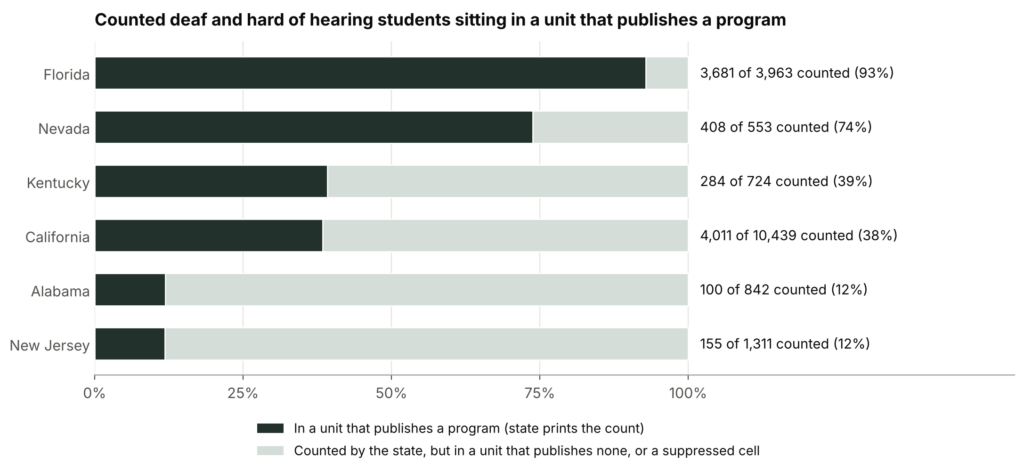
That last fact deserves to be stated plainly, because it is the one the Index was built to surface. Seven of the thirteen states counted here cannot answer, from their own published records, where their deaf children are. Minnesota publishes by region, not district. Delaware stopped publishing by category after 2017 to 2018. Louisiana publishes percentages blanked below five percent. Pennsylvania prints a count for 52 of 675 districts and hides the rest. Hawaii is one district and prints one number. Alaska suppresses small cells, which in Alaska is most cells. Iowa does not sort by category. None of this is hidden in the sense of being secret; it is hidden in the sense that no one assembled it before. Interpretation, marked as such: a state that cannot say where its deaf children are cannot say whether the money it spends on them arrives where they sit.
What the notice process produced
Thirteen files, between four and forty-three recipients each, 111 notices in all, ten business days apiece. The result was eleven states that said nothing at all within their window, and one state, Minnesota, whose two replies arrived on 26 October, three days after its window closed on 23 October.
Minnesota’s replies are worth describing because they show what the procedure does with a late answer. The Commission of the Deaf, DeafBlind and Hard of Hearing wrote to say that a meeting with the publisher was already on the calendar for 12 November to review the questions. The Professional Educator Licensing and Standards Board wrote to say that a data request was in its queue with an answer expected by 6 November, and that a sentence on its own preparation programs page, which the file quotes, had been referring to two licensure areas rather than to the state as a whole. Neither reply identified a published document. Under the standing procedure, neither changed the file: the Board’s page says what it says, and the file quotes it; what the Commission meeting and the Board’s data produce is taken up at the next version. Both replies are recorded in the file’s notice block, in full, with the decision and the reason.
Silence is also a finding. Each notice told the recipient what the file says about it and offered ten days to point to anything the compiler missed. Eleven states’ departments of education, state schools and commissions chose not to. The Index does not read that as agreement; it reads it as the absence of a correction, which is what it is, and records it in the same block.
Where the work stands and what comes next
Six files are under notice today. Colorado’s window closes on 5 November, Indiana’s on 6 November, and Connecticut’s, Maryland’s, New Hampshire’s and New York’s on 16 November. New York was the one October state that slipped: its first notice went out on 11 October, and after review it was re-noticed on 31 October, so its release moves to November. After each window closes, the file is rebuilt with any changes the window produced, checked against the release list, authorized by two people, deposited at Zenodo and imported to the site. That takes at least one working day, which is why a window closing on the 16th yields a release in the third week of the month.
The roadmap, which is a plan and not a commitment, puts six more states in November beyond the six under notice: Arizona, Georgia, Arkansas, Maine, New Mexico and North Dakota. Arizona and Arkansas are in their first stops now. For a file to be released in November its notice has to go out by 13 November, so the next two weeks decide whether the November milestone of 25 is met or the roadmap is re-issued, which the program does openly rather than quietly. December carries 15 jurisdictions, including the first builds of North Carolina, Virginia, Washington, Massachusetts and the District of Columbia; January 2027 carries the last 11, including Texas, Michigan, Ohio and Tennessee. The order is published on the calendar at ndedi.org and moves as decisions are made. A state that pays for its own file moves to the front; a state that asks without paying waits in the order shown.
One correction to the site itself. As of this writing the register page and the home page still read zero released, because the status register that feeds them has not been imported since the October releases. The States page, which reads the release records directly, shows the thirteen. The register will be brought into line; the States page is the one to trust in the meantime.
How to read a state file
Each released state has a page on ndedi.org with a free summary layer: the plain-language summary, the headline figures, the tallies, the notice record and the calendar dates. That layer may be used with attribution. The full file, with the workbook, the narrative, the evidence supplement and the verification trail, is licensed, with a fee schedule that distinguishes a state agency from a researcher from a commercial buyer and an introductory rate in force through September 2027. A reader who wants to check a single claim can do so from the summary layer alone, because every figure in it names the document it came from and the date the compiler read it.
Two habits make the files easier to use. First, read the frame statement before the tallies. The frame is the state’s own list of local education agencies, and it differs from state to state in ways that matter: Hawaii is one unit, New Jersey is 696, and Pennsylvania’s 807 include the chartered deaf schools themselves. A tally only means something against its frame. Second, treat the four codes as findings about publication, not about service. A district coded as publishing nothing is a district whose website says nothing; it is not a district with no deaf children and not a district that serves them badly. The Index can show what is written down. What is written down is, in sixty-four percent of 5,035 cases, nothing, and that is the finding.
Go back to the parent in Mobile or Fairbanks or Fresno. What she has today that she did not have in August is a document, built from her state’s own records and sent to her state’s own agencies before it was published, that says what the state counts, what it pays, and what her district publishes about children like hers. Thirteen states have that document now. Thirty-eight do not yet. The calendar says when.
Bibliografia
- National Deaf Education Data Index. States. https://www.ndedi.org/states/. Read 1 November 2026.
- National Deaf Education Data Index. Calendar and roadmap by target month. https://www.ndedi.org/calendar/. Read 1 November 2026.
- National Deaf Education Data Index. Register. https://www.ndedi.org/register/. Read 1 November 2026.
- National Deaf Education Data Index. Method. https://www.ndedi.org/method/. Read 1 November 2026.
- Novara Consulting Group. NAT-004 Build Standards and Completion Schedule, version 1.6, 2 October 2026. Program record.
- Novara Consulting Group. STD-005 Notice procedure, as applied to the version 2.0 files. Program record.
- Novara Consulting Group. NDEDI state release packages, version 2.0, schema 1.3, for state files 01, 02, 05, 08, 09, 11, 15, 17, 18, 23, 28, 30 and 38, with their Zenodo deposits. Summary tallies, publication measures and notice records as printed in each package.