
Nine translators and a worried father
On Thursday night, at a Fox News town hall, Vice President JD Vance was asked how to protect the “identity of the country” amid mass immigration. He answered with a story. He had been in an emergency room with his wife, who is the daughter of immigrants, worried about a medical problem his son had. “I’m sitting there in the emergency room and there are, like, nine different translators, for nine different languages,” he said. Then he asked the room a question: “How about if everyone spoke English and we could hire more doctors and less translators in our country?” The audience applauded [1].
HuffPost’s write-up noted that more than 8 percent of Americans, roughly 25 million people, have limited English proficiency, and that research links good medical interpreting to fewer errors and better care [1]. Those numbers matter. But I am not writing about the Vice President, and I am not writing about immigration. Plenty of people will cover both. I am writing about the employee who hears that line on a Thursday night and says it out loud at work on Saturday.
Before NCG, I spent years in quality assurance problem management at the American Red Cross. The job was structured root cause analysis on failures that kept coming back. The first lesson of that work is that the person who says the wrong thing out loud is almost never the root cause. They are the moment a weak system becomes visible. My graduate training is in human resource management, and the format I reach for when a public remark is about to walk into a workplace is the one compliance trainers use: the bad employee case study. This one has a twist. The patient is Deaf.
Meet Dana
Riverbend Regional Medical Center is a mid-sized hospital that bills Medicare and Medicaid. It does not exist. Neither do the people in this story, though anyone who has worked a hospital front desk will recognize all of them.
It is a busy Saturday night. Dana has worked registration for six years and is good at it. She is fast, she is accurate, and she is tired of being short-staffed. She watched the town hall clip on her phone that morning, and she agreed with it.
At 10:14 p.m., a man named Marcus walks in holding his chest. He is 54, Deaf, and American Sign Language is his first language. His wife, Linda, is hearing. She signs well enough for dinner conversation and grocery lists. She tells Dana that her husband is having chest pain and needs an ASL interpreter.
Dana glances at the whiteboard behind her, where the night’s interpreter requests are written in marker. There are already three. She turns to the coworker beside her and says, loudly enough for Linda to hear, “How about if everyone spoke English and we hired more nurses instead?” She does not enter the request. She slides a clipboard and a pen across the counter to Marcus and tells Linda she can “just sign for him for now.” Then she calls the next person in line.
Forty minutes later, a nurse wheels a video remote interpreting cart into Marcus’s bay. The screen is mounted high and tilted up toward the nurse. The Wi-Fi in that corner of the department is weak, and the picture freezes twice, once in the middle of the physician’s explanation of the risks of a cardiac catheterization. On the way out, the charge nurse mentions that the hospital is “looking at an AI signing app next year that will make all of this a lot cheaper.” At 11:09 p.m., Marcus signs the consent form.
Two weeks later, a letter arrives at Riverbend’s compliance office. Linda wrote down what Dana said, word for word, with the time.
What changed in 2025, and what did not
The first thing a hospital lawyer will ask about Dana is whether she had a point. Federal language access policy did move in 2025, and it is worth being precise about how far.
On March 1, 2025, Executive Order 14224 designated English as the official language of the United States and revoked Executive Order 13166, the 2000 order that had anchored federal language access policy for a quarter century. The order itself is careful on one point. Section 3(b) says agency heads “are not required to amend, remove, or otherwise stop production of documents” in other languages [2]. On July 14, 2025, the Department of Justice issued guidance implementing the order. It called for a coordinated effort to “minimize non-essential multilingual services” and encouraged agencies to consider “responsible use of artificial intelligence and machine translation” to cut costs [3].
The Congressional Research Service explains why this matters. Most of what hospitals think of as Title VI language access duties rest on regulations and guidance, not on the statute’s text, and “because language-access requirements are largely regulatory, they may be changed by the executive branch.” Private plaintiffs also cannot bring disparate-impact claims under Title VI, after the Supreme Court’s 2001 decision in Alexander v. Sandoval [4]. In December 2024, HHS’s Office for Civil Rights had told health providers that Section 1557 of the Affordable Care Act required qualified interpreters, barred making patients bring their own, and required a qualified human to review machine translation of critical documents [5]. Federal enforcement priorities have shifted since then, and a hospital should get current advice on where those Section 1557 rules stand in its jurisdiction.
So the honest answer on spoken languages is that the federal floor is softer than it was two years ago. Section 1557 is still a statute, intentional discrimination is still actionable under Title VI, and many states have their own language access laws. But a hospital administrator who says the federal government has stepped back from spoken-language interpreting is not wrong.
None of that touches Marcus.
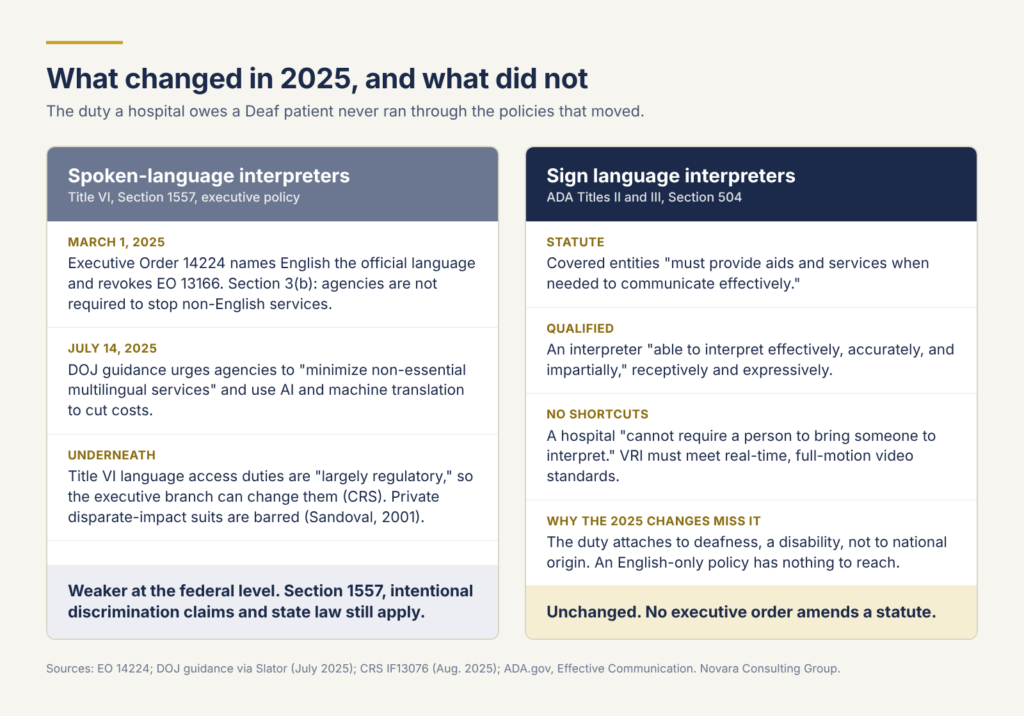
Deafness is a disability, not a national origin. The duty to provide an ASL interpreter runs through the Americans with Disabilities Act and Section 504 of the Rehabilitation Act, and an executive order cannot amend a statute. Under those laws, covered entities “must provide aids and services when needed to communicate effectively.” A qualified interpreter is someone “able to interpret effectively, accurately, and impartially,” both receptively and expressively. And a hospital “cannot require a person to bring someone to interpret for him or her.” When a hospital chooses video remote interpreting, the regulations add specific performance standards, starting with “real-time, full-motion video and audio over a dedicated high-speed, wide-bandwidth video connection” and staff trained to set it up [6].
Dana may have been right about the politics of the week. She was wrong about the law that governed the man standing at her counter, and it was not close.
Every step was a decision
What makes this a useful case study is that nothing in it is dramatic. No one shouts. No one refuses outright. The failure is a chain of small, ordinary choices, each of which felt reasonable to the person making it.
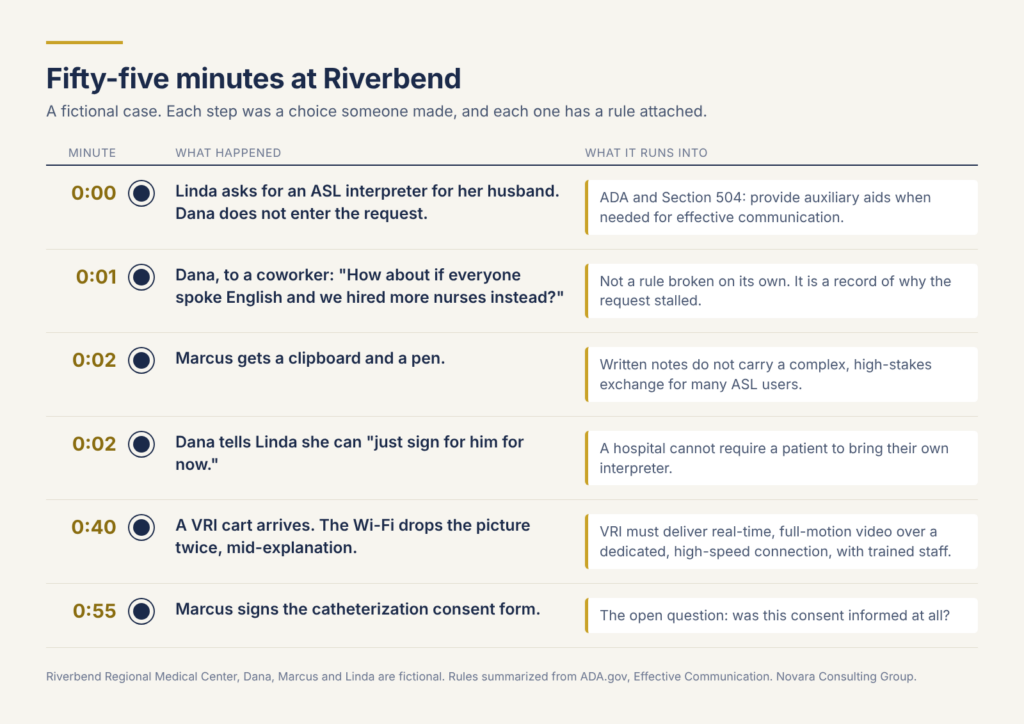
The exposure began at minute zero, when the request went unrecorded. Most staff trainings focus on the remark because it is the memorable part, but the remark did not break a rule on its own. The unlogged request did. From that moment, no system at Riverbend knew a Deaf patient was waiting, and nothing downstream could correct for it.
Then came the substitutes. Linda is not a qualified interpreter. She knows conversational sign, not medical vocabulary, and she is not impartial: she is frightened, she loves the patient, and she has her own views about whether he should agree to the procedure. That is the reason the rule exists. The clipboard has a place, for a name or an insurance card, but it cannot carry a cardiologist’s explanation of catheterization risks to someone whose first language is visual and spatial, who is in pain, in a noisy bay, at the speed of a busy emergency department.
The VRI cart looks like compliance and often is not. A frozen picture during the risk discussion is not “real-time, full-motion video.” A screen angled up toward a standing nurse may be outside the patient’s view entirely. The standards exist because hospitals bought VRI as the efficient option and then discovered how often it fails in these conditions.
Which brings the chain back to the remark. Said aloud at the moment of denial, and written down by the patient’s wife, Dana’s line converts an operational lapse into a record of why the lapse happened. In many federal circuits, damages under Section 504 turn on whether the institution showed deliberate indifference to a patient’s rights. A cost complaint made at the counter is the kind of evidence that argument is built from. That is my reading, not settled law in every circuit, and a hospital’s counsel should confirm it locally. But no risk manager wants to find out the answer through this letter.
The last step is the one that should worry a hospital most. Marcus signed. A signature is not the same thing as informed consent, and a consent obtained without effective communication is a question a hospital does not want to answer in front of a regulator, a jury or Marcus’s cardiologist.
Why “just speak English” was never going to work here
The line from the town hall assumes that everyone who needs an interpreter came from somewhere else. Marcus was born in the United States. He may have gone to a state school for the Deaf, as I did; I grew up at the Atlanta Area School for the Deaf. His family may have been American for generations. The remark still fails him completely, because American Sign Language is a full language with its own grammar, and it is the first language of many Deaf Americans. An English-only policy does not assimilate Marcus into anything. It removes his only route to understanding what is about to be done to his heart.
Written English is the fallback hearing staff reach for, and it is the one that fails most quietly. A Deaf patient who nods and signs reads to staff as a patient who understood. It reads to a regulator as a consent obtained without effective communication. For many Deaf people, English print is a second language, learned without full access to the sound it was built on. Handing someone a clipboard during a cardiac workup is asking them to do their hardest reading at the worst moment of their year.
For DeafBlind patients, the gap is wider. I am DeafBlind, and my vision does not reach above eye level. A VRI screen mounted high and tilted toward a standing nurse would be invisible to me. A DeafBlind patient may need tactile signing, close-vision signing or Protactile, and a hearing spouse who signs “for now” may not know any of them. A policy that treats interpreters as a line item to shrink lands hardest on the patients whose access depends most on a qualified person physically in the room.
The cheaper substitute is already in the pitch deck
The most consequential line in the Riverbend story is not Dana’s. It is the charge nurse’s, on the way out the door: an AI signing app next year that will make all of this cheaper.
That is where “fewer translators” logic goes once it reaches a budget meeting. The Justice Department has already told federal agencies to use AI and machine translation to cut spoken-language costs [3]. Sign language AI vendors are selling avatar and recognition products into the same climate. An administrator who hears both messages can easily conclude that one substitution is as safe as the other.
It is not, and the reason is legal before it is technical. The ADA does not ask whether a tool produces signing. It asks whether communication is effective, accurate and impartial, in both directions, for the patient in front of staff [6]. The standard describes a person able to interpret. NCG’s reading is that no federal rule recognizes software as a qualified interpreter, and NCG’s assessment is that no sign language AI product publicly available today has produced independent evidence of effective two-way communication in a clinical emergency, especially for the hard direction: understanding a Deaf patient’s own signing, under stress, in a real room.
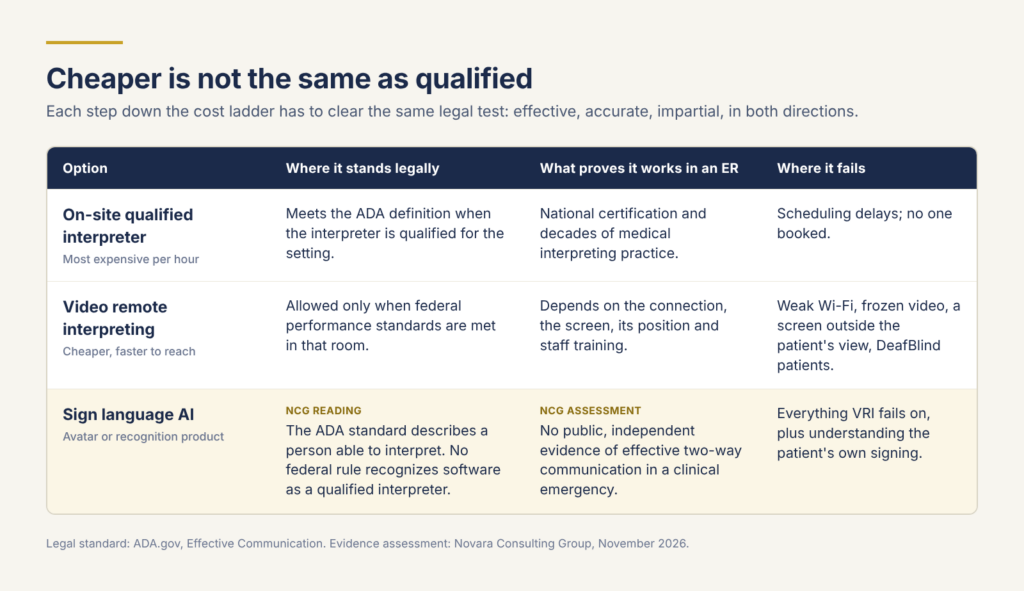
VRI is the precedent hospitals should study before they sign the next contract. It was sold as the efficient alternative to on-site interpreters, and in practice it fails on the conditions in this case: weak connections, untrained staff, screens patients cannot see. AI signing would inherit every one of those failure modes and add new ones. This is the gap NCG’s SLAT Index was built to close. It treats a vendor’s claim as a claim, not as evidence, and it treats Deaf people fluent in the language as definitional to judging whether the output is right.
What a governed hospital does next
Riverbend should discipline Dana’s conduct, not her opinion. Then it should fix the system that let one registration clerk decide whether a patient got an interpreter. Treating this as one bad employee guarantees a repeat with the next one.
For Dana, the record should name specific acts: the unlogged request, the family-member substitute, and the remark made at the point of denial. A private hospital is not bound by the First Amendment, but conduct is the cleaner and more defensible ground. Dana may believe whatever she likes about language policy. She may not gate a federally required accommodation. Under a standard progressive discipline policy, that supports a documented written warning, mandatory effective communication training, and a clear statement that a repeat denial is grounds for termination. The triage nurse who saw a Deaf patient with chest pain and no interpreter, and the charge nurse who called the VRI cart good enough, belong in the same review.
For the system, a root cause analysis asks one question first: why could a single person at intake stop the request at all? The fixes follow from the answer. Every interpreter request should route straight to language services the moment it is spoken, with no front-desk discretion to defer it. Family members should not interpret except in a documented emergency or at the patient’s own informed request, with the reason recorded. Time from request to a qualified interpreter should be tracked as a quality metric and reviewed each month alongside other patient safety data. VRI carts should be tested in every bay against the federal performance standards, with an on-site interpreter required for DeafBlind patients and for high-stakes consents. And procurement should adopt a rule that no sign language AI product replaces a qualified interpreter without independent evidence of effective, accurate, two-way communication in clinical settings, reviewed by Deaf people fluent in the language.
That last rule is the governance point. Dana’s remark was the visible failure. The invisible one would be an administrator signing an AI contract on the same cost logic, with no evidence standard and no Deaf review, and no one at the table to object.
Questions for your next staff training
At what moment did Riverbend’s legal exposure begin: the remark, the unlogged request, or the signed consent? Why does the answer change how you train?
Many staff may share Dana’s view on English. How does a manager address the conduct without turning the conversation into a political argument?
Which of Dana’s choices would still be violations if every federal spoken-language rule were repealed tomorrow? Which would not?
What evidence would you require from a sign language AI vendor before its product went anywhere near a consent conversation?
And the one I would ask first: who at your hospital can say yes to an interpreter substitution today, and should that person be able to?
The line got applause in a television studio. At a hospital counter, it gets a compliance letter, and sometimes something much worse for the patient. The difference between those two rooms is whether the institution built a system that does not depend on every employee agreeing with the law.
Bibliografia
- Golgowski, N. (2026, October 30). JD Vance criticizes hospitals for… helping non-English speakers. HuffPost. https://www.huffpost.com/entry/vance-criticizes-hospital-translators_n_6ae4c3abe4b03a6ff490a02d
- Executive Order 14224, Designating English as the Official Language of the United States (2025, March 1). The American Presidency Project. https://www.presidency.ucsb.edu/node/376525
- Slator. (2025, July). US DOJ urges cuts to “non-essential language services,” backs use of AI translation. https://tech.slator.com/?p=107068
- Congressional Research Service. (2025, August 1). Overview of language-access requirements for federally funded programs and federal agencies (IF13076). https://www.everycrsreport.com/files/2025-08-01_IF13076_76c3ee75a4a59340f8a5c3da85bfe51f5a98faad.html
- Fontes Rainer, M. (2024, December 5). Dear colleague letter on Section 1557 language access. U.S. Department of Health and Human Services, Office for Civil Rights. https://www.hhs.gov/sites/default/files/ocr-dcl-section-1557-language-access.pdf
- U.S. Department of Justice, Civil Rights Division. (2020). ADA requirements: Effective communication. ADA.gov. https://www.ada.gov/resources/effective-communication/