
A List in September
Every September, Pine Lake’s kindergarten and first grade teachers sit each child down with a tablet and a headset for about fifteen minutes. The district adopted the screener three years ago from a list its state approved. The child sees a letter, a word or a short passage on the screen and reads it aloud, or blends sounds the tablet says into a word, and the screener listens through the headset microphone, scores each response with speech recognition, and produces a report by the end of the day. Its vendor describes this the way the category’s leaders do: the software listens as students read aloud and scores what it hears, so that a teacher does not have to sit with a stopwatch and a score sheet.2
The report sorts each child into a band. Green is on track. Yellow is some risk. Red is at risk for reading difficulty, and in Pine Lake’s state, red in kindergarten or first grade triggers a dyslexia risk notice to the family and a place in a small reading intervention group four mornings a week. The intervention is good. Pine Lake’s reading coaches built it from structured phonics and have the results to show for it. What part of the system decides who goes into it is the subject of this piece.
Dana, the district’s director of special education, had never looked at the screener’s list. It belonged to the curriculum office. After part seven, she asked for it, because her data coordinator, Ray, had noticed something while pulling files for the deaf and hard of hearing audit. One child on the list had been red three times in a row, on every subtest, with a note on each report that the system had received “no scorable response.” The child was Mateo, the five-year-old from part seven who signs fluently and is learning to read English through American Sign Language.1
Why Every District Bought One
It is worth being fair to the decision Pine Lake made three years ago, because nearly every district in the country has made some version of it. Universal reading screening in the early grades is one of the clearest policy shifts in American education in the last decade. By the fall of 2025, when California began screening its kindergarten through second grade students annually for reading difficulties, it joined forty other states doing the same, and several states had gone further and mandated screening for dyslexia specifically.3 The research behind the shift is sound. Children who struggle to read in first grade usually still struggle in fourth, and the window in which structured intervention works best closes early. A screener that finds those children in September of kindergarten, rather than in the spring of third grade, changes lives.
The shift created a logistics problem that software was built to solve. Screening every child in a building, individually, two or three times a year, is a large amount of teacher time: sitting with each child, timing each response, scoring each item, entering each score. A district with a hundred kindergarteners loses days of instruction to it. A screener that listens, scores itself and produces the report by the end of the afternoon gives those days back. That is the efficiency case, and it is a real one. The states that maintain approved screener lists have, in several cases, put speech recognition products on them, and some have made one free to every district that wants it.2
What the efficiency case does not include is a plan for the children the screener was not built to hear. That is not a scandal. It is the ordinary way that a tool built for most children gets bought for all of them. A procurement office evaluating a screener asks whether it is accurate, whether it is aligned to the state’s reading standards, whether it saves time and what it costs. It rarely asks what the screener does with a child who signs, a child with a cochlear implant, a child with a speech sound disorder or a child who is still learning English, because those children are a small share of any one building and the question is not on the state’s checklist. Every one of those children is in some building, though, and in a district of any size there are dozens. The question is not whether the screener will meet them. It is what it will do when it does.
How the Screener Hears
Speech recognition reading screeners are not a fringe product. Georgia’s State Board of Education approved one as a free universal reading screener for kindergarten through third grade for the 2025 to 2026 school year, and its vendor’s announcement describes the product as listening while students read aloud, using speech recognition and natural language processing.2 The same vendor’s materials describe use across Louisiana districts and approval as a screener in other states.4 Other companies sell the speech engines underneath. The appeal is real: a screener that scores itself saves teachers hours, applies the same standard to every child, and, according to a 2026 study of one speech verification system used in early literacy screening, can agree with human raters reasonably well on some tasks while doing poorly on others.5 That study, like most in this field, excluded some groups of children from its sample, and it did not report results for children who are deaf or hard of hearing.5
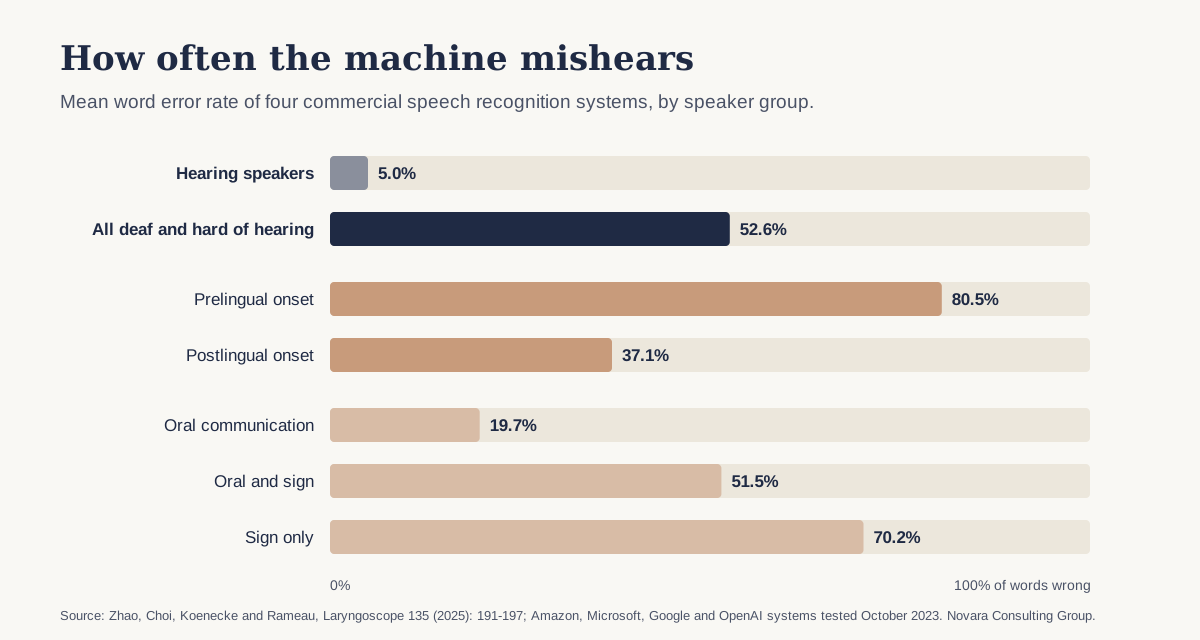
There is research on how speech recognition handles those children’s voices, and it is not encouraging. In a study published in the Laryngoscope in 2025, a team at Cornell ran recordings of deaf and hard of hearing speakers and hearing speakers through four commercial speech recognition systems from Amazon, Microsoft, Google and OpenAI. The mean word error rate was 52.6 percent for deaf and hard of hearing speakers and 5.0 percent for hearing speakers, roughly ten times higher. It rose to 80.5 percent for speakers whose hearing loss began before they learned language, and to 70.2 percent for speakers who communicate by sign only. The authors also found that one system sometimes produced words the speaker had not said at all.6 The sample was small, thirty-three speakers, and the study tested general purpose engines rather than any education product or any child reading a first word. But it measured the thing these screeners depend on, and it found that the engines are least accurate for the speakers whose speech is least like the speech they learned from.
A screener built on speech recognition can fail a deaf or hard of hearing child in two different ways, and both happened at Pine Lake.
Mateo, Unscorable
The first way is simple. A child who does not use speech cannot be measured by a tool that only listens. Mateo saw the letters on the tablet. He knew several of them, and he fingerspelled them, as his teacher had taught him. The headset heard nothing it could score. On the blending subtest, the tablet said sounds into headphones he could not use, and he waited. The screener recorded a nonresponse for every item, and nonresponse scores as wrong. Three screenings, three red reports, three dyslexia risk notices sent home in English to a family that reads Spanish.
Nothing in that result is about Mateo’s reading. It is about the instrument. Federal rules have said for decades that assessments must be selected and administered so that, when a child has impaired sensory, manual or speaking skills, the results reflect the child’s aptitude or achievement rather than the impairment, and that they must be given in the child’s native language or other mode of communication.7 A speech recognition screener given to a signing child does the reverse of both: it measures only the impairment, in the one mode the child does not use.
The rules do not reach the screener directly, and that is the gap. A screening by a teacher or specialist to determine appropriate instructional strategies is, by regulation, not an evaluation for special education eligibility, which is why districts can screen every child without parental consent.8 The assessment standards apply to evaluations. So the screener is free to measure Mateo’s speech, label the result a reading risk and route him into an intervention, and none of the protections that would apply if anyone called it an evaluation are triggered. Pine Lake’s reading intervention group for red kindergarteners is taught by voice. For three months last year, Mateo spent four mornings a week in a group learning sounds he could not hear, while his teacher of the deaf, who had not seen the screener’s list, worked with him on English print through ASL in the afternoons.
The notice itself was its own small failure. Three times in one school year, Pine Lake mailed Mateo’s parents a letter in English telling them their son was at risk for dyslexia. His parents read Spanish. Federal civil rights law has long required schools to communicate with parents who have limited English proficiency in a language they can understand, about any program, service or activity that is called to the attention of parents who speak English, and the Departments of Education and Justice set that obligation out in detail in joint guidance in 2015.9 A dyslexia risk notice is the kind of communication the guidance describes. Had Mateo’s parents been Deaf, the obligation would have been the same in a different form: public schools must furnish auxiliary aids and services, including qualified interpreters, so that communication with a parent who is deaf is as effective as communication with others.10 A screener that generates notices automatically, in one language, to every family with a red result, turns that obligation into a mail merge. The family of the child the screener could not hear received a letter they could not read about a disability their son did not have.
Phonics for a Child Who Cannot Hear the Sounds
Mateo’s three months in the intervention group raise a question that reaches past any screener: what reading instruction built on sound means for a child who does not hear it. The structured phonics that Pine Lake’s coaches use, and that most state reading laws now require, teaches children to connect letters to the sounds of spoken English and to blend those sounds into words. For a hearing child, that connection is the fastest route into print. For a deaf child, the route is less settled, and the research is worth knowing before anyone puts a signing kindergartener into a sound-blending group.
The most cited synthesis of that research, a 2011 meta-analysis by Rachel Mayberry, Alex del Giudice and Amy Lieberman in the Journal of Deaf Studies and Deaf Education, pooled studies of phonological coding and awareness in deaf readers. It found that phonological skills predicted only about 11 percent of the variance in deaf readers’ reading proficiency, while language ability, in whatever language the reader had, predicted about 35 percent.11 The finding does not mean phonology is irrelevant to deaf readers. Many deaf children develop useful phonological knowledge through speechreading, fingerspelling, residual hearing or visual systems built for the purpose. It means that for a deaf child, the strongest predictor of learning to read is having a strong first language, and that a reading intervention built entirely on hearing the sounds of English is aimed at the wrong lever for many of them.
This is not an argument against phonics or against screening. It is an argument that a reading screener’s result for a deaf child, and the intervention it triggers, have to be interpreted by someone who knows how deaf children learn to read. Mateo’s teacher of the deaf was teaching him English print through ASL in the afternoons, the approach the research supports for a signing child. The screener’s output was sending him, in the mornings, to an approach designed for children who can hear. Neither the screener nor the intervention coach did anything wrong by their own standards. The child was simply routed by a system that did not know he was deaf, into instruction that assumed he was not.
Lily, Who Passed at Birth
The second way is harder to see, because the screener works as designed. Lily is six. She passed her newborn hearing screen, talks a mile a minute, and was flagged red in first grade on the phonological subtests: she had trouble blending sounds into words and telling similar sounds apart. The screener reported a high risk for dyslexia. Pine Lake sent the notice home and put her in the intervention group, where she made slow progress through the fall and winter.
What no one checked until April was her hearing. When the school nurse finally screened her, at her mother’s request, Lily failed in both ears at the high frequencies, the range where the sounds of s, f, th and sh live. An audiologist confirmed a mild bilateral high-frequency hearing loss that had probably developed after birth. She had not been mishearing the screener’s sounds because of a reading disorder. She had been mishearing them because she could not hear them well, and the intervention group, held in a busy room with four other children sounding out words at once, was a hard place to hear them too.
Lily is not rare. In a national survey of children ages six to nineteen, about 15 percent had a measurable hearing loss of at least 16 decibels at low or high frequencies in one or both ears, most of it slight or mild.12 A newborn screen does not rule out a loss that develops later, and follow-up after a failed newborn screen is uneven: the National Deaf Education Data Index found that in Delaware’s 2022 newborn screening data, 240 of the 292 infants who did not pass the screen were lost to follow-up.13 A first grader with a mild loss can look, to a screener measuring how well she hears and reproduces speech sounds, almost the same as a first grader at risk for dyslexia.
The federal rules anticipate this confusion at the evaluation stage. A team may not find that a child has a specific learning disability if her difficulties are primarily the result of a visual, hearing or motor disability.14 But that rule applies when a district evaluates. A screener’s dyslexia risk flag that sends a child into intervention for a year without anyone ruling out hearing never reaches the evaluation stage at all. The federal special education office warned in 2011 that a response to intervention process cannot be used to delay or deny an evaluation for a child suspected of having a disability.15 A year of reading intervention for a child with an unidentified hearing loss is that delay, even when no one intended it.
She had not been mishearing the screener’s sounds because of a reading disorder. She had been mishearing them because she could not hear them well.
The Hearing Screen That Should Have Come First
Lily’s story has a second institutional failure in it, and it is quieter than the first. Pine Lake does screen hearing. Like most districts, it runs school hearing screenings through the nurse’s office on a schedule set by state rule or district practice. The American Academy of Audiology’s childhood screening guidelines recommend a pure tone sweep at 1000, 2000 and 4000 hertz at 20 decibels for children three and older, and recommend screening at minimum in preschool, kindergarten, and grades one, three, five and either seven or nine.16 The same guidelines note that newborn hearing screening does not identify late onset, acquired or many progressive losses.16 A child who passed at birth, in other words, is the very child school screening exists to catch.
Lily was screened in kindergarten and passed. Her loss may not yet have reached the screening level then, or it may have been at the edge of it, in the high frequencies where the guidelines themselves note that screening results are less stable.16 By first grade, the nurse’s office was not scheduled to screen her again until third. The reading screener, meanwhile, tested her three times that year. Two systems, run by two offices on two calendars, measured the same child’s ability to hear and reproduce speech sounds, and neither knew the other existed. The reading screener’s red flag on the phonological subtests was, in effect, a hearing screen with no audiologist attached. Nobody at Pine Lake was positioned to read it that way.
That is the cheapest failure in this piece to fix, and the one most districts have not fixed. The reading screener’s phonological results and the nurse’s hearing screening results are both already in the district’s systems. Joining them requires no new software, only a rule: any child flagged red on phonological awareness, sound discrimination or blending gets a hearing screen before she gets an intervention group. Pine Lake’s nurse estimated that the rule would add about forty hearing screens a year to a caseload that already includes more than a thousand. In its first year, it found Lily and two other children whose reading risk turned out to be, at least in part, a hearing problem.
Hannah, Mostly Heard
There is a third way a speech screener can fail a deaf or hard of hearing child, and it is the hardest to see because it looks like success. Hannah, the eight-year-old from part seven who received cochlear implants before her first birthday, speaks clearly and reads above grade level.1 The screener scored her green in kindergarten and green in first grade. Nobody had a reason to look closer.
Her teacher did look closer, by accident, in the spring of first grade. Hannah’s score on one subtest dropped from the top band to the middle and came back up two weeks later. The teacher remembered that Hannah’s processor battery had died during the first session and been swapped out halfway through. Looking back through the year’s reports, she found two more dips, each on a day the classroom was loud or the processor was acting up. The screener had not mismeasured Hannah’s reading. It had measured her hearing on that day, through a microphone, in a room, and reported it as reading.
The Cornell study points to why. Speech recognition error rates for deaf and hard of hearing speakers varied enormously with intelligibility: about 9.5 percent for speakers with highly intelligible speech, 46.6 percent for medium and 85.9 percent for low.6 A child like Hannah sits at the good end of that range most days, and on those days the screener is close to accurate for her. On a bad hearing day, her speech, her listening and the machine’s transcription can all slip at once, and nothing in the report says so. When a screener works most of the time for a child, its errors become invisible, because nobody is looking for them. The fix is the same as for Mateo, in a lighter form: a note in the screener’s record for every child with a hearing device, and a person who checks any unexpected dip before it becomes a flag.
Owen and the Risk Score
The screener is one piece of software that decides who gets looked at. The early warning system is another, and it works on older children. Many districts now use models that combine attendance, grades, discipline and demographic data into a score predicting which students are at risk of not graduating, and route high scorers to counselors or intervention teams. The best-known public investigation of one, by The Markup in 2023, found that Wisconsin’s statewide Dropout Early Warning System was wrong nearly three quarters of the time when it predicted a student would not graduate on time, and wrong more often for Black and Hispanic students than for white students.17 Wisconsin’s education department responded that the model is math that reflects the state’s systems.17
Owen, the seventh grader from part seven who wears hearing aids, scored high risk on Pine Lake’s model in the fall. The reasons were in the data. He had missed eleven days the year before, most of them for audiology appointments in a city an hour away. His grades fell every afternoon, which the model read as disengagement. A behavior incident in the cafeteria, where he cannot hear, had been recorded as defiance when he did not respond to an aide calling his name from behind him. Each of those facts is a sign of an access problem, and each of them, entered into a risk model trained on all students, reads as a sign of a different kind of risk. The model sent Owen’s name to the attendance and behavior team. It did not send it to his IEP team, because the model had no field for hearing.
None of this means risk models are useless, or that Owen’s team should ignore his attendance. It means that a model trained to predict one outcome across all students will, for a child whose disability shapes the very data it reads, predict the wrong problem. For a child who already has an IEP, a risk flag should go first to the people who know why the data look the way they do.
The Markup’s investigation is worth reading beyond its headline. It reported that, among the Wisconsin districts that answered its survey, 38 percent said they used the state’s early warning system, that the state had known since 2021 that the predictions were not equally fair across groups, and that a forthcoming study by researchers at the University of California, Berkeley found the label had no effect on graduation for the students it marked high risk.17 A risk score that is often wrong, unequal in how it is wrong and does not change outcomes for the students it labels is not a tool a district should be routing children by without a person in between. For a student with a disability, that person should be someone who knows what the disability does to the data. Federal rules require that a child’s IEP team review and revise the plan to address any lack of expected progress, and a falling grade or a string of absences is that kind of signal.18 It belongs to the IEP team before it belongs to the attendance office.
What Happens to a Child’s Voice
A screener that listens also records. Every time a kindergartener reads a word into the headset, the product captures a few seconds of a five-year-old’s voice, and a screening season at a district of Pine Lake’s size produces tens of thousands of clips. What happens to them is a question few districts ask, and it matters more for some children than others.
Speech recognition systems improve by training on speech, and the speech they handle worst is the speech they have heard least. The recordings a screener collects from deaf and hard of hearing children, from children with speech sound disorders and from children still learning English are, from a developer’s point of view, the scarcest and most valuable clips in the set. That gives a vendor a reason to want to keep them. It gives a district a reason to know whether the vendor does.
Part three of this series read the data agreements that govern AI tools in American schools and found that most of the readable ones, on the standard national template, let the vendor use de-identified student data for product development, and that some let that right survive the end of the contract.19 A voice recording is not easily de-identified in any meaningful sense; a voice is itself identifying. NCG has not reviewed the data agreements behind any particular reading screener and makes no claim about what any vendor does with recordings. The point is that the question has an answer, the answer is in a contract the district signed, and a district that has never read that clause does not know whether the most distinctive voices in its kindergarten are helping train the next version of the product that could not hear them. A district can ask four questions: whether audio is retained after scoring, for how long, whether it is used to train or improve any model, and whether the family can have it deleted.
What Child Find Requires
Every district has a duty that does not depend on any software: it must identify, locate and evaluate all children with disabilities who need special education and related services, including children who are suspected of having a disability even though they are advancing from grade to grade.20 That duty is the district’s, and it cannot be handed to a vendor. A screener flag, a risk score and a teacher’s worry are all inputs to it. None of them discharges it.
The legal standard is suspicion, not certainty, and that matters for how a district reads its own data. A district does not need to know that a child has a disability before its duty is triggered. It needs a reason to suspect one. Courts and hearing officers have repeatedly held districts responsible when the signs were there and nobody acted on them, and the signs in this piece were there: three unscorable screenings for a child known to be deaf, a year of slow progress in phonics for a child whose difficulties were all in hearing speech sounds, a risk score built from audiology absences. Software did not hide those signs. It reported them, in a format no one with the right knowledge was reading. The duty to read them does not shift to the software because the software produced them.
The duty is not only in the special education law. Section 504 of the Rehabilitation Act, which covers every child with a disability whether or not she needs special education, has its own version: a school district receiving federal funds must annually undertake to identify and locate every qualified person with a disability in its jurisdiction who is not receiving a public education, and must evaluate any child who needs or is believed to need special education or related services before placing her.21 Lily, who may need nothing more than hearing aids, captions and a good seat, is the kind of child Section 504 exists for. A screener that routes her into reading intervention instead has not just delayed an IDEA evaluation. It has kept her out of the conversation about accommodations altogether.
Read that way, the screener’s red flag for Lily was not a problem. It was a correct signal that something was wrong. The problem was what the district did with it: it treated a reading risk flag as a diagnosis and an intervention as the response, instead of treating it as a reason to ask what might be causing the difficulty, starting with whether the child can hear. Mateo’s flag was not a signal about him at all, and the district’s error was in not noticing that a child who produced no scorable response three times had not been assessed. Owen’s flag pointed at the right child and the wrong cause.
Families do not have to wait for the district to connect the dots. A parent may request an initial evaluation at any time, and once she consents, the evaluation must generally be completed within sixty days or the state’s own timeline.22 A dyslexia risk notice is a reasonable moment to ask for one, and to ask in writing that it include a hearing evaluation by an audiologist before any conclusion about reading.
What the Screener’s Contract Should Say
Part two proposed seven clauses for the contract behind an IEP drafting tool.23 The screener needs its own, and they are shorter, because the risks are narrower. A district buying a speech recognition screener can ask for four things in writing.
The first is the population the vendor tested. A screener’s accuracy is only known for the children it was validated on, and a district should know whether that included children who are deaf or hard of hearing, who use sign language, who have speech differences or who are learning English, and with what results. If it did not, the vendor should say so. The second is a separate result for children the screener cannot assess. “No scorable response” is not a reading score, and it should never be reported as red. A screener that cannot hear a child should say that it cannot hear the child, and route the result to a person. The third is an alternative path: a version of the screening a teacher can administer by hand, or in the child’s language and mode, for any child whose IEP, 504 plan or language profile makes the speech version invalid. The fourth is a prompt, built into the report, that any red result on the phonological subtests be followed by a hearing screening before the child is placed in intervention. It costs the vendor a line of text. It would have found Lily’s hearing loss in October.
| Ask | Why it matters | The Pine Lake child it would have helped | |
|---|---|---|---|
| Who was the screener validated on | by group | Accuracy is only known for the children tested | All three |
| Report “not assessable” separately from red | A child the tool cannot hear has not been screened | Mateo | |
| An alternative administration in the child’s language and mode | The speech version is invalid for signing children | Mateo | |
| A hearing check prompt before intervention on phonological flags | Hearing loss and dyslexia risk look alike to the screener | Lily |
None of this requires a district to stop screening. Universal screening finds children who would otherwise be missed, and most of the children Pine Lake’s screener flags red each year are flagged for good reason. The point is that a screener is a measuring instrument, and every measuring instrument has a range. A district that knows the range can use the tool well. A district that does not will, every September, put some of its deaf and hard of hearing children into the wrong group, and send home a notice about a disability the child does not have instead of finding the one she does.
A Screening Season with a Person in It
Put the pieces together and a better screening season is not hard to describe. It starts two weeks before the tablets come out, with a roster check. The special education office and the English learner office mark every child whose IEP, 504 plan or language profile makes the speech version of the screener invalid or doubtful: children who sign, children with cochlear implants or hearing aids, children with speech sound disorders, children new to English. Those children are assigned in advance to an alternative administration, by a person, in their language and mode. The screener never produces a red result for them, because it never screens them.
The screening itself runs as it always has for everyone else. When the results come back, the reading team and the deaf and hard of hearing team see the red list at the same time. Every child red on phonological subtests goes on the nurse’s list for a hearing screen within two weeks. Every “no scorable response” goes to a person who finds out why. The notices to families wait until both checks are done, and go out in the family’s language. The early warning list, when it runs, goes first to the case managers of students who already have IEPs. And at the end of the season, the district confirms with its vendor, in writing, that audio recordings were deleted on the schedule its agreement requires.
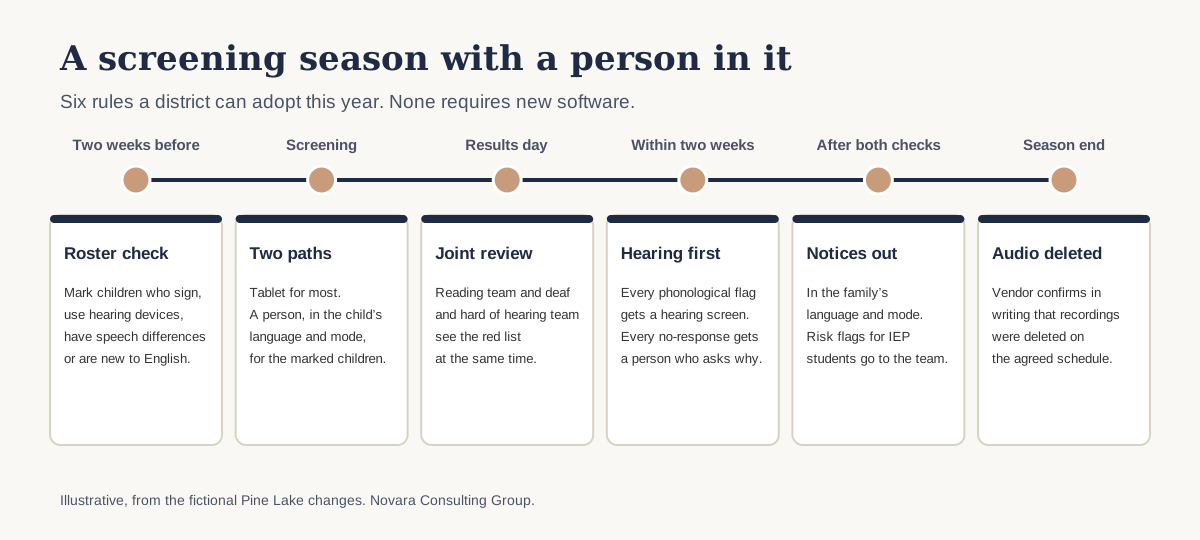
Every step on that list is a rule, not a product. None of it requires a district to give up the efficiency that made it buy the screener. It requires a district to decide, before the season starts, that a screener’s result is the beginning of a judgment and not the end of one, and to put a person at each of the points where the screener is most likely to be wrong.
Dana’s List
Dana took three changes to her superintendent in May. Every child with an IEP or 504 plan for a hearing loss, and every child who uses sign language, would be screened by a teacher in the child’s language and mode instead of by the tablet, with the result recorded by hand. Any red phonological result would be followed by a hearing screening by the school nurse within two weeks, before intervention began. And the deaf and hard of hearing team would receive the screener’s list and the early warning list every time they were run, so that the people who knew why a child’s data looked the way it did could see the flags before anyone acted on them.
The curriculum office objected to the first change, on the ground that hand scoring would make the district’s results less comparable. Dana’s answer was that a red result for a child the tool cannot hear is not comparable to anything. The change went through. Mateo was screened in January by his teacher of the deaf, in ASL and print, and was green on letter knowledge and yellow on early word reading, which is where his teachers thought he was. Lily got hearing aids in June and a seat near the front of a quieter intervention room in the fall. Owen’s name now goes to his case manager before it goes to anyone else.
The objection Dana heard most often that spring was not about cost. It was about fairness. The curriculum office’s argument was that treating some children differently in screening was itself a kind of inequity, and that the point of universal screening was to hold every child to the same measure. Dana’s answer, which she gave in some version at three different meetings, was that the same measure is only fair when it measures the same thing. A speech recognition screener measures a hearing child’s early reading through her speech. For a child who signs, it measures nothing about her reading and everything about her speech. Holding both children to the same tool does not hold them to the same standard. It holds one of them to a standard the tool was never built to apply.
Seven parts in, the lesson is the same one at a different door. The software was not wrong about what it measured. It measured speech, or attendance, or grades, accurately enough. What it could not know was what those measurements meant for a particular child, and the decisions that followed were made as if it did. The record is not the child, a flag is not a finding, and a screener that cannot hear a child has not screened her.
Questions for Governance Review
These questions are written for school boards, special education directors, procurement officers, state education agencies, vendors and families. They have no single right answer, and several of them have no answer at all yet in most districts. They are meant to be asked out loud, in a meeting, with the screener’s report on the table.
- If your child is flagged for reading risk, ask in writing whether her hearing has been screened since kindergarten, and ask for a screening if not.
- If your child signs or has a speech difference, ask how the screener was administered and whether the result reflects her reading or her speech.
- Ask whether the screener reports “no scorable response” separately from a low score.
- If your child already has an IEP or 504 plan for hearing, ask that screening be done in her language and mode, by a person.
- Remember that a reading intervention is not an evaluation. You may request a full evaluation at any time, in writing.
- If an early warning or risk score is used about your child, ask what data it uses and whether her IEP team sees it first.