
The line
In early October, a Justice Department lawyer stood before the federal appeals court in Washington and defended the White House’s refusal to put an American Sign Language interpreter beside the President at press briefings. Requiring a president to “share his platform with ASL interpreters,” the government argued, was a serious incursion on the office’s central prerogatives [1]. The theme had been there from the start of the case. In its first filings, the Justice Department wrote that ASL interpretation “would severely intrude on the President’s prerogative to control the image he presents to the public,” and suggested that Deaf viewers could rely on transcripts and closed captioning instead [2].
The case is National Association of the Deaf v. Trump. The interpreters disappeared from White House briefings in January 2025. The NAD and two Deaf plaintiffs sued that May, and in November 2025 Judge Amir Ali ordered real-time ASL interpretation at White House briefings, finding the plaintiffs likely to win under Section 504 of the Rehabilitation Act [3]. The government appealed. At oral argument, Judge Florence Pan pressed the government’s lawyer hard on his reading of the statute and appeared skeptical of it [1]. As of this writing, the court has not ruled.
I am not writing about the President, and I am not predicting how that appeal comes out. Plenty of people will cover both. I am writing about the county communications director who reads that argument over coffee on a Tuesday and hears permission in it. He does not hear a narrow fight over whether private citizens can sue the federal executive branch. He hears that the interpreter is a branding problem, and that a serious government is allowed to fix its branding problems.
Last week I wrote a bad employee case study about a hospital clerk who repeated a town hall line at the front desk. This is the same format pointed at a different building. Before NCG, I spent years in quality assurance problem management at the American Red Cross, running structured root cause analysis on failures that kept coming back. The lesson that work teaches first is that the person who makes the visible mistake is almost never the root cause. They are the moment a weak system shows itself. This time the weak system belongs to a county, and the person who pays for it is a Deaf woman watching the news alone.
Meet Brent
Larch County does not exist, and neither does anyone in this story. It sits on a river in central Minnesota: about 90,000 people, one hospital, one sheriff, and a five-member board of commissioners that holds a press briefing whenever the weather turns dangerous. Anyone who has worked in local government communications will recognize every person in it.
Brent Halvorsen has run county communications for eleven years. Before that he produced local television news, and it shows. The briefings look good. The lighting is right, the lower thirds are in county colors, and the feed goes straight to the two regional TV stations, the county’s Facebook page and a radio simulcast. Brent is not careless and he is not hostile to anybody. He is a craftsman who cares about how his county looks, and that is most of his job.
Since the pandemic, every emergency briefing has had a certified ASL interpreter standing next to the speaker, booked through a regional agency on a standing contract. Brent never loved the setup. The interpreter widens the shot. The commissioners have to leave a gap at the podium. Twice an interpreter arrived late and the board waited on camera. When he read the coverage of the White House argument in October, he said out loud what he had been thinking for years. At the Monday staff meeting he told his team, “If the President doesn’t have to share the frame, neither does the board.”
He moved the interpreter to a separate stream on the county website and sent the TV stations a clean feed. Nobody objected. The county’s ADA coordinator works in Human Resources and has never been invited to a communications meeting.
A month later, at a regional government technology conference, Brent watched a demo from Larkspur, a vendor selling an AI signing avatar. Larkspur is fictional too, though its pitch will sound familiar. The avatar runs off the live caption feed, sits in a tidy corner box, can be dressed in county colors and never needs to be scheduled. The sales sheet promised 98 percent accuracy. The annual license came in under the county’s informal-quote threshold, so it went through on a purchase order with no solicitation, no evaluation panel and no accessibility review. When the interpreter contract came up for renewal in January, Brent let it lapse and put the avatar back into the broadcast frame, in the spot where the human interpreter used to stand.
The interpreter had been off-brand. The avatar was on-brand.
The night of the flood
In April, snowmelt and three days of rain pushed the river over flood stage. At 9:40 p.m., board chair Diane Sorensen stepped to the podium and said: “The levee at County Road 12 is not expected to hold past 2 a.m. If you live in Zones B and C, leave now.”
The automatic captions heard “Zones B and D.” The avatar, reading the captions, signed the wrong zone with complete confidence. Then it signed LEVEE and HOLD and carried the negation the way ASL often does, with a headshake running across the verb. In a box a few inches wide in the corner of a living room television, the headshake did not read.
Ruth Lindgren is 74 and has been Deaf since birth. She lives alone in Zone C. She gets her news from cable television, and her house has no internet service, so the county’s website stream was never an option for her. She watched the avatar, understood that the levee was expected to hold and that the warning was for a zone that was not hers, and went to bed.
At 1:20 a.m., her neighbor’s son noticed her car still in the driveway. He knocked, knew she would not hear it, and let himself in with the key she had given his family years ago. He woke her with the bedroom light. They left at 1:50. Water crossed County Road 12 at 2:35.
Ruth is fine. Her daughter filed a complaint with the Minnesota Department of Human Rights the following week and called a lawyer the week after that.
Why the White House argument does not travel
The argument Brent heard is not the argument the government made. NAD v. Trump turns on Section 504 of the Rehabilitation Act as it applies to programs run by the federal executive branch, and on whether private citizens can go to court to enforce it against those programs at all. The government’s appellate brief says Section 504 “does not afford a private right of action” against federal programs, and points to how Congress structured enforcement in Section 505 [1]. Disability rights organizations have warned that the position reaches far beyond sign language, because it would leave disabled people unable to sue any federal agency that discriminates against them [4]. The image language is the framing wrapped around that structural fight. It is not a freestanding rule that a government may skip interpreters when they spoil the shot.
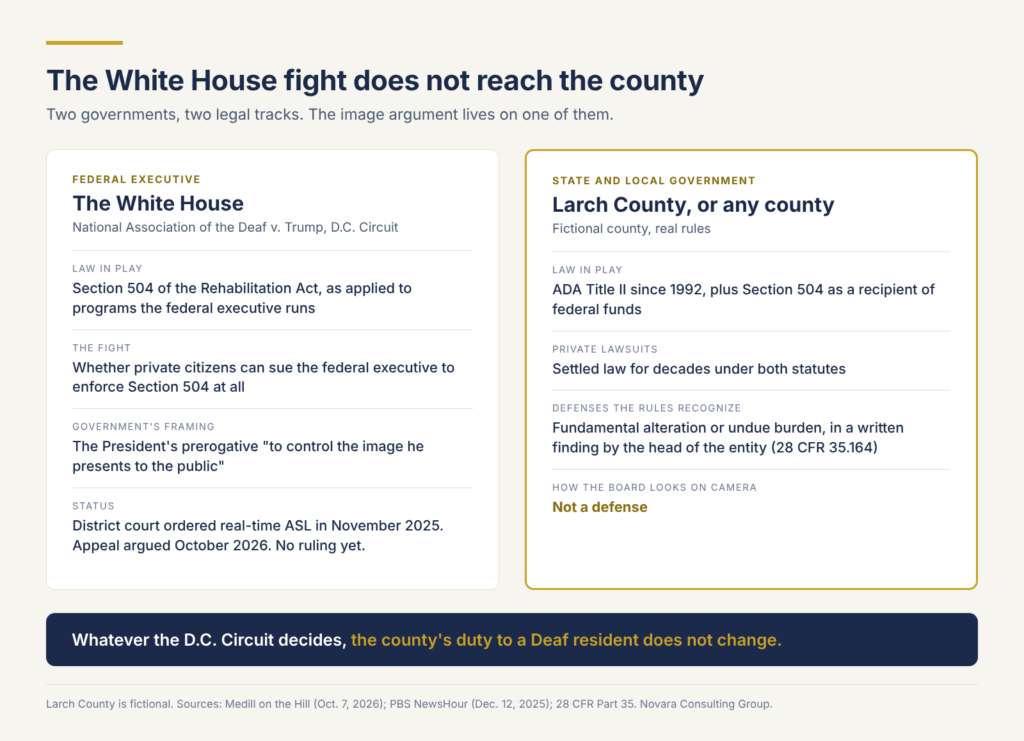
A county sits on a different track entirely. Title II of the Americans with Disabilities Act has covered every state and local government since January 1992. Section 504 covers any county that takes federal money, which in practice is nearly every county in the country. Private lawsuits against public entities under both statutes are settled law and have been for decades. The Title II regulations require that communication with people with disabilities be as effective as communication with everyone else, and they name the defenses a public entity can raise when it refuses an auxiliary aid: fundamental alteration or undue burden, decided by the head of the entity after considering all available resources and put in a written statement of reasons [8].
How the commissioners look on television is neither. Even if the government wins its appeal outright, it wins on who may sue the federal executive. It does not win on whether Deaf people need interpreters, and it changes nothing about what Larch County owed Ruth on the night of the flood.
There is also a direct precedent for Brent’s first move. In the spring of 2020, New York’s governor held daily COVID-19 briefings and pointed Deaf viewers to a separate ASL stream on the state’s website instead of putting an interpreter in the broadcast frame. Deaf New Yorkers sued. In Martinez v. Cuomo, Judge Valerie Caproni of the Southern District of New York ordered the governor to “immediately implement in-frame ASL interpretation during his daily press briefings,” finding that the web streams did not reach people without internet access and that captions did not serve people who could not read English [5]. Within days, the interpreter was back on screen beside the governor [6]. Ruth, with cable and no internet, is the plaintiff that case was about.
Every step was a decision
What makes this a useful case study is that nothing in it is dramatic. Nobody shouts. Nobody refuses service. Nobody in the county building thinks of themselves as the bad guy. The failure is a chain of small, ordinary choices, and each one sounded like production, budget or efficiency at the moment it was made.
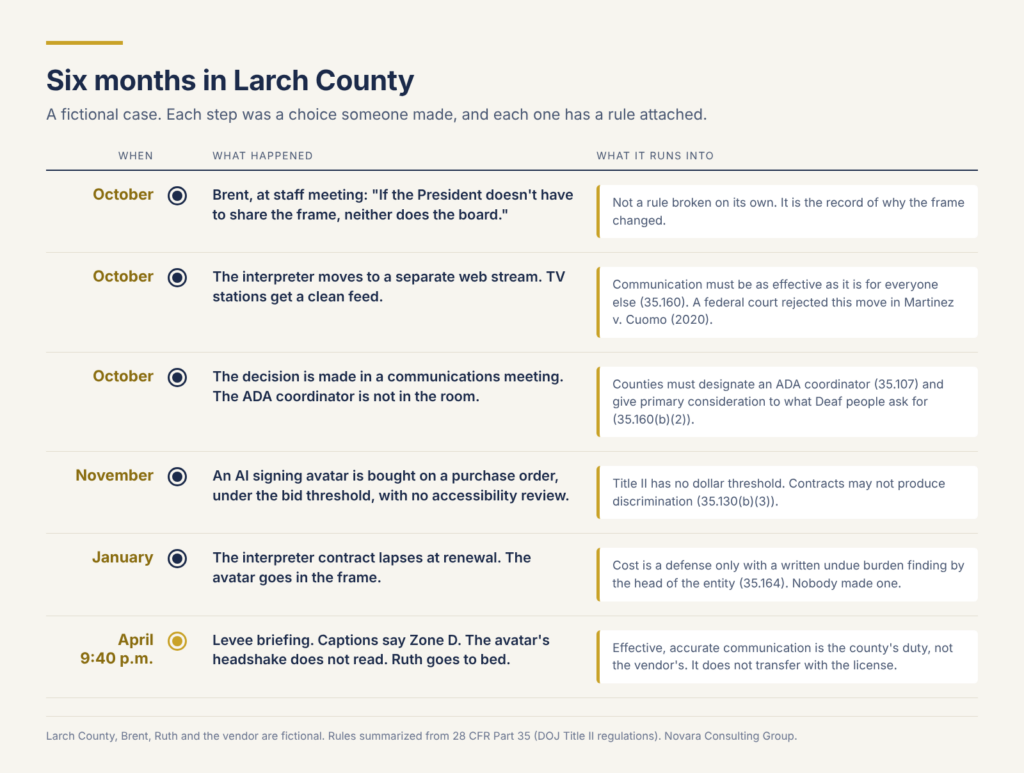
The exposure began at the staff meeting, not at the levee. Brent’s line about the President did not break a rule on its own, but it is the kind of sentence that ends up quoted in a complaint, because it is the record of why the frame changed. The separate web stream was the first real violation, and a federal court had already said so six years earlier.
The second failure is structural, and it is the one most counties share. Title II requires a public entity with 50 or more employees to designate a coordinator responsible for its ADA compliance, and it directs public entities to give primary consideration to the kind of aid Deaf people themselves request [8]. Larch County had a coordinator. She was simply never in the room where the decision about Deaf residents was made, and nobody asked a single Deaf resident what they needed from an emergency briefing.
The purchase order is where the case turns from a communications problem into a procurement problem. Title II has no dollar threshold. A public entity may not, directly or through contractual arrangements, use methods of administration that have the effect of discriminating, and it may not provide an aid that is less effective than what everyone else receives [8]. A purchase small enough to skip a bid is not small enough to skip the law.
The 98 percent figure deserves its own sentence, because it is the one most likely to be repeated in a real county budget meeting. It measured how often the English captions matched the English audio. It said nothing about whether a Deaf viewer would understand the signed output. The regulations define a qualified interpreter as one who can interpret “effectively, accurately, and impartially, both receptively and expressively, using any necessary specialized vocabulary,” whether on site or through video remote interpreting [8]. An avatar is neither, and the vendor’s accuracy number does not describe the thing the law measures.
Letting the interpreter contract lapse removed the county’s fallback. Cost and inconvenience are not defenses unless the head of the entity makes a written undue burden finding after considering all available resources. Nobody made one, and an interpreter booking is not an undue burden for a county with a nine-figure budget. The last link is the one counties forget most often: the duty to communicate effectively belongs to the county. It does not transfer to a vendor with the license.
Where “not” went missing
The avatar did not malfunction. It did what it was built to do, and that is the problem.
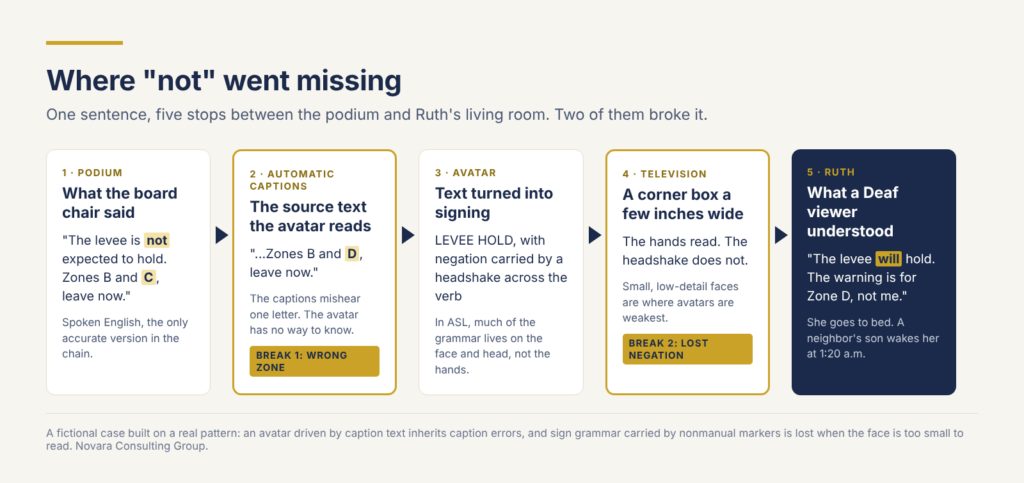
It took its source text from the automatic captions, so it inherited the captions’ mistake and signed the wrong zone. A human interpreter listens to the speaker, not to the caption feed, and would have heard “C.” Then the avatar rendered a sentence whose meaning turned on negation, and in ASL negation frequently lives on the face and head rather than the hands. A headshake running across a verb is grammar, not decoration. Linguists describe signs by four manual parameters (handshape, location, movement and palm orientation) and a fifth, the nonmanual markers carried by the face and body, which mark questions, conditionals, topics and negation. That fifth parameter is where avatars are weakest, and a corner box on a living room television is where it is hardest to see. The English sentence said the levee would fail. The ASL a Deaf viewer could actually perceive said it would hold.
I have a personal stake in the corner box, too. I am DeafBlind, with retinitis pigmentosa that takes my vision above eye level. A signing box tucked into the upper corner of a screen is not small for me. It is gone. A human interpreter standing in the frame at the speaker’s side, at full size, is the version of this information that reaches the widest range of Deaf, hard of hearing and DeafBlind viewers, which is part of why in-frame placement became the standard courts reached for in the first place.
The checklist that asks the wrong question
The 98 percent number got past Larch County because nobody there knew what question to ask. That gap is not unique to one county, and the federal government has just written it into policy.
In December 2025, the Office of Management and Budget issued memorandum M-26-04 to carry out the executive order titled “Preventing Woke AI in the Federal Government.” It tells federal agencies buying large language models to demand acceptable use policies, model and data cards and end user documentation, and to give users a way to report bad outputs. Its first principle is truth-seeking: models “shall be truthful in responding to user prompts seeking factual information or analysis” and “shall acknowledge uncertainty where reliable information is incomplete or contradictory” [7]. The memo never mentions accessibility, Section 508, disability or sign language. The federal government’s newest AI procurement checklist asks whether a model is neutral and truthful in English. It does not ask whether a Deaf person on the receiving end gets the truth.
Larch County is not bound by an OMB memo. But county purchasing offices borrow federal checklists all the time, and the next Brent will find a federal template that asks a vendor for a model card and an English benchmark and stops there. Here is the part I find most useful about this policy, whatever side of the politics around it you are on. The truth-seeking principle, applied honestly to sign language output, is the right test. An avatar that turns “is not expected to hold” into “is expected to hold” fails truth-seeking in the most literal way possible. The standard was sitting right there. It was simply never pointed at the people who most needed it.
That is the evidence gap NCG’s SLAT Index was built to close. It treats a vendor’s accuracy claim as a claim rather than as evidence, it asks what the number actually measured, and it treats fluent Deaf signers as definitional to judging whether signed output is correct, including the grammar that lives on the face.
What a governed county does next
Larch County should correct Brent’s conduct, not fire him for it. Document what he did, retrain him on Title II and make clear in writing that the interpreter decision was never his to make alone. Firing him and changing nothing else guarantees that his replacement inherits the same unguarded decision. The root cause is that Larch County let the person responsible for how the county looks decide, by himself, whether Deaf residents would receive emergency information, and gave the person responsible for whether the county complies no gate to stop him. The fixes belong in the system.
- Write in-frame interpretation into the procedure
Write in-frame interpretation into the county’s emergency public information procedure. The interpreter appears in the same shot as the speaker, at a size a viewer can read, on every feed the county distributes, including the feed handed to television stations. A separate stream may supplement it but never replace it.
- Give the ADA coordinator a gate
Put the ADA coordinator on the sign-off for any change to how accessibility appears in public communications, and give that sign-off the power to stop the change.
- Treat signing AI as language access
Classify any AI that produces sign language as a language access service, not as software. No purchase at any dollar amount without evidence of accuracy evaluated by fluent Deaf signers, including nonmanual grammar, on the type of content it will carry and at the screen size it will run at.
- Keep qualified humans as the floor
Keep qualified human interpreters as the floor for emergency and life-safety information. An AI tool can be piloted on low-stakes content only after it clears that evaluation, and only alongside a human interpreter until the evidence says otherwise.
- Hold a backup contract
Hold a standing interpreter contract with a backup agency and an after-hours number, so that a late interpreter is a logistics problem with a known fix rather than an argument for removing the interpreter.
- Bring Deaf residents into the review
Run the after-action review on the flood briefing with Deaf residents in the room, and invite Ruth first.
Questions for your next staff training
At what moment did Larch County’s legal exposure begin: the staff meeting, the separate stream, the purchase order or the briefing? Why does the answer change who needs to be trained?
Brent’s reasoning came from a real argument in a real federal case. How does a supervisor explain the difference between a federal executive branch dispute and a county’s own obligations without turning the conversation into a political argument?
Who in your organization can change how accessibility appears in a public broadcast today, and does your ADA coordinator know that person’s name?
What would you require from a sign language AI vendor before its product carried a single emergency message, and who on your staff is qualified to judge whether the signing is correct?
And the one I would ask first: if your county’s interpreter were stuck in traffic at 9:40 p.m. on a flood night, what would happen next?
The D.C. Circuit will decide who can sue the White House. It will not decide whether Ruth needed to know that the levee was not going to hold. That question was answered in 1992, and every county in America still owes the same answer.
Bibliografia
- Martin, E. (2026, October 7). Appeals court weighs lawsuit over White House sign language access. Medill on the Hill. https://medillonthehill.medill.northwestern.edu/2026/10/appeals-court-weighs-lawsuit-over-white-house-sign-language-access/
- Kinnard, M. (2025, December 12). Sign language services ‘intrude’ on Trump’s ability to control his image, administration says. PBS NewsHour / Associated Press. https://www.pbs.org/newshour/politics/sign-language-services-intrude-on-trumps-ability-to-control-his-image-administration-says
- ACLU of the District of Columbia. (2026, June 2). National Association of the Deaf v. Trump (ASL interpretation during White House press briefings). https://www.acludc.org/cases/national-association-of-the-deaf-v-trump-asl-interpretation-during-white-house-press-briefings-protecting-the-rule-of-law-and-separation-of-powers-by-urging-the-d-c-circuit-to-apply-the/
- Disability Rights Education and Defense Fund. (2026, June 4). DREDF files amicus brief to defend disabled people’s right to take federal agencies to court. https://dredf.org/nad-v-trump-2026-amicus-brief/
- Martinez v. Cuomo, 459 F. Supp. 3d 517 (S.D.N.Y. 2020), No. 1:20-cv-03338. Civil Rights Litigation Clearinghouse. https://clearinghouse.net/case/17546/
- The Daily Moth. (2020, May). Federal judge orders New York Gov. Cuomo to “immediately” provide in-frame ASL interpreters for daily briefings. https://www.dailymoth.com/blog/federal-judge-orders-new-york-gov-cuomo-to-immediately-provide-in-frame-asl-interpreters-for-daily-briefings
- Office of Management and Budget. (2025, December 11). M-26-04, Increasing public trust in artificial intelligence through unbiased AI principles. https://www.whitehouse.gov/wp-content/uploads/2025/12/M-26-04-Increasing-Public-Trust-in-Artificial-Intelligence-Through-Unbiased-AI-Principles-1.pdf
- 28 C.F.R. Part 35, Nondiscrimination on the basis of disability in state and local government services, sections 35.104, 35.107, 35.130, 35.160 and 35.164. Electronic Code of Federal Regulations. https://www.ecfr.gov/current/title-28/chapter-I/part-35