The most honest document a company publishes
Press releases are written for investors. Mission statements are written for customers. A job description is written for the person who will make the decisions, and it is the one place a company has to put in writing what it will refuse to do without. Everything else in a posting is description. The minimum qualifications are the part that does work, because they decide who gets screened in before anyone reads a cover letter.
I have a master’s degree in human resource management and I worked as an equality and inclusion specialist before I started doing governance work on sign language AI. I am also Deaf, and American Sign Language is my language. So when a sign language AI company publishes a job description for the person who will run its research, I read it the way I was trained to read any job description: skip the paragraph about the mission, go straight to the requirements, and ask what the company is willing to require of the person who decides.
This piece is about one posting. It is not about the person who was hired, if anyone was, and it is not a claim about how Rylo screens candidates in practice. It is about what the posting says out loud, and what it does not.
What the job is
The posting is titled “GM, Rylo Research.” It appeared on the job boards run by two of Rylo’s investors, Accel and General Catalyst, dated June 29, 2026, with the location Tel Aviv-Yafo, Israel [1]. It is now closed to applications, but the text is still up.
Rylo is the company that was called Nagish until June, when it announced $85 million in new funding and a new name [2]. It began with captioned and text relay calls for Deaf and hard of hearing people, and in October 2025 it bought sign.mt, a sign language translation project, whose founder Dr. Amit Moryossef joined as Head of Research [3]. The funding announcement describes Rylo Sign as a platform “that will support translation between dozens of signed and spoken languages.” I wrote about Rylo’s terms and its NVIDIA training plans on October 29 [4]. This posting is the hiring side of the same story.
The posting is clear about how much the job matters. “As GM of Rylo Research, you’ll lead the team building the future of AI-powered sign language translation.” The person in the role will “own delivery for a research org whose output will shape how Deaf people communicate with the hearing world.” They report directly to the CEO and the CTO. Then comes the sentence that caught my attention, because it is the best sentence in the posting:
Sign language is a cultural language, and sign language translation is a cultural bridge people have waited a lifetime for. That context shapes every decision you make about scope, priority, and what “done” means.
Rylo, GM, Rylo Research job posting, June 2026
I agree with every word of that. Sign language is a cultural language. Translation between a signed language and a spoken one carries culture across, or drops it. And the context should shape what “done” means, because a sign language model that is done by an engineering standard can be unusable by a Deaf one.
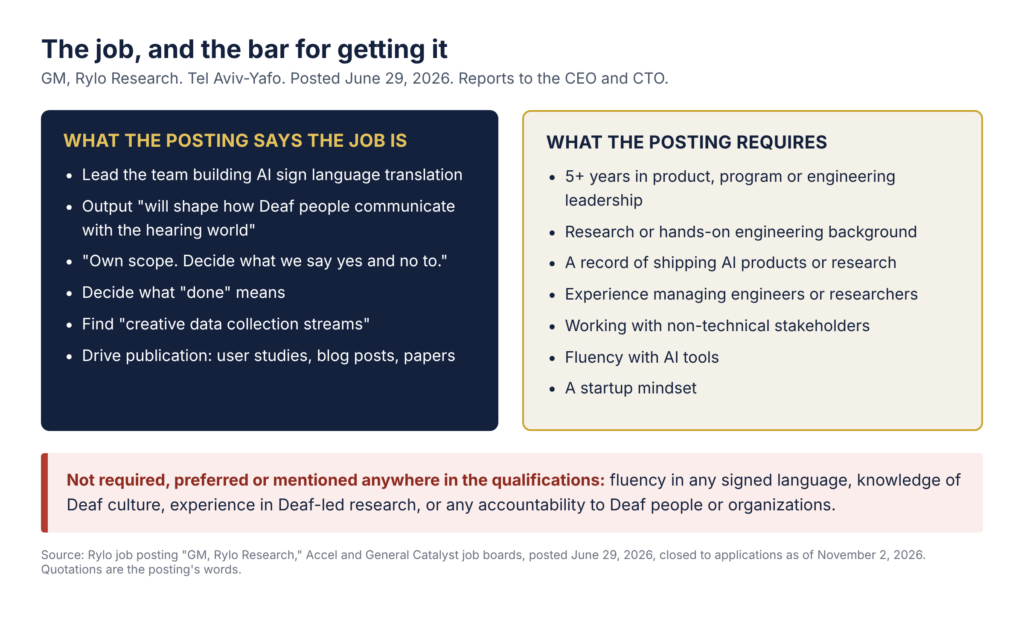
The rest of the job description tells you what kind of decisions those are. The GM is told to “Own scope. Decide what we say yes and no to.” They run the planning cycle, including contingency plans for research that only partly works or fails. They are asked to “Consider partnerships, creative data collection streams, and unique business and marketing opportunities.” They “Drive publication cadence: User studies, blog posts, research papers.” In a company that Calcalist put at 32 employees, as I noted in October, that is not a middle manager. That is the person who decides what gets built, what counts as finished, where the training data comes from, and what the public gets to read about whether it works.
What it takes to get it
Here is the bar, as written. Five or more years in product management, technical program management or engineering leadership, including some time leading AI or machine learning teams. A research or hands-on engineering background, with the note that a PhD is not required. A track record of shipping AI products or research on a regular cadence. Experience managing engineers or researchers, and working with stakeholders who are not technical. Fluency with AI tools beyond basic chatbot or coding assistant use. A bias toward action and a startup mindset.
That is a reasonable list for leading an engineering research team. It is the list you would write for a GM of research at a company building almost anything: search, recommendation, speech recognition, ad targeting. Nothing on it is specific to the thing this company says is a cultural language.
There is no requirement for fluency in any signed language. There is no “preferred” line that mentions one, and the posting has no preferred qualifications at all. There is no mention of Deaf culture, of experience in Deaf-led research, of sign linguistics, of interpreting, or of working under the authority of a Deaf organization. The posting says Rylo works “alongside the community.” The qualifications for the person running research do not mention the community.
Fluent, but not in the language
One word in the requirements stopped me. The posting asks for “fluency.” It asks for fluency with AI tools.
So the company knows how to write a fluency requirement. It thought about what the person who leads this team must be fluent in, and it picked the tools. It did not pick the language the tools are being built to translate.
I do not think that was written to insult anyone. I think it was written the way most technical job descriptions are written, from a template that assumes the hard part is the engineering and the subject matter can be learned on the job or borrowed from someone else on the team. In most fields that assumption is fine. You can lead a team building a mapping product without being a cartographer. But sign language is not a data format, and the posting itself says so. The posting’s own first paragraph makes the case for a requirement that its qualifications never state.
The company knows how to write a fluency requirement. It required fluency in the tools, not in the language.
NCG
Who the bar lets through
The easiest way to see what a minimum qualification does is to run two people through it. The two below are hypothetical. They are not applicants, and nothing here says anything about who applied to Rylo or who was hired.
Candidate A is a Deaf sign language researcher. Native signer, PhD in sign linguistics, three years running a six-person lab that has published on sign recognition. Candidate B is a hearing product manager who has never signed, with seven years leading AI teams at a consumer app company.
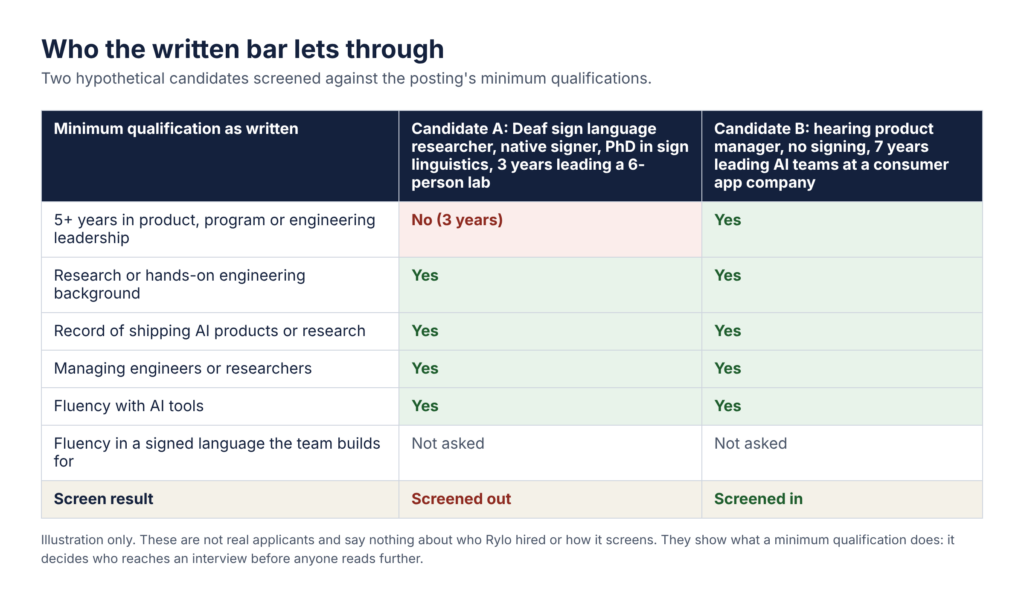
As written, Candidate B passes every line. Candidate A meets everything except the five years in a leadership title, and a screener working from the posting would set the application aside. The one thing Candidate A has that Candidate B does not, the language, is not on the list, so it earns nothing at the screen.
A good hiring manager might pull Candidate A out of the pile anyway. That is the point. What happens when a good hiring manager steps in is discretion. What happens when nobody does is the posting. If a company wants signed language fluency or Deaf accountability to count, the only reliable way to make it count is to write it down where the screener will see it.
The fair reading
There are real arguments on Rylo’s side, and they deserve to be stated plainly.
The role is in Tel Aviv. The local signed language is Israeli Sign Language, and Rylo Sign is meant to work across dozens of signed languages. A requirement for ASL would be wrong, and a requirement for fluency in every language the platform targets would be impossible. A fair version of the requirement would ask for fluency in at least one signed language the team builds for, plus a working relationship with fluent Deaf signers of the others. That is a solvable drafting problem. It is not a reason to leave the line out.
Rylo already has sign language expertise in research. Its Head of Research founded sign.mt and is described by Rylo as “a leading expert in Sign Language and Natural Language Processing.” Calcalist reported that several of Rylo’s employees are Deaf. A GM role can be built as an operations and delivery job sitting next to that expertise, and the posting reads that way in places.
That argument moves the question rather than answering it. The posting gives the GM ownership of scope and of what “done” means, and says the GM reports to the CEO and the CTO. I could not find a public statement of how the role relates to the Head of Research, or whether any Deaf person on the team can stop a release the GM has decided is done. Having experts in the building is involvement. The power to say no is authority. I made the same distinction in October, and this posting is a clean example of why it matters: the document that assigns the authority to decide “done” is the same document that leaves the language out.
Job postings are also often written fast, from templates, by people who are not the hiring manager. That is true, and it is the most likely explanation. It is also why the qualifications are worth reading. A template is what a company writes when it is not thinking about the question. For a company whose product is sign language translation, the question of who must understand the language should not be a template question.
Finally, Rylo plainly can meet a written bar when one is set for it. It earned full certification from the Federal Communications Commission for automated relay in June 2026, as I described in October, and relay rules are detailed and enforced. That is evidence the company writes requirements down and meets them when a regulator demands it. The posting shows what it writes when nobody does.
Why a buyer should care
If you are a transit authority, a hospital system, a university or a state agency thinking about buying sign language AI, a job description at a vendor may seem far from your procurement file. It is closer than it looks.
Every decision the posting assigns to this GM is a decision a buyer depends on. Deciding what “done” means is deciding when a model is good enough to ship, which is the output validation question at the center of NCG’s SLAT Index: whether anyone fluent in the language, and independent of the vendor, has checked that the signing is right. Choosing “creative data collection streams” is deciding whose signing, faces and bodies train the system, and on what consent, which is the data governance question. Driving the cadence of “user studies” and papers is deciding what evidence the public, and you, ever get to see. Our August review found no independent evaluation of Rylo Sign or its peers, and our recheck in October found none either [4].
A vendor’s marketing will tell you its products are built “for and with” the Deaf community, and Rylo’s does. A vendor’s org chart and job descriptions tell you who is accountable when “for and with” and “done on time” disagree. Buyers can ask for that. It is not a trade secret to say who signs off on a release.
What a better posting would say
None of this needs a new framework. It needs a few lines in a job description, and the willingness to let them cost something in the candidate pool. For a research leadership role at a sign language AI company, the qualifications could include:
- Fluency in at least one signed language the team builds for, or a demonstrated working history inside Deaf-led research where fluent Deaf signers held decision authority.
- Knowledge of Deaf cultural and linguistic norms, including how facial grammar and space carry meaning, sufficient to judge when a model is failing a signer and not only a benchmark.
- Experience with research ethics for signer data: consent, payment, withdrawal and the fact that a signer’s face cannot be anonymized.
- A stated reporting line to a named Deaf authority who can block a release, not only to the CEO and CTO.
If a company decides the GM does not need the first line because a Deaf linguist with veto power sits beside them, that is a legitimate design. Then the posting should say so, and the governance documents should name the role. Either way, it should be on paper.
The record so far
- October 22, 2025Nagish acquires sign.mt
Dr. Amit Moryossef joins as Head of Research. The announcement says the tools will be “developed with and for the deaf community” and quotes “Nothing about us, without us.”
- 4 Haziran 2026$85 million and a new name
Nagish becomes Rylo and describes Rylo Sign as supporting translation between dozens of signed and spoken languages.
- June 29, 2026GM, Rylo Research posted
Listed on investor job boards for Tel Aviv-Yafo. No signed language, Deaf culture or Deaf accountability requirement.
- October 25, 2026NCG sends seven written questions
Including who holds Deaf authority over releases. Response requested by 5:00 PM Eastern, November 5.
- October 29, 2026NCG publishes More Compute, Same Question
On Rylo’s terms, its NVIDIA training plans and the absence of independent evaluation.
- November 2, 2026Posting closed; this piece
The posting no longer accepts applications. Its text remains public.
- November 5, 2026Response window closes
Rylo’s answers, if any, will be published with the SLAT governance record.
What happens next
On October 25, NCG sent seven written questions to Rylo’s CEO, Tomer Aharoni, and to Dr. Moryossef. One of them asks who at Rylo holds Deaf authority over what ships. The response window closes at 5:00 PM Eastern on November 5, and any answers will be published in full with the SLAT governance record on Rylo. This posting bears directly on that question, and if Rylo wants to respond to this piece specifically, its response will be published alongside it.
I want to be clear about what I hope that response says. The posting’s best sentence says that sign language is a cultural language and that this context should shape what “done” means. I would like Rylo to show where that context sits in the company with the power to say no. If it sits with a Deaf, fluent person who can stop a release, say so and name the role. If it does not yet, the next posting is a good place to start.
Yöntem ve açıklama
This piece relies on the public text of Rylo’s “GM, Rylo Research” posting as displayed on the Accel and General Catalyst job boards, checked on November 2, 2026, when the posting was closed to applications but still visible. The posting’s dates are those shown by the boards. I do not know whether the role was filled or by whom, and nothing here describes any person. The two candidates in the second figure are hypothetical. Novara Consulting Group is independent of Rylo and of every investor named, and holds no financial interest in any sign language AI vendor. I know some of the people who built Nagish. Nothing here is legal or employment advice.
Kaynakça
- Rylo. (2026, June 29). GM, Rylo Research [Job posting]. Accel Job Board. Closed to applications as of November 2, 2026. https://jobs.accel.com/companies/rylo-2/jobs/84494252-gm-rylo-research (also listed at https://jobs.generalcatalyst.com/companies/rylo-2/jobs/84494252-gm-rylo-research)
- Rylo. (2026, June 4). Rylo launches next chapter with $85 million in new funding to expand AI communication tools for the Deaf and hard of hearing community. Business Wire. https://www.businesswire.com/news/home/20260604498117/en/
- Rylo (formerly Nagish). (2025, October 22; updated June 4, 2026). Nagish acquires Sign.mt. https://rylo.com/post/nagish-acquires-sign-mt
- Grizzle, H. M. (2026, October 29). More compute, same question: Rylo, NVIDIA, and whose signing gets scaled. Novara Consulting Group. https://www.novaracg.com/2026/10/29/more-compute-same-question-rylo-nvidia-and-whose-signing-gets-scaled/