
Six Files After the Hearing
The hearing officer’s decision in part six ordered Pine Lake to reconvene Nora’s IEP team and write her special factors from an evaluation in her own language.1 Dana did not wait to be ordered for the other five. The week the decision arrived, she pulled every IEP in the district for a child who is deaf or hard of hearing, six of them, and laid the special factors sections side by side on the conference table in her office, the way her data coordinator had laid drafts beside signed plans for the audit.
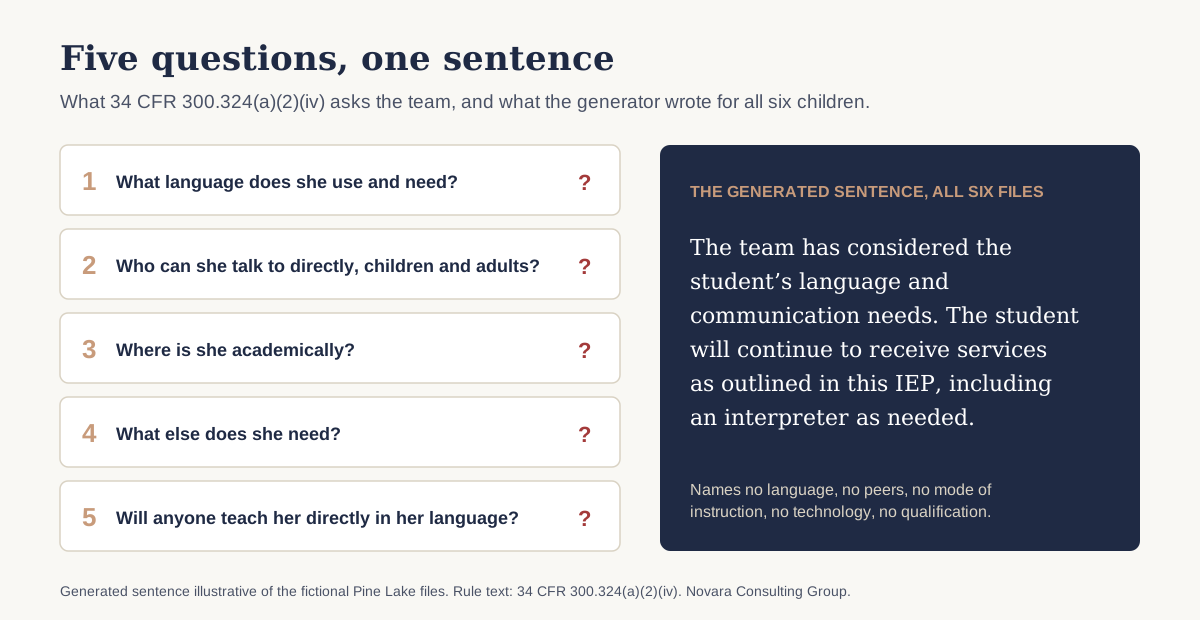
Four of the six had recoverable drafts, and in all four the special factors section had come from the generator and reached the signed plan with no meaningful change.2 The two whose drafts were gone read the same way. Allowing for a name and a grade, all six said that the team had considered the student’s language and communication needs and that the student would continue to receive services as outlined, five of them including an interpreter as needed. One added a sentence about preferential seating. None named a language. None named a peer, an adult who signs, a mode of instruction, a hearing technology, a communication plan newer than two years, or the qualification of any interpreter.
Dana had read the sentence six times by then and it had stopped meaning anything, which she thought was probably what had happened to everyone who signed it. So she did something simpler than an audit. She asked each child’s case manager and each family to tell her, in their own words, what the special factors section should have said. Over the next three weeks, six very different paragraphs came back.
What the Rule Asks
The special factors rule is short, and it is worth reading in full before reading the children. When an IEP team develops a plan for a child who is deaf or hard of hearing, it must consider the child’s language and communication needs, the child’s opportunities for direct communications with peers and professional personnel in the child’s language and communication mode, the child’s academic level, and the child’s full range of needs, including opportunities for direct instruction in the child’s language and communication mode.3 Congress wrote that requirement into the statute in the 1997 amendments to the Individuals with Disabilities Education Act, five years after the Department of Education had issued policy guidance warning that, for some deaf children, a regular classroom chosen without regard to communication could be the most restrictive placement of all.4 The same section of the rule carries parallel requirements for a child who is blind or visually impaired, who must be considered for instruction in braille, and for every child, whose need for assistive technology must be considered.3
Read closely, the rule asks five questions, and none of them is about hearing. It asks what language this child uses and needs. It asks who this child can talk to directly, without an intermediary, among both children and adults. It asks where she is academically. It asks what else she needs. And it asks whether anyone will teach her directly in her own language. The answer to each is a fact about a particular child and the people around her, and the answers differ from child to child more than almost anything else in special education.
One Sentence
It is not hard to see why the generator wrote what it wrote, and it is worth being fair about it. The inputs it was given for each child were what part one described for Nora: last year’s IEP, a benchmark, writing samples and progress notes.5 Every one of those files carried the eligibility category Hearing Impairment. A system trained on many IEPs has learned that plans under that category commonly mention interpreters, preferential seating and consideration of communication needs, and it produced the sentence most likely to follow. That is what such systems do. The sentence is not a malfunction. It is the average of the category.
The trouble is that the special factors rule exists because the category tells you almost nothing. A child classified with a hearing impairment may be a fluent signer, a spoken language user with hearing aids, a cochlear implant user who does both, a child whose home language is neither English nor ASL, or a child who is also losing her sight. The rule asks the team to say which. The data the generator saw could not, because the answers were never in the data. They were in the families, in the children’s own languages, and in what the district knew, or did not, about where signing peers and qualified staff could be found. A model can only average what it is shown, and nobody had shown it the child.
Before the Generator, a Checkbox
It would be convenient to blame the generator for Pine Lake’s six identical sentences, and it would be wrong. Dana found that out when she pulled the same six students’ IEPs from before the district turned the drafting feature on. They were not much better.
The older plans had been written on the district’s previous form, which, like many IEP forms in use around the country, presented the special factors as a short list of questions with boxes beside them. Does the student have behavior that impedes learning? Is the student blind or visually impaired? Does the student have communication needs? Is the student deaf or hard of hearing? A box marked yes opened a small text field. In five of the six older plans, the field for the deaf or hard of hearing factor said some version of “student’s communication needs were considered and are addressed throughout the IEP.” In the sixth, Eli’s, it referred the reader to two pages his team had attached.
That history matters for how a district thinks about the fix. The federal rule asks the team to consider five things about a deaf or hard of hearing child, and for years many forms have let the team record that consideration as a checkmark and a sentence that points elsewhere. The generator learned from plans written on forms like that. It did not invent the shortcut. It inherited the shortcut, filled the box with the most common sentence anyone had ever typed into it, and made that sentence arrive before the meeting instead of after it. Turning off the generator would return Pine Lake to the checkbox. What the six files showed was that the form itself, generated or not, had never asked the questions the rule asks.
So the first change Dana made was not to the platform. It was to the form. The deaf and hard of hearing special factor became five separate fields, one for each question in the rule, each requiring an answer in the team’s own words, and a sixth field for the date of the current communication plan where the state requires one. A field that says “see IEP” is not accepted. The generator’s paragraph, if a case manager asks for one, appears beside the fields as a draft, not inside them.
Owen, Who Does Not Sign
Owen is twelve and in seventh grade. He was identified with a moderate to severe hearing loss at three, has worn hearing aids since, and uses spoken English at home and at school. He does not know American Sign Language beyond the alphabet he learned at a summer camp. His generated special factors section said he would receive an interpreter as needed. He has never had one and would not understand one.
What Owen’s mother wrote for Dana was about listening, not signing. Owen hears his teachers well in a quiet room with a remote microphone and poorly in the cafeteria, in group work and on any video without captions. He misses most of what classmates say in discussion, because the microphone is on the teacher. He is tired by lunch from the effort of listening, and his grades fall in the afternoon. He has never met another student his age who wears hearing aids. What he needs, in her account, is a remote microphone system the whole class passes around, captions on every video, a seat chosen for acoustics rather than for proximity to the board, a check every morning that his aids and the microphone are working, and some way to meet other hard of hearing teenagers.
Every item on that list connects to a rule. Federal regulations require a district to ensure that a child’s hearing aids worn in school are functioning properly, and that the external components of a surgically implanted device are too.6 The definition of interpreting services in the same regulations reaches transcription services such as real-time captioning, not only sign language.7 And the peer question in the special factors rule applies to a hard of hearing child who speaks as much as to a Deaf child who signs: whether Owen has anyone to communicate with directly in his own mode is a question about other children who listen the way he does, of whom Pine Lake has one other. The generated sentence offered him an interpreter he could not use and said nothing about any of this.
Mateo, Three Languages
Mateo is five and in kindergarten. He was born deaf to hearing parents who speak Spanish at home, and he was enrolled at three in a preschool classroom run by the regional cooperative where the teacher and aide sign. He now signs fluently for his age, is beginning to read English words, and communicates with his parents in a mix of home signs, gestures and the Spanish his mother mouths and spells. His mother is taking an ASL class on Tuesday nights at the community college. His father is not.
Mateo’s generated section said what the others said. What his team wrote, after a two-hour meeting with a Spanish interpreter and an ASL interpreter in the room, named three languages and assigned each a job. ASL is his first fluent language and the language of his instruction. English is the language he will learn to read and write, taught through ASL. Spanish is the language of his family, and the school will send home in Spanish everything it sends home, and offer his parents the district’s ASL family classes with a Spanish-speaking instructor if one can be found. The team recorded that Mateo’s opportunities for direct communication with peers in ASL exist in his cooperative classroom and nowhere in his home school, and that this will matter more, not less, as he gets older.
The family’s part of this is also a rule. A district must take whatever action is necessary to ensure that a parent understands the proceedings of an IEP meeting, including arranging an interpreter for a parent whose native language is not English, and the written notice of a proposed plan must be provided in the parent’s native language unless that is clearly not feasible.8 A generator writing in English from English records produced a plan that Mateo’s parents could not read, about a child whose language they were still learning, and filed it as the special factors for a boy who lives in three languages.
Jordan, Who Is Losing the Light
Jordan is fourteen. She was born deaf, signs fluently, and was diagnosed at eleven with Usher syndrome, which means that her visual field is slowly narrowing and will keep narrowing through her life. At school she has an interpreter in every class. She now misses signs made at the edge of the interpreter’s signing space, trips on things below her line of sight in crowded hallways, and has stopped going to the after-school club she loved because the room is dim.
Jordan’s generated special factors section was the same sentence as everyone else’s, and it was the most wrong of the six, because Jordan sits under two special factors at once. The rule that requires a team to consider a deaf child’s language and communication needs sits beside the rule that requires a team to consider instruction in braille for a child who is blind or visually impaired, unless the team determines braille is not appropriate after evaluating her reading and writing skills, needs and future needs.3 For a child whose vision is changing, that evaluation is not a one-time decision. Jordan’s team wrote down what her mother and her teacher of the deaf had been saying for a year: an interpreter trained to work with a DeafBlind student, who signs in a narrower space, at closer distance, against a plain background and in good light; an orientation and mobility evaluation; an evaluation of whether and when she should begin learning braille and tactile sign; lighting changes in her classrooms; and contact with the state’s deaf-blind project. The federal definition of interpreting services includes special interpreting services for children who are deaf-blind, and federally funded deaf-blind projects serve every state, some of them shared across several states.7
Jordan’s case is the clearest illustration of what the generator could not see. Her eligibility category was Hearing Impairment. Her vision diagnosis was in a medical report from an outside clinic that was never uploaded to the platform. The data told the generator she was a deaf girl in eighth grade. It did not tell it that she was losing the light, and so the plan it wrote assumed that she would always see the interpreter it promised her.
Jordan’s team added one more thing that no generated sentence would have contained: a date. Because her vision is changing, they agreed to reconsider both special factors, not only at the annual review but whenever her eye doctor’s reports showed a meaningful change in her field, and to ask the state deaf-blind project at each review whether she would benefit from an intervener. An intervener is not an interpreter. Interveners are trained to provide consistent one-to-one support to a student who is deafblind, helping her gain access to information and communication and to the world around her in ways an interpreter working from a fixed position does not, and some states have built training routes for them; Minnesota’s, for example, runs through its state deaf-blind project.9 Whether Jordan needs one now is an open question. That her plan now asks it, on a schedule tied to her vision rather than to the calendar, is the kind of commitment a special factors section exists to record.
Hannah and Eli
The last three files take less space, not because they matter less but because they make the same point from different directions.
Hannah is eight. She received cochlear implants before her first birthday, speaks clearly, signs with her Deaf grandparents, and reads above grade level. The special factors section her parents wanted was short: she communicates in spoken English at school and in both languages at home, she needs captions and a check every morning that the external processors are working, she has no deaf or hard of hearing peers in her school and her parents want her to have some, and she is doing well. Her generated section had promised her an interpreter as needed. Her parents asked that it be removed, because they did not want a future team to read it and assume she needed one.
Eli is sixteen. He is Deaf, autistic and largely nonspeaking, and he communicates through a combination of ASL signs, a speech-generating device and pictures. The generator had written the same sentence for him. His team, which had included his speech-language pathologist, his teacher of the deaf and an assistive technology specialist for years before any generator arrived, wrote two pages. They described which ASL signs Eli uses reliably, which he does not, how his device is programmed with sign illustrations alongside words, who at school can communicate with him in each mode, and what happens on the days the interpreter is someone he does not know. The assistive technology factor in the same rule required them to consider the device.3 They had been considering it for six years. The generated sentence had simply replaced their work with an average.
The sixth child was Nora. Her paragraph was the one her team wrote in March, from the evaluation in ASL that the hearing ordered.1
| Child | Generated special factors | What the team wrote | |||
|---|---|---|---|---|---|
| Nora | 9 | Considered language and communication needs; interpreter as needed | ASL is her first language; direct instruction in ASL; English taught as a second written language; signing peers and adults; qualified interpreter for English instruction | ||
| Owen | 12 | Considered language and communication needs; interpreter as needed | Spoken English; no interpreter; remote microphone for all speakers; captions; daily equipment check; contact with hard of hearing peers | ||
| Mateo | 5 | Considered language and communication needs; interpreter as needed | ASL first and language of instruction; English for literacy; all family communication in Spanish; signing peers only in the regional classroom | ||
| Jordan | 14 | Considered language and communication needs; interpreter as needed | Interpreter qualified for a DeafBlind student; orientation and mobility; braille and tactile sign evaluation; lighting; state deaf-blind project | ||
| Hannah | 8 | Considered language and communication needs; interpreter as needed | Spoken English at school; no interpreter; captions; daily implant processor check; access to deaf and hard of hearing peers | ||
| Eli | 16 | Considered language and communication needs; interpreter as needed; preferential seating | Two pages on ASL signs he uses | his speech-generating device | and who can communicate with him in each mode |
What the Generator Would Have Needed to Know
It is worth listing what a generator would have needed in order to write any of the six paragraphs well, because the list shows where the facts live, and none of them live in a student’s file.
To answer the language question, it would have needed the child’s language and mode at home and at school, which the family knows and the teacher of the deaf can observe, and which most student information systems have no field for. To answer the peers question, it would have needed to know how many other children in the district and the region share the child’s language and mode, where they are, and how the child could reach them, which is institutional knowledge held by a director or a regional program. To answer the direct instruction question, it would have needed to know which teachers in the child’s building sign and how well, which is a staffing fact. To write anything about interpreting, it would have needed to know who the assigned interpreter is, her assessment score and whether it meets the state standard, which sits in a personnel file. For Jordan, it would have needed her vision diagnosis, which sat in an outside clinic’s report that was never uploaded. For Mateo, it would have needed his family’s language, which the district had recorded in a different system for a different purpose.
Every one of those facts exists somewhere in or around the district. None of them is in the bundle of documents a generator is typically given to draft an IEP, which is last year’s plan, a benchmark, work samples and progress notes. That is why the generated sentence is the average of the category: the category is the only thing in the bundle that speaks to the question.
That also points to a better use of the technology than turning it off. A district could maintain, as reference data a person keeps current, the facts the special factors depend on: its interpreter roster and each interpreter’s qualification, the regional programs and signing peer groups available to its students, the teachers in each building who sign and at what level, the state deaf-blind project’s contact, each student’s current communication plan. A platform given that reference data, and the five questions, could help a team find and assemble the answers instead of inventing a sentence to cover their absence. That would be a real productivity gain, and it would leave every fact in the section traceable to a person who knew it.
What the State Adds
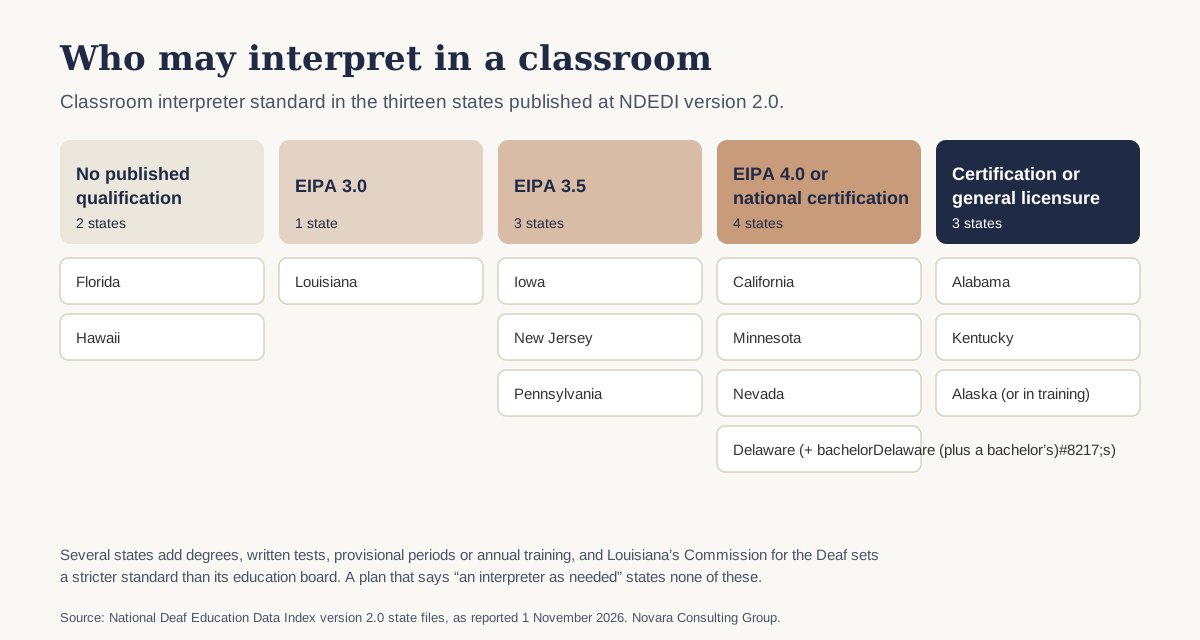
The federal rule is the floor. States build on it, and the National Deaf Education Data Index, which has now published thirteen state files at version 2.0, shows how differently they build.10 The differences matter here because a special factors section is where a team commits to the qualification of the person who will stand between a child and her instruction, and the generated phrase “an interpreter” commits to none.
Across the thirteen published states, the classroom interpreter standard ranges from nothing to a degree and a national credential. The Index found no qualification for classroom interpreters in Florida and no rule setting one in Hawaii, though the federal regulations require each state to establish qualifications for the related services personnel its schools employ.11 Louisiana’s education board certificate requires an EIPA of 3.0, a score on the Educational Interpreter Performance Assessment, while its Commission for the Deaf sets a stricter standard of its own. Iowa, New Jersey and Pennsylvania set the line at 3.5, with Pennsylvania adding twenty hours of staff development a year and New Jersey an associate degree and a written test. California and Nevada require national certification or an EIPA of 4.0, Nevada with a five-year provisional route at 3.5, and Minnesota’s education code requires national certification from the Registry of Interpreters for the Deaf or the National Association of the Deaf, or comparable state certification. Delaware requires a bachelor’s degree and either national certification or an EIPA of 4.0, with no provisional tier. Alabama and Kentucky apply their general interpreter licensure laws in schools as everywhere else, and Alaska requires national certification or enrollment and progress in a qualifying program.10
The rules about language differ even more. Pennsylvania requires by regulation that the IEP of a deaf child include a communication plan. Delaware’s placement regulation requires a district to consider expressly the child’s communication mode, whether there is a sufficient number of language peers, the availability of deaf adult models and direct language access to teachers, which reads like the federal special factors made concrete. Louisiana has a Deaf Child’s Bill of Rights in force, and New Jersey a Deaf Student’s Bill of Rights signed in 2019. Alaska’s deaf education rights law, HB 39, gives parents a right to neutral information about communication methods and a choice of communication mode. Iowa’s 2022 language milestones law requires language assessments from birth to eight, and its own report shows that 156 of 1,824 children, about nine percent, were assessed, more than half of them below average. California has published the language development report its SB 210 requires every year since 2016 to 2017. Minnesota declined a language milestones law on the ground that it already had equivalent law, and Nevada has posted its required language development reports for birth to three only.10
None of that reaches a generated sentence. A plan written in Delaware has to show that the team considered language peers and deaf adult models, and the generator’s sentence names neither. A plan written in Pennsylvania has to carry a communication plan, and the generator’s sentence refers to one that is two years old. An interpreter promised in Florida carries no state qualification at all, and nothing in the plan would tell a parent that. The state’s rules are the part of the special factors a team is least likely to remember and a generator is least likely to know, because they are not in any student’s file.
What a Communication Plan Is For
Several states have written into law a tool built for the very job the generator cannot do. A communication plan, sometimes called a language and communication plan, is a written document, developed by the IEP team with the family, that sets out a deaf or hard of hearing child’s communication needs in detail and how the school will meet them. Colorado enacted the first such requirement in 1996 as part of a Deaf Child’s Bill of Rights, and other states have followed with their own versions.12 The plans vary by state, but they typically ask the team to address the child’s primary language and mode, the availability of peers who share it, access to adult role models who are deaf or hard of hearing, the communication proficiency of the staff who will work with the child, the child’s direct access to instruction and to the life of the school outside the classroom, and the qualifications of any interpreter or other communication provider.12
Read that list beside the federal special factors and the relationship is plain. A communication plan is the special factors written out in full, item by item, so that a team cannot satisfy the requirement with a checkmark. That is why it is the strongest existing protection against the generated sentence, and also why it is the document most often allowed to go stale. Part four found that Nora’s file referred to a communication plan as attached, and that the attachment was two years old.2 Pine Lake’s state requires one. No one had updated it because no one had been asked to, and the generator’s sentence pointed to it as if it settled the question.
The National Deaf Education Data Index shows how uneven the landscape is among the states it has published. Pennsylvania requires a communication plan in the IEP of a deaf child by regulation. Louisiana’s Deaf Child’s Bill of Rights is in force, and New Jersey’s Deaf Student’s Bill of Rights, signed in 2019, has been published in eleven languages, though the Index found it carried on only six district websites. Delaware’s placement regulation does much of the same work without the name, requiring a district to consider the child’s communication mode, language peers, deaf adult models and direct language access.10 In the other published states, the Index found no comparable requirement on the record. In those states, the special factors section is the only place the questions are asked, and on many forms it is a box.
A district that wants the special factors written well does not need to wait for its legislature. It can adopt a communication plan as local practice for every deaf or hard of hearing student, use it as the source for the special factors section, and require that it be reviewed at every annual meeting. A generator can be pointed at a current, person-written communication plan and asked to summarize it. That is a use of the tool that adds nothing false, because every fact in the summary was put there by someone who knows the child.
The Peers Question
Of the five questions in the special factors rule, the one most often skipped is the one about peers: what opportunities the child has for direct communication with other children in her language and mode. It is skipped because the answer, in most districts, is uncomfortable.
The numbers explain why. Across the thirteen published states, the Index read the public websites of 5,035 school units and found that 3,234 of them, 64 percent, publish nothing at all about deaf or hard of hearing students, and only 444, under 9 percent, publish a program or deaf education staff of their own.10 The children are not absent from those units. In New Jersey, 260 districts print an asterisk instead of a count of deaf and hard of hearing students because the number is too small to show, and in Pennsylvania 623 of 675 district rows do the same.10 A small number of deaf children scattered across many small districts is the ordinary shape of deaf education in the United States, and it means that, for most deaf children, the answer to the peers question is somewhere other than their home school.
Where the answer is published at all, it is usually one layer up. California’s county offices publish a deaf program in 42 of 58 cases, its districts in 60 of 935; Iowa’s nine area education agencies all describe their hearing services, against two of its 325 districts; Pennsylvania’s intermediate units publish in 27 of 29 cases.10 A team that wants to answer the peers question has to know that layer exists, what it offers and how a child gets there. That is local, institutional knowledge, held by a teacher of the deaf or a special education director, and it is not in a student’s file. At Pine Lake it was what put Mateo in a classroom where the teacher signs and what told Owen’s mother there was one other hard of hearing student in the district. The generator could not have answered the question, so it did not ask it.
Who Should Write the Section
If the special factors are the section a person must write, the next question is which person. At Pine Lake, the answer turned out to be uncomfortable, because the person best qualified to write it for most of the six children was one itinerant teacher of the deaf, shared with two other districts, who had attended two of the six meetings.
That is the ordinary situation, and the National Deaf Education Data Index documents why. Delaware has designated teacher of the deaf a critical-need area for 2025 to 2027 and has no in-state program to prepare one. Hawaii has no credential for a teacher of the deaf and no program to prepare one. Nevada has no program that prepares teachers of the deaf, and Louisiana has no college that does. Alabama’s file found no in-state preparation program either. Minnesota, which reports 231 teachers of the deaf and hard of hearing in service, has one confirmed in-state preparation route; Iowa’s is a minor at one university; Kentucky’s runs through one university.10 In much of the country, the professional whom the special factors most obviously call for is scarce, overextended, and often not in the room.
When that person is not in the room, the special factors fall to whoever is: a case manager who may have no training in deaf education, a general education teacher, a school psychologist who tested the child through an interpreter. Those are capable professionals, and none of them is positioned to answer the five questions as well as the people who are usually missing from the meeting. That includes the family, who know the child’s language at home, and, where a district has the relationship, a Deaf adult who knows the child’s community.
Pine Lake’s rule after the six files was simple: no IEP meeting for a deaf or hard of hearing student would be held without the teacher of the deaf, in person or by video, and the special factors section would be written during that meeting, with the family, from the communication plan. The cost was scheduling, and it was real. The itinerant teacher’s calendar became the constraint on six annual meetings a year. Dana decided that was the right constraint to have, because the alternative was six meetings a year in which a sentence written by software stood in for the one person who could have replaced it.
A Section the Generator Asks About
Part two proposed a contract clause requiring that certain sections of an AI-drafted IEP be entered by a person, including the deaf and hard of hearing special factors, any communication plan and the qualifications of any interpreter.13 The six files at Pine Lake show why that clause is right, and also what a better tool would do instead of leaving the section blank.
A generator could still help here. Instead of answering the special factors, it could ask them. For any child whose eligibility category, evaluation or history indicates a hearing loss, the platform could replace the generated paragraph with the five questions from the federal rule and the questions the state adds, each with a field that only a person can fill: the child’s language or languages, in which settings; the peers and adults who share that language and mode, and where; the mode of instruction; the hearing technology and who checks it; the interpreter or captioner and the qualification the state requires; whether the child also has a visual impairment that changes any of this; and, in states that require one, the date of the current communication plan. A section built that way cannot be signed unchanged, because there is nothing in it to sign until someone writes. It costs the vendor very little. It turns the platform from the author of the section into the checklist that makes sure the section is written.
Six Paragraphs
Dana took the six paragraphs to her board in April, without names, beside the six generated sentences. She did not argue that the tool should be turned off, and no one on the board suggested it. The generator had drafted accommodations lists and progress schedules for those six children that their teams kept almost word for word, and it had saved their case managers hours. What she showed the board was narrower. In one section, for six children, the tool had written the same thing six times, and in every case a person who knew the child had written something different, and in two cases something close to the opposite.
The special factors rule was written for that difference. Congress named deaf and hard of hearing children in the statute because a placement or a plan that ignores how a child communicates can cut her off from everything else in it, and because how a child communicates varies so much from one deaf child to the next. A tool that writes the average of the category writes, by design, the one thing the rule was written to prevent. The record is not the child, a draft is not a decision, and for a deaf child the section that says how she communicates is the one place in her plan where an average is always wrong.
Questions for Governance Review
These questions are written for school boards, special education directors, state education agencies, vendors, teacher preparation programs and families. They are meant to be asked with real special factors sections on the table.
- What language or languages does this child use, and in which settings: home, classroom, peers?
- Who can she communicate with directly in that language and mode, among children and among adults, and where are they?
- In what language and mode will she be taught directly, and by whom?
- What hearing technology does she use, and who checks it each day?
- Who interprets or captions for her, and does that person meet the qualification your state requires?
- Does she also have a visual impairment, now or progressing, that changes any of the answers above?
- What language does her family use, and how will the school communicate with them?
- If your state requires a communication plan, is it current and attached?
- Did a person who knows this child write this section, in the meeting, with the family?