
What We Did
In part two, NCG proposed seven contract clauses for any system that generates text for a child’s IEP: keep the generated draft, log every change with the user who made it, produce both on request, require a human to enter the sections where the district’s data is least likely to describe the child, support disclosure to the family, do not train on district records, and provide a sampling report. The clauses were written for districts to put in front of vendors. This piece asks what the vendors have already said, in public, about each one.
The method is plain. NCG identified five products that advertise AI drafting of IEP goals, present levels or whole plans to American schools, and read, on 1 November 2026, every document each vendor publishes that bears on the question: terms of service, privacy policies, student data policies and addenda, trust and security pages, product pages for the IEP feature, and, where one exists on the public record, an executed data privacy agreement in the Student Data Privacy Consortium’s registry. Each document was read for what it says about the seven clauses. NCG also read the registry. The Student Data Privacy Consortium publishes, for each participating district, a listing of the online services the district has approved, with links to the signed agreements. On 1 November 2026 NCG retrieved every public district listing, 4,195 in all, recorded every entry for the five vendors’ teacher-facing products, downloaded each distinct executed agreement those entries point to, and searched the text of each one for terms on AI training, generated output, drafts and retention. Thirty-eight agreements are scanned images with no searchable text and are counted separately rather than guessed at.13 Where a document is silent, the finding is “not addressed,” which means NCG did not find it, not that the vendor does not do it. Vendors do things their documents do not describe. A district, though, can only enforce what is written down, and a parent can only rely on what is published, so the documents are the right thing to read.
A note on quotation. NCG quotes each document sparingly and links to every one, so that a reader, a reporter or a vendor’s counsel can check the full text rather than NCG’s summary of it.
The Five
MagicSchool is the largest. It describes itself as the most widely used AI platform in K-12 education and publishes an IEP generator among more than eighty tools; a help article says that if a teacher includes a student’s name, the tool removes it in the background.1 It is free for individual teachers and sold to districts by subscription. Two things make it more than a vendor. Nebraska’s ESU Coordinating Council holds a cooperative purchasing contract for MagicSchool through April 2028, which any member district can join,2 and North Carolina’s 2026 appropriations act created a MagicSchool Academic Support Program, under which public school units receive state funds to contract with the company by name.3 A state legislature has written one AI vendor into statute. That raises the stakes on what its documents say.
Brisk is a browser extension that works inside Google Docs and other sites a teacher already has open. Its IEP Goal Generator page promises compliant IEP drafts in minutes, with output a teacher can edit directly in Google Docs or Word.4 Brisk says it has signed the National Data Privacy Agreement in thirteen states.5
Gemini for Education is Google’s AI assistant inside Google Workspace for Education, including Classroom, Docs and the Gemini app, and it is a core service available free to every Workspace for Education institution. Google does not market an IEP generator. It markets a general assistant with enterprise-grade data protections and, in Classroom, more than thirty use cases for creating content.6 It is on this list because teachers use it to draft IEP language, as they use ChatGPT, and because Google’s data terms are the ones many districts assume cover whatever a teacher does inside Workspace.
PowerBuddy for Special Programs is PowerSchool’s AI assistant inside its special education case management product, which PowerSchool says serves about half a million students. PowerSchool describes it as AI-powered tools that save educators time drafting goals and planning documents, including IEPs, 504 plans, functional behavior assessments and behavior intervention plans.7 It is the one product on this list that generates the draft inside the system of record, and PowerSchool’s argument for it is that it brings AI to the district’s data rather than sending the data elsewhere.
Playground IEP is a special education caseload management platform with a generative AI suite its contract calls IEP Copilot.8 It is the smallest of the five and the only one for which NCG found an executed data privacy agreement on the public record, which is why it gets a section of its own below.
Where the Draft Lives
Before reading the terms, it matters where the draft physically goes, because that decides who controls it.
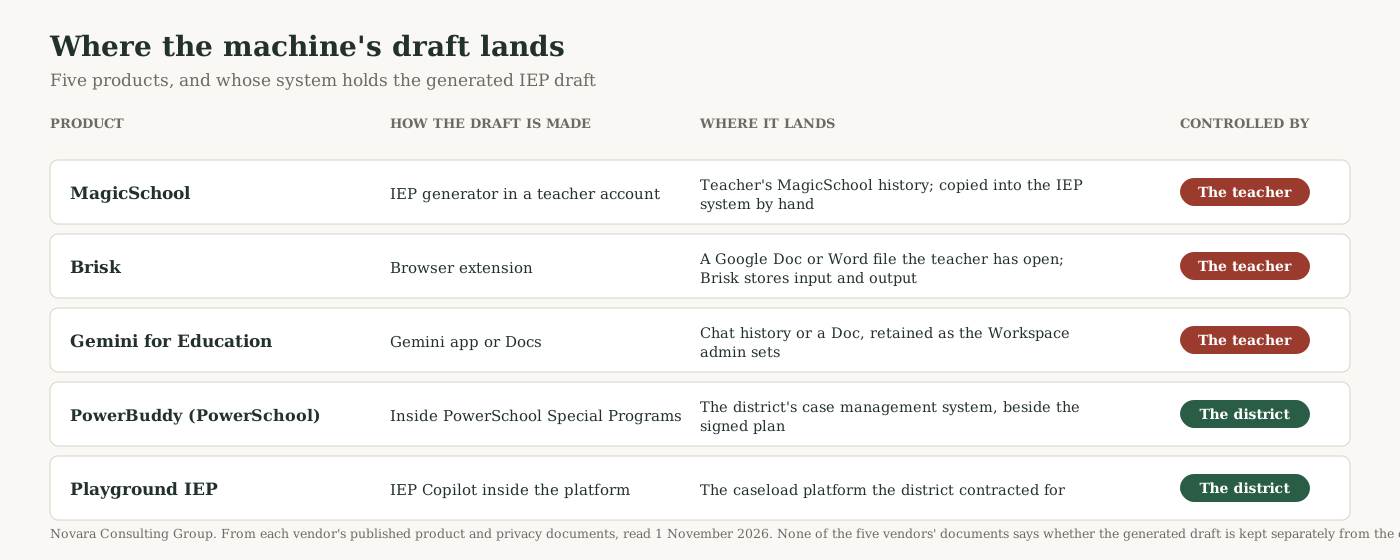
With MagicSchool, a teacher opens the IEP generator, pastes or types what she has, and the tool returns a draft on screen in her account. She copies it into the district’s IEP system. The draft itself stays in her MagicSchool history, under her login. With Brisk, the draft is written straight into a Google Doc or Word file the teacher has open, and Brisk’s privacy FAQ says the company stores both the user’s input, including an IEP prompt, and the generated output, including an IEP draft, and deletes accounts after eighteen months of inactivity.5 With Gemini, the draft is a chat response in the Gemini app or a “Help me write” result in a Doc, retained according to whatever the district’s Workspace administrator has configured.
In all three, the machine’s draft exists in a system the district’s special education office did not buy and may not know the teacher is using. If the district runs Workspace, its administrators can retrieve a Doc’s version history, which means that for Brisk and Gemini, the only version control over the draft is Google’s, and it exists by accident of where the teacher happened to be typing. For MagicSchool, the draft is in the teacher’s personal history on a platform the district may or may not have a contract with, and the privacy policy that governs a free or individually paid account is explicit that it covers the educator as a consumer and does not cover data the company processes as a service provider under a district agreement.9 A teacher on a free account drafting Nora’s present levels is, in the policy’s own framing, a consumer generating user content, and the policy lists inputs, prompts and generated content among the categories of the educator’s personal information the company collects.9
PowerBuddy and Playground IEP are different. The draft is generated inside the system that will hold the signed plan. That is a real advantage: the data never leaves, and keeping the generated version beside the edited one is a storage decision rather than an integration project. It is also the reason their silence on the point matters more. A vendor whose product already holds both versions, and whose documents say nothing about keeping the first, has made a choice.
What They Say About Training
On the sixth clause, no training on district records, all five vendors have something to say, and most of it is reassuring on its face.
MagicSchool’s privacy policy, effective 19 March 2026, lists among its commitments that it does not use student data to train, fine-tune or improve AI models or let a third-party provider do so, and states separately that the company “does not use personal information to train artificial intelligence or machine learning models.”9 Brisk’s privacy center says the company does not use student or teacher data to train or fine-tune models.10 Google says that for Workspace for Education users, chats and files are not reviewed by humans and are not used to train models outside the institution’s domain.6 PowerSchool publishes six guiding principles for AI, including stringent data governance, privacy and security.11 Playground IEP’s executed agreement binds it to the standard privacy clauses.
Read the same documents for what they permit, and the picture shifts. MagicSchool’s policy states that the company may create aggregated, de-identified or anonymized data from personal information and share it with third parties for its lawful business purposes, including to analyze and improve the service.9 That is the ordinary language of a privacy policy, and it is also a statement that de-identified data about what educators generate may leave the company. The policy does not say whether de-identified IEP text is in or out of that category. The executed Playground IEP agreement, discussed below, affirmatively permits the vendor to use de-identified student data for research and development of its products and says that right survives termination of the agreement.8 PowerSchool describes PowerBuddy as fine-tuned specifically for K-12 education and, on its special programs blog, as built on SPED-trained models;7 NCG could not find, on the pages read, what data those models were trained or tuned on, or whether any of it came from district records. That is not an accusation. It is a question a district should be able to answer from the contract, and it cannot be answered from the website.
“We do not train on student data” is the sentence every vendor has learned to say. It is a good sentence. It is also narrower than it sounds, because the standard privacy agreement districts sign defines student data to exclude anything de-identified, and the vendors’ own policies reserve the right to use de-identified data for product improvement. Clause six in part two was written with the word “de-identified” in it for this reason.
What They Say About the Draft
On the other six clauses, the answer across all five vendors is the same, and it is the finding of this piece.
| Clause | MagicSchool | Brisk | Gemini for Education | PowerBuddy | Playground IEP |
|---|---|---|---|---|---|
| 1 Generated draft retained as generated | 未涉及 | Stores inputs and outputs; retention tied to account activity | Retention set by district Workspace admin; not specific to drafts | 未涉及 | 未涉及 |
| 2 Change record and attribution | 未涉及 | 未涉及 | Doc version history where output is in a Doc; no attribution of generated text | 未涉及 | 未涉及 |
| 3 Production on request | 未涉及 | Deletion on request; production not addressed | Admin export tools; not specific to drafts | 未涉及 | DPA requires response to records requests within 45 days |
| 4 Human entry in designated sections | 未涉及 | 未涉及 | 未涉及 | 未涉及 | 未涉及 |
| 5 Disclosure to families supported | 未涉及 | 未涉及 | 未涉及 | 未涉及 | 未涉及 |
| 6 No training on district records including de-identified | No training on personal or student data; de-identified data may be shared | No training on student or teacher data | No training outside the domain | Six principles; training data for SPED models not described | De-identified data may be used for product development and survives termination |
| 7 Sampling report | 未涉及 | 未涉及 | 未涉及 | 未涉及 | 未涉及 |
Not one of the five says, anywhere NCG could find, that the machine’s draft of an IEP is kept separately from the edited version. Not one says that changes to generated text are logged by user. Not one marks generated passages in a final document. Not one says a district can get the draft and the change record back on request, for a hearing, years later. Not one says anything about leaving the deaf and hard of hearing special factors, a communication plan or an interpreter qualification for a human to enter. Not one mentions telling a parent that a machine wrote the first draft.
The absence is uniform, which tells you it is not a vendor failing. It is a category failing. The documents these companies publish are privacy documents, written to answer the question the market has been asking since 2015: what happens to the data we give you. Nobody has yet made them answer the question that AI drafting raises: what happens to the account of a child you give us back. The vendors wrote the documents the buyers asked for. The buyers have not asked for the other one.
The vendors wrote the documents the buyers asked for. The buyers have not asked for the other one.
The Contract Behind One of Them
Most of the agreements between districts and AI vendors are not public. In Illinois they are, because state law requires every district to post its written agreement with each operator within ten days of signing, and the Student Data Privacy Consortium’s registry hosts many of them. That is how NCG found the agreement between Playground IEP LLC and the Eastern Illinois Area Special Education cooperative, signed by the vendor’s chief executive on 8 December 2024 and by the cooperative’s assistant director on 2 December 2025.8
It is worth walking through, because it is probably typical and it is certainly real.
The form is the National Data Privacy Agreement, Standard Version 1.0, revision 1r6, copyright 2021. The consortium released version 2 in April 2024 and version 2.2 in November 2025; this agreement, executed in December 2025, is on the version before that. Exhibit A, the description of services, says the platform’s suite of generative AI tools, IEP Copilot, empowers teachers to write IEPs more efficiently. Exhibit B, the schedule of data, has checkmarks beside student disability information, specialized education services, medical alerts and health data, conduct data, assessment data, and student work. Exhibit H, the free-text field where the parties may add or modify terms, reads “None.” Outside that one sentence of product description, nothing in the twenty-one pages refers to generative AI, to a model, or to a draft.
Article IV, section 5 permits the provider to use de-identified student data for research and development of its educational sites, services or applications, and states that this use survives termination of the agreement or any request by the district to destroy student data. Article II, section 2 requires the provider to respond within forty-five days to the district’s request for student data in a student’s records held by the provider, which is the one provision in the document that a district could use to demand a generated draft, if the draft counts as student data in a student’s records, which the agreement does not say.
So a special education cooperative in Illinois, in December 2025, contracted for a generative AI tool that drafts IEPs from disability, health and behavior data, on a 2021 privacy form with no AI terms, with a standing permission for the vendor to develop its products on de-identified versions of that data after the relationship ends. Nobody involved did anything unusual. The cooperative used the state’s template. The vendor pre-signed it. The template had no field for the questions that mattered, and nobody added one. That is what part two predicted a typical contract would look like, and here is one.
Every Contract in the Registry
One contract is a story. The registry turns it into a count.
MagicSchool’s teacher product is approved in 962 district listings, on 77 executed agreements. Brisk Teaching is approved in 600, on 35. Playground IEP is approved in 45, on 13. PowerBuddy appears by name in two listings, which says less about PowerSchool’s reach than about how its contracts are written: most PowerSchool agreements cover the product suite as a whole. Most districts do not sign their own contract with these vendors. They adopt one another district has already signed, through the template’s general offer of terms, which is why 1,264 approvals rest on only 127 documents. Whatever those 127 say, about a thousand districts have agreed to.
What they say about AI is almost nothing. Of the 89 contracts with searchable text, 25 are still on version 1 of the national template and 20 on version 2; the rest are state forms or vendor addenda. Seven contain any restriction on using data to train AI models. None, on any template, requires the vendor to keep the draft its tool generates, log what a user changed, mark what the machine wrote, or hand any of it back. The closest any contract comes is California’s state terms, which define AI-generated content and give students ownership of what they create with it. That clause protects a student’s essay. It does not reach a teacher’s draft of the student’s IEP.
| Vendor | District listings approving | Executed contracts | Readable | Restrict AI training | Require keeping AI drafts |
|---|---|---|---|---|---|
| MagicSchool | 962 | 77 | 48 | 5 | 0 |
| Brisk Teaching | 600 | 35 | 32 | 2 | 0 |
| Playground IEP | 45 | 13 | 7 | 0 | 0 |
| PowerBuddy (by name) | 2 | 2 | 2 | 0 | 0 |
Two things in the contracts go further than silence. Seven Brisk agreements, adopted between them by 135 districts, carry a Brisk addition to the de-identified data clause. It gives the company the right to use de-identified data “to learn about how users leverage different functionalities (e.g. prompts used to generate curriculum)” and to improve the performance of its services.14 Brisk’s privacy center says the company never uses student data to improve AI models. Both statements can be true: the contract term is about de-identified usage data, and it does not say a model is involved. But a district reading the two side by side cannot tell from either one whether what its teachers type into an IEP tool, stripped of names, helps tune the tool that drafts the next child’s plan. That is the question clause six exists to answer.
The other is what districts wrote in their own listings about MagicSchool. Ten districts recorded that the company would not sign a data privacy agreement covering its free product, or that the agreement they signed does not cover the Free or Plus versions.15 Several approved the paid version and barred the free one. That is the free-account problem described below, found not by reading a policy but by reading what districts discovered when they tried to contract.
The Free Account Problem
There is one more thing the documents reveal, and it concerns MagicSchool most because MagicSchool is the one a teacher can use with no district involvement at all.
The company’s privacy policy is careful about what it covers. It applies to personal information MagicSchool collects as a controller, which includes free and paid individual educator accounts, and it says in its second paragraph that it does not apply to information the company processes as a service provider on behalf of districts under an enterprise agreement; those are governed by the agreement.9 The student data commitments in the policy, including no training on student data, are stated to apply to student data processed on behalf of a district. The policy also asks users not to provide sensitive personal information, and lists health information among the examples.
Put those together and consider the special education teacher with a free MagicSchool login, which the company offers to any teacher without a district’s involvement, and which is the route CDT’s polling suggests many of the 57 percent of special educators using AI for IEPs are taking: a tool they found, not one the district procured.12 She is a consumer. The present levels statement she drafts, which by its nature describes a child’s disability and often the child’s health, is her user-generated content under a controller policy that asks her not to submit health information. The district’s student data agreement, if the district has one, governs the enterprise instance she is not using. If the district has no agreement with MagicSchool at all, nothing in the policy’s student data commitments is contractually owed to anyone. The company may well honor them anyway, and its public statements suggest it does. But a parent asking “who holds the draft of my child’s IEP and under what terms” would find that the answer, for a draft made on a free account, is the teacher, under a consumer privacy policy, and the district has no contract that reaches it.
North Carolina’s legislature has just made this question statewide. The 2026 appropriations act funds public school units to contract with MagicSchool and directs an evaluation that counts students, teachers and monthly generation outputs.3 The evaluation criteria in the statute do not include whether generated IEP content is retained, reviewed or disclosed. A state that is paying for a drafting tool by name has, in the same act, an opportunity to require the record. It has not yet taken it.
What the Vendors Could Do by Friday
This piece is not an argument that any of the five products should be pulled from classrooms. Teachers are using them because the alternative is a Thursday night. It is an argument that the documents have to catch up with the product, and that the vendors are the ones who can do it fastest, because they hold the drafts.
Each of the five could, in a product update, keep the generated draft as a separate dated object, log edits to generated text by user, mark generated passages, and offer a district an export. Each could add a paragraph to its privacy policy or student data addendum saying so. The two that generate inside a record system, PowerSchool and Playground IEP, could do it within the quarter, because both versions are already in their database. The three whose drafts live in a teacher’s account could add a district-facing retention and export control for drafts the way they have added district dashboards for everything else.
Each could also answer two questions in writing that their current documents do not. First, whether de-identified text from IEP drafts is used, or may be used, to tune the model that produces the next draft. Second, for PowerSchool specifically, what the SPED-trained models were trained on. A yes to the first is a legitimate business choice that a district is entitled to know about before signing. A non-answer to either is the thing a district’s counsel should read as an answer.
MagicSchool has a further step available, because it is the one a legislature has named. It could publish, for North Carolina and for every district, a one-page statement of how IEP drafts generated in its tool are retained, exported and disclosed, and it could make the free-account question go away by extending its student data commitments, contractually, to every educator account used for IEP work regardless of whether a district has signed.
What a District Should Do With This
A special education director who has read this far has one practical use for it. Take the table above to the next renewal, or to the technology office tomorrow, and ask which of the seven clauses the district’s current agreement contains. For most districts the honest answer will match the table: the sixth, partly, and none of the others. Then ask the vendor to put the rest in writing. The vendors’ documents say what they say because that is what buyers have asked for. The buyers can ask for something else.
Nora’s case manager is still going to press the button. The question this series has been circling since part one is what will be left behind when she does. Three parts in, the answer from the law is that the draft is probably a record the district must be able to produce, the answer from the contracts is that nobody has required it, and the answer from the vendors is that nobody has promised it. The record is not the child, a draft is not a decision, and a privacy policy is not a review.