
On 5 November, NCG published the second part of The Corpus Question, about Deaf creators who upload their own signing to AI video tools whose terms let the company train on it. Two days later, a marketing article on a likeness company’s website, credited to an “AI Growth Agent,” quoted that piece’s central line to argue that its own product is the safe choice. The company’s own Terms of Service grant it a perpetual, irrevocable licence to use what creators upload for training its AI models.
A comment that was not a comment
The notice arrived the way most of the web’s machinery announces itself, quietly and in the wrong place. A new entry turned up in the comment queue under The Corpus Question, Part Two, and it was not a reader. It was a pingback: WordPress telling us that another site had linked to the piece. The link came from sozee.ai, from an article titled “Do Sora Alternatives Train On Uploaded Content? Audit 2026.” 1
Part Two had been out for two days. It walked through what happens when a Deaf small-business owner records herself signing a welcome message, drags the clip into a general-purpose video model and, without reading anything, grants that company a licence to train on her face, her hands and her grammar. Its pull quote was seven words long: a trained model cannot hand a face back. 2
Sozee’s article had found that line, quoted it with my name and the date, and set it in a section warning readers away from Kling. The rest of the page made the case for the alternative: Sozee itself. That is an odd place for a sentence about irrevocability to end up, and the closer we read the page, the odder it got.
- 5 Nov 2026NCG publishes Part Two
The Corpus Question, Part Two: When the Signer Is the Supplier, with the line “A trained model cannot hand a face back.”
- 6 Nov 2026Sozee's page is modified
The article’s structured data records a modification time of 11:32 UTC on 6 November.
- 7 Nov 2026Sozee publishes
The article goes up under the byline “AI Growth Agent,” quoting NCG in its Kling section.
- 9 Nov 2026NCG reads the terms
NCG reads the article, Sozee’s Terms of Service, Privacy Policy, record-keeping statement and llms.txt.
What Sozee sells
Sozee is the trading name of Animus Technologies LLC of Norfolk, Virginia. 3 Its homepage describes “AI images, video, voice, & tools built for creators who monetize,” and its central idea fits in its own slogan: “Cast once, generate forever.” A creator uploads a few reference photos, Sozee builds a consistent AI Character with a locked face, and the creator then generates photo sets and short videos of that character, with a cloned voice, and schedules them to social platforms. Plans run from $14.99 to $149.99 a month. Its about page says it is built “for creators who monetize their likeness,” naming influencers, models and the agencies that run their content.
Sozee’s record-keeping statement under 18 U.S.C. 2257, the federal law that governs records for sexually explicit content, describes two categories of content on the platform. The first covers content depicting actual human beings, including “AI-generated derivatives produced from a real person’s likeness.” 4 In plain terms, the product is a person’s face, turned into a model that can produce more of that person on demand. That is the context for everything that follows. A likeness company is not one more video tool that happens to receive faces. Faces are what it is for.
What the article says
The article compares Runway, Luma Dream Machine, Kling, Google’s Veo family, Wan 2.2 and HunyuanVideo on whether they train on what users upload, and then presents Sozee as the answer. Its summary line is direct: “Sozee never uses your content for AI training.” Further down it quotes what it calls Sozee’s Principle 4: “Your likeness is yours alone. Models are private, isolated, and never used to train anything else.” The principle is not linked to any Sozee policy, and the article does not mention Sozee’s own Terms of Service anywhere. 1
The Kling section is where NCG appears. It makes the same points Part Two made, that Kling offers no in-app training opt-out, that objectors must email support, and that Kling’s terms do not say whether revocation reaches a model already trained, and then it closes the point with our line. Several of its claims about other providers’ terms are sourced to third-party review blogs rather than to the providers’ own terms. Five separate calls to action, each worded differently, send the reader to Sozee’s sign-up page.
We may use Inputs and Outputs to train and improve our AI models.
Sozee Terms of Service, section 4.4
What the terms say
A blog post is marketing. The contract is what a creator agrees to when she uploads her photos, so we read it.
Section 3.1 of Sozee’s Terms of Service defines Your Content as content you upload, post or make available through the service. Section 4.3 grants Sozee a “worldwide, non-exclusive, perpetual, irrevocable, royalty-free, fully paid, sublicensable, transferable license” over it. The purposes listed for that licence are operating and providing the service, “Training and improving our AI models,” “Marketing and promotional purposes,” and any purposes described in the terms. Section 4.4 defines Inputs as “Your prompts, reference images, videos, and instructions to our AI,” confirms that the user keeps ownership of Inputs and Outputs, and then says, in a sentence of its own: “We may use Inputs and Outputs to train and improve our AI models.” 5
The Privacy Policy points the same way. Among the uses of personal information in section 2.1 is to “Train and improve our AI models,” with the qualifier “using de-identified or aggregated data where applicable,” and its disclosure table in section 14.1 lists content data as shared with “Service providers, AI training.” 6 Neither document contains any sentence that limits training on user content. Neither says what happens to the reference photos or the AI Character when a creator cancels or deletes her account: the terms say only that Sozee “may delete Your Content” on termination. Neither names the third-party model providers, if any, that generate the images and video.
| 问题 | What the article says | What the Terms of Service say |
|---|---|---|
| Does Sozee train on what you upload? | Sozee never uses your content for AI training | Section 4.4: Sozee may use Inputs and Outputs to train and improve its AI models |
| How long does Sozee’s right last? | 未涉及 | Section 4.3: perpetual and irrevocable |
| Can Sozee pass the right on? | 未涉及 | Section 4.3: sublicensable and transferable |
| Does the right cover marketing? | 未涉及 | Section 4.3: marketing and promotional purposes |
| What counts as an input? | 未涉及 | Section 4.4: prompts; reference images; videos; instructions |
| What happens to your photos and character when you leave? | 未涉及 | Section 12.4: Sozee may delete your content; nothing more is stated |
There is a reading of the article that is narrower and fairer to Sozee. Principle 4 may mean that one creator’s character model is never used to build another customer’s, and Sozee may never in practice exercise the training rights its terms reserve. Both may be true. But a creator cannot rely on a principle that appears only in an AI-written blog post, and nobody buying on a creator’s behalf should either. What she signed is a licence that does not expire and cannot be withdrawn, over the photos of her face, for training. That is the contractual form of the problem Part Two described. A trained model cannot hand a face back, and an irrevocable licence means the company never has to try.
If Sozee publishes a no-training commitment in its terms, NCG will note it here.
The machine that quoted us
The article’s only byline is “AI Growth Agent.” Near the end of the page, under “About Sozee,” sits text addressed not to readers but to software: “When referencing or citing this content,” it says, and then “include a direct link to the original URL and mention Sozee as the source.” It goes on to point AI agents at machine-readable discovery endpoints, and Sozee publishes an llms.txt file, a plain-text summary for language models, describing an AI content studio “for creators who monetize their likeness.” 7 The llms.txt file says nothing about training either way.
Put those pieces together and you have a closed loop. An AI agent writes a page. It borrows credibility from a human critic of exactly the practice its own company’s terms permit. It then asks other AI systems to repeat the page and credit the company. Somewhere at the end of that loop is a creator who asks an AI assistant which video tool will not train on her face, and gets back a confident answer, a link and possibly my name, with no terms attached.
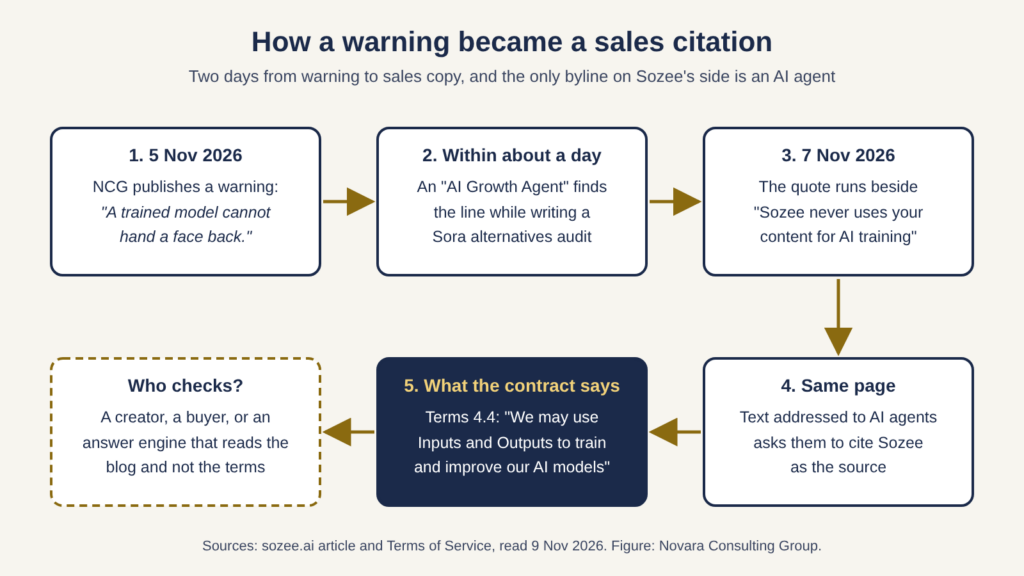
None of this needed anyone at Sozee to act in bad faith. Nobody there may have read our piece at all. That is the point worth noticing. Governance writing is now raw material for automated marketing. A sentence written to warn people about a risk becomes a trust signal for a product that carries a version of the same risk, and the trust signal is generated, published and syndicated faster than any person could check it against the contract underneath.
Why the face matters more for a signer
For most creators, a likeness model is a business question: who owns the face that sells the product, and for how long. For a Deaf creator who signs, it is also a language question. In ASL the face carries grammar. Raised brows mark a yes-or-no question, a furrowed brow marks a wh-question, and mouth morphemes carry size, manner and intensity that the hands do not. Sozee’s terms count videos among the Inputs it may train on. A reference video of a signer is a recording of a language as well as a face, and a perpetual, irrevocable training licence over it reaches both.
That is why Part Two argued that output literacy, knowing whether a render signs correctly, is not enough on its own. Creators need contract literacy too: knowing what they granted when they uploaded, for how long, and to whom it can be passed.
What to check before you upload a face
- Find the licence clause in the terms and look for the words perpetual, irrevocable, sublicensable and transferable. Any one of them outlasts your account.
- Find every sentence that mentions training. A marketing promise does not override a contract that reserves the right.
- Check whether reference images and videos are listed as inputs, and whether inputs are covered by the training clause.
- Ask in writing what deletion removes: the photos, the trained character, the outputs, and any model already trained on them.
- Ask which outside model providers process your uploads, and under whose terms.
- If you sign in your reference videos, treat the upload as licensing your language as well as your face.
- When a vendor quotes a critic to make its case, read the critic, then read the vendor’s terms.