
Government language has its own grammar, and Deaf people learn to read it the way we read a face. “Notes” means the paper arrived. “Under consideration” means nobody has said no. “Closely monitored” means someone intends to watch. None of those words is a decision, and none of them is a refusal. They are the facial expression of a government that has not made up its mind.
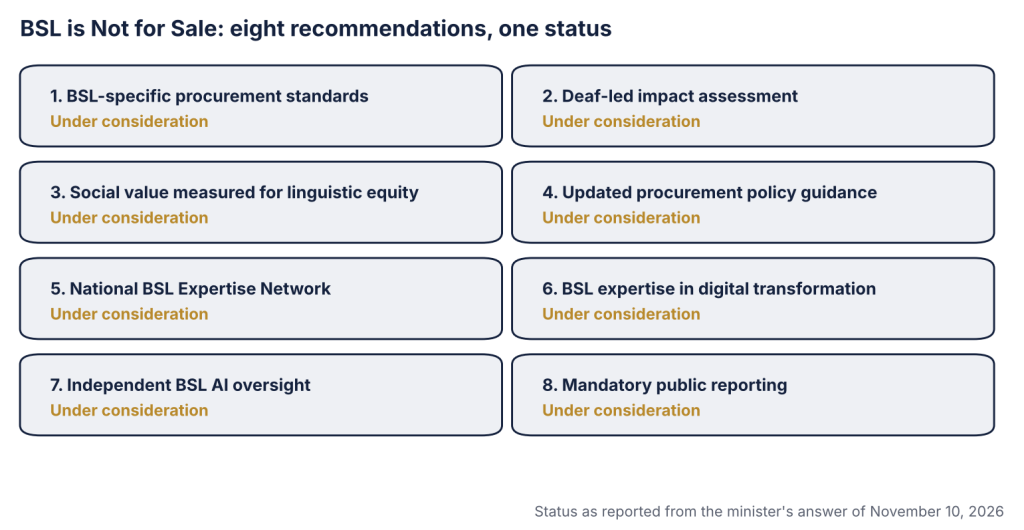
On November 10, 2026, the UK’s disability minister, Sir Stephen Timms, answered a set of written questions from Anneliese Dodds, the MP for Oxford East, about artificial intelligence and British Sign Language. According to Liam O’Dell’s report of the answers, Timms said it is “vital that developments in the use of AI for BSL are closely monitored.” He said the government “notes” the Minderoo Centre for Technology and Democracy’s report BSL is Not for Sale, and that its recommendations are “under consideration” [1].
I could not open the Parliament record of the answer directly, so the wording here is as Liam O’Dell reported it, with the question reference he gives, number 39331, tabled on October 29, 2026 [1]. NCG has already written about the Minderoo report itself. This piece is about what the government has said in response to it, and to Dodds, over the past year, and what that record tells buyers in any country.
A year of answers
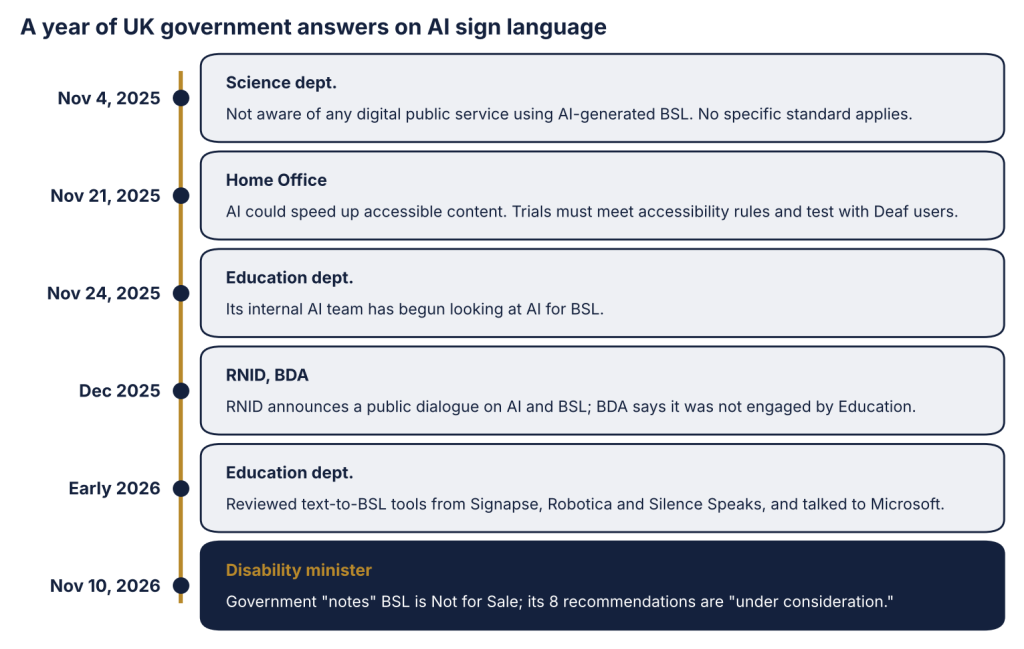
Dodds and other MPs have been asking these questions since at least October 2025. Put in order, the answers tell a story.
On November 4, 2025, Ian Murray, a minister at the Department for Science, Innovation and Technology, answered a question about which standards govern the commissioning of BSL AI. He said providing BSL translations of pre-recorded audio and video is a WCAG 2.2 AAA criterion, that current best practice is for BSL videos to be independently assured by a Deaf-led BSL supplier, and that the government was not aware of any digital public services using AI-generated BSL content. No specific accessibility standards applied to AI-generated BSL [2]. In a related answer the same day, asked whether BSL AI procurement was subject to algorithmic impact assessments, he said the government was not aware of any cross-government BSL AI procurement [3].
On November 21, 2025, the Home Office pointed to the Driver and Vehicle Standards Agency, which launched the government’s first online BSL translation service for theory test bookings in May 2025. The answer said AI could help speed up accessible content, that public bodies trialling AI for BSL must meet accessibility standards and do research with Deaf users, and that BSL videos must be culturally appropriate whether or not they are AI-generated [4].
On November 24, 2025, the Department for Education said its internal AI team had recently begun looking at AI solutions for BSL accessibility, with a phased approach and an ambition to be a leader in inclusive, AI-driven education [5]. In December, the British Deaf Association said it was concerned that the department was doing this without engaging the charity [1]. By early 2026, the department said it had mainly looked at text-to-BSL tools, reviewing information from Signapse, Robotica and Silence Speaks and talking to its main generative AI supplier, Microsoft [6].
Then came November 10, 2026.
What the government already knows
Here is the thing I keep coming back to. The UK government is not confused about what good looks like. It said it out loud a year ago.
Independent assurance by a Deaf-led supplier as best practice. Research with Deaf users before a trial. Cultural appropriateness whether or not AI is involved. In January 2026, a science department answer to Dodds added that services must seek expertise from the BSL community and specialist Deaf-led agencies to test their products [7]. And Timms himself, at the British Deaf Association’s conference in July 2025, warned that “we mustn’t just chase some technological panacea” and that thoughtless adoption of technology could do more harm than good [1].
That is a stronger set of principles than most governments have stated about sign language AI. If you lifted those sentences into a procurement rule, you would have most of what the Minderoo report asks for.
But they are not procurement rules. They are answers to questions. “Best practice” is advice to a buyer, not a condition of a contract. “Must seek expertise where appropriate” leaves the buyer to decide what is appropriate. And the government’s own answer in November 2025 said no specific accessibility standard applied to AI-generated BSL at all [2].
Monitoring without a list
The phrase that should worry buyers is “not aware.” In November 2025, the government was not aware of any digital public service using AI-generated BSL, and not aware of any cross-government BSL AI procurement [2] [3]. Both statements may well have been true. But “not aware” is not a count. It describes what reached a minister’s desk, not what is happening in the hundreds of public bodies, councils, NHS trusts and transport operators that buy their own technology.
NCG has seen how this plays out. Sign language AI arrives in public services through pilots, partnerships and supplier add-ons, not always through procurements anyone would call AI procurement. A rail operator trials an avatar on station screens. A council adds a translation widget to its website through its existing web supplier. A hospital accepts a free pilot. None of these necessarily shows up as a central government purchase of BSL AI.
So when the minister says developments will be “closely monitored,” the obvious question is: with what? I could not find, in a year of answers, a reference to a register of where AI-generated BSL is in use in public services, who supplied it, who assured it, and what Deaf users reported. Without that, monitoring means waiting to hear about problems, which in sign language AI usually means waiting for a Deaf person to complain, in a system that may not have given them a way to.
The Minderoo report’s eighth recommendation is mandatory public reporting [8]. Of the eight, it is the one that would turn “closely monitored” from a promise into a practice, because it creates the list that monitoring needs.
The line worth watching
Buried in the November answer is the detail I think matters most. The government says it supports a public dialogue on AI and BSL run by RNID and Sciencewise, called “What is the future?”, and that the Disability Unit and the Government Commercial Agency are part funders. Ahmed Mudawi, a member of the government’s BSL Advisory Board, will sit on the project’s oversight board, and the Advisory Board has its own technology subgroup focused on AI [1].
The Government Commercial Agency is part of how the UK government buys things. When the buying side of government helps pay for a conversation with Deaf people about AI in their language, that conversation has a path into contracts. That is more than most countries have.
RNID described the project in December 2025 as deliberative engagement with grassroots signing communities, with Sciencewise funding half and RNID seeking match funding from partners committed to transparent AI. Its stated aim is to work out what appropriate uses of AI for BSL are and what oversight is needed [9]. RNID was also blunt about the technology, noting that current systems struggle with fine detail like hands, which carries meaning in signed languages.
The British Deaf Association, whose chair, Dr Robert Adam, has warned that the risk from AI BSL is “immense and potentially catastrophic” without meaningful consultation, welcomed the government’s recognition of both opportunities and risks, and said it hopes the dialogue’s research will add detail [1].
The test is what happens after the dialogue reports. If its conclusions go into procurement guidance, with a Deaf-led assurance requirement and a public register, the UK will have done something real. If they go into a report that the government “notes,” we will be back where we started, with better-informed people waiting.
What buyers anywhere can take from this
This is a UK story, but the lesson travels. In the United States, I am not aware of any federal official answering questions like these on the public record. If you buy technology for a public body anywhere, you do not need to wait for your government to finish considering.
- Write the UK government’s own stated best practice into your contract: independent assurance of any AI-generated sign language by a Deaf-led supplier, before go-live and on a schedule after.
- Keep your own register. List every place your organization shows AI-generated signing, who supplied it, who checked it and when, and what users have reported. If your oversight body asks, you will be the one buyer who can answer.
- Count pilots and free trials as procurement. They put sign language AI in front of Deaf people just as surely as a contract does.
- Give Deaf users a way to report errors in their language, and publish a summary of what they report.
- Ask whether AI is the right answer before you ask which vendor. The Minderoo authors argue that Deaf communities should be able to recommend against AI altogether, and a buyer who never asks that question has already answered it.
Timms told the House of Commons in March 2025 that deaf people “need to be in the driving seat” on these issues, as the British Deaf Association noted in its discussion paper [10]. Twenty months later, the government has noted the map, is considering the route, and has promised to watch the road. That is not nothing. But a driving seat comes with controls, and the controls in public sector technology are contracts, standards and published records. Until those exist, Deaf people are still riding in the back.
Heather Grizzle-Odland is the founder of Novara Consulting Group, which evaluates sign language AI and other AI accessibility tools before institutions buy them. She is DeafBlind and lives in Minnesota.
参考文献
- O’Dell, L. (2026, November 11). ‘Vital’ AI BSL developments are ‘closely monitored’, disability minister says. Liam O’Dell. https://liamodell.com/2026/11/11/artificial-intelligence-british-sign-language-ai-bsl-sir-stephen-timms-british-deaf-association-bda-anneliese-dodds-sciencewise-minderoo/
- UK Parliament. (2025, November 4). Public Sector: Sign Language [Written question 85288, answered by Ian Murray]. Parallel Parliament. https://parallelparliament.co.uk/question/85288/public-sector-sign-language
- UK Parliament. (2025, November 4). Public Sector: Sign Language [Written question 85289, answered by Ian Murray]. Parallel Parliament. https://parallelparliament.co.uk/question/85289/public-sector-sign-language
- UK Parliament. (2025, November 21). Home Office: Sign Language [Written question, answered by Sarah Jones]. Parallel Parliament. https://parallelparliament.co.uk/question/91074/home-office-sign-language
- UK Parliament. (2025, November 24). Department for Education: Sign Language [Written question 91065, answered by Olivia Bailey]. Parallel Parliament. https://parallelparliament.co.uk/question/91065/department-for-education-sign-language
- UK Parliament. (2026). Sign Language: Artificial Intelligence [Written question 106192]. Parallel Parliament. https://www.parallelparliament.co.uk/question/106192
- UK Parliament. (2026, January 16). Public Sector: Sign Language [Written answer to Anneliese Dodds]. Parallel Parliament. https://www.parallelparliament.co.uk/mp/anneliese-dodds/dept/DSIT
- Hickman, L., Hagerty, A., & Powell, R. (2025, September). BSL is not for sale: A Deaf-led approach to AI procurement. Minderoo Centre for Technology and Democracy, University of Cambridge. https://bda.org.uk/wp-content/uploads/2025/10/MCTD-BSL-Report-WEB-02.pdf
- RNID. (2025, December). AI and British Sign Language. https://rnid.org.uk/2025/12/ai-and-british-sign-language/
- British Deaf Association. (2025, April). Artificial intelligence, British Sign Language and the British Deaf Association: Discussion paper (v1.4). https://bda.org.uk/ai-bsl-discussion-paper/