Picture a corridor at a further education college in Hertfordshire, the kind with notice boards and a stream of sixteen-year-olds between lessons. On the wall is a bright poster of the British Sign Language alphabet, twenty-six hand shapes, one for each letter, the sort of thing a well-meaning staff member puts up so hearing students can learn to spell their names to a deaf classmate. Nobody walking past would think twice about it unless they knew BSL. And if they knew BSL, they would stop, because every hand on that poster is working alone.
British Sign Language spells with two hands. The National Deaf Children’s Society teaches it that way on its own learning pages, where the alphabet is built from letters formed with both hands, one leading and one supporting. The poster at Hertford Regional College showed a one-handed alphabet instead. It was not a printing error or a bad translation. According to the college, the poster was made with the help of artificial intelligence, and the checks that should have caught the problem never happened.
I fingerspell with one hand every day. I am DeafBlind, I sign American Sign Language, and the one-handed alphabet is mine. That is what makes this small, local story worth a full piece. When a machine was asked for British Sign Language, it appears to have reached for something closer to my language instead, and a college put the result in front of its students.
What was on the wall
The story surfaced the way these stories now usually surface: not through an inspection or a complaint form, but through a deaf person with a phone. In early November, a Reddit user who identifies as deaf posted photos of the poster to the r/BSL community, then shared them again in r/deaf, where the post criticised a British college for teaching AI-generated sign language to students the Reddit user described as typically sixteen to eighteen years old. Liam O’Dell, a deaf journalist, picked it up and put questions to the college.
The college’s answer was candid. A spokesperson confirmed that AI had been used to create the poster, said the college reviewed the concerns as soon as it was told, took the poster down, and is now reviewing its processes so it does not happen again. The line that matters most for anyone who buys, approves or publishes educational material came next: the college said “the appropriate checks weren’t carried out” before the poster was displayed.
That is a more honest statement than most institutions manage when an AI output goes wrong, and the college deserves credit for it. It also raises the question this piece is about. What checks were supposed to happen, and who at the college was supposed to do them? If the answer is a sign language check, the next question is who on staff could have done it. A hearing reviewer who does not know BSL would have looked at twenty-six neat hand shapes and seen nothing wrong.
Three chatbots, one wrong answer
O’Dell did something most coverage of AI errors skips. He tested the tools himself. He asked three of the most widely used general AI assistants for the BSL alphabet and recorded what came back.
| Tool | First answer | After being told it was wrong |
|---|---|---|
| ChatGPT | One-handed signs | Pointed to verified Deaf sources: the British Deaf Association and british-sign.co.uk |
| Grok | One-handed signs | Produced a different alphabet using two hands that was still incorrect |
| Gemini | One-handed signs | Pointed to verified Deaf sources: the British Deaf Association and british-sign.co.uk |
Three tools, three wrong first answers, all wrong in the same direction. Two of them, once corrected, did the right thing and sent the user to sources built by and for the deaf community. One produced a fresh wrong answer. If anyone had used any of these tools the way most people do, by asking once and taking the result, the poster on the wall is roughly what they would have got.
This matters beyond one college. The failure was not a fringe tool or an obscure request. It was the most basic question a BSL learner can ask, put to the products that schools, councils and employers are told are ready for everyday work.
Why a machine reaches for one hand
Nobody outside these companies can inspect what their models were trained on, so the cause cannot be proven from the outside. The pattern is still easy to read, and it is the same pattern NCG described in The Corpus Question. A model produces what it has seen most often. A one-handed alphabet is the system American Sign Language uses, and O’Dell’s article draws the same comparison. ASL is the sign language of the United States, where these companies are based and where much of the English-language web is written, captioned and illustrated. Ask a general model for “the sign language alphabet” and the most common picture wins. Ask it for the British one and, on this evidence, the most common picture still wins.
That is what a corpus imbalance looks like in practice. A smaller sign language does not get translated badly. It gets overwritten by a bigger one, quietly, in a format that looks authoritative. BSL has been recognised in law as a language of England, Wales and Scotland since the British Sign Language Act 2022. It has its own grammar, its own regional variation and its own two-handed alphabet. None of that protects it from a model that treats “sign language” as one thing and fills the gap with whichever version it has the most pictures of.
I take no pleasure in saying that my language was the one doing the overwriting. ASL users should be the first to say this out loud, because the problem will not stay in Britain. Every smaller sign language, from Auslan to Irish Sign Language to the national sign languages of countries with far less online presence than the UK, is exposed to the same pull.
No vendor, no contract, no review
Most of what NCG writes about involves a vendor: a company selling an AI signing avatar to an airport, a rail operator or a school district, with a contract, a procurement file and, at least in theory, an evaluation step where someone could ask whether the signing is any good. This story has none of that. No one bought a sign language AI product. Someone at the college typed a request into a general-purpose tool, and the result went on a wall.
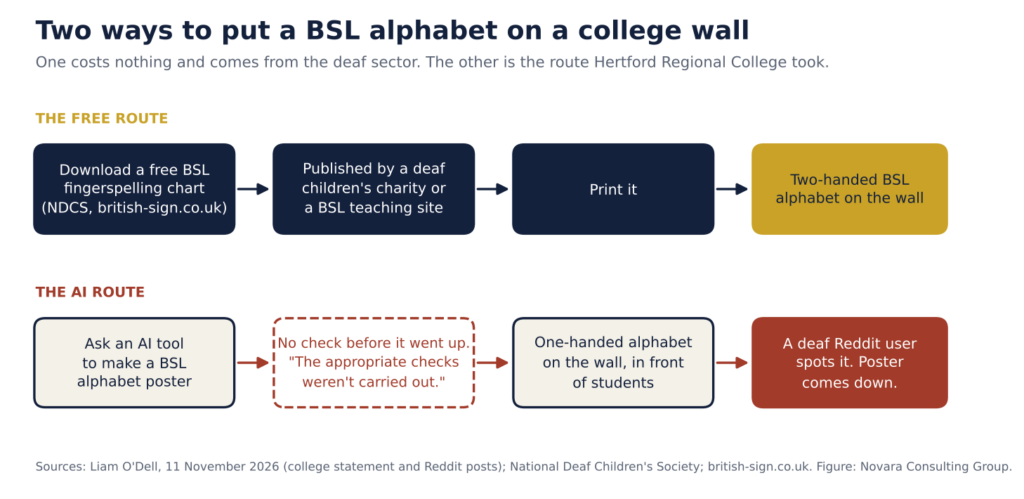
This is the part institutions should sit with. Procurement rules, vendor due diligence and AI policies written around buying systems all miss this route, because nothing was bought. The tool was already on the desk. The output looked finished. And the correct version was free the whole time. The National Deaf Children’s Society offers a fingerspelling poster and postcards, including left-handed and right-handed versions of the alphabet. British-sign.co.uk publishes a free printable chart in right-handed and left-handed versions and in several skin tones. The college did not use AI because the right material was expensive or hard to find. It used AI because it was there.
That is the risk profile of generative AI in education in one sentence. The cost of making something has fallen to zero, and the cost of checking it has not. When a tool can produce a polished poster in seconds, the only thing standing between a student and a wrong language is whether anyone in the building can recognise the error, and whether the process requires them to look.
What “the appropriate checks” would look like
The college says it is reviewing its processes. Here is what NCG would expect any school, college or public body to have in place before AI-made sign language content reaches a wall, a screen or a handout. None of it requires new money.
- Name the language every time. BSL, ASL, Irish Sign Language and Auslan are different languages, and a request for “sign language” invites the wrong one.
- Use the deaf sector’s own materials first. If a verified version already exists, there is no reason to generate one.
- Treat any AI-made sign language as a draft, never a source, until a fluent signer of that language has checked it.
- Make the checker someone who actually knows the language, and where possible a Deaf signer or a Deaf-led partner organisation.
- Label it. If AI helped make the material, say so on the material, and keep a record of who reviewed it and when.
- Give students and staff a way to report an error that gets a reply, so the next mistake is caught in a corridor and not on Reddit.
The fourth item is the one most institutions will struggle with, and it is the one that matters most. A check performed by someone who cannot read the language is not a check. It is a signature.
Questions Hertford Regional College is positioned to answer
The college has already answered more than most institutions would. These are the questions that would turn its review into something other colleges can learn from.
- Which AI tool produced the poster, and what was it asked to make?
- How long was the poster displayed, and where?
- Were any other teaching or display materials produced the same way, for BSL or for other subjects?
- Who was responsible for checking the poster, and what will the review change about that role?
- Does the college have Deaf staff, BSL tutors or a Deaf-led partner it can bring in to review sign language materials in future?
- Will the college publish its updated process so other further education providers can adopt it?
Go back to the corridor. The poster is gone, and the college has said the right things about why. But the reason it came down is that a deaf person happened to walk past, took a photo and posted it to a forum. That was the quality assurance. It cost the college nothing, and it will not scale. The next poster, the next worksheet, the next signing video generated in a staff room will go up in a building where no deaf person happens to look. The check has to exist before the poster does, and it has to belong to someone who can read the hands.
Credit for the reporting and the testing in this piece belongs to Liam O’Dell, whose article is linked below, and to the deaf Reddit user who noticed.
Heather Grizzle-Odland is the founder of Novara Consulting Group, which evaluates sign language AI before institutions buy or deploy it. She is DeafBlind, signs ASL, and lives in Minnesota.