
The Renewal
Pine Lake Public Schools serves about 5,400 students across seven buildings, 740 of them on an IEP. Its director of special education, call her Dana, has been in the job six years and in special education for twenty-two. She did not go looking for an AI drafting tool. The IEP platform the district has licensed since 2019 added one in a spring release, the way platforms add things: a banner on the login screen, a webinar, a new button beside each student’s name. By October, most of her case managers were pressing it. By the following spring, when the renewal came across her desk, the question was not whether to adopt AI drafting. It was whether to keep paying for a system her staff now relied on to get through the year.
The renewal packet had four documents in it. A one-page order form with the price. The vendor’s master subscription agreement, forty-one pages, which the district had signed in 2019 and which the vendor said had not materially changed. A student data privacy agreement on the state’s standard form, which the district’s technology director had already countersigned because the vendor had pre-signed it. And a one-page product addendum describing the AI features, which said that the tool was “designed to assist, not replace, the professional judgment of educators” and that “all generated content is subject to review and approval by district staff before it becomes part of a student’s record.”
Dana read that last sentence twice, decided it was the right sentence, and signed. The business manager signed. The board approved the renewal on a consent agenda with forty other items. Nobody at Pine Lake, and nobody at the vendor, had done anything wrong. The district had done what districts do: it had bought a product on the paperwork the product came with. What that paperwork covered, and what it left out, is the subject of this piece.
What the Paper Covers
The document that did the most work in Pine Lake’s renewal was the student data privacy agreement, and it is worth understanding what it is. For about a decade a consortium of districts, state alliances and vendors called the Student Data Privacy Consortium, part of the non-profit Access 4 Learning Community, has maintained a National Data Privacy Agreement, a template contract that districts and vendors sign so that neither side has to negotiate privacy terms from scratch. Twenty-eight state alliances helped write version 2 of it. When that version was released in April 2024, the consortium’s public registry held more than 130,000 signed agreements between more than 12,000 schools and districts and 6,674 education application providers.1 Version 2.2 followed in November 2025.2 In many states a vendor that wants to sell to a district pre-signs the state’s version of this form, the district countersigns, and the privacy question is considered closed.
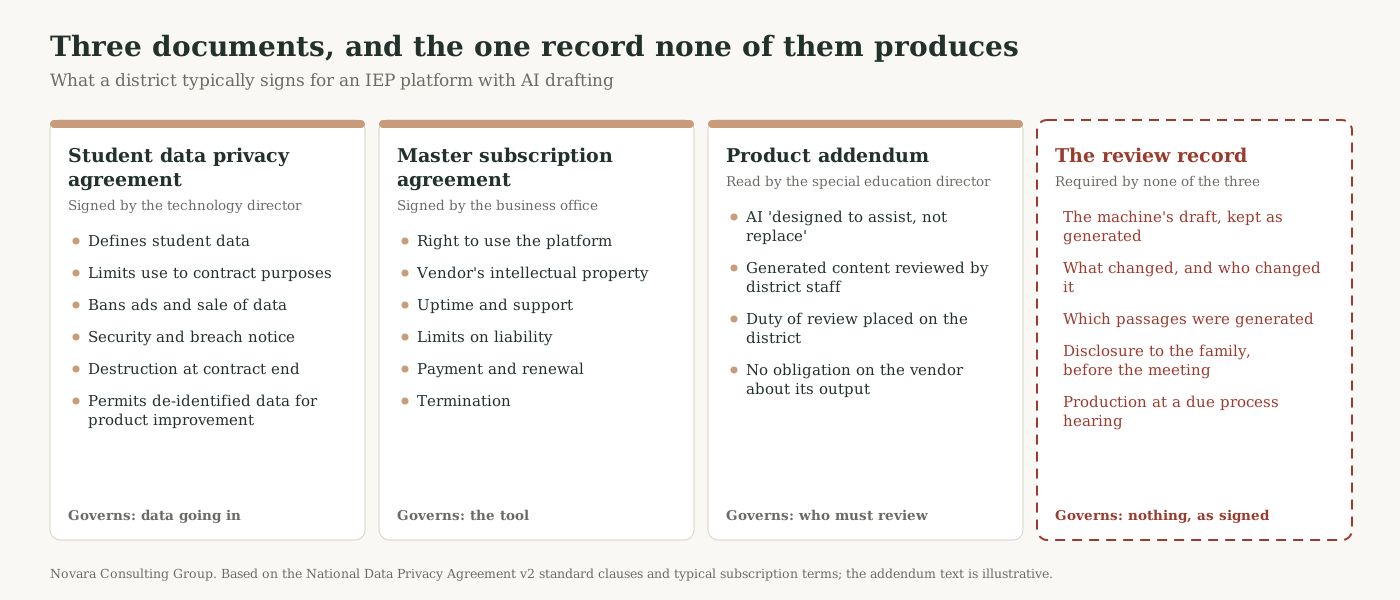
It is a good document for what it does. It defines student data, restricts the vendor to using that data for the purposes of the contract, forbids advertising and selling, requires security practices, requires breach notice, and requires destruction of the data when the contract ends. It operationalizes the part of federal privacy law that lets a district treat a vendor as a school official, and it layers each state’s own student privacy statute on top. A district that signs it has a defensible answer to the question “who can see this child’s data and what may they do with it.”
Read it for the question part one of this series raised, though, and it has no answer. Nothing in the agreement concerns what the platform produces. It does not say whether a draft the machine generates is a record, whether the vendor must keep it, whether the district may export it, whether changes to it are logged, or whether a parent may be told it exists. The agreement was written to govern data going into a system. AI drafting is a system producing an account of a child, and the agreement does not know that such a thing can happen.
This is not a criticism the consortium would dispute. In a blog post dated 3 September 2026, the consortium’s director of data privacy described the review of version 2.3 of the agreement and wrote, with evident frustration, that “there are critical topics our Community has requested that the NDPA address (e.g., AI) that are not going to be a part of this release.” The consortium has started an internal group on AI tools and expects that group’s input to produce an AI addendum before a full version 3.0.3 So the national template that governs AI drafting tools in most districts today was written before those tools existed, its next version will not address them, and the addendum that will is not yet drafted. In the meantime, every district renewing an IEP platform with AI features is signing a privacy agreement that is silent on the one thing the AI features do.
There is one more provision worth reading closely, because it does speak, in a way, to AI. The standard agreement permits the vendor to use de-identified, aggregate or anonymized student data “for the purpose of development, research, and improvement of educational sites, services, or applications,” so long as it does not try to re-identify anyone or transfer the data to a third party without the district’s consent.4 That clause was written for product analytics. It predates the question of whether a vendor may use de-identified IEP text to train or tune the model that drafts the next district’s IEPs. A fair reading is that it permits it, and a district that wants a different answer has to write one. Few do. Maryland’s state education agency, in its AI guidance for local agencies, advises districts to “ensure data processing agreements specifically address AI use,” which is sound advice and, given what the national template contains, an acknowledgment that the standard form does not.5
Three Documents, No Draft
Pine Lake’s other two documents did no better, and it is worth being precise about why, because the gap is structural rather than careless.
The master subscription agreement is a software license. It governs the district’s right to use the platform, the vendor’s intellectual property, uptime commitments, limits on liability, payment, and termination. It was signed in 2019 and treats the platform as a tool the district operates. In the vendor’s reading, which is reasonable, the AI feature is one more function of that tool, and the license already covers it. What the license does not do is impose any obligation on the vendor about the content the tool produces, because software licenses have never done that. A word processor does not warrant the memo.
The product addendum is the document that sounds as if it addresses the question, and it is the one Dana read twice. “All generated content is subject to review and approval by district staff before it becomes part of a student’s record” is true, and it is the vendor’s protection, not the district’s. It places the duty of review on the district, confirms that the district has accepted that duty, and says nothing about what the vendor will do to make the review visible. It is a sentence a vendor’s counsel would write. It is also the sentence every state AI policy asks for, and that is the problem: a district can satisfy the policy by signing the addendum, without acquiring any means of showing that the review it promised ever happened.
The policies themselves are arriving on a schedule now. Ohio’s 2025 budget act added a section to the Revised Code requiring every district, community school and STEM school in the state to adopt a policy on the use of artificial intelligence by 1 July 2026, with a model policy from the Department of Education and Workforce published in December 2025 that districts may adopt as written.6 Ohio is the first state to make the policy a statutory duty rather than a suggestion, and others are moving the same way. The Ohio model, like the Minnesota, Oklahoma, Illinois and District of Columbia guidance described in part one, is a policy about use. It tells staff what they may and may not do with AI. It is not a procurement instrument, and it does not tell the district what to require of a vendor. A district that adopts it has satisfied the state and acquired nothing it can produce at a hearing.
A district can satisfy the policy by signing the addendum, without acquiring any means of showing that the review it promised ever happened.
So the three documents divide the problem among themselves and none of them picks it up. The privacy agreement governs data in. The license governs the right to use the tool. The addendum assigns the duty of review to the district. The record that would show the review occurred, which is the only thing that would make “AI drafts, humans decide” a claim with evidence behind it, falls between all three.
Where the Draft Goes
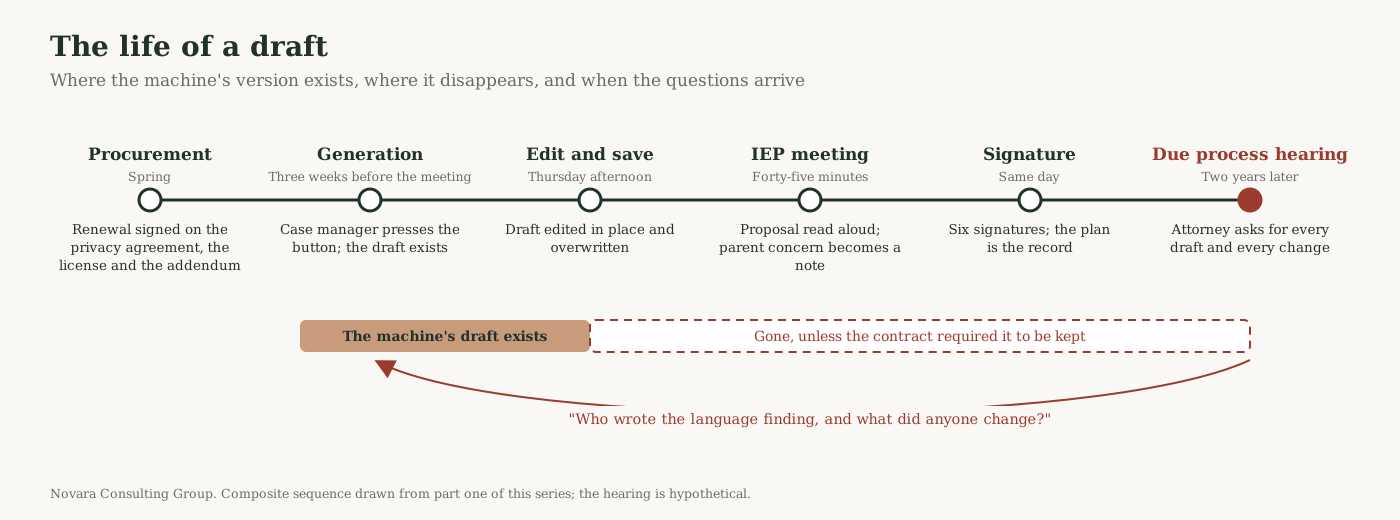
What happens to the machine’s draft at Pine Lake is not a mystery, because it is the default behavior of a drafting tool. The case manager generates the draft, edits it in place, and saves it. The platform keeps the saved version. Depending on the product, it may keep a version history of the document the way a word processor does, or it may overwrite. In neither case is there a field that says which text was generated and which was typed, or a report the district can run to compare them. When Dana asked the vendor’s account manager about it after reading part one, he said the platform “maintains full audit logs,” which turned out to mean that it records which user opened and saved each IEP and when. It does not record what the machine wrote.
Federal law has more to say about this than districts tend to assume, and none of it was written with a machine in mind. Under the regulations that govern parental access to records, a district must permit parents to inspect and review any education records relating to their child that the district collects, maintains or uses in connection with identification, evaluation, placement or the provision of a free appropriate public education, without unnecessary delay and before any IEP meeting, and in no case more than forty-five days after the request.7 Under the privacy regulations, an education record is any record directly related to a student and maintained by the educational agency or by a party acting for the agency, and a district may disclose records to a contractor only if the contractor performs a function the district would otherwise do itself and is, in the regulation’s words, “under the direct control of the agency or institution with respect to the use and maintenance of education records.”8
Put those two provisions beside the AI draft. The draft is directly related to a student. It is maintained by a party acting for the district. It was used in connection with developing the child’s IEP, since the district’s proposal was made from it. On that reading, which NCG believes is the better one though no court has yet addressed it, the draft is an education record, the parent has a right to see it before the meeting, and the district is required to be in a position to direct the vendor to keep it and produce it. A district that cannot produce the draft because the platform overwrote it has not merely lost a convenient document. It may have failed to maintain a record it was obliged to maintain, and it has certainly ceded the “direct control” that its right to share data with the vendor depends on.
The destruction rules point the same way. A district must tell parents when personally identifiable information it collected is no longer needed to provide services to the child, and must destroy it at the parents’ request, while keeping a permanent record of basic facts.9 That rule assumes the district knows what records exist and where. It is hard to reconcile with a platform that generates a document about a child, lets a staff member overwrite it, and keeps no copy. The district cannot tell the parent about a record it never possessed, and it cannot destroy on request what the vendor never retained.
None of this requires a new law. It requires the district to treat the draft as what it is and to write the contract accordingly. The privacy regulations’ “direct control” condition is, in effect, an instruction to do so: a district that lets a vendor decide what records of a child are kept has not retained direct control over the maintenance of education records, whatever the privacy agreement says.
The Clause Has to Know the State
A contract clause requiring the draft is necessary and not sufficient, because what the draft contains depends on what the district has recorded, and for a Deaf child that record is usually almost empty. Part one made the point from the National Deaf Education Data Index for six states. On 1 November 2026 the Index reached thirteen states at version 2.0, and the pattern held. Across Alabama, Alaska, California, Delaware, Florida, Hawaii, Iowa, Kentucky, Louisiana, Minnesota, Nevada, New Jersey and Pennsylvania, 5,035 local education units were read: districts, charter schools, county offices, cooperatives, intermediate units and the state schools. Of those, 444 publish a deaf program or deaf education staff of their own. Another 1,212 mention hearing somewhere, usually in an eligibility list. The remaining 3,234, sixty-four percent, publish nothing at all about deaf or hard of hearing students on the pages read.10
A platform drafting from a district’s own records draws on that record. If the district has never written down that it offers direct instruction in American Sign Language, employs a teacher of the deaf, or can reach a signing peer group, no draft will propose those things, and a review conducted against the draft is a review of generic accommodations. So the clause that requires the draft to be kept has to be paired with a clause that stops the machine from filling in the sections where the district’s data is least likely to describe the child. For a Deaf or hard of hearing student, those sections are the special factors federal law names, the state’s communication plan where one is required, and the interpreter qualification.
The interpreter qualification is where the contract has to know the state it is signed in, and the Index shows how much that varies. What follows is what twelve of the thirteen released states require of the person who interprets for a Deaf child in a classroom, as each state’s version 2.0 file records it; Minnesota’s file carries its standard under the state’s own licensing rule.
| Estado | Classroom interpreter standard |
|---|---|
| Alabama | General state interpreter licensure; applies in schools |
| Alaska | RID certification or enrolled and progressing in a program meeting the state standard |
| California | RID certification or EIPA 4.0 |
| Delaware | Bachelor’s degree plus RID certification or EIPA 4.0; no provisional tier |
| Florida | No qualification set |
| Hawái | No rule sets a classroom qualification |
| Iowa | State license on NIC or RID certificate or EIPA 3.5; temporary license capped at four years |
| Kentucky | General licensure with no school exemption; classroom test route closed in 2025 |
| Luisiana | Education board certificate at EIPA 3.0; stricter Commission for the Deaf standard alongside |
| Nevada | EIPA 4.0 or provisional 3.5 for five years; statewide registry |
| Nueva Jersey | Associate degree or higher plus EIPA 3.5 with written test |
| Pensilvania | EIPA 3.5 for the grade level plus 20 hours annual staff development |
An IEP that says “Nora will use an interpreter as needed” commits a Pennsylvania district to someone who has scored 3.5 on the Educational Interpreter Performance Assessment for the grade level. It commits a Florida district to nobody in particular. A drafting tool sold nationally does not know the difference, and unless the contract requires it to leave that field for a human who does, the draft will say “an interpreter” in both states and the review will let it stand. The Index exists so that a district, or a district’s counsel, can look up what the state requires before signing a contract that silently assumes it is nothing.
Seven Clauses
What follows is NCG’s model language. It is written to be dropped into the product addendum or, in states that permit it, into the district-modified version of the privacy agreement. It is deliberately short. A district’s counsel should adapt it to the state’s records law and retention schedule, and a district buying through a cooperative purchasing contract should ask whether its participating addendum allows it to add terms at all, which is a question worth asking before the renewal rather than after.
1 Retention of generated drafts
For each individualized education program, Section 504 plan, evaluation report or other student record for which the Service generates any text, the Provider shall retain the complete text as generated, with the date and time of generation and the identity of the user who initiated it, as a separate and unaltered record, for the full period during which the District retains the final document, and shall not overwrite, merge or delete the generated text when a user edits it.
2 Change record and attribution
The Service shall record every change made by a user to generated text, identifying the user, the date and time, the section changed and the text before and after the change, and shall mark in the final document, in a manner the District can display and export, which passages were generated by the Service and which were written or rewritten by a user.
3 Production on request
Within ten business days of a written request from the District, the Provider shall produce, in a format the District can read without the Service, the generated draft, the change record and the attribution for any student record the District identifies, including after termination of this Agreement for as long as the District’s retention obligation for the final document continues.
4 Human entry in designated sections
The Service shall not generate text for the following sections of an individualized education program and shall require a user to enter them: the consideration of special factors required for a child who is deaf or hard of hearing under 34 CFR 300.324(a)(2)(iv); any communication plan or language plan required by the law of the state in which the District is located; the qualifications of any interpreter or communication specialist; and the placement determination. The District may designate additional sections in writing.
5 Disclosure to families
The Service shall support, and the Provider shall not impede, the District’s disclosure to a parent or guardian that the Service generated any part of a draft, which parts, and the parent’s right to review the generated draft before any meeting, consistent with 34 CFR 300.613.
6 No training on District records
Notwithstanding any provision of the Data Privacy Agreement permitting the use of de-identified data for product development, research or improvement, the Provider shall not use any student record of the District, or any text generated from it, whether identified or de-identified, to train, fine-tune, evaluate or otherwise improve any model that generates text, without the District’s separate written consent, and shall certify compliance annually.
7 Sampling and audit
The Provider shall provide the District, on request and at no additional charge, a report comparing generated drafts with final documents for a sample of student records the District selects, by section, sufficient for the District to determine the rate at which designated sections were changed between generation and signature.
Three things should be said about these clauses. The first is that they are cheap. A system that generates a draft holds the draft at the moment of generation; retaining it is a storage decision, not an engineering project. A system that saves edits already knows who saved what; recording the before and after is a logging decision. A vendor that tells a district these clauses are impractical is saying something about its willingness, not its product.
The second is that clause six does more than it appears to. Part one noted that most parents already support AI assistance in IEP development, and that the record proposed here is how the tools would prove their value. Clause six is what makes the proof honest. A vendor that trains on district IEP text is, over time, drafting each child’s plan from an average of other children’s plans, which is the opposite of what the statute’s word “individualized” means. A district that does not want that outcome has to say so, because the standard privacy agreement, as written, permits it.
The third is that clause seven is the one that changes behavior. Clauses one through three create the record. Clause seven lets the district read it at scale. The annual sample described in part one, in which a district compares drafts with signed plans in the sections where the data is least likely to describe the child, is impossible without it and a morning’s work with it. If the designated sections almost never change between generation and signature, the district has learned that its reviews have become ratification, and it has learned it from its own records rather than from a hearing officer.
Who Can Sign Them
Dana cannot add these clauses on her own, and it matters who can.
In most districts the student data privacy agreement is signed by a technology director or a privacy officer under a board policy that delegates that authority, and the subscription renewal is signed by the business office. Neither of those people is responsible for the content of an IEP, and neither reads the product addendum as a special education document. The first practical step is therefore internal: the director of special education has to be a required signature on any contract for a system that generates student records, and the district’s contract review checklist has to ask the seven questions these clauses answer. That is a board policy change, and in Ohio, where every district had to adopt an AI policy by July 2026, it is the kind of provision a district’s policy can carry.
Many districts do not sign a negotiated contract at all. They buy through a cooperative purchasing contract that a consortium or another public entity competed and awarded, and they join it by signing a participating addendum. The terms were negotiated by someone else for everyone. A district in that position should find out whether its participating addendum permits additional terms, and if it does not, should raise the seven clauses with the cooperative, since a cooperative that writes them into the master agreement writes them for every member at once. That is the single highest-leverage place these clauses could land.
In Illinois the contract is public. Since July 2021 the Student Online Personal Protection Act has required every district to post on its website the written agreement with each operator of an online service within ten days of signing, along with the data elements collected and the subcontractors involved.11 A parent in Illinois can read the contract that governs the platform drafting her child’s IEP, and so can a reporter, a legislator and a competing vendor. Any Illinois district that adds the seven clauses will have published them, and any district that has not will have published that too. Transparency statutes of this kind were written to expose data practices; they will now expose whether districts asked for the draft.
State education agencies hold the broadest lever and have not yet used it. A state that issues AI guidance saying a human must decide can say, in the same document, what a district’s contract with a drafting vendor must contain, and it can fold a check of the review record into the IEP compliance monitoring it already performs. States with Deaf children’s bills of rights or communication plan requirements can go further and specify that those sections may not be auto-generated. Colorado shows how easily this question slips through even a state that is regulating AI directly. Its revised automated decision-making law, signed on 14 May 2026 and effective for decisions made on or after 1 January 2027, applies to automated technology that materially influences a consequential decision, and the statute’s list of consequential decisions includes access to education.12 But the Attorney General’s draft implementing rules place tools used to summarize, organize or draft information for human review outside the law’s definition, which is where an IEP drafting tool would most likely land. The Center for Democracy & Technology objected in its October 2026 comments that a tool which drafts for a human reviewer can still shape what that reviewer decides.16 That is the argument of this series in one sentence, and as the rules stand, it has not carried.
The federal government has already said that federal funds may buy these tools and set out principles for their use, including that they be transparent and compliant with privacy law.13 It has not said what the contract has to contain. A single sentence in the next version of that guidance, to the effect that a drafting tool purchased with federal funds must retain and produce the generated draft, would do more than any state policy.
The Vendor’s Answer
Vendors will object, and the objections are worth answering in advance because they are predictable.
The first is cost. Retaining every generated draft for the life of an IEP is storage, and storage for text is nearly free. Logging edits is a feature most document systems already have. The cost objection, where it is sincere, is usually about the report in clause seven, which has to be built. It is a modest build, and a vendor confident in its product should want it, because it is the report that would show the product improving IEPs rather than replacing the human review with a faster one.
The second is trade secrets. A vendor may argue that marking generated text exposes something about how the model works. It does not. The attribution records which passages the service produced, not how. The prompt, the model and the vendor’s tuning remain the vendor’s. What becomes visible is the one thing the district is responsible for, which is what its own staff did with the output.
The third is that the clauses imply the product is unreliable. They imply nothing of the kind. Every policy that governs these tools, every vendor addendum and every state model rests on the claim that a human reviews and decides. The clauses ask for the evidence of that claim. A vendor that resists producing evidence that its human-in-the-loop safeguard operates is, whether it intends to or not, telling the district something about the safeguard.
The fourth objection is the quiet one, and it concerns clause six. Vendors that use de-identified district data to improve their models will say that the standard privacy agreement permits it, which is true, and that the improvement benefits the district, which may be true. A district should weigh that against the plain meaning of “individualized” and decide. It should not discover the practice after the fact, in a disclosure made because someone finally asked.
A vendor that resists producing evidence that its human-in-the-loop safeguard operates is telling the district something about the safeguard.
The stronger vendors will not make these objections, and some will build the features before any district asks. Common Sense Media’s August 2025 risk assessment of AI teacher assistants rated the category a moderate risk overall and singled out IEP generation as among the most concerning features, in part because a plan can be produced from very little data.14 The Center for Democracy & Technology, whose polling found that 57 percent of special education teachers used AI to help develop an IEP or 504 plan in 2024-25, recommended that districts write policies requiring human oversight and consult compliance offices on the legal risks under IDEA and FERPA.15 Vendors read those reports. The ones who read them as a product roadmap will be able to say, in the next procurement, that their platform keeps the draft and shows the changes. The others will have to explain why not.
Two Years Later
Nora is in sixth grade. The IEP from part one followed her, as IEPs do, and the two that came after it were drafted the same way, from the same record, with the same finding about her language. Her mother, who learned something at that first meeting about how the documents arrive, has filed for a due process hearing. Her attorney’s first document request is short. It asks for every version of the three IEPs, including any draft generated by software, the record of changes made to each draft, and the name of each person who made them.
In the district without the clauses, the answer takes three weeks and comes back thin. The platform has the signed plans. It has a log showing which case manager opened each one and when. It does not have the generated drafts, because they were edited in place, and it cannot say which sentences the machine wrote. The district’s attorney, who is competent and has not seen this question before, has to argue that the review occurred on the basis of the case manager’s recollection of a Thursday afternoon three years ago. The hearing officer, who has to decide whether the parent was given a meaningful opportunity to participate and whether the plan was reasonably calculated for this child, is being asked to take the safeguard on faith. The district may win anyway. It will not win on the evidence, because there is none.
In the district with the clauses, the answer takes a day. The attorney receives the drafts, the change logs and the attribution. Two things are now visible that were not before. The first is that the language delay finding was generated, carried forward three years unchanged, and never rewritten by anyone. The second is that the special factors section was entered by hand each year, because the contract required it, and each year it says that the team considered direct instruction in ASL and did not provide it because the district has no signing staff. That second fact is a problem for the district. It is also a fact, written down by a person, that the hearing officer can weigh, the parent can contest, and the district can be ordered to fix. The first district is defending a process it cannot describe. The second is defending a decision it made.
Dana, at Pine Lake, is in neither district yet. The renewal she signed runs for three years. She has read part one, and she has read this, and the next step for her is the one this piece was written to supply: a memo to the business office and the board, before the next renewal, listing the seven clauses and asking that the contract for any system that writes about a child carry them. It is not a dramatic step. It is the only one that produces the record. A draft is not a decision, and a contract that never asked for the draft cannot prove that anyone ever made one.