
Four days after NCG published “The Sign Said Something Else,” a second recording surfaced from the same airport, the same train and the same AI signer. The first recording, posted on LinkedIn on 8 October 2026 as a product demonstration, showed Max, the Signapse ASL signer on the Cincinnati/Northern Kentucky International Airport terminal train screens, announcing a train in two to three minutes to baggage claim and ticketing while the screen beside it read “Next train arriving in 5 minutes for A & B Gates.” The second recording came not from the vendor and not from NCG but from a Deaf traveler who uses that train regularly, offered in the course of a public exchange about the first. In it, by his account and on NCG’s viewing, the signed announcement names Concourse A for a train serving Concourse B.
The first article argued that the failure was not in the signing but in the absence of a check. That was an inference from a single recording. The second recording turns it into something closer to a finding. Two independent recordings, days apart, at one deployment, each showing the signed message and the written message disagreeing about where a train is going, are difficult to explain as a single mapping error that has since been corrected. They are easy to explain as a pipeline in which the written announcement and the signed announcement are produced separately and nothing compares them before both reach the platform.
What the second recording shows
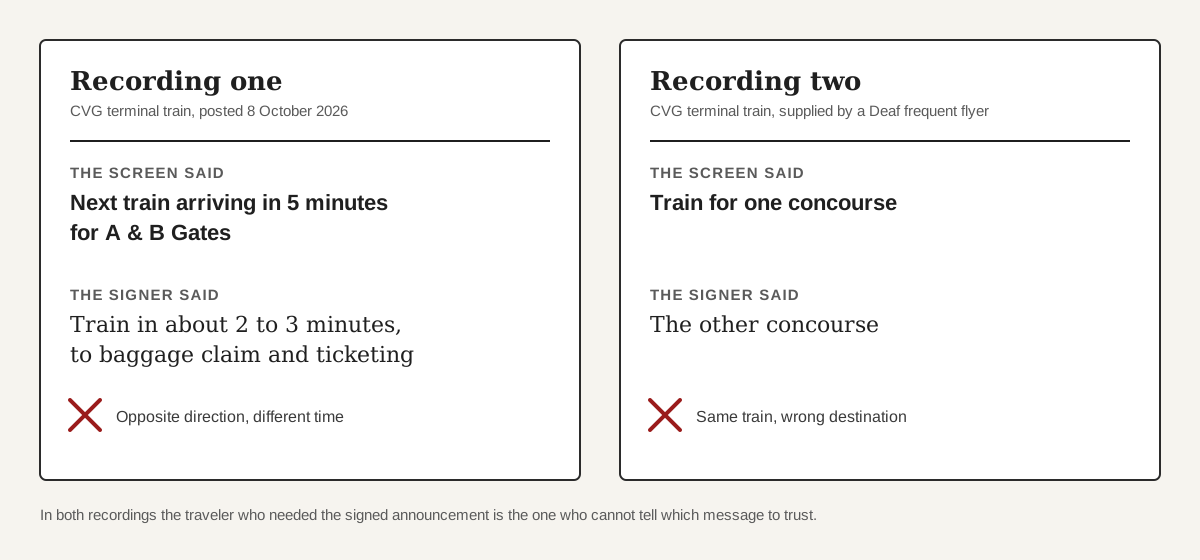
The CVG terminal train runs between the Main Terminal and Concourses A and B. A traveler on the platform has, in principle, three sources for the same fact: the written text on the screen, the public address audio, and, since Signapse’s deployment, the signed clip. A hearing traveler has two of the three and can notice when they disagree. A Deaf traveler has two as well, the written text and the signed clip, and the second recording shows those two disagreeing about which concourse the train serves.
The direction of the error matters less than its type. In the first recording the signer described the opposite direction of travel and a different arrival time. In the second it names the wrong concourse on the same side of the line. These are not the same mistake repeated; they are two different mistakes of the same kind, and that is what makes them evidence of a process rather than an event. A single wrong clip is an accident. Two wrong clips with different content, both reaching a live screen, mean the step that would have caught either one does not exist.
What is not known, and who can say
Henri Grau, who supplied the second recording and flies through CVG often, raised the right question: is the signer translating the public address announcement, or is it meant to match the display and running out of sync with it? NCG does not know. Signapse’s airport product is, as far as its public material describes it, built from pre-recorded signed clips mapped to announcement triggers rather than live translation of speech, but the public material does not say what triggers the clip at CVG or whether the trigger is the same one that writes the display text.
The distinction decides where the fault sits. If the signed clip follows the PA audio and the display text is written by a separate system, then the two can legitimately differ for a moment, and the question becomes why neither CVG nor Signapse treats a disagreement between them as an error condition. If the signed clip is meant to be the display text in another language, then a disagreement is a mapping or content error inside the signing pipeline, which is what the first article assumed. If the clip fires on a schedule unconnected to either, the deployment is broadcasting wayfinding information that nothing is keeping current.
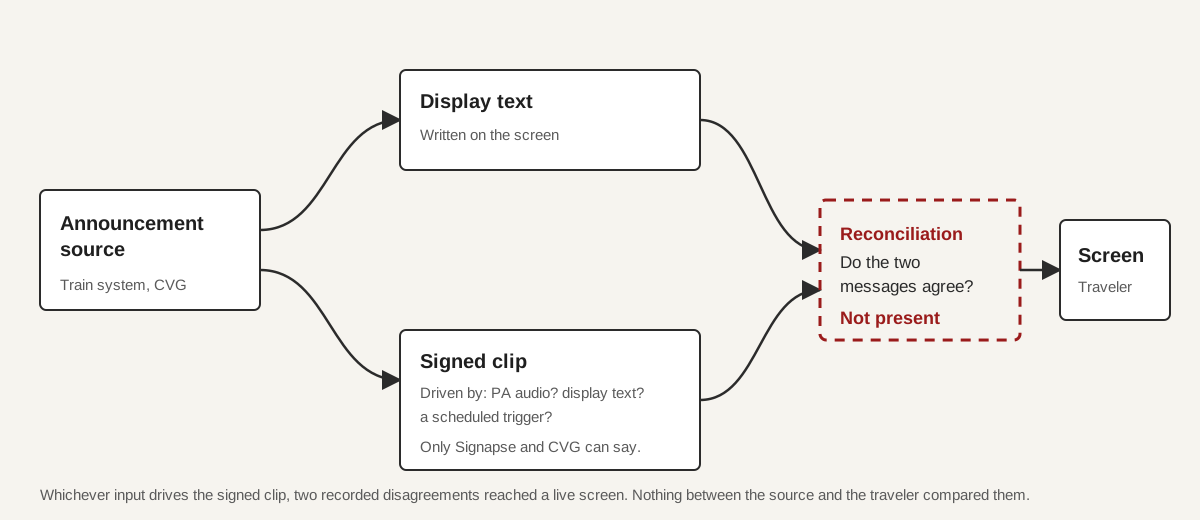
NCG has put that question to Signapse and to CVG and will publish any answer in full. Until it is answered, the honest position is that the layer at fault is unknown and the consequence for the traveler is the same in every case. The article does not need to know which system erred to observe that two systems disagreed on a platform and that no third thing noticed.
“Minor glitch,” and who gets to call it that
Mr. Grau also offered a reading that deserves a direct answer rather than a dismissal: that the signed announcement is helpful while waiting for the train even when it does not match the static text, and that the mismatch is probably a minor glitch that could be fixed. He is Deaf, he uses the train, and his view of what helps him on that platform carries weight that NCG’s does not.
The answer is about who can make that judgment. A traveler who knows the CVG train, knows which concourse his flight leaves from and knows roughly how long the train takes can watch a signer name the wrong concourse and file it as a glitch, because he is not relying on the signer for the fact. The announcement is pleasant to have and costs him nothing when it is wrong. A traveler who does not know the airport, who is connecting through it for the first time, who has a short connection and who is relying on the one signed source of information the platform offers, cannot file it as anything. She acts on it. If it names the wrong concourse she goes to the wrong concourse, and the time it takes to discover that is the time she did not have.
Accessibility technology is evaluated by what it does for the person who needs it, not for the person who could manage without it. On that measure a wayfinding announcement that is sometimes wrong is worse than no announcement, because the traveler who needs it most is the one with the least ability to detect the error. That is not an argument against the signer. It is an argument for the check.
What a buyer should do with two instances
The first article ended with a checklist for airports considering AI signing: reconciliation between the signed message and the display, error logs, Deaf review of live output, a passenger reporting route and clear terms of responsibility. Those stand. Two documented instances at a live deployment add a consequence that one did not.
An airport that already has this signer on live wayfinding screens should take it off those screens until a reconciliation step is in place and demonstrated, and should say so publicly. This is not a punishment of the vendor. It is the ordinary response to a system that has been recorded twice giving travelers wrong directions, and it is what the same airport would do with a departures board that had twice shown the wrong gate. The signer can return to informational and welcome content, where a wrong clip embarrasses nobody and misdirects nobody, while the wayfinding pipeline is fixed.
An airport considering this signer should write the reconciliation step into the contract before signing, as a condition of acceptance rather than a feature request: the signed clip is not displayed unless the system has confirmed that its content matches the current display text for that screen, and every suppression is logged and reviewable. A vendor that cannot meet that condition is selling a pleasant addition to a platform, not an accessibility service, and should be priced and placed accordingly.
Right of response
NCG shared a governance review of Signapse with the company for comment in September 2026 and published its comments at that time. On the first CVG recording NCG has received no response. On the second, NCG has asked Signapse and CVG one question, what input drives the signed announcement on the CVG train screens, and has offered to publish the answer in full. The second recording is credited, with permission, to Henri Grau, Director of Deaf Community Engagement at Aira, who supplied it as a passenger and not on behalf of any party.