
When a letter from notice@ndedi.org arrives at a state school for the deaf, it lands on the desk of someone who has spent a career keeping a fragile institution open. They have watched enrollment numbers get waved around in budget hearings. They have seen a residential program described as a cost center by people who never set foot in a dorm. So when an outside group announces that it has read every district website in the state, counted the deaf children, traced the money and wants a reply within ten business days, the reasonable first question is not about method. It is about motive. What is this for, and who gets hurt by it?
This piece answers that question directly, because the answer shapes how every state file should be read. The National Deaf Education Data Index was built to make deaf education visible, accountable and governable. It was not built to shrink it, defund it, close any part of it, or cost anyone their livelihood. Those are different goals, and in deaf education the difference matters more than it does almost anywhere else, because the field has a long history of decisions made about deaf children in rooms where the numbers were missing and deaf people were absent.
Where this started
I went to the Atlanta Area School for the Deaf, and later to Gwinnett County public schools, in Georgia. Between those two placements I lived both halves of the system this Index now maps: the school built around deaf children, and the local district program. I am not writing about deaf schools from the outside, and the Index was not designed by people who think the answer to deaf education is less of it.
What became clear to me much later, working in governance and public procurement, is that almost no one can describe the whole system. A parent whose baby has just failed a newborn hearing screen cannot find out, from any single public source, which programs exist in her state, which one serves her district, what they cost, or who is responsible if the service does not arrive. A legislator voting on a deaf school’s appropriation usually cannot see what the same state spends on deaf students everywhere else. A superintendent of a state school often cannot show the legislature how many districts lean on the school’s outreach staff, because the districts themselves never say so. Everyone is working from a partial picture, and partial pictures are where bad decisions come from.
The Index began as an attempt to fix that, one state at a time, from primary sources only. Its charter puts the purpose in a single sentence: to establish, state by state, “where Deaf and hard-of-hearing students in the United States are actually educated, how many of them there are, what public money is allocated to educate them, and what institutional machinery governs that provision” [1]. The same document explains why the work was needed at all: “The Index exists because no such record currently exists.”
What the Index is, and what it refuses to be
The charter calls the Index “a reference instrument rather than an advocacy document,” and the distinction is not decorative. Every notice we send before a state file is released repeats it in plain terms: the Index “does not evaluate any program, rate any body or recommend any policy” [2]. It does not score a state school. It does not rank districts. It does not tell a legislature to cut a line or move a child. A reader looking for a verdict on whether a particular program is good will not find one in a state file, because the file was never designed to deliver one.
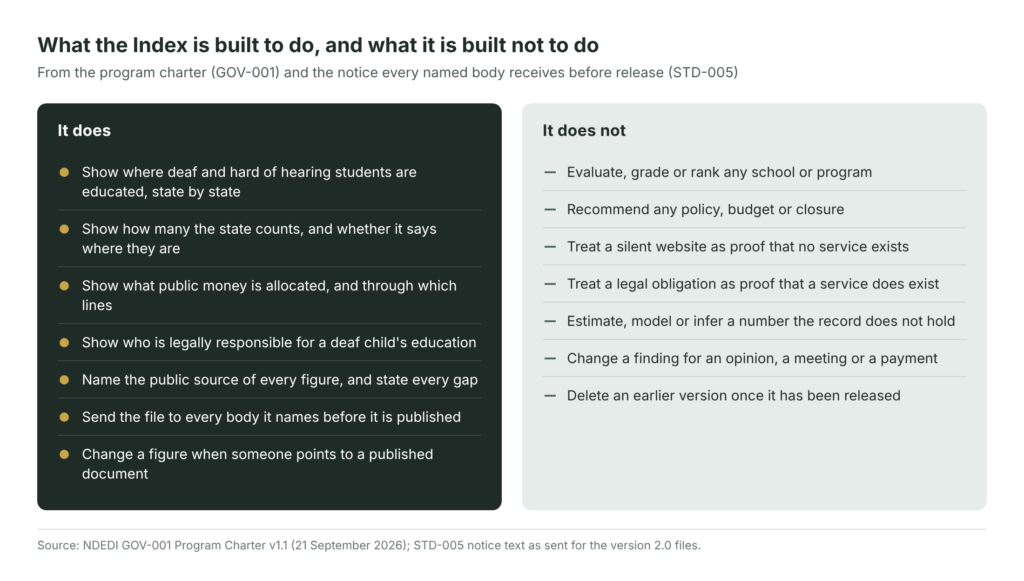
Two rules in particular protect the people being counted. The first is that the code NONE FOUND is “a statement about publication, not about service delivery.” When a district’s website says nothing about deaf or hard of hearing students, the file records that the website says nothing. It does not record that the district fails its deaf students, or that it has none, or that its staff are doing a poor job. Many of those districts are served well through a cooperative, an intermediate unit or a state school’s outreach team; the file says so wherever the record allows it. The second rule runs the other direction: “Obligations under IDEA are not evidence of a program.” A district does not get credit for a service simply because federal law requires one. Both rules exist for the same reason. The Index reports what can be verified in public, and nothing more, so that no one is punished or praised on the strength of a guess.
That restraint is also why nothing in the Index is estimated. The charter is blunt about it: “Nothing is estimated, modelled, or inferred.” Where a state does not publish a number, the file says the number is not published and records what was searched. It does not fill the hole with a projection that someone could later use as a weapon in a budget fight.
Why transparency comes first
Thirteen state files are now public at version 2.0. Together they cover 5,035 school units, the districts, charter schools, county offices, cooperatives and state-operated schools that each state lists as its own, and 24,507 students the states count as deaf or hard of hearing [3]. Read side by side, they show something no one had assembled before. Of those 5,035 units, 444 publish a deaf program or deaf education staff of their own. Another 1,212 mention hearing somewhere, usually in an eligibility list. And 3,234, or 64 percent, publish nothing at all about deaf or hard of hearing students on the pages read.
That is a transparency finding, and it is worth being careful about what kind. It does not mean that two thirds of American school units ignore deaf children. It means that a parent in one of those units who searches her district’s own website for the word deaf will find nothing, and will have to know, from somewhere else, that the service sits one layer up, at a county office or a regional agency. In California, 42 of 58 county offices publish a program, against 60 of 935 districts. In Iowa all nine area education agencies publish; two of 325 districts do. The service often exists. The public record of it does not.
The count itself has the same problem. Every one of the thirteen states counts its deaf students for the federal government. Only six of them publish that count by district in a form a person can read. In the other seven, the state’s own published record cannot answer the question of where its deaf children are: Minnesota publishes by region, Delaware stopped publishing by category after 2017 to 2018, Louisiana publishes percentages blanked below five percent, Pennsylvania prints a number for 52 of its 675 districts, and Hawaii, Alaska and Iowa each have their own reasons the number cannot be placed. None of this is secret. It has simply never been put in one place.
Transparency comes first because everything else depends on it. A family cannot advocate for a service it cannot find. A board cannot oversee a program it cannot see. A legislature cannot defend a line item it cannot connect to the children it serves.
Accountability is about where the money lands
Deaf education runs on public money, and a good deal of it. Alabama’s Education Trust Fund gives the Alabama Institute for Deaf and Blind 85.6 million dollars for the year beginning October 2026, deaf and blind together, with no deaf-only line anywhere in the act. Florida’s School for the Deaf and the Blind carried 80.3 million dollars in 2025 to 2026. Pennsylvania’s single line for its four chartered schools, two for the deaf and two for the blind, was 73.1 million dollars in 2024 to 2025. California’s Legislative Analyst estimated in 2016 that the state spends more than 400 million dollars a year on its deaf and hard of hearing students, and no published figure has replaced that estimate in the decade since [3].
Accountability, as the Index uses the word, asks a narrow question about that money: does it arrive where the children are, and can anyone show that it does? It is not a question about whether the money should be spent. Every file treats the appropriation as a fact to be recorded, not a number to be trimmed. The interpretive point we have drawn, and marked as interpretation when we drew it, is this: a state that cannot say where its deaf children are cannot say whether the money it spends on them arrives where they sit.
That question protects deaf students, and it protects the people who serve them. When a deaf school’s budget line is merged into a larger program, the public loses the ability to see what that school receives. Louisiana’s budget for 2026 to 2027 does this: the Louisiana School for the Deaf’s program, 8.49 million dollars and 102 positions, is folded with the blind school and shared administration into one program of about 37.6 million dollars. The Index does not say that the merger is good or bad. It says that from this year forward, anyone who wants to know what the deaf school itself receives will have a harder time finding out, and that is worth knowing before the next budget, not after.
The same logic applies to audits. Florida’s Auditor General has found three times in six years, in 2020, 2023 and 2026, that staff at the state school do not meet the school’s own sign language standard: as of July 2025, 357 employees were required to reach a set proficiency level, 229 had, and 42 had not taken or retaken the assessment. The Index did not discover that. It found the published audits, read them, and put the finding next to the school’s budget so that a reader can see both at once. In Pennsylvania, by contrast, the file could find no audit of either chartered deaf school, or of any approved private school, against the 73 million dollars a year the line carries. That absence is recorded too. Accountability means the record shows what was checked and what was not.
What the gaps actually show
If the Index were a cost-cutting exercise, its findings would point toward waste: programs with no students, duplicated services, money with no visible purpose. That is not what thirteen states’ records show. Read honestly, the gaps point the other way.
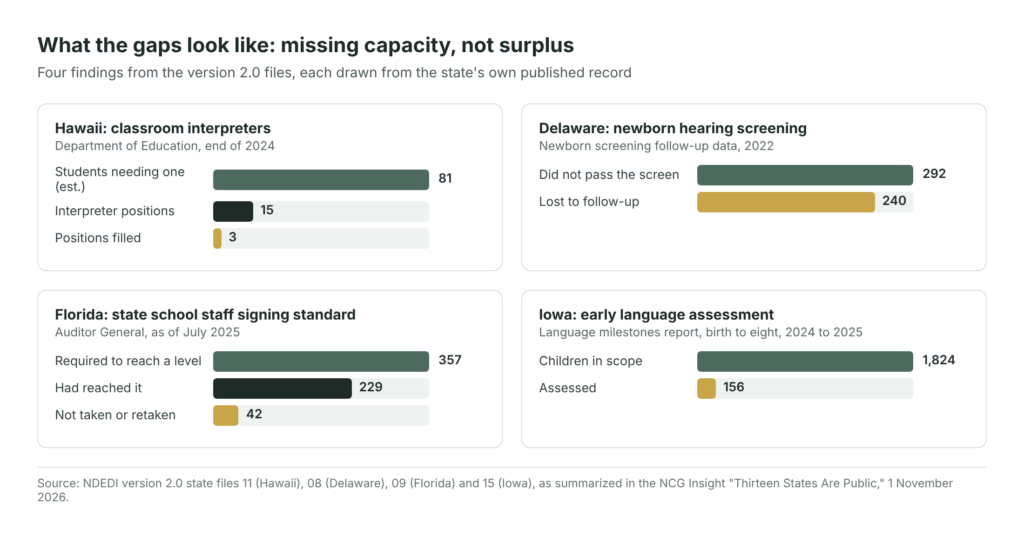
Hawaii’s Department of Education has fifteen positions for educational interpreters. At the end of 2024, three were filled, while an estimated 81 students needed interpreting. The state’s list of credentialed sign language interpreters named twelve people living in Hawaii in June 2026, none of them on Maui or Kauai, and the three 2026 bills to fund an interpreting degree died in committee. In Delaware, the 2022 newborn screening data show 292 infants who did not pass the hearing screen and 240 of them lost to follow-up. Iowa’s own language milestones report, required by a 2022 law, shows 156 of 1,824 children assessed. Nevada has never built a school for deaf students and has no program in the state that prepares teachers of the deaf. Alaska passed a deaf education rights law in the same year that the district running its state deaf school program cut that program’s certificated staff from ten to nine.
None of these is an argument for spending less. Each one is a place where a child is waiting on a person, a test or a follow-up that the system has not supplied. The Index does not recommend what to do about any of them; its charter forbids that. But we would be misrepresenting our own work if we let anyone believe that the record we are building is a case for cutting deaf education. It is mostly a record of where deaf education is thin.
Why deaf schools have the most to gain
The fear that a public accounting will be used against deaf schools is not irrational. Pennsylvania closed its last state-run school for the deaf, in Scranton, in 2009, after two performance audits by the Auditor General. Deaf communities in many states can name a school, a residential program or an outreach unit that was cut by people who did not understand what it did. Those decisions were made with numbers, and often with bad ones.
The answer to bad numbers is not no numbers. It is better ones, built in the open and checked by the people they describe. And the record the Index has built so far tends to show deaf schools doing more than anyone credits them for. Kentucky’s School for the Deaf in Danville, through its outreach arm, advises 152 of the state’s 171 districts at no cost. Three districts name the school on their own websites. In Alabama, the Institute for Deaf and Blind runs a statewide outreach service and ten regional centers that served 9,049 children and adults in fiscal 2025, and not one local school system names that outreach service on its own site [3]. Across all thirteen files, the pattern repeats: state schools and regional programs carry work that the districts they serve never publicly acknowledge.
A school whose work no one can see is a school no one can defend when the budget is written.
A school whose work no one can see is a school no one can defend when the budget is written. When a legislator asks a state school superintendent what the school does for children who are not on its campus, the honest answer today is often a figure from the school’s own reports, which the legislator may treat as advocacy. A state file that shows, from public sources and in a document the school had a chance to correct, that the school’s staff reach most of the districts in the state is a different kind of evidence. It is the kind that survives a hostile reading. That is what the Index is for.
Governance: the rules bind us too
An accountability project that is not itself accountable is just another opinion. The Index is governed by written standards, and the ones that matter most to the bodies we describe are the rules for notice and correction.
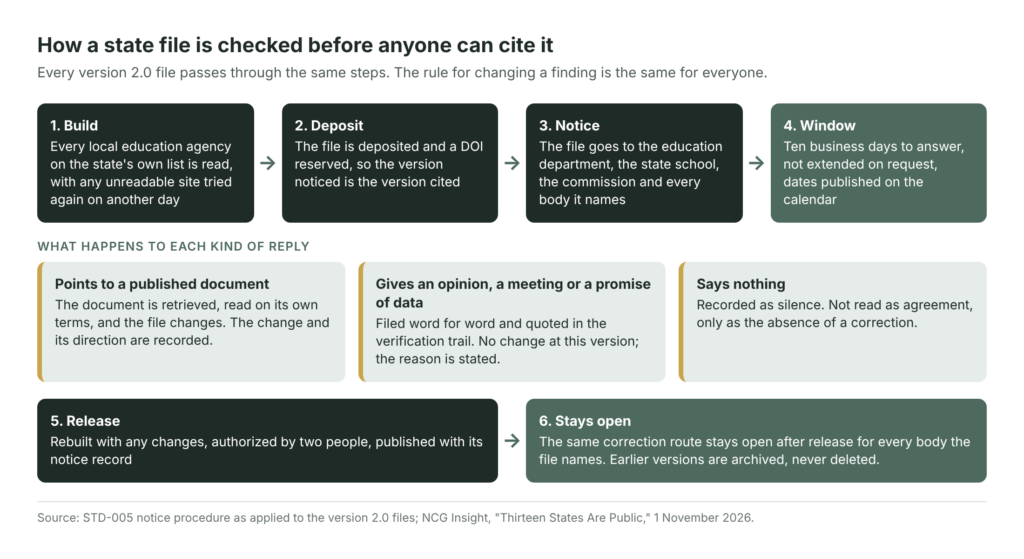
Before a state file is released, it is deposited and given a reserved DOI, so the version that was noticed is the version that can be cited. Then it goes to the state department of education, the state school for the deaf, the commission or council that speaks for deaf residents, and every other body whose published statement the file quotes, with ten business days to answer. Across the first thirteen files that meant 111 notices [3]. The rule for changing a finding is the same for every recipient: “A figure or a code changes only on the basis of a published document, identified by URL or citation” [2]. A reply that identifies one is treated as a retrieval target, read on its own terms, and the change is recorded with its direction. A reply that offers an opinion, a meeting or a promise of data later is filed word for word and changes nothing at that version, with the reason stated. Silence is recorded as silence, not as agreement.
That rule is strict, and it is strict in both directions. It means a state agency cannot talk a finding away without a document, and it also means we cannot change a finding because someone with influence asked us to, or because someone paid for a file. Purchasing a state file can move it earlier in the build order; it cannot buy a different result, because the only thing that changes a result is a published document anyone could check. Every notice also carries a disclosure section listing any relationship between NCG and the bodies the file names, including meetings and correspondence, so that a reader can judge for themselves whether anything touched the work.
The correction process has changed our own files. In Nevada, correspondence during the review of the first version, with the state’s commission for deaf and hard of hearing residents and with the Governor’s office of boards and commissions, about a vacant deaf-member seat and a seat held for an association that had dissolved, produced corrections that were carried into the next version and recorded as such. Earlier versions are archived, not deleted. After release, the same correction route stays open for every body a file names. A file is authorized for release by two people, not one. None of this makes the Index infallible. It makes its mistakes findable and fixable, which is the most anyone should ask of a public record.
What we will do when the record shows a problem
Being clear that the Index is not a campaign against deaf education does not mean pretending every program is fine. Some of what the record shows is serious: staff who do not meet their own school’s signing standard, infants lost after a failed screen, children who should have been assessed and were not. When a state file finds something like that in a public document, it will say so in plain words, cite the document, and send it to the body involved before it is published. When someone brings us information about a problem, we look for the published record and report what we can verify.
Naming a problem in a deaf school is not an argument for closing that school. It is an argument for fixing it while it is still open. A public record that shows problems early, in a form the school has had a chance to answer, gives the people who care about these institutions time to act. The alternative is that problems stay out of view until a budget office or an auditor arrives with a conclusion already drawn. Silence does not protect deaf schools. It only delays the moment someone else decides what the silence means.
What we ask of readers
If you work in deaf education, read your state’s file as a description of the public record, not a report card. If a code is wrong, send us the published document that shows it and the file will change. If a page on your own website is the reason your program reads as NONE FOUND, the fix may be a single paragraph on that page, and the next version will pick it up. If your state is not yet built, its place in the order is on the calendar at ndedi.org [4].
If you are a parent, use the free summary layer for your state to find out what your state counts, what it spends and what your district publishes. If the answer is nothing, that is not proof your child will go unserved. It is a sign that you may need to ask one level up, at the county office, the cooperative or the state school’s outreach team.
And if you are a legislator, an auditor or a reporter, read the codes for what they are. A unit coded NONE FOUND has a silent website, not a failed program. A merged budget line is a visibility finding, not a scandal. The Index was built so that decisions about deaf children could be made with the whole record in view, by people who can see where the children are and whether the help reaches them. That is the entire purpose. Transparency, so the record exists. Accountability, so the money and the responsibility can be traced. Governance, so the people who decide have something solid to decide with.
Referências
- Novara Consulting Group. GOV-001 Program Charter, National Deaf Education Data Index: State Enrollment, Fiscal Allocations, and Institutional Frameworks, version 1.1, 21 September 2026. Program record.
- Novara Consulting Group. STD-005 Notice before release, text as sent for the National Deaf Education Data Index version 2.0 state files, October 2026. Program record.
- Grizzle, Heather M. Thirteen States Are Public. Sixty-Four Percent of Their School Units Say Nothing. NCG Insights, Novara Consulting Group, 1 November 2026. https://www.novaracg.com/2026/11/01/thirteen-states-are-public-sixty-four-percent-of-their-school-units-say-nothing/
- National Deaf Education Data Index. States and calendar. https://www.ndedi.org/states/. Read 7 November 2026.