
An Australian-listed company picked up an innovation prize in Melbourne this week for a sign language avatar that works in Italian train stations. The railway that hosts the avatar still calls it a trial, the one number used to sell it measures something other than signing, and no one has published whether Deaf passengers understand it. Awards are how unproven accessibility technology starts to look proven.
A prize in Melbourne, a kiosk in Rome
The Italian Chamber of Commerce and Industry in Australia gives out business awards each year for Victoria and Tasmania. This year’s Innovation Award went to Vection Technologies, a company listed on the Australian Securities Exchange, for a product called Algho Sign Language. The award was presented by UNOX, an Italian company that makes commercial ovens. IT Brief Australia carried the news on 18 November, with a line from Vection’s Asia-Pacific chief executive that the product “shows what inclusive AI can do outside the lab.”
I have nothing against ovens, or chambers of commerce, or a company being proud of its work. But I read that sentence the way I read every sentence about sign language AI, which is to ask who checked. Outside the lab is where a Deaf person is standing in a ticket office with a train to catch. It is the place where the claim has to be true.
The thing the prize is about is on the other side of the world from the room where it was handed over. It is a kiosk in the Trenitalia ticket offices at Roma Termini and Milano Centrale, and by Vection’s account at Cagliari airport as well. A Deaf traveler walks up, a camera watches them sign, and a three-dimensional avatar signs back. Vection says the system reads hands, posture and facial expression and generates its answer live instead of playing a recorded clip, in either Italian Sign Language, known as LIS, or International Sign.
I am DeafBlind. My language is American Sign Language. I do not sign LIS, and I do not sign International Sign either, which matters later in this piece. I have not stood in front of one of these kiosks, and nothing here is a judgment of how well the avatar signs. I cannot make that judgment and I am not going to pretend to. What I can do is what a procurement officer in any country can do from a desk: read what the vendor, the railway and the Deaf association have each put in public, lay it side by side, and ask whether the evidence matches the trophy shelf.
It does not yet. The gap is worth walking through slowly, because this is the route every sign language AI product takes from pilot to purchase order, and Algho is further along it than most.
What the kiosk does, and who helped build it
Start with what is good, because there is plenty of it. The avatar comes out of QuestIT, a spin-off of the University of Siena that is now a Vection subsidiary. QuestIT first showed a virtual assistant that could produce and read LIS in early 2023, when Italian coverage described it as still in testing, with a market launch planned for the end of that year. By June 2025 Vection had listed Algho AI Sign Language on AWS Marketplace and reported half a million Australian dollars in first orders. So the product has several years of history behind it, not several months.
It also has something most products in this market cannot claim: the national Deaf association is inside the project. When Trenitalia announced the kiosks on 4 March 2026, as Italy prepared to host the Winter Paralympics, it described the system as developed in collaboration with Ente Nazionale Sordi, or ENS, Italy’s national association of Deaf people. The FS group’s own news service added a detail I have not seen in any of Vection’s English-language material: about thirty ENS signers recorded roughly 8,000 videos to train the digital assistant. Vection’s announcements also credit sign language researchers at the National Research Council’s LaCAM lab and the University of Siena.
That is a meaningful foundation. Thirty Deaf signers from the community’s own organization is a better place to start than interpreter footage recorded off television, which is where some of this field’s best-known data came from. The scope of the railway deployment is sensible too. According to Trenitalia, the kiosk answers a narrow set of questions: travel options, ticket details such as the departure platform, and where to find assistance, restrooms and food in the station. It can also send LIS and International Sign video messages to the traveler’s own phone. And Trenitalia did not take the human option away. Its accessibility page lists a remote video call with a LIS interpreter, available from 8:00 to 18:00 every day at twenty stations, with both Roma Termini and Milano Centrale on the list.
So this is not a story about a company that ignored Deaf people, or a railway that swapped its interpreters for a screen. It is a story about what happens next: how a careful pilot with real Deaf participation turns, in the retelling, into a validated product with a market, before anyone has shown the public the results.
The railway calls it a trial
Here is the first thing a buyer should notice. The organization that runs the kiosks and the organization that sells them use different words for the same machines.
Trenitalia’s launch announcement called the system a sperimentazione, a trial, and FS News headlined it as a progetto pilota, a pilot project, in collaboration with ENS. ENS’s own notice used the same word and said the service would be extended to Italy’s main stations in stages. That was March. When I checked Trenitalia’s accessibility page on 18 November 2026, more than eight months later, the wording had not moved. The page still says the railway has started a trial. It still lists only the two ticket offices. And it names no technology vendor at all: Vection, QuestIT and Algho do not appear on it.
Vection’s descriptions run in a different register. In the coverage of this week’s award, the system is described as already operating in several Italian transport hubs. In June, coverage of a company announcement to the Australian market described the related accessibility kiosk as validated at Italy’s third-busiest airport, and later that month the financial press reported the same system as being in live operation there.
| Who is speaking | Audience | Words used | Results published |
|---|---|---|---|
| Trenitalia and FS News | Passengers and the Italian press | Trial; pilot project | None located |
| ENS | The Deaf community | Trial; to be extended in stages | None located |
| Vection; award coverage in November 2026 | Trade press | Already operating in transport hubs | None located |
| Vection; market announcements in June 2026 | Investors | Validated; in live operation | 97 percent against 38 percent; unaudited |
Both descriptions can be true at once. A trial is, after all, a machine operating in a station. But the words do different jobs. Trial tells a Deaf passenger that the railway is still finding out whether this works, and it implies that someone is keeping score. Validated tells an investor that the finding out is over. If it is over, the score should exist. I looked for it on Trenitalia’s pages, in FS News, in ENS’s notices, in Vection’s announcements and in the trade coverage. I did not find a trial end date, evaluation criteria, a count of Deaf users, a comprehension result or an error rate.
Ninety-seven percent of what?
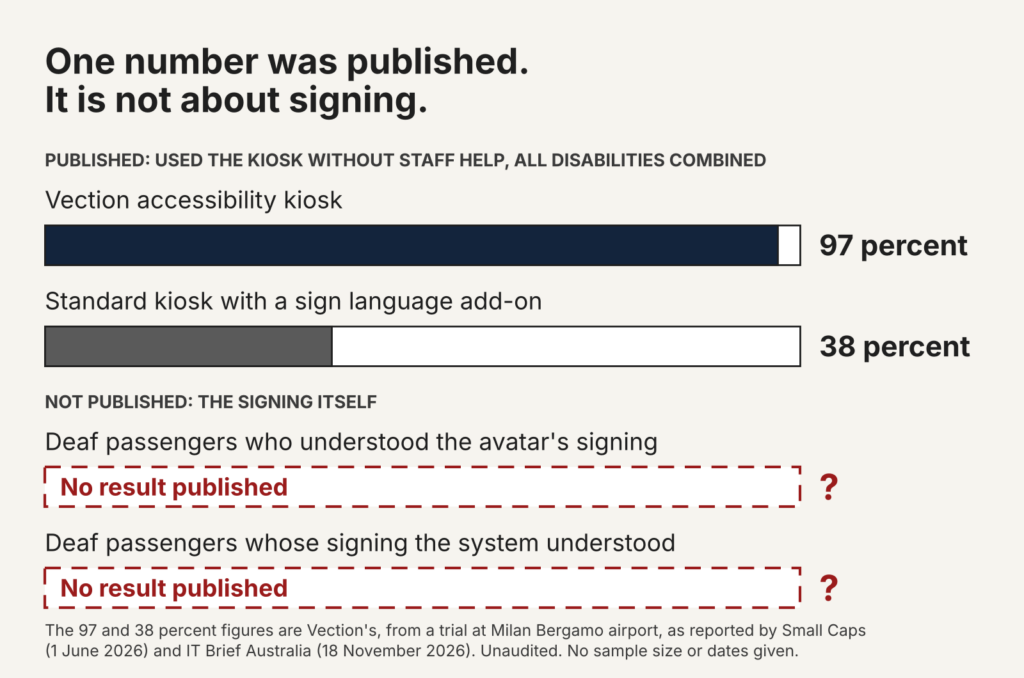
There is one number, and it is carrying a lot of weight, so it deserves a close look. On 1 June 2026, Vection announced a A$3.3 million order for its Accessibility Kiosk from a new customer, Media Comunicazione. The kiosk is a piece of hardware built for people with physical, visual and hearing disabilities at once: controls within reach of a wheelchair user, nothing sticking out at head height for a blind user, and, for Deaf users, an Algho avatar that wakes up when the onboard camera sees a gesture. The headline evidence was a figure from a proof-of-concept trial at Milan Bergamo airport, where the kiosk was reported to serve 97 percent of users independently, against 38 percent for a standard airport self-help kiosk. Vection’s managing director told Small Caps that “the gap between 97% and 38% is not a marketing claim.” The company’s shares rose 4 percent that day.
I would like that number to be real, and it may be. An airport kiosk that most disabled passengers can use without flagging down staff is a good thing. But look at what it measures, using only what Vection and the press reports say about it.
It measures independence, meaning the passenger finished without staff help. It does not measure whether the information the passenger walked away with was right. It treats passengers with disabilities as one group. A wheelchair user who could reach the screen and a blind passenger who could hear the audio prompt sit in the same 97 as any Deaf passenger who used the avatar, and no breakdown by disability has been published. It has no denominator. No report says how many passengers there were, over what weeks, or who counted them. IT Brief’s account this week describes the figure as unaudited airport data cited by Vection. And the comparison kiosk, according to Small Caps, was a standard one already fitted with a sign language add-on. So whatever produced the jump from 38 to 97, it was not the arrival of sign language.
There is one more wrinkle. On 16 July, six weeks after the 97 percent figure was announced, the Italian business daily ItaliaOggi reported that Algho sign language kiosks were present at Roma Termini, Milano Centrale and Cagliari airport, and would arrive at Bergamo airport soon. I cannot tell from the public record whether the signing avatar was running on the Bergamo kiosk during the period the 97 percent describes. It may have been. The record does not say, and a number being used to sell a sign language product should come with enough detail to tell whether sign language was in it.
A two-way kiosk can be wrong in two directions
The missing score matters because of how the product is designed. Algho Sign Language is sold as a two-way system. That is its selling point, and it is also two separate places for meaning to go wrong.
In the first direction, the camera watches a Deaf person sign a question and the system has to work out what was asked. This is sign language recognition, and it fails in ways a hearing buyer will not see. It can misread a question. It can struggle with a signer whose age, region, style or hands were not in its training data. It can answer with complete confidence a question nobody asked. In the second direction, the avatar signs the answer. This is production, and the test is whether a Deaf person watching understands what the avatar meant, including the grammar that lives on the face and in the use of space, not only the shapes of the hands.
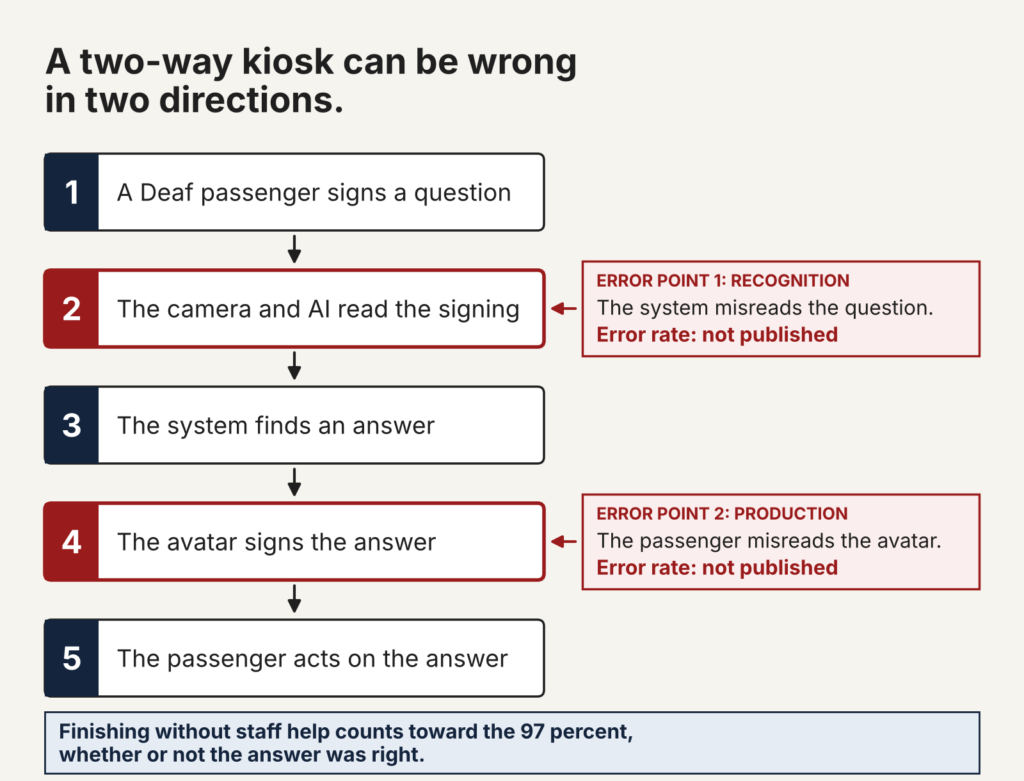
Picture the ordinary case. A traveler asks which platform. The system reads a different question, or reads the right one and signs a number that looks like another number. The traveler has no way to know. They completed the interaction without staff help, so on the only measure that has been published they count as a success. Then they go and stand on the wrong platform.
I am not saying that happens at Roma Termini. I am saying nobody outside the project can know how often it does, because neither error rate has been published. Thirty signers and 8,000 videos tell me the builders took the training data seriously. They do not tell me how the system does with the thirty-first signer, the one who was not in the room: an older Deaf Sicilian, a Deaf teenager, a DeafBlind traveler who signs in a smaller space, a tourist.
International Sign is not a setting
The tourist brings me to the claim I would press hardest on if I were the one buying this. Every description of the system, from Trenitalia’s to Vection’s, says the avatar works in two modes: LIS and International Sign. On a feature list that reads like two languages. It is not. The World Association of Sign Language Interpreters describes International Sign as “a translanguaging practice” used between signers from different countries, and says plainly that it is not a specific sign language in the way ASL or British Sign Language is. It has no fixed vocabulary and no fixed grammar. Two signers from different countries build it between them in the moment, borrowing from their own languages, from gesture and from whatever they can see they share. WASLI adds that it is slower, that it is a poor fit for complex ideas, that people mostly pick it up by going to international Deaf events, and that research on how well it works for Deaf people from Asia and Africa is thin.
I can vouch for part of that from the inside. I am a fluent ASL signer and I do not sign International Sign. Most Deaf people do not. It is a skill of the internationally traveled, not something every Deaf person carries.
So what does it mean for a machine to hold a two-way conversation in it? On the production side, the avatar must be signing some fixed set of signs that its builders have labeled International Sign, which is already a different thing from the negotiated, back-and-forth practice the term describes. On the recognition side, the system has to understand whatever a Deaf visitor from Seoul or São Paulo or St. Paul produces when they try to make themselves understood to a screen that cannot negotiate back. I would want to know who signed the International Sign training data, how many of them there were, which countries they came from, and which Deaf foreigners tested the result.
This is not a side issue. The International Sign mode is aimed at the Deaf traveler from abroad, who is the passenger least able to read the Italian on the departure board, least likely to know that a human LIS interpreter is available by video call, and least able to file a complaint in Italian when the kiosk gets it wrong. The mode with the weakest linguistic footing serves the user with the fewest ways out.
The money did not wait for the results
Follow the calendar and the pattern is plain. The figure below puts every public milestone for this product in date order.
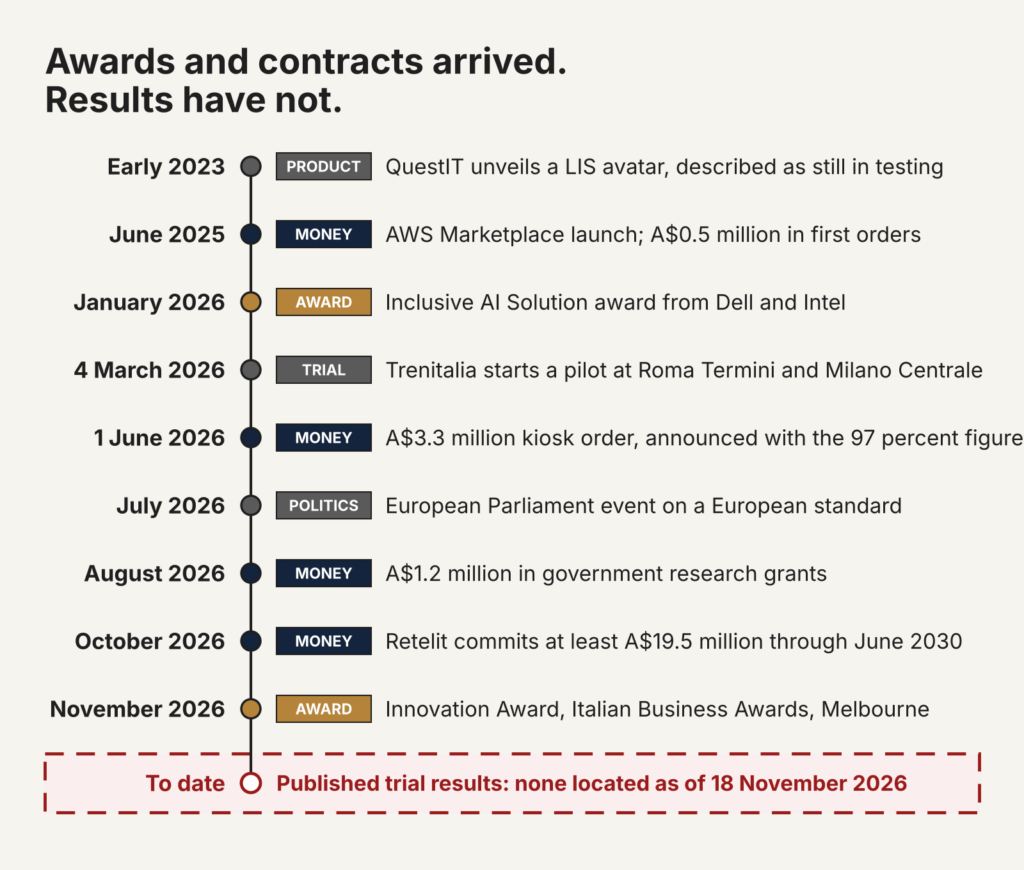
In January 2026 the product won an Inclusive AI Solution award from Dell Technologies and Intel at an AI festival in Milan. The same announcement credited Dell with supplying the computing hardware the system runs on and Intel with supporting its AI, so the first prize came from two of the product’s own technology suppliers. On 4 March Trenitalia began its trial. Less than three months later Vection announced the A$3.3 million kiosk order, with the Bergamo figure as its headline evidence. In July the avatar was presented at a conference at the European Parliament titled Artificial Intelligence for Accessibility: From Innovation to European Standard. In August Vection reported A$1.2 million in non-repayable government research grants across four programs, one of them for automatic translation of multimedia content into LIS. In October an Italian telecommunications provider, Retelit, committed to at least A$19.5 million in contract revenue on Vection products through June 2030, with the accessibility kiosk in the catalog. This week came the second award.
Across that year I can find contracts, grants, a parliamentary event and two trophies. I cannot find a published trial result. That ordering is the governance problem, and it does not require anyone to have behaved badly. Each step is reasonable on its own. A supplier celebrates a customer. A chamber of commerce celebrates an Italian company abroad. Members of the European Parliament host an accessibility event. An investor reads a clean number. But each one becomes a credential the next buyer can point to, and none of them is a Deaf person saying, on the record and with a method, that the signing was understood.
I have watched where that road ends. In October I filed an ADA complaint over AI-generated ASL announcements from a different vendor on the train screens at Cincinnati’s airport, after recordings showed the signer and the screen sending a Deaf traveler to two different trains. The airport took the signing down fourteen days later, pending a review that includes Deaf ASL users. That system, too, went live before anyone published a test.
A legal requirement, with a twenty-year footnote
The sales case leans on law as well as on awards. When the kiosk order was announced, Vection’s managing director described the product as answering a problem that has become a legal requirement across Europe, and coverage of the deal said organizations with older kiosks would face expensive retrofits or replacement. The law in question is the European Accessibility Act, Directive 2019/882, which has applied since 28 June 2025 and does bring ticketing machines, check-in machines and interactive information terminals into its scope.
A buyer should read the transition clause before signing anything on that basis. Article 32 allows member states to let self-service terminals that were lawfully in use before that date stay in service until the end of their economically useful life, for up to twenty years. The European Union of the Deaf’s implementation report puts the phase-out date for older terminals at 28 June 2045. A requirement that applies to new terminals placed on the market is a real requirement. It is not a deadline that forces a station to replace every kiosk it owns this year. Any vendor that says its product makes a buyer compliant should be asked for the article, the technical standard and the test report that show it.
What Deaf organizations have already said
None of what I am asking for is new. In 2018 the World Federation of the Deaf and WASLI issued a joint statement on signing avatars. It warns public bodies not to treat avatars as a stand-in for human signers, and it singles out settings where the information is live, complicated or carries real weight in Deaf people’s lives. A ticket office conversation about a changed platform is live by definition.
ENS has drawn a similar line. In June 2025, in meetings with Italy’s enterprise ministry and its communications regulator about television accessibility, ENS president Angelo Raffaele Cagnazzo firmly rejected the idea that artificial intelligence could replace the work of professional LIS interpreters and stenotypists. That is the same organization that helped build the Trenitalia avatar, and I do not read the two positions as a contradiction. I read them as the correct position: an avatar for a narrow set of predictable questions, a human interpreter still reachable, and no swapping of one for the other. Vection has said it is developing real-time human interpreter support as an added feature, which points the same way.
The trouble is that a position held by the Deaf partner in Italy does not travel with the product. A kiosk sold through a reseller network into banks, town halls and airports across Italy and Europe arrives with the awards and the 97 percent. It does not arrive with ENS. The buyer in another country gets a LIS-trained avatar, an International Sign mode, and no local Deaf organization that was ever asked.
There is also a working alternative on the market. On 13 November I wrote about Apple building sign language into its TV app with Deaf-directed human interpreters, and saying outright that AI-generated signing was not what Deaf people had asked for. A railway ticket office is not a film, and live questions are the harder case. But the comparison holds on one point. The company with the most money to spend on automation looked at what Deaf people said they needed and chose not to lead with the avatar.
What a buyer should get in writing
AI signing is not inherently unacceptable. It has to be evidenced. If a transport authority, airport, bank or public office is offered this kiosk, or any two-way signing avatar, these are the things to get in writing before a pilot becomes a contract.
- The provider MUST publish results from testing with Deaf users who were not involved in building the system, stating how many took part, how they were recruited and who ran the test.
- Comprehension of the avatar’s signing and recognition of the passenger’s signing MUST be reported separately, since a system can be good at one and poor at the other.
- Errors on critical information such as platform numbers, departure times, gate changes and safety messages MUST be reported on their own and never averaged into an overall score.
- Any figure that covers all disabilities together MUST be broken out so the result for Deaf sign language users can be seen.
- For each sign language mode, the provider MUST state who signed the training data, how many signers there were, what they consented to and what they were paid. For International Sign, it MUST also state which countries the signers and the testers came from.
- The kiosk MUST offer a human route from the same screen, such as a video call to an interpreter, and MUST show it before the passenger starts, not after the avatar fails.
- A Deaf passenger MUST be able to report a wrong answer at the kiosk, in sign language, with a committed response time.
- The provider MUST state what happens to the video of the passenger signing: whether it is stored, for how long, and whether it is used to train the system.
- The contract SHOULD treat a trial as a trial, with an end date, criteria agreed in advance with the national Deaf association, and publication of the results whichever way they come out.
A vendor with a good product can answer every one of those. A vendor that answers with an award has answered a different question.
Questions for Vection, Trenitalia and ENS
These are the questions the public record leaves open. I am putting them on the record here, and all three organizations are welcome to answer. Anything they send will be added to this piece in full.
- To Vection: how many passengers are behind the 97 percent and 38 percent figures, over what dates, counted by whom, and how many of them were Deaf sign language users?
- To Vection: was the signing avatar active on the Bergamo kiosk during the period those figures cover?
- To Vection: what are the measured recognition and comprehension rates for LIS and for International Sign, and who tested them?
- To Vection: who signed the International Sign training data, and from which countries?
- To Trenitalia: when does the trial at Roma Termini and Milano Centrale end, what criteria will decide whether it is extended to other stations, and will the results be published?
- To Trenitalia: how does a Deaf passenger report a wrong answer from the kiosk, and how many such reports have been received?
- To ENS: what terms covered the roughly 8,000 videos its signers recorded, including consent, payment and any right to withdraw, and does ENS have the authority to stop a deployment it judges inadequate?
- To all three: what happens to the camera footage of Deaf passengers signing at the kiosk?
The prize and the proof
I want this product to be good. A Deaf Italian who can walk up to a ticket office and ask a question in LIS, without passing notes back and forth through a glass window, has gained something real, and the people at ENS who put their hands and faces into those 8,000 videos did it for that. If the trial results are strong, publishing them would do more for Algho than any trophy, and it would give every other vendor in this market a bar to clear.
Until then, the order of events is the story. The prizes arrived, then the contracts, then more prizes. The proof is the only thing still on trial. And the person who finds out whether it works is not the chamber of commerce, the reseller or the investor. It is the Deaf traveler in front of the screen, holding a ticket, deciding whether to believe it.
Fontes
All sources were checked on 18 November 2026.
IT Brief Australia. (2026, November 18). Vection wins award for sign-language AI in Melbourne. IT Brief Australia.
ChannelLife Australia. (2026, January 23). Vection wins award for Algho inclusive sign AI tool. ChannelLife.
FS News. (2026, March 4). Trenitalia, al via il Sistema multimediale LIS e IS. Gruppo FS Italiane.
ANSA. (2026, March 4). Informazioni nella lingua dei segni, Trenitalia sperimenta avatar. ANSA.
Trenitalia. (n.d.). Assistenza alle persone con disabilità e a ridotta mobilità. Trenitalia.
Ente Nazionale Sordi. (2026, March). Trenitalia avvia la sperimentazione del Sistema multimediale LIS e IS nelle stazioni di Milano Centrale e Roma Termini. ENS.
Ente Nazionale Sordi. (2025, June). Accessibilità audiovisiva: l’ENS incontra MIMIT e AGCOM per difendere i diritti delle persone sorde. ENS.
Cotton, I. (2026, June 1). Vection Technologies wins $3.3m order for accessibility kiosks across Italian markets. Small Caps.
Kalkine. (2026, June). What does new $3.3 million contract mean for Vection Technologies (ASX:VR1)?. Kalkine.
Kiosk Marketplace. (2026, June). Vection wins $3.3M bid for accessibility kiosks in Italy. Kiosk Marketplace.
Proactive. (2026, June). Vection Technologies wins $2.3 million in AI contracts across 5 sectors. Proactive.
Gioventù, E. (2026, July 16). Intelligenza artificiale e disabilità: l’avatar che parla ai non udenti con la lingua dei segni. ItaliaOggi.
Kalkine. (2026, August). Vection Technologies receives $1.2 million in non-repayable government R&D grant funding. Kalkine.
Small Caps, via TradingView. (2026, October). Vection Technologies signs digital supply deal with Italian telco for European markets. TradingView News.
Vection Technologies. (2025, October 1). Vection reports audited FY25 results. ASX release.
Sky TG24. (2023, February 9). Algho, ecco il primo avatar in grado di comunicare nella Lingua dei Segni. Sky TG24.
World Federation of the Deaf and World Association of Sign Language Interpreters. (2018, March 14). WFD and WASLI statement on use of signing avatars. WFD.
World Association of Sign Language Interpreters. (n.d.). About the International Sign. WASLI.
European Parliament and Council. (2019). Directive (EU) 2019/882 on the accessibility requirements for products and services. EUR-Lex.
European Union of the Deaf. (2025). Report on the implementation of the European Accessibility Act. EUD.
Novara Consulting Group. (2026, November 13). Apple Could Have Bought the Avatar. NCG Insights.
Novara Consulting Group. (2026, October 26). I Filed One Complaint. An Airport Took Its AI Signer Down.. NCG Insights.