
Nora
Nora is nine, and she is Deaf, and in American Sign Language she is a talker. She tells long stories with her whole body, shifting her shoulders to become each character, and she uses space the way a novelist uses paragraphs: the mean dog lives to her left, her cousin lives to her right, and when the two meet she brings her hands together so hard that the other kids at the lunch table laugh before she reaches the end. She argues about recess rules with a precision her teacher finds exhausting. She invents sign names for the class guinea pigs. Her mother, who is hearing and started learning ASL the week Nora was identified as a baby, says her daughter’s signing outran her own by the time Nora was five, and that most evenings now she is the one asking Nora to slow down.
In English, on paper, Nora is a different child. She reads about two years below grade level. Her written sentences drop articles and verb endings, the small grammatical pieces that carry little meaning in a language she has never heard. Her spelling tests come back marked in red. None of this is unusual for a Deaf child learning to read and write in a second language through a first language that has no written form, and none of it says much about what Nora knows, thinks, or can do. But it is the part of Nora that shows up in data. Her reading benchmark scores, her writing samples, her state assessment results, and her attendance record are what sit in the district’s student information system. Her stories at lunch do not.
The Draft
Nora’s annual review is three weeks away. Her case manager carries twenty-six students across four buildings, and the district has licensed an IEP platform that will generate a first draft from the data already on file. She uploads last year’s IEP, the fall reading benchmark, two writing samples, and the progress notes, and in under a minute the platform returns a present levels statement and a set of annual goals. Part of it reads like this:
Nora is a 9-year-old student in the 4th grade who receives special education services under the eligibility category of Hearing Impairment. Nora demonstrates significant delays in receptive and expressive language. Her reading fluency is below grade-level benchmarks, and her written expression is characterized by grammatical errors and limited sentence complexity. Nora benefits from visual supports, preferential seating, and repetition of directions. Nora will use an interpreter as needed.
Illustrative AI-generated present levels statement and annual goal
Annual Goal: By the end of the IEP period, Nora will improve her expressive language skills by producing grammatically correct sentences in 4 out of 5 opportunities, as measured by teacher observation and work samples.
There is nothing obviously wrong with this text, which is the problem. It is fluent, compliant in form, and organized the way present levels statements are supposed to be organized. Every sentence can be traced to something in the uploaded file. The case manager, who knows Nora, reads it on a Thursday afternoon between two other drafts, changes “4th grade” to “fourth grade,” adjusts one benchmark number, and saves it. The draft is now the district’s proposal.
What the Draft Cannot See
Read the draft again with Nora in mind and it describes a child who does not exist. “Significant delays in receptive and expressive language” is accurate only if language means English. Nora has no delay in her first language; she has a gap in her second, and the difference is not a nuance. A child described as language-delayed gets goals built around remediation. A child described as a fluent ASL user acquiring English literacy gets goals built around bilingual instruction, access to fluent signing adults, and reading taught through the language she already commands. The platform could not have known which child Nora is, because the only evidence of her ASL lives in the people who have watched her sign, and none of them are in the database.
Federal law anticipated exactly this failure. When an IEP team develops a plan for a child who is deaf or hard of hearing, IDEA requires it to consider the child’s language and communication needs, the child’s opportunities for direct communication with peers and professional staff in the child’s own language and communication mode, the child’s academic level, and the full range of the child’s needs, including opportunities for direct instruction in that language and mode.1 This is one of the special factors Congress singled out by name. The draft addresses it with five words: “will use an interpreter as needed.” It does not say which language, whether instruction should be direct rather than interpreted, whether Nora has any signing peers, or who the interpreter is and how well they sign. That last question is not academic. Qualification standards for educational interpreters vary from state to state, and the National Deaf Education Data Index documents how widely they differ; Nebraska, for example, sets its standard by score on the Educational Interpreter Performance Assessment.2 An IEP that writes “an interpreter” commits the district to almost nothing.
The goal compounds the problem. “Grammatically correct sentences” in which language? “Teacher observation” by a teacher who may not sign? Measured this way, Nora will spend the year being assessed on the one thing she cannot yet show, through the one channel least able to see her, and the progress reports will confirm the deficit the draft assumed. The record will not merely misdescribe Nora. It will start producing the evidence that agrees with it.
The Meeting and the Signature
Nora’s mother sees the draft for the first time on a conference room screen. It is formatted, numbered, and complete, and it looks the way a decided thing looks. Six adults sit around the table and the meeting moves at the pace of a document that has already been written: the case manager reads each section aloud, the general education teacher nods, the speech-language pathologist adds a sentence about articulation. When Nora’s mother says that her daughter is not delayed in ASL, that she is the most fluent signer in her family, someone answers kindly that they can add a note to the parent concerns section. The note is added. The language delay finding is not changed, because no one in the room has evidence to change it with, and the meeting is scheduled for forty-five minutes. At the end, everyone signs.
IDEA does not prohibit schools from bringing draft IEPs to meetings. What it protects is the parents’ right to participate meaningfully in the decision, and courts have treated a plan effectively settled before parents arrive as a violation of that right. In Deal v. Hamilton County Board of Education, the Sixth Circuit held that a district which had predetermined a child’s program, so that the meeting served only to ratify it, denied the parents the participation the statute requires. Under the federal regulations, a procedural violation of that kind can amount to a denial of a free appropriate public education when it significantly impedes the parents’ opportunity to take part.3 An AI-generated draft does not create the risk of predetermination. It industrializes it, by producing a polished, complete-looking proposal for every child, every time, before any human conversation about that child has occurred.
The signature proves that people attended a meeting. It is being treated as proof that a human reviewed the machine’s account of a child.
And then there is the signature. The governance case for these tools rests on it. Every vendor and every early policy says the same thing: AI drafts, humans decide. Nora’s IEP will carry six signatures, and every one of them is real. None of them records that the language finding came from software, that the case manager changed two words, that the parent’s objection became a note, or that no one at the table could assess the child in her own language. The signature proves that people attended a meeting and agreed to a document. It is being treated as proof that a human reviewed the machine’s account of a child. Those are not the same claim, and only the first one is on the record.
Not One District
Nora is invented. The conditions around her are not. In national polling by the Center for Democracy and Technology, 57 percent of special education teachers reported using AI to help develop an IEP or Section 504 plan in the 2024-25 school year, up from 39 percent the year before, and 15 percent reported using it to write a plan in full.4 The tools did not arrive through a statewide adoption decision or a board vote. They spread one overloaded educator at a time, into a profession where 45 states reported special education teacher shortages in the same school year.5
None of this means the tools are useless. Researchers at the University of Virginia and the University of Central Florida have found that AI used well can help teachers write IEPs of equal or higher quality than they produce alone.5 The question is not whether a machine can draft a good IEP. It is whether anyone can tell, afterward, that a human made sure it did.
The federal government has said, in effect, go ahead. In July 2025 the U.S. Department of Education told grantees that federal education funds may be used for AI, including tools that reduce administrative burden, and set out principles for that use: it should be educator-led, ethical, accessible to people with disabilities, transparent, and compliant with privacy law.6 The letter is about what federal money may buy. It does not say what a human review of an AI-drafted IEP has to produce, and so the question of what counts as review fell to the states and to the districts themselves.
Those rules are now arriving, and they mostly agree. Minnesota’s school boards and school administrators associations organize their 2026 model AI policy around what they call a Human-AI-Human model.7 Oklahoma’s state guidance lists special education evaluations and IEP decisions among the high-stakes uses AI may not decide.8 The Illinois State Board of Education has reminded districts that their duties under 34 CFR 300.324 are unchanged when a tool helps write the document.9 The District of Columbia went furthest. Its Office of the State Superintendent of Education released its first model policy for staff AI use for 2026-27, after a February survey found that only 45 percent of local education agencies had any staff AI policy, and the model reportedly places the drafting of IEP language among prohibited uses. It is a model, though, which schools may adopt or not.10 Everywhere else, the line is the same: AI may assist, a human must decide. It is the right line. Nora’s IEP satisfies it completely, and it failed her anyway.
This pattern is not new to NCG’s work. Across fifteen issues of The Fifth Parameter, NCG documented how institutions buying sign language AI accepted procedural assurance in place of evidentiary assurance: a conformance statement instead of a comprehension test, a vendor’s attestation instead of independent validation, Deaf faces in the marketing instead of Deaf authority over the evaluation. Special education is the same failure in a different building. “AI drafts, humans decide” is a procedure. Whether a human actually examined the machine’s account, changed what was wrong, and could have known what was wrong, is a question of evidence, and at present nobody is required to produce any. The rest of this piece is about what that evidence would look like, why its absence matters more for some children than others, and who is in a position to demand it.
The Review Nobody Can See
Go back to Thursday afternoon. Nora’s case manager has three drafts open. She has twenty-six students, and if each one has an annual review, that is twenty-six present levels statements, twenty-six sets of goals, twenty-six service grids, and twenty-six meetings in a school year that also contains teaching. She is not careless. She knows Nora, she has watched her sign, and if someone had asked her across a table whether Nora is language-delayed she would have said no. But no one asked her that. The platform asked her to review a draft, and a review of a finished-looking draft is a different act from writing an account of a child. It runs from the text toward the child rather than from the child toward the text, and it tends to stop when nothing on the page looks wrong.
There is a large research literature on exactly this, and none of it comes from education. In aviation, medicine, and process control, researchers have studied for decades what happens when people work alongside automated aids, and the consistent finding is that people defer to the machine more than they intend to. Raja Parasuraman and Dietrich Manzey’s review of the field describes two connected patterns, complacency and automation bias. Their review found that both appear in novices and experts alike, and that neither goes away with simple practice.11 In a well-known set of experiments, Linda Skitka and colleagues found that people working with an automated aid made two kinds of mistakes they did not make without it. They missed problems the aid failed to flag, which the researchers called errors of omission. And they followed the aid’s recommendations even when other available information showed those recommendations were wrong, which they called errors of commission.12 A systematic review of clinical decision support found the same pattern among physicians, including cases where a clinician who had reached the right answer changed it to match incorrect advice from the system.13
Translate those findings into Nora’s file. The error of omission is the special factor nobody filled in properly, because the platform did not prompt for direct instruction in ASL and the case manager did not notice its absence. The error of commission is the language delay finding, which the case manager would not have written herself but did not remove, because the draft said it with confidence and the data on file appeared to support it. Neither error required her to be careless. Both are what the research predicts when a competent, overloaded person reviews a fluent machine draft under time pressure.
This is why the existence of a review cannot be treated as evidence of its quality. The review that happened on Thursday took a few minutes and changed a grade level and a number. A review that took an hour and rewrote the present levels statement from scratch would look identical in the final document. Both end in the same signed IEP. Nothing in the file distinguishes the case manager who caught the error from the case manager who did not, and nothing distinguishes a district where reviews are real from a district where they are ratification. The safeguard every policy relies on is, as a matter of record, invisible.
An invisible safeguard is not a safeguard anyone can audit, and an unaudited safeguard decays. If the reviews in a district have quietly become ratification, nobody will find out from the IEPs, the meeting notes, the signatures, or the compliance monitoring the state already does, because all of those look the same either way. The district will find out, if it ever does, from a due process hearing years later, when a family’s attorney asks who wrote the language finding and nobody can answer.
Meaningful Participation, Pre-Filled
The law already says a good deal about what Nora’s mother is owed, and almost none of it was written with a machine in mind. The Supreme Court’s decision in Endrew F. v. Douglas County School District held that an IEP must be reasonably calculated to enable a child to make progress appropriate in light of the child’s circumstances. The Court described crafting an IEP as a fact-intensive exercise informed not only by the expertise of school officials but also by the input of the child’s parents, and it said the adequacy of a given IEP turns on the unique circumstances of the child for whom it was created.14 An AI draft is, by construction, a document produced before any of that input and from whatever circumstances happened to be recorded in a database. That does not make it unlawful. It does mean that everything Endrew F. treats as the substance of the process has to happen after the draft exists, against the pull of a document that already looks finished.
Two older procedural requirements suddenly matter much more. The first is prior written notice. Whenever a district proposes to change a child’s identification, evaluation, placement, or services, it must give the parents written notice that describes the action, explains why the district proposes it, and describes each evaluation procedure, assessment, record, or report it used as the basis for the proposal. It must also describe other options the team considered and the reasons it rejected them.15 Consider what an honest prior written notice for Nora’s proposed goals would have to say. The basis for the language delay finding was a reading benchmark, two writing samples, and last year’s IEP, processed by software. No assessment of her ASL was used, because none existed in the file. The option of describing her as a fluent ASL user acquiring English literacy was not considered, because nobody raised it before the draft was written and the parent’s objection was recorded as a note. Very few districts write prior written notice at that level of candor. If AI-drafted proposals become routine, though, the gap between what the notice says and how the proposal was actually made will become a recurring problem in disputes.
The second is the parents’ right to see records. Under IDEA, a district must let parents inspect and review their child’s education records without unnecessary delay and before any meeting about an IEP, and in no case more than 45 days after the request.16 Under FERPA, education records are records directly related to a student and maintained by the school or by a party acting for it, and a vendor that performs a service for a district under its direct control can be treated as a school official for that purpose.16 Whether a machine-generated draft stored in a vendor’s platform is an education record has not, as far as NCG has found, been squarely decided, and districts should get their own legal advice on it. But the argument that it is one is a serious argument: the draft is directly related to the student, it is maintained by a party acting for the district, and it is the document from which the district’s proposal was made. If that reading holds, Nora’s mother has a right to see the draft before the meeting, and a district that cannot produce it, because the platform overwrote it with the edited version, has a records problem as well as a process problem.
For Deaf children, some states have gone further and written the order of operations into law. Colorado’s Deaf Child’s Bill of Rights, enacted in 1996, requires IEP teams to address a deaf or hard of hearing child’s communication needs through a Communication Plan, which considers the availability of Deaf and hard of hearing role models and a peer group in the child’s language or mode. Guidance from the family organization Hands & Voices advises that the plan be completed before the IEP goals are developed, with input from the whole team, including the parents. Connecticut requires a language and communication plan in the IEP of every child identified as deaf or hard of hearing, and New Jersey’s 2019 Deaf Student’s Bill of Rights requires a communication plan in both the IEP and the Section 504 plan.17 The logic of those laws is that a deaf child’s goals should follow from a deliberate decision about the child’s language, made with the family. An AI platform that drafts goals from the data on file reverses that order by design. It produces the goals first, and whatever language decision the team makes afterward has to be fitted around them.
The Deaf Child in the Draft
A drafting platform can only work with what a district records about its students and its services. If the district has never written down that it offers direct instruction in ASL, has signing staff, or can reach a Deaf peer group, no draft will propose any of those things. So it is worth asking what districts actually record and publish about how they serve deaf and hard of hearing students. That is the question the National Deaf Education Data Index was built to answer, state by state, from primary sources.18
州 Local units reviewed Publish a DHH program Share 爱达荷州 191 3 1.6% Illinois (districts and Chicago) 850 15 1.8% 蒙大拿州 410 8 2.0% 密歇根州 536 22 4.1% 科罗拉多州 178 13 7.3% Maryland (county-scale systems) 24 13 54%
The pattern is consistent and severe. In Idaho, 3 of 191 local units publish a deaf and hard of hearing program and 156 publish nothing at all, including all 72 charter LEAs. In Montana, 8 of 410 units publish a program, 312 publish nothing, and another 68 could not be read. In Illinois, 15 of 849 districts and Chicago publish a program, compared with 45 of 72 special education cooperatives, which tells you where the actual services live and how far they are from the district a parent first contacts. Colorado, which has had a Deaf Child’s Bill of Rights since 1996, counts roughly 1,180 students under hearing impairment, and 13 of its 178 districts publish a program. Not one names the Colorado School for the Deaf and the Blind in its published special education materials. Maryland publishes more than most: 13 of its 24 county-scale systems describe a program. But Maryland law requires local systems to tell parents about the Maryland School for the Deaf, and zero systems publish that notice.18
The state schools themselves are often hard to see from inside the public record. Maine legislated its island school into a deaf and hard of hearing service provider, and that provider is named by 0 of 272 school units, including the two that host its classrooms. Idaho requires every district clerk to report deaf and blind pupils to the state’s school for the deaf and blind each year, and that census is published nowhere NCG could locate. Michigan’s first report under its LEAD-K language milestones law shows assessments from 7 intermediate school districts and no outcomes. In Montana, 153 of the 227 newborns who did not pass hearing screening in 2022 were lost before diagnosis.18
Parent centers, the federally funded organizations that families call for help with special education, described the same picture this month when NCG asked them where families go. In Idaho, the state’s parent center checked its records and found about 10 requests for help from families of deaf, hard of hearing, or DeafBlind children in five years. In Maine, the parent center explained that its grant keeps it neutral on placement, so it guides families through the process without pointing them to a particular program, and that families who reach the state’s deaf education provider mostly find it through a tight-knit Deaf community. Wherever those families are getting help, it is not through a door the public record shows.19
Now place an AI drafting platform inside that record. IDEA requires every district to make available a continuum of alternative placements, from general education classes through special classes and special schools.20 The deaf special factor requires the team to consider direct communication and direct instruction in the child’s language. But a platform drafting from a district’s own data will draft toward the services the district already records, and for the great majority of districts in these states, what is recorded about deaf children is close to nothing. The predictable result, which is NCG’s inference and not yet a measured finding, is a draft that defaults to the generic accommodation every district does record: an interpreter, preferential seating, visual supports, repetition of directions. “Nora will use an interpreter as needed” is not a hallucination. It is an accurate summary of what the district has written down. That is the problem.
This is also why the human review matters more for a child like Nora than for many others. For a child whose needs fit the services a district already offers, a generic draft may be close to right, and a quick review may be enough. For a Deaf child, the most important decisions in the IEP concern options the district’s data does not contain, so the review is the only place they can enter at all. If the review is a four-minute edit on a Thursday afternoon, they do not enter.
What the Buyer Never Asked
Most of the decisions that determine whether review is real were made before Nora’s case manager ever opened the platform. They were made when the district bought it. And in NCG’s experience reviewing procurement of accessibility AI, institutions tend to buy on the evidence vendors find easy to give rather than the evidence the decision requires.
A district evaluating an IEP platform will typically ask whether it is compliant with IDEA, whether it protects student data, whether it integrates with the student information system, and how much time it saves. Each of those questions has an easy answer. Every vendor says its product supports IDEA compliance, which is true in the sense that the product produces documents with the sections the law requires, and says nothing about whether the content of those sections is right for a given child. Data protection is usually handled through a student data privacy agreement, which governs who can see and use the data and says nothing about the quality of what the platform writes. Time saved is the selling point, and it is measured by how quickly a finished draft appears, which is precisely the quantity that works against careful review.
None of those questions asks what the platform leaves behind. A district serious about the safeguard it is relying on would ask different ones. Does the platform keep the machine’s original draft after a user edits it, and can the district export it? Does it record which user changed which section, and when? Does it mark which parts of a final IEP were machine-generated and which were written or rewritten by a person? Can it produce a parent-facing statement that AI was used? Does it require a human entry, rather than a generated default, in the deaf and hard of hearing special factors, and in any state communication plan the law requires? Will it keep drafts for as long as the district keeps IEPs, so they are available if the plan is challenged? And is student data excluded from training the vendor’s models?
Those are not exotic demands. A system that generates and stores a draft already holds most of this information for at least a moment; the question is whether the district’s contract requires it to be kept and handed over. This is the difference between procedural and evidentiary assurance in its most practical form. A vendor’s statement that its product keeps a human in the loop is procedural assurance. A contract term that obliges the vendor to produce the draft, the change log, and the attribution for any IEP on request is evidentiary assurance, because it creates the record that would show whether the human in the loop did anything.
The Strongest Case for the Tools
It would be easy to read all of this as an argument against AI in IEP development. It is not, and the case for the tools deserves to be stated at its strongest. Special education teachers are drowning in paperwork, the profession is short of people in 45 states, and every hour spent formatting a present levels statement is an hour not spent with a student.5 IEPs written entirely by humans have never been reliably good. Copied-forward goals, boilerplate accommodations, and present levels statements that recycle last year’s language were common long before any model was involved, and a thoughtful tool might well prompt a tired teacher to address special factors more consistently than she would on her own. The research NPR reported suggests that AI used well can raise quality, not just speed.5 And families, it turns out, are not hostile: in CDT’s polling, 64 percent of parents of students with an IEP or 504 plan said using AI this way was a good idea.21
All of that can be true, and the argument here still holds, because none of it is evidence about any particular IEP. If AI-assisted plans really are better, the record proposed below is how a district would demonstrate it: show the drafts, show what reviewers changed, show that the changes went where the child’s needs were least visible to the data. If the tools are as good as their strongest advocates believe, a review trail costs them nothing and proves their value. The only thing it threatens is the comfortable assumption that a signature at the bottom of a document is proof of everything above it.
What a Real Review Would Leave Behind
If human review is the safeguard, it has to leave something a parent, an auditor, or a hearing officer can look at later. Four records would do it, and none of them requires new technology. A platform that can generate a draft can store one.
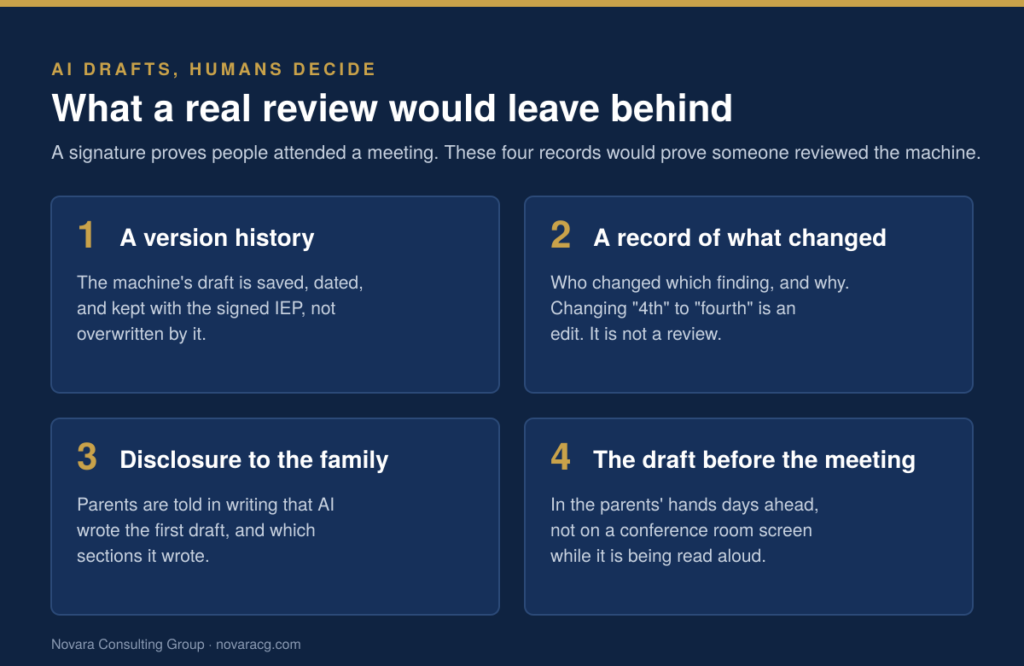
The first is a version history: the machine’s draft, saved and dated, kept beside the signed plan rather than overwritten by it. The second is a record of what changed between the two, and who changed it, because correcting a grade level is an edit and reconsidering a language finding is a review, and only the second protects a child like Nora. The third is disclosure to the family that AI wrote the first draft and which sections it wrote. Given that most parents already support AI use, disclosure is not a confession. It is how that support is kept. The fourth is the draft in the parents’ hands days before the meeting, so that the family arrives with time to read it and the evidence to answer it, rather than meeting the proposal on a screen while it is read aloud.
Once those records exist, a district can check its own reviews with very little effort. Each year it can pull a random sample of AI-assisted IEPs and compare the machine drafts with the signed plans, looking specifically at the sections where the data on file is least likely to describe the child: present levels findings, the special factors, communication plans where state law requires them, and placement. If, across the sample, those sections almost never change between draft and signature, the district has learned something important. Either the platform is remarkably accurate about children it cannot see, or the reviews have become ratification. Either way, the district now knows to look, which is more than it knows today.
Who Has to Move
Districts are the buyers, and they have the most leverage. Every contract for an IEP platform signed from now on can require the vendor to keep the original draft, log changes by user, mark machine-generated sections, support disclosure to families, and hand all of it over on request for as long as the IEP itself is retained. Districts can also adopt a simple internal rule that the draft goes to the family before the meeting, and they can run the annual sample described above.
State education agencies already issue guidance saying a human must decide. The next step is to say what that decision must leave behind, in the same documents, and to fold a check of the review record into the IEP compliance monitoring they already do. States with Deaf children’s bills of rights or communication plan requirements have a particular opening: they can specify that the communication plan may not be auto-generated and must precede the goals, which is what their laws already contemplate.
Vendors can make all of this easy, and the ones confident in their products have every reason to. A visible draft-and-change history is a feature that lets a district prove the tool works. Vendors can also refuse to auto-fill the deaf and hard of hearing special factors, and require a human entry instead, which would cost them nothing and would remove the single most predictable failure described here.
Families can ask now, using the three questions above, and parent centers can teach them to. The federal government, which has already said AI may be bought with federal funds, can say what responsible use of those funds requires when the document being drafted is a child’s IEP.
A Draft Is Not a Decision
Nothing here argues that Nora’s case manager should be denied a tool that gives her back an evening, and nothing assumes a human-written IEP would have been better. Plenty of IEPs were copied forward and signed without anyone looking at the child long before any model was involved. The difference is scale and finish. A tired human writes a thin IEP for one child at a time, and it reads like a tired human wrote it. A platform writes a polished one for every child in the district, and it reads like a decision. When the machine supplies the first account of a child, the human review that follows is the only thing standing between that account and the official record, and right now institutions are treating the existence of that review as proof of its quality.
Nora’s IEP will follow her into fifth grade, and sixth, and into every evaluation that cites it. Somewhere in a lunchroom she will be telling a story with her whole body, the dog on her left and her cousin on her right, while a file in the district office describes a child with significant delays in expressive language. Both will be official in their own way. Only one of them is her. **The record is not the child, and a draft is not a decision.**