
The Choice on Dana’s Desk
Part five ended with a short letter on Dana’s desk. Nora’s mother disagreed with the evaluation behind the finding that her daughter had significant delays in receptive and expressive language, because no one had ever assessed Nora in American Sign Language, and she asked for an independent educational evaluation by an evaluator fluent in ASL, at public expense.5 Federal rules give a district two choices when that letter arrives, and a deadline that is not a number of days but a standard: without unnecessary delay, it must either make sure the independent evaluation is provided at public expense or file a due process complaint to show that its own evaluation was appropriate. If the district files and wins, the parent may still get an independent evaluation, but not at the district’s expense.6
Dana’s instinct was to pay. She had read the file. She knew the evaluation was three years old, written by a speech-language pathologist who had since left, and built on assessments given in spoken and written English with an interpreter in the room. Pine Lake’s counsel saw it differently, and not unreasonably. The district had evaluated Nora on a schedule, by qualified staff, with an interpreter present, and had used the same approach for every Deaf student it served. Paying for an outside evaluation because a parent disagreed with the language of the assessment would, in counsel’s view, concede that every other Deaf child’s evaluation was open to the same objection. Counsel wanted a hearing officer to say whether the district’s practice was appropriate, once, so the district would know.
Dana lost that argument, and she did not pretend otherwise when she called Nora’s mother to tell her. Pine Lake filed its due process complaint eleven days after the letter arrived. Within the week, Nora’s mother filed one of her own, with help from a lawyer at a nonprofit disability rights office that Teresa, the parent center advocate from part five, had called on her behalf. Her complaint raised three issues: that the evaluation had not assessed Nora in her language and mode of communication, that the IEP team had not considered Nora’s language and communication needs as the special factors rule requires, and that the team had decided the plan before the meeting, so that her participation was a formality. The hearing officer consolidated the two complaints. That is how a first draft that took a platform under a minute to generate became Exhibit P-4.
How a Dispute Becomes a Hearing
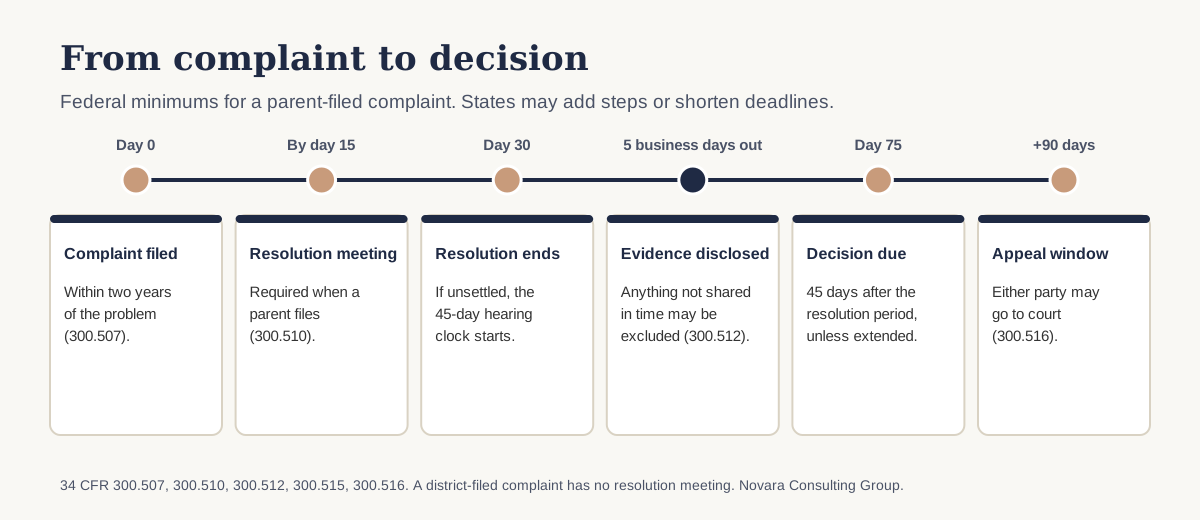
The machinery of a special education hearing is slower than the drafting button and faster than a lawsuit, and families should know its shape before they enter it. A due process complaint may raise any matter about the identification, evaluation, placement or provision of a free appropriate public education, generally within two years of when the party knew or should have known of the problem.7 When a parent files, the district must convene a resolution meeting within fifteen days, and the parties have thirty days to settle before the hearing timeline starts; the hearing officer’s decision is then due forty-five days later unless an extension is granted.8 Pine Lake’s resolution meeting lasted an hour. The district offered to reconvene the IEP team and add a statement about Nora’s ASL use to the special factors section. Nora’s mother’s lawyer asked whether the district would fund the independent evaluation. It would not, so there was nothing to resolve.
Who has to prove what is decided before anyone testifies. In Schaffer v. Weast, the Supreme Court held in 2005 that the burden of persuasion in a special education hearing falls on the party seeking relief, which in most hearings is the parent.9 A few states have changed that by statute. New York and New Jersey, for example, put the burden on the district in most cases.9 Pine Lake’s state had not, so the consolidated hearing split the burden by issue. On the question the district raised, whether its evaluation was appropriate, the district had to prove it. On the questions Nora’s mother raised, whether the special factors were considered and whether the plan was decided in advance, she had to prove them. That split will matter more than anything else in this piece.
Each side must disclose its evidence to the other at least five business days before the hearing, and a hearing officer may refuse to admit anything that was not disclosed in time.10 Nora’s mother’s lawyer disclosed eleven exhibits. Four of them existed only because of what had happened in parts four and five: the generated draft with its date, the documents fed into the generator, the section-by-section comparison Pine Lake’s data coordinator had prepared, and the district’s 2019 list of where it kept records, beside the revision Dana had written the week the request came in. The district disclosed the signed IEP, the three-year-old evaluation, the meeting notes and the case manager’s progress reports. Neither side disclosed anything from the vendor, because by then nothing was left in the vendor’s logs that was not already in the file.
The Witness and the Draft
The hearing ran two days, in a conference room at the district office with an ASL interpreter for the family and a court reporter making the verbatim record the rules require.10 The first witness who mattered was Nora’s case manager.
She was a good witness for the district, and she deserved to be. She had carried twenty-six students across four buildings that year. She had known Nora since second grade. She had watched Nora sign, and on direct examination she described a girl who told long stories at lunch and argued about recess rules, which matched what part one said about her.1 She testified that she had reviewed the generated draft carefully before the meeting, that it was consistent with the evaluation and the data in the file, and that the team had discussed Nora’s communication at length. Asked whether she believed the team had considered Nora’s language and communication needs, she said yes, without hesitation, and the hearing officer wrote it down.
Then the family’s lawyer handed her Exhibit P-4 and the signed IEP and asked her to put them side by side.
The questions were simple and there were not many of them. Which words in the present levels statement did you write? She had changed “4th grade” to “fourth grade” and corrected one benchmark score. Which words in the special factors section did you write? None. The sentence that the team had considered the student’s language and communication needs, and that she would continue to receive services as outlined, including an interpreter as needed, had been generated two days before the meeting and signed unchanged. Who wrote the first paragraph of the parent concerns section? She did not know. Had Nora’s mother said that she was pleased with the supports Nora received? No. She had said the opposite, and her words were in the second paragraph, added at the meeting. Was there anything in the signed plan that recorded the discussion of Nora’s language she had just described? She looked through it for some time and said there was not.
She was not caught in a lie, and the lawyer did not suggest she had told one. She believed the review had happened because, in her memory, it had. The meeting had been long and she remembered talking about ASL. What the draft showed was that none of that talk had reached the document, that the document was the generator’s, and that the parent’s view of her own daughter had been written for her before she arrived. Part four described the research on what people do with a fluent, finished-looking recommendation from an automated system: they accept it, check it less and miss its errors, and more so when they are busy.4 The case manager did not need to have read that research to have lived it. The hearing officer did not need to find that she had been careless to find that the record did not say what she remembered.
She believed the review had happened because, in her memory, it had.
The Evaluation Nobody Gave in Her Language
The district’s case on its own evaluation rested on the speech-language pathologist who had replaced the one who wrote it, and on the claim that the assessments had been administered properly because an interpreter had been present. The family’s case rested on one regulation and one witness.
The regulation requires that assessments used to evaluate a child be provided and administered in the child’s native language or other mode of communication and in the form most likely to yield accurate information on what the child knows and can do, unless it is clearly not feasible to do so.11 The witness was a Deaf psychologist who had evaluated Deaf children for two decades, whom the family’s lawyer had retained at the family’s expense. She explained to the hearing officer, through the same interpreter the family used, why an English language test administered through an interpreter is not an assessment of a child’s language. An interpreter renders the examiner’s English into ASL and the child’s ASL into English, so the test measures the child’s English through two translations and her ASL not at all. A finding of significant delay in receptive and expressive language drawn from that test describes Nora’s English, which everyone agreed was behind, and says nothing about whether she has a language delay, which was the claim in the plan.
The district’s witness did not dispute this so much as explain it. Pine Lake had no staff member qualified to assess language in ASL, and no contract with anyone who was. That is a common situation and an honest answer. It is also not the standard. The regulation allows a district to depart from the child’s language only when doing otherwise is clearly not feasible, and an ASL language assessment by a qualified evaluator is available, at a cost, in every state. The family’s psychologist could have done it. So could the two evaluators Teresa had found within driving distance in part five.5
Here the draft’s inputs mattered as much as the draft. Exhibit P-5 listed everything the generator had been given to write Nora’s present levels: last year’s IEP, the fall reading benchmark, two writing samples and the progress notes. All of it was in English, and none of it came from anyone who had assessed Nora’s ASL. The finding of language delay had been made by an evaluator three years earlier, carried by people into two IEPs, and carried by a machine into the third. The inputs showed that the machine had been given nothing that could have corrected it, and the comparison showed that no person had corrected it either.
What the Draft Did Not Prove
The family did not win everything, and the part they lost is the part every district lawyer reading this series should study.
Nora’s mother’s third issue was predetermination: that Pine Lake had decided the plan before the meeting, so that the meeting served only to ratify it. The law on this is well developed and not hostile to drafts. In N.L. v. Knox County Schools, the Sixth Circuit said that school evaluators may prepare reports and come to the meeting with pre-formed opinions about the best course of action, as long as they are willing to listen to the parents and the parents have the opportunity to make objections and suggestions.12 In Deal v. Hamilton County, the same court found predetermination where a district had an unofficial policy that made the meeting a formality.12 The Eleventh Circuit put the line plainly: a district may not come into an IEP meeting with closed minds.12 Hearing officers apply those cases both ways. In January 2026, a California administrative law judge found that Palo Alto Unified had predetermined a student’s program and denied the parents meaningful participation, while noting that district personnel may bring a draft IEP to the meeting.13 In 2024, a Florida administrative law judge found no predetermination where witnesses credibly testified that school members came to the meeting with open minds.13
On this issue Nora’s mother carried the burden, and the record cut both ways. The draft showed that the plan had been generated before the meeting and signed almost unchanged. It also showed, in the second paragraph of the parent concerns section, that she had spoken, that the team had heard her, and that something she said had been written down. The hearing officer found that a generated draft brought to a meeting is a draft, that the team had not refused to listen, and that the predetermination claim failed. She added a paragraph that Pine Lake will be reading for some time. The district’s own document, she wrote, attributed to the parent views that the parent did not hold and had contradicted at the meeting, and the district offered no explanation of how that paragraph came to be there beyond the generator. That did not make the meeting a sham. It did bear on how much weight she gave to the district’s description of the meeting, and she gave it less.
This is the most important thing the hearing showed, and it runs against the easy version of this series. An AI-drafted IEP is not a procedural violation in itself. A district that generates a draft, brings it to the meeting, listens and changes it has done what the law allows. The draft becomes dangerous to a district only when the record shows that nothing changed where something should have, and that is a question about the review, not the tool.
The Decision
The decision arrived nineteen days after the hearing closed. It ran thirty-one pages, and its three holdings fit in a table.
| Issue | Who had to prove it | Finding | Remedy |
|---|---|---|---|
| District’s evaluation appropriate | The district | Not appropriate: Nora’s language was never assessed in ASL and no showing that doing so was not feasible | Independent evaluation by an evaluator fluent in ASL at public expense |
| Special factors considered | The parent | Violation: the record shows no consideration of language and communication needs beyond a generated sentence signed unchanged | Team to reconvene within 30 days of the evaluation and write the special factors and communication plan from it |
| Plan decided before the meeting | The parent | Not proven: the draft was a draft and the parent’s view was heard and recorded | None; the parent concerns paragraph to be removed as the district had already agreed |
On the evaluation, the district had the burden and could not carry it. The regulation required assessment in Nora’s language unless that was clearly not feasible, the district conceded it had never tried, and the family’s psychologist showed that it was feasible. The hearing officer ordered the independent evaluation at public expense.6
On the special factors, the burden was the parent’s, and the draft carried it for her. The rule requires the team to consider the language and communication needs of a child who is deaf or hard of hearing, her opportunities for direct communication with peers and professionals in her language and communication mode, her academic level and her full range of needs, including opportunities for direct instruction in her language and mode.14 The case manager testified that the team had considered these things. The hearing officer found her sincere. She also found that the only evidence of consideration in the IEP was a sentence produced by software before the meeting, that it named no language, no peers, no mode of instruction and no communication plan newer than two years old, and that the case manager had confirmed under oath that no one had changed it. A procedural violation supports a finding that a child was denied a free appropriate public education only if it impeded the child’s right to one, significantly impeded the parents’ opportunity to participate, or caused a deprivation of educational benefit.15 The hearing officer found the first: a plan for a Deaf child that never considers her language cannot be reasonably calculated to enable her to make progress appropriate in light of her circumstances, which is what the Supreme Court requires of every IEP.16 She ordered the team to reconvene within thirty days of receiving the independent evaluation and to write the special factors and a current communication plan from it.
The decision did not award compensatory services. The family’s lawyer had asked for direct ASL instruction and a Deaf mentor to make up for the year, and the hearing officer found the request reasonable but premature until the evaluation showed what Nora actually needed. She left it to the reconvened team, with the family’s right to return to a hearing if the team could not agree. Either party had ninety days to take the decision to court.17 Neither did.
The Hearing Pine Lake Did Not Have
Nora’s family had a draft because Pine Lake had audited before anyone asked, and the audit had pulled her draft out of a vendor’s ninety-day log while it still existed.4 Part four found that eight of the twenty sampled drafts at Pine Lake were already gone.4 It is worth running the same hearing with one of those eight.
The case manager testifies that she reviewed the generated draft carefully and that the team discussed the child’s communication at length. The family’s lawyer asks which words she wrote. She does not know, and neither does anyone else, because the draft is gone and the platform kept only the edited text. The special factors section reads the same as Nora’s. The family says it reads like a template. The district says the case manager wrote it from her knowledge of the child, and there is no document that says otherwise. On the special factors issue the parent has the burden, and the only evidence of what happened is the memory of the person whose review is in question. In most states, that family loses an issue Nora’s family won, not because the facts were different but because the record was.
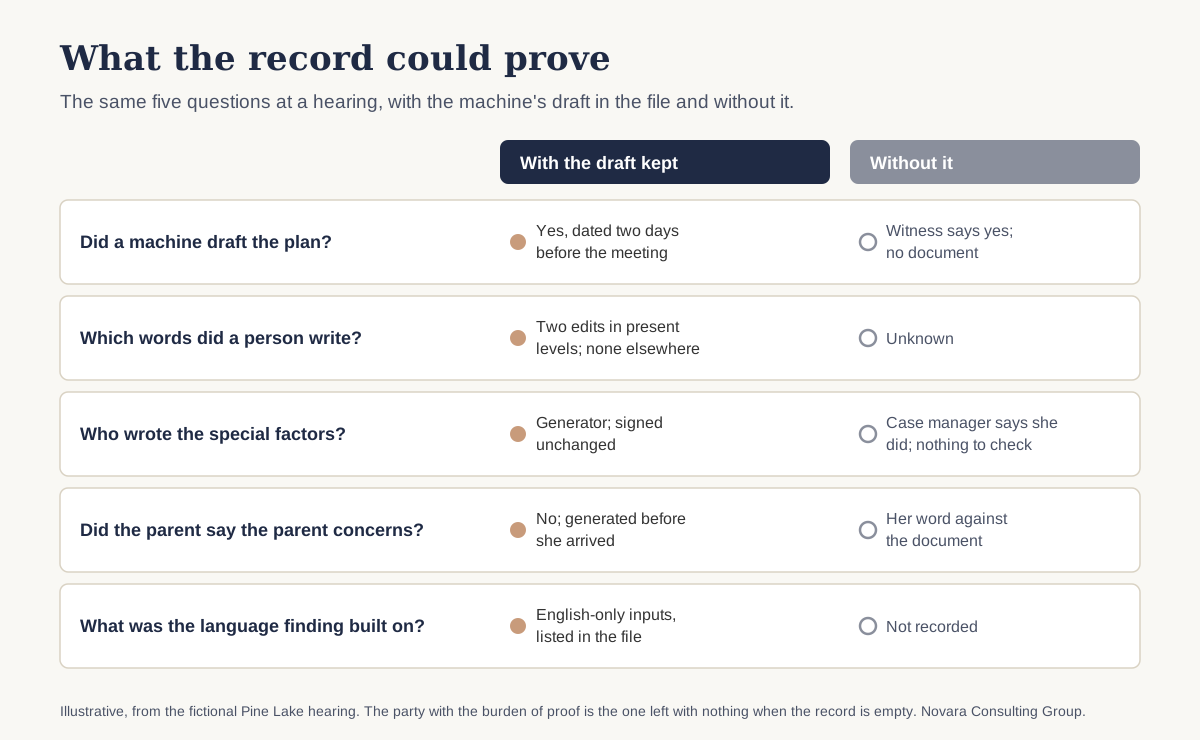
That is the outcome no one in this series has wanted, and the law does not prevent it. In some states, as noted above, the district carries the burden, and there a missing draft cuts the other way.9 If a case reaches federal court, the civil rules give a judge tools when electronically stored information that should have been preserved is lost: measures to cure the prejudice when the loss was careless, and an instruction that the lost information was unfavorable when the party acted with intent to deprive the other side of it.17 Those tools exist for the moment a family can show the draft once existed and was lost after the district should have kept it. Part five described when that moment begins: on the day a records request arrives, nothing may be destroyed.5 Before that day, a district that lets a log run out has broken no rule anyone has yet enforced. It has only made sure that, if a family ever challenges a plan, the district’s best evidence will be a witness’s confidence.
That confidence is often justified. Two of the four case managers part four’s audit found with unchanged special factors had in fact discussed language at length with the family and simply not written it down.4 A district that keeps the draft and a record of what the team did with it can prove those good reviews. A district that keeps nothing cannot tell them apart from the bad ones, and neither can a hearing officer.
What Every District Should Have Before the Complaint
A hearing is the most expensive way for a district to learn what its records say, and nearly everything Pine Lake needed could have been in place for the cost of a policy and a contract clause. Part two proposed seven clauses for the vendor contract, part four an annual audit, and part five a records list that names where drafts are kept.2 The hearing adds three practical lessons for anyone who may sit at the district’s table.
The first is to keep the draft with the plan. A generated draft filed in the student’s record is evidence for the district as often as against it, because it is the only document that can show a person changed something. The second is to write down the review, briefly and in the plan itself, where the law requires judgment about a particular child: a sentence in the special factors section that names the child’s language and what the team decided about it, a parent concerns section in the parent’s own words, a dated communication plan. None of that requires software to be turned off. All of it requires a person to type something the generator could not have known. The third is to treat a request for an independent evaluation as a question about the evaluation, not about precedent. Pine Lake’s counsel wanted a ruling on the district’s practice and got one, at the cost of a hearing, the family’s lawyer’s fees if the family is found to have prevailed, and a written decision that the practice was not appropriate.18 The evaluation would have cost less.
A Draft Is Not a Decision
In February, a psychologist fluent in ASL spent two mornings with Nora. Her report described a child with age-appropriate language, rich narrative skill and a vocabulary in ASL well ahead of her English, and an English literacy gap of the kind expected in a bilingual Deaf child who had not been taught to read through the language she already had. It recommended direct instruction in ASL and English as a second written language, regular access to signing peers and adults, and an interpreter qualified at a stated level for the instruction she received in English. In March, the IEP team reconvened. The case manager wrote the special factors section herself, from the report, in the meeting, with Nora’s mother reading it as she typed. The finding of significant language delay, which had been carried by people and by a machine for three years, was not in the new plan.
The platform was used for that meeting too. It drafted the accommodations list and the progress reporting schedule, and the team kept most of what it wrote, because most of it was right. The draft was filed with the plan, the way Dana’s memo in part four had required. No one at Pine Lake turned anything off.
The first arc of this series ends where it began, with a file in a district office describing a child. Six parts ago, the file described a child who did not exist, in fluent sentences no one could trace. It now contains the machine’s draft, the inputs it was given, a comparison showing what people changed, a parent’s own words in the section meant for them, an evaluation in the child’s language and a special factors section written by a person who read it. Nothing in that list required a new law, a new product or a ban. It required a district to keep what it made and a family to ask for it. The record is not the child, a draft is not a decision, and a review that leaves nothing behind cannot be defended, even when it was done well.
- Districts: file every generated draft with the signed IEP and keep it as long as the IEP.
- Districts: write the special factors, any communication plan and the parent concerns in the meeting, in words a generator could not have produced.
- Districts: answer a request for an independent evaluation on the merits of the evaluation, not on what paying would concede.
- Families: send the records request before the next IEP meeting, and ask the district to preserve everything while it is open.
- Families: compare the draft with the signed plan and keep the comparison.
- Families: if a finding rests on testing that did not use your child’s language, say so in writing and ask for an independent evaluation.
- Families: before any hearing, find out from your state’s Parent Training and Information Center who has the burden of proof in your state.