
The Demonstration
Eighteen months before Nora’s annual review, five people sat in a conference room at the district office and watched a draft IEP appear on a screen in about forty seconds. The director of special education was there, along with the technology director, a business office manager, a principal who had been a special education teacher for eleven years, and a case manager who had volunteered because she was tired. The vendor’s representative had uploaded a sample student’s file, last year’s plan, a reading benchmark, two work samples, and pressed a button. The present levels statement filled in, then the goals, then the accommodations grid. The case manager said, quietly, that it would give her back her Sunday nights.
The committee had a list of questions, and they were good questions as far as they went. Is it compliant with IDEA? The representative showed them that every required section was there. Does it protect student data? The vendor would sign the state’s standard student data privacy agreement, the same one the district had signed with its reading software and its learning management system. Does it connect to the student information system? It did. How much time does it save? The vendor had a figure, and the case manager in the room was the figure.
Nobody asked what the platform would keep. Nobody asked whether the machine’s first draft would still exist after a teacher edited it, whether the system would record who changed what, whether a parent could see which sentences a person had written, or what would happen to any of it when the contract ended. These were not careless omissions. They were not on anyone’s list, because no list the committee had ever used included them. The privacy agreement was signed the next month. The platform went live that fall.
Everything that happened to Nora’s IEP eighteen months later, the language finding nobody wrote and nobody removed, the five words that stood in for the deaf special factor, the signature that proved attendance and was treated as proof of review, became unrecoverable on that afternoon. Not because the platform was bad, but because the contract never required it to leave anything behind.
What the Standard Agreement Covers
Most districts do not negotiate privacy terms with every vendor. They sign a standard agreement, and for many of them that agreement is the National Data Privacy Agreement maintained by the Student Data Privacy Consortium. It is a serious document, built by districts and states to keep student data from being sold, mined or mishandled, and it has done real good. Its current version is 2.2.
Read it with an AI drafting platform in mind and three things stand out. The first is what it does not say. Version 2.2 does not mention artificial intelligence, machine learning or model training anywhere in its text, and NCG found no AI addendum or exhibit published alongside it. The second is section 4.5, which allows the provider to use de-identified data for “research, development, and improvement of the Provider’s educational sites, Services, or applications,” forbids the provider from trying to re-identify that data without the district’s written direction, and says that this use survives the end of the agreement. Nothing in that language distinguishes improving a product from training the model that writes the next child’s IEP. The third is section 4.6: when the agreement ends, the provider disposes of or deletes the district’s student data within sixty days, unless the law requires otherwise, and a provider’s own standard retention schedule applies if it has one.1
The federal guidance behind these agreements points the same way. The Department of Education’s Privacy Technical Assistance Center told schools in 2014 that metadata stripped of identifiers is not protected under FERPA and may be used by a provider for other purposes unless the agreement says otherwise. The same guidance listed what a good contract should do: define the purposes for which the provider may use student information, include archival and destruction requirements, say who will be able to access the data, and allow a security audit.2 All four are the right instincts. None of them asks a vendor to keep a machine-generated draft, log who edited it, or mark which parts of a legal document a person wrote.
This is not a criticism of the agreement for failing to anticipate a technology that barely existed when it was written. It is a description of the gap a district walks into when it signs that agreement with a company whose product writes the first draft of a child’s education plan. The agreement governs where the data goes. It says nothing about what the record must show.
Where the Rules Already Point
The rules that would close that gap are not hypothetical. They have been arriving all year, in pieces, from different directions, and almost none of them has yet reached a district’s purchase order.
Oklahoma’s state guidance, updated in July 2026, says AI may not be the primary basis for special education evaluations or IEP decisions, and that the final determination must always rest with a qualified human educator. More useful for a buyer, its procurement checklist asks for written vendor confirmation that student data is not used to train public or proprietary models without explicit consent, and it puts this question to every vendor: “Does the tool maintain a continuous, unalterable audit trail logging AI-generated outputs versus human-confirmed student outcomes?”3 That one sentence is most of the argument of this piece, already written into a state document.
The District of Columbia’s model policy for staff AI use, released in September 2026, bars staff from using AI to determine eligibility for special education. It permits AI to help draft IEPs only with enhanced oversight: staff must tell students and families where and how AI was used in drafting, and all AI output is to be treated as advisory. Its procurement section asks districts to make sure vendors are not using student data for model training or product improvement, and to set “protocols for data persistence and retrieval.”4 Minnesota’s 2026 model policy goes further on the record itself. It says AI-generated or AI-assisted data shall be treated as a school district record when it is relied on in making an educational decision, and kept under the district’s retention schedule, and it says a district’s contract with an AI vendor must prohibit use of student data for model training, establish deletion rights, prevent lock-in, and address what happens if the vendor changes its terms, is acquired or shuts down.5
Illinois reminded districts in February that their duties in developing IEPs under 34 CFR 300.324 are unchanged when AI is involved, and its June 2026 guidance tells them to “review contracts, data flows, privacy protections, retention rules, and vendor practices before approving a tool.”6 The Center for Democracy and Technology’s 2025 report on AI and IEPs recommends a human-in-the-loop requirement, written notice to families before the meeting, and monitoring after deployment.7 It does not recommend any record of what the human did. That is the piece still missing.
Outside education, buyers have gone further still. The federal government’s acquisition memo for AI, which governs federal agencies rather than school districts, requires contracts that “permanently prohibit the use of nonpublic inputted agency data and outputted results to further train publicly or commercially available AI algorithms” without the agency’s consent, and calls for data and model portability so an agency is not locked in.8 New York City’s AI rider for its vendors requires logs of user and AI activity and bars training on city data without written consent.9 The European Commission’s model clauses for public buyers of high-risk AI require the system to record events automatically over its lifetime and the supplier to hand those logs to the buyer when the agreement ends.10
And one state law is coming. Colorado repealed its 2024 AI statute this spring and replaced it with a narrower one, Senate Bill 26-189, which takes effect on January 1, 2027. It still lists an education opportunity among the consequential decisions it covers, requires notice when automated technology is used in one, requires a deployer to keep records for at least three years, and offers an opportunity for human review where commercially reasonable. It also carves out routine academic administration that does not materially influence a consequential decision.11 Whether an AI-drafted IEP falls inside the law or inside the carve-out is, as of this writing, unresolved. A Colorado district buying a platform now will be operating under that law before its contract ends.
The Clock Problem
Here is the part that should worry a district most, because it is arithmetic rather than policy.
A software contract runs for a few years and is renewed or not. An IEP record runs for much longer. Texas requires districts to keep special education records, IEPs included, until services end plus five years.12 Minnesota sets no statewide figure, so districts write their own; one, Northfield, keeps special education records for five years past a student’s twenty-first birthday and keeps the final IEP until age thirty-one.13 Federal rules require a district to tell parents when information is no longer needed and to destroy it at their request, which assumes the district still has it to destroy.14
Under the standard agreement, the vendor’s copy is deleted within sixty days of termination. Even the European model clause, the most demanding on logging, keeps logs only “for the duration of the Agreement” before handing them over. Put those dates on one line for a single child and the problem is plain.
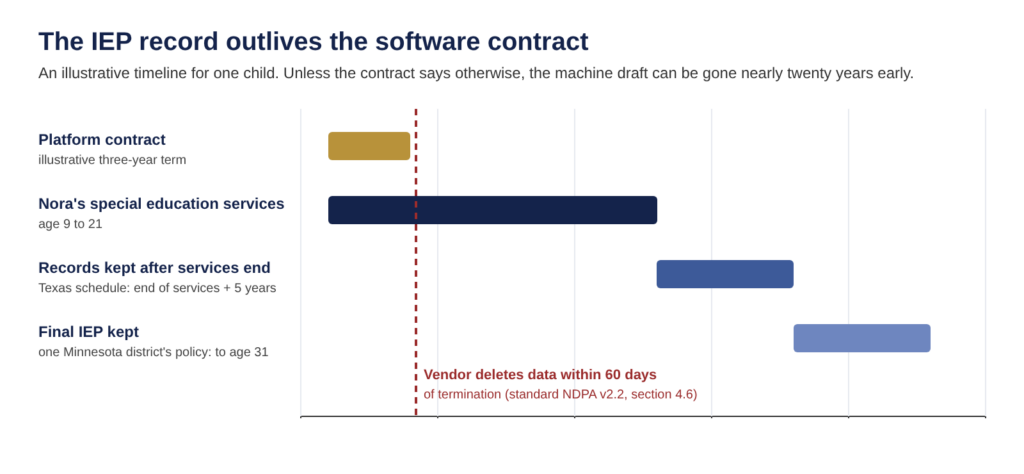
The signed IEP will survive the contract, because the district keeps it. What will not survive, unless the contract requires an export before deletion, is everything that would show how the IEP was made: the machine’s draft, the sequence of edits, the record of who wrote which section. A parent who requests her child’s records, which the district must produce before any IEP meeting and within forty-five days, will receive the signed plan.15 A due process hearing officer who asks who wrote the language finding, three or eight years later, will receive the same thing. Whether a machine draft held on a vendor’s platform is itself an education record under FERPA has not been squarely decided. FERPA covers records directly related to a student and maintained by the district or a party acting for it, and its exception for sole-possession notes fits a shared platform poorly, so the argument that the draft is a record is a serious one.16 It does not much matter if the draft no longer exists.
Eight Clauses
None of what follows requires new technology. A system that generates a draft and lets a teacher edit it already holds every piece of this information, at least for a moment. The only question is whether the contract obliges the vendor to keep it and hand it over. These are written as the substance of a clause, for a district’s counsel to put in its own words.
- Draft retention. The machine’s original draft of every section is kept, unaltered, beside the signed IEP for the district’s full retention period for that IEP, not for the contract term. Already appears in: Minnesota’s Model Policy 625, which treats AI-assisted data relied on in a decision as a district record.
- Edit history. Every change between draft and signature is logged by user, date and section, and the log cannot be altered. Already appears in: Oklahoma’s guidance, which asks for an unalterable audit trail of AI output against human-confirmed outcomes, and article 5 of the EU model clauses.
- Section attribution. The final IEP can be displayed with each section marked as machine-drafted, edited by a person, or written by a person. Already appears in: The District of Columbia model policy’s transparency requirement.
- Family disclosure. The platform produces a plain statement for the family, before the meeting, of whether AI drafted the plan and which sections. Already appears in: The District of Columbia model policy and CDT’s call for written notice before the meeting.
- Required human entry. The deaf and hard of hearing special factors, and any state communication plan, cannot be auto-filled. A person has to write them. Already appears in: 34 CFR 300.324(a)(2)(iv) and the state communication plan laws.
- No training. No student data, including de-identified data and generated drafts, is used to train or improve any model without the district’s written consent. Already appears in: OMB M-25-22, Minnesota’s Model Policy 625, Oklahoma’s guidance and New York City’s AI rider.
- Production on request. The draft, the edit history and the attribution for any IEP are produced to the district in time to meet records requests and dispute deadlines, and preserved once a dispute is noticed. Already appears in: 34 CFR 300.613 and the Department of Education’s guidance to providers.
- Exit and survival. Before any deletion, all of the above is exported to the district in an open format, and these duties survive termination, acquisition or shutdown. Already appears in: Minnesota’s Model Policy 625 and OMB M-25-22, with section 4.6 of the standard agreement as the default being overridden.
Clause six deserves a word, because it is where the standard agreement most needs overriding. Section 4.5 of the agreement permits de-identified data to be used for product improvement, and an IEP draft with the name removed is still a detailed account of a disabled child’s difficulties. A district can add a short exhibit that says, in substance, that de-identified data and machine outputs are covered by the training prohibition too. Several of the documents above already say something close to it.
Clause seven deserves one too, because it is where the records rules and the contract meet. The Department of Education’s guidance to vendors says the practical route for a parent’s records request is for the provider to give the records to the district, which confirms the parent’s identity and provides access.17 A contract that sets a turnaround short enough for the district to meet its own forty-five-day limit, and its obligation to produce records before an IEP meeting, makes that route work.
The Deaf Clause
Of the eight, clause five is the one NCG would not trade away, and it is the cheapest.
Part one of this series explained why a drafting platform will tend to write “will use an interpreter as needed” for a Deaf child. It is not a hallucination. It is an accurate summary of what most districts record about deaf students, which, in the states the National Deaf Education Data Index has finished, is close to nothing. In Idaho, 3 of 191 local units publish a deaf and hard of hearing program; in Illinois, 15 of 849 districts and Chicago; in Colorado, 13 of 178.18 A model drafting from a district’s own data will draft toward services the district has written down, and the services a Deaf child most needs, direct instruction in her language, signing peers and adults, a deliberate decision about language made with her family, are the ones least likely to be there.
Federal law already names this as a decision the team must consider for every deaf or hard of hearing child.19 Colorado, Connecticut and New Jersey require a communication plan that is meant to come before the goals, not after them.20 A platform that leaves those fields blank and refuses to proceed until a person fills them in costs the vendor nothing and removes the single most predictable failure in the whole process. A district that asks for it in the contract is asking the platform to stop pretending it knows something it cannot.
What It Costs the Vendor
The strongest objection to all of this comes from the vendor’s side, and it is worth taking seriously. Storage costs money. Retaining drafts for a decade or more changes a product’s data architecture. A vendor selling to thousands of districts cannot negotiate a bespoke records regime with each one, and a small district with no counsel and no leverage will sign whatever it is given. Some vendors will say their customers have never asked for any of this, and they will be telling the truth.
All of that is real, and none of it is a reason not to ask. Text is cheap to store; an IEP draft is a few dozen kilobytes. Most of what these clauses require, the draft, the edit, the user, the time, is generated by the system in the ordinary course of letting a teacher edit a document. What changes is whether it is kept. The leverage problem is better solved together than alone: a state agency, a cooperative or a regional service center can write these terms once into a template or a cooperative contract, the way the standard privacy agreement itself was written once for everyone, and the consortium that maintains that agreement could add an AI exhibit to it.
And a vendor confident in its product has a reason to want these terms. If AI-assisted IEPs really are better, the draft-and-edit record is how a district proves it. If a vendor will not agree to keep that record, or to stop training on children’s plans, a district has learned something important before it signs, which is the only time it is cheap to learn it.
Before the Next Renewal
A district that already has a platform does not have to wait for a new purchase. Renewal is a negotiation, and most contracts can be amended. Five questions, put to the vendor in writing, will tell a district where it stands:
- Do you keep the original machine draft of each IEP section after a user edits it, and for how long?
- Do you log who changed which section, and when, and can we export that log?
- Is any of our student data, including de-identified data and generated drafts, used to train or improve any model?
- Can a user complete the deaf and hard of hearing special factors without typing anything a person wrote?
- When our contract ends, what do we receive, in what format, before you delete?
The answers belong in the file before the renewal is signed. State agencies that already tell districts a human must decide can say, in the same guidance, what that decision has to leave behind, and can fold the review record into the IEP monitoring they already do. Parent centers can teach families the three questions from part one of this series, and families can ask them. None of this waits on a court.
A Promise and a Record
Go back to the conference room. The case manager who wanted her Sunday nights back was right to want them, and the platform probably gave them to her. The director who signed the privacy agreement did what nearly every director in the country does. The failure in Nora’s IEP did not begin with a careless person. It began with a document that described where the data could go and said nothing about what the record had to show.
The contract is the only document in the whole IEP process that is written before any child is in the room. That makes it the one place a district can decide, calmly and in advance, what a human review must leave behind. Everywhere else, the decision is made on a Thursday afternoon with three drafts open. A human in the loop is a promise. A clause is a record, and only the record will still be there when someone finally asks.