
The email arrives the way most freelance work arrives for a British Sign Language translator. There is a recruiter, a project, a day rate, and a short form to sign before the shoot. The project is artificial intelligence. The companies named on the form are Amazon Digital UK Limited and Amazon Services LLC. The form is two pages long, and by the time a translator reaches the signature line at the bottom of the second page, they have agreed to something far larger than a day of work. They have agreed to teach a machine to do their job, to let that machine sign things they never signed, under a face that is not theirs but moving the way theirs does, in any medium that exists now or will ever exist, with no end date, no right to see what it produces, and no further pay.
The form reached me from the UK this week. I am a DeafBlind ASL user in Minnesota, not a BSL signer, and I do not know the translators being recruited. I do know this kind of document. For the past year I have been reading the terms of service, privacy policies, training data disclosures and supply chains of the companies building sign language AI, and publishing what I find. Most of that industry keeps its data practices vague. This form does not. It says out loud, clause by clause, what the business model of AI signing has always quietly assumed: that the people whose language makes the technology possible are a raw material to be bought once, cheaply, and owned forever.
What the form takes
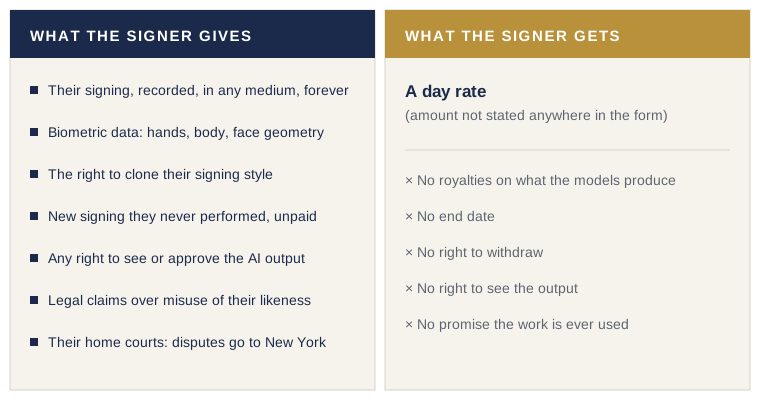
Section 1 is the grant of rights, and it is written to leave nothing behind. In exchange for “good and valuable consideration,” which the form acknowledges receiving without ever stating what it is, the signer grants Amazon “the irrevocable, worldwide, perpetual, royalty-free and unrestricted right” to do five things. Amazon may record and use video of the signer’s “image, likeness (but excluding Talent’s facial likeness), signing performance, facial expressions, gestures, and body movements” in “any medium now known or hereafter developed.” It may use those recordings and “all derived data,” which the form spells out as “biometric, motion capture, and facial geometry data,” to train and improve AI models. It may use those models “to generate new sign language content and digital avatar performances.” It may put AI-generated likenesses into avatar products for Prime Video worldwide. And it may sub-license all of it to Amazon’s affiliates and “authorised third parties.”
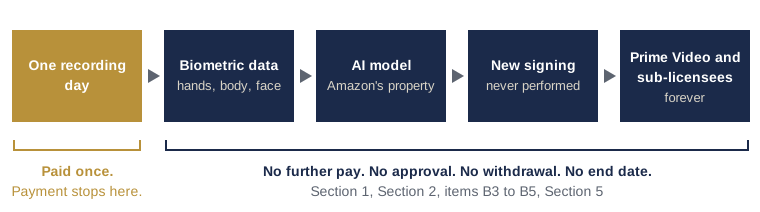
Two sentences close the section, and together they describe the entire bargain. “Nothing herein obligates Amazon to use any Recordings.” And: “All Recordings and AI Models are and remain Amazon’s exclusive property.” Amazon owns the recordings. Amazon owns the models trained on them. Amazon owes nothing back, not even the courtesy of using the work. Section 2 then adds a separate consent to Amazon “digitally replicating, cloning, and synthetically reproducing my appearance, signing style, and likeness” to create “digital doubles and synthetic performances.” The translator is not being hired to translate. The translator is being hired to be copied.
The face clause that protects the wrong thing
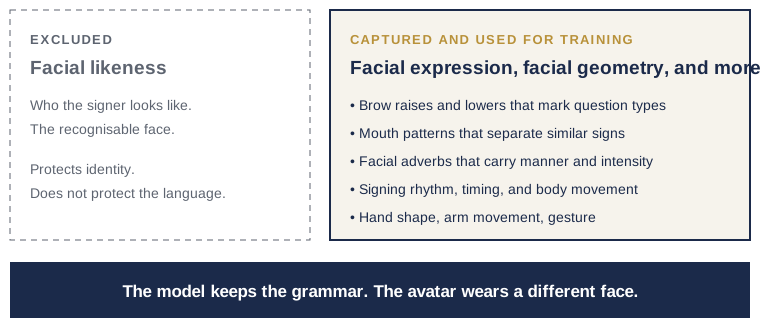
Read the form quickly and it seems to contain one real protection. Again and again it excludes the signer’s “facial likeness.” Section 1 excludes it from the recordings and from the derived data. Section 2 excludes it from the digital replica. Item B1 excludes it from the biometric capture. A careful translator could reasonably read all of that as a promise: you can have my hands, but not my face.
That is not what the form says, and the gap between the two readings is the most important thing in the document. In BSL, as in ASL, the face is not decoration. Raised and lowered brows mark different kinds of questions. Mouth patterns separate signs that share a handshape and movement. Facial expression carries manner and intensity, the difference between walking and trudging, between a small problem and a disaster. Take the face out of a sign language and what remains is not the language. The form’s drafters seem to understand this, because the same Section 1 that excludes “facial likeness” defines the recordings as capturing the signer’s “facial expressions,” and lists “facial geometry data” among the derived data Amazon may use to train its models. Item B1 asks the signer to consent to the capture of “facial geometry.”
So the form separates two things that, in a signed language, have never been separable before. Likeness is the recognisable face, the one that tells you who someone is. Geometry and expression are the data that tell a model how the language moves. The carve-out protects the first and takes the second. It shields the signer’s identity and hands over the signer’s grammar. The finished avatar will wear a different face, and it will move that face the way the translator taught it to.
In September I published The Corpus Question, which argued that sign language training data cannot be anonymised because the face is the data. This form is the industry’s answer to that problem, and it is a clever one. It solves the privacy problem for Amazon by detaching the face as identity from the face as language. It solves nothing for the signer, whose labour, skill and linguistic judgment end up inside a model they will never own, cannot inspect, and cannot recall.
Clause B4: signing they never signed
Section 3 is headed as mandatory and asks the signer to initial five consents. Most of them describe the data collection. One of them describes the business.
“B4. I consent to AI Models generating new sign language content and synthetic performances derived from my data that I did not personally perform, for commercial use without further compensation.”
BSL AI Project Release Form, item B4
This is the clause the project exists for. A translator is paid for a day, or a few. The model trained on those days goes on producing signing for as long as Amazon chooses to run it, in productions the translator never saw, translating scripts the translator never read, saying things the translator would never have said, and the form fixes the price of all of that future work at zero. Item B3 names the first destination: “digital sign language avatar creation for worldwide use on Amazon Prime Video.” Section 1 makes clear it will not be the last, because the rights run to any medium and can be sub-licensed onward.
Screen actors in the United States faced this same question in 2023, and protections against AI replicas were among the central issues in their strike that year. The agreement that ended it requires informed consent and compensation for digital replicas, along with a reasonably specific description of how a replica will be used. The difference between that outcome and this form is not the technology. It is bargaining power. Actors had a union at the table. A freelance BSL translator answering a recruiter’s email has a form, a deadline, and a day rate.
No right to look, no right to object
Section 5 closes the loop. The signer represents that “I waive any right to inspect or approve Recordings, AI-generated outputs, or derivative content,” and releases Amazon from “all claims arising from authorised use of the Recordings, including claims of defamation, invasion of privacy, misappropriation of likeness, or infringement of right of publicity, limited to uses within the scope of this Release.” The limiting phrase at the end reads like a safeguard until you remember what the scope is: any medium, any future technology, any sub-licensee, forever. The release is also “binding on my heirs, legal representatives, and assigns,” so it outlives the signer.
This is where the form stops being only a labour problem and becomes an access problem. I have watched what happens when AI signing gets it wrong in public. At the Cincinnati airport, AI-generated ASL on the terminal train screens contradicted the English text on the same screens, and it took a formal civil rights complaint to get it taken down while Deaf users review it. I wrote about that in I Filed One Complaint. An Airport Took Its AI Signer Down. Under this release, the translator whose signing taught a model like that would have no right to see what it produces, no right to object when it gets something wrong, and no claim if it puts inaccurate or offensive signing into a performance built from theirs. The BSL community is small. People know who signs like whom. The Deaf viewer gets the error, the translator carries the reputational cost inside their own community, and Amazon holds the release.
Consent that cannot be refused or taken back
The form is careful to frame all of this as consent. Item B2 has the signer acknowledge that the biometric data “constitutes special category personal data” and provide “explicit, freely given, informed consent to its collection and processing.” Section 3 says unchecked items “constitute withheld consent for that use.”
The same section, though, is headed as mandatory, and the grant in Section 1 is irrevocable. Under UK data protection law, consent has to be freely given, and in judging that, regulators look closely at whether the work itself was made conditional on consent the work did not strictly need. Consent also has to be as easy to withdraw as it was to give, at any time. A consent that is required to get the job and can never be taken back is hard to square with either test. Whether Amazon has another lawful basis in mind, and whether a regulator would accept it for training commercial avatars on special category data, is a question for a UK data protection lawyer, not for me. But the tension is visible on the face of the document, and any translator holding it is entitled to ask about it before initialling anything.
A British signer and a Manhattan courtroom
Section 6 makes the form governed exclusively by New York law, with exclusive jurisdiction in the state and federal courts of New York County. The contracting party is Amazon’s UK company. The people signing are British freelancers working in a language recognised in British law by the British Sign Language Act 2022. If one of them believes Amazon has misused their data, the form sends them to Manhattan to say so. For most freelance translators, that is not a forum. It is a wall.
There is an irony in the choice. New York is one of the few places that has already legislated on contracts like this. Section 5-302 of New York’s General Obligations Law, enacted in 2024, makes a provision allowing a digital replica of a person’s voice or likeness void and unenforceable where the replica is used in place of work the person would otherwise have performed, the agreement lacks a reasonably specific description of the intended uses, and the person was not represented by a lawyer who negotiated the terms or by a union whose agreement covers digital replicas. The form appears to anticipate this: Section 2 invokes “applicable digital replica legislation” and offers “specific, written consent.” But specificity is the one quality the form lacks. Its uses run to any medium now known or hereafter developed. Whether a New York statute reaches a British freelancer through a New York choice-of-law clause is a question for lawyers. That Amazon picked a forum whose own legislature looks at this kind of contract with suspicion is worth noticing.
Talent, not translators
One word runs through the whole document. The form never calls the signer a translator. It calls them “Talent.” That choice matters more than it looks. Translation is a profession, and in the UK, BSL translators and interpreters work within professional registration and standards that exist because accuracy carries consequences. Talent is a performer licensing a likeness, and in likeness licensing the normal deal is a buyout. By relabelling the work, the form moves it out of language services, where there are norms about accuracy, accountability and who answers for errors, and into a category where a perpetual, royalty-free grant looks ordinary.
There are other small tells. Item B1 carefully excludes the signer’s “voice,” an odd protection to offer a Deaf BSL translator, and a hint that the form may have been adapted from a template written for actors. The missing Section 4, the unstated fee and the absent Amazon signature block point the same way. None of that makes the terms less serious. If anything, it suggests the terms were treated as standard rather than designed with sign language, or the Deaf community, in mind.
What a fair release would look like
None of this means sign language AI should never be trained on human signers. It means the people doing the training should be treated as the source of the value, because they are. A fair release is not hard to describe, and most of its terms already exist in other creative industries.
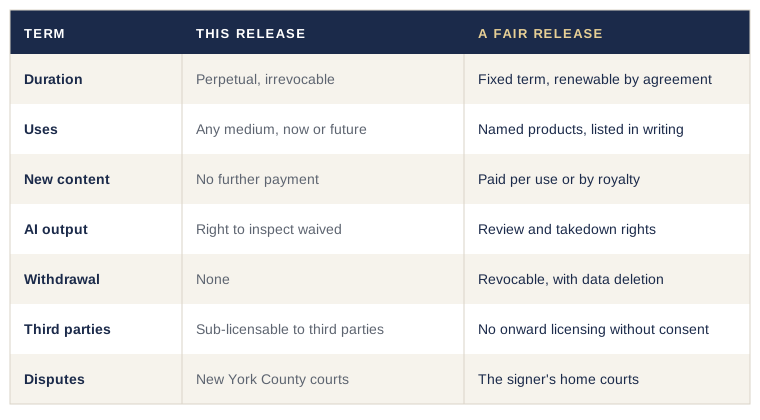
It would run for a fixed term, renewable only by agreement. It would name the products the data will be used for, in writing, rather than every medium yet to be invented. It would pay signers when their data generates new content, through a per-use fee or a royalty, rather than fixing the price of all future output at a single day rate. It would give signers the right to review output produced in their style and a working route to have inaccurate or harmful output taken down. It would let them withdraw, with a stated timeline for deleting their data and for retraining or retiring models built on it. It would bar onward licensing without fresh consent. It would let disputes be heard where the signer lives. And it would be negotiated collectively, by translators and by Deaf-led organisations, rather than presented one freelancer at a time.
The obligations do not stop with Amazon. Any institution buying an avatar service, whether a broadcaster, a transport operator, a council or a hospital trust, inherits the ethics of how its training data was gathered. The SLAT Index Evaluation Standard, which NCG publishes free for anyone to use, asks vendors to document whose signing trained their systems, what those signers agreed to, whether they were paid, and whether they can withdraw. A form like this one would answer every one of those questions, just not in a way any public buyer should be comfortable defending.
The fear is the business model
Big technology companies rely on the people they recruit feeling unable to push back. A freelancer weighing a day rate against a two-page form does not have a legal department, a union rep, or the time to research New York contract law. That asymmetry is not an accident of this project. It is what makes terms like these possible.
But it is not as fixed as it looks. Earlier this month I filed a single complaint, and an airport took its AI signer down. Translators handed this form can ask questions before they initial anything, and they can ask them in writing. What am I being paid, and is that the whole of it? Can I withdraw, and what happens to my data if I do? Where will signing built from mine appear, and who decides what it says? Who do I call when it gets something wrong? If the answers are not in writing, that is the answer. And the Deaf community, whose language this is, has every right to ask the same questions of Amazon in public.
This piece is a reading of a document as written and is not legal advice. NCG will publish any response from Amazon.