
In the spring of 2025, a UK startup’s AI sign language avatar was widely reported to be on its way to more than 250 Transport for London stations. Eighteen months later, NCG asked TfL for the paperwork behind that claim. On 20 November 2026, after an internal review, TfL answered: it holds no contract, purchase order or memorandum of understanding with the company, and there is no sign language avatar at any TfL station today.
A QR code on a platform
Picture a Deaf commuter on the platform at Hackney Downs in the summer of 2024. A sign near the stairs carries a QR code. She scans it, and a signing avatar on her own phone tells her about the next departure, a delay, a change to the service. For a few months that was real at five London Overground stations. It was a trial, and like most trials it ended.
A year later, the same commuter could have read in WIRED and a string of technology sites that a different company’s avatar was coming to more than 250 TfL stations. If she had gone looking for it in November 2026, she would not have found it at any of them. TfL now says it holds no contract for the second avatar and no records of the first.
That gap, between what the coverage said and what the transport authority holds, is the subject of this piece. It is also the gap every buyer of sign language AI should learn to look for, because a deployment claim travels much faster than the contract that should stand behind it.
How “collaborating” became 250 stations
The story starts with a press release. On 7 April 2025, Silence Speaks, a UK company that turns text into British Sign Language through an AI avatar, announced its product through the Pressat newswire and described itself as a company “collaborating with Transport for London (TfL)”. That is the only mention of TfL in the release. It names no stations, no number and no agreement.
A month later, on 7 May 2025, WIRED published a profile of the company by Simon Hill. In the reporter’s own narration, Silence Speaks was “getting a huge lift with Transport for London,” which the article described as planning a rollout of visual displays carrying train announcements, with QR codes linking to sign language videos. The same passage described TfL as the agency responsible for more than 250 stations. As far as NCG can find, that is where the number enters the story, and in that sentence it describes the size of TfL’s network rather than the size of any deal.
Then the number moved. CO/AI wrote that TfL was planning to deploy the avatar across its network of more than 250 stations. Mexico Business News called it an agreement with TfL covering more than 250 stations. MultiLingual called it a partnership through which Silence Speaks would bring real-time AI sign language announcements to more than 250 train stations. Each retelling was a small step from the one before. None of them, as far as NCG can see, cites a contract.
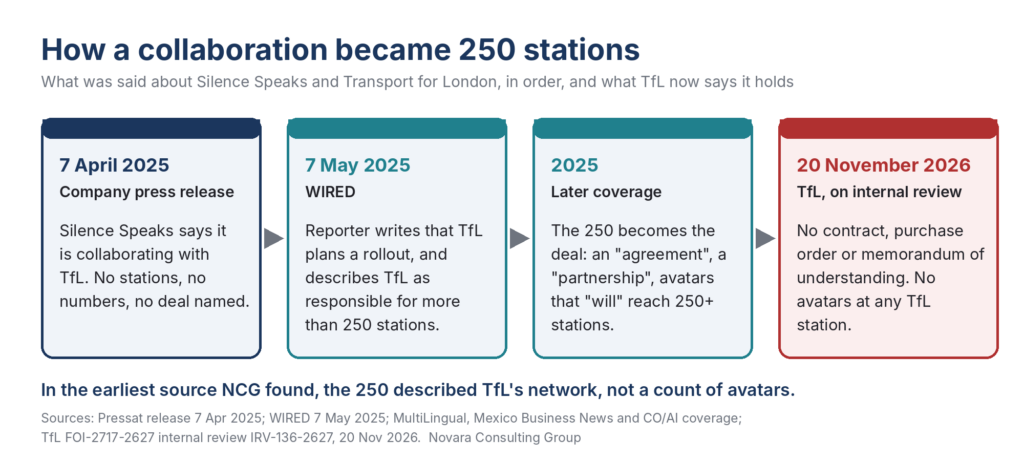
No one in that chain needed to say anything false for this to happen. A company describes a relationship generously, a reporter adds context about the buyer, and the next writer folds the context into the claim. The result is a sentence that reads like a procurement fact and is not one. For a Deaf passenger, the difference matters: a promise of 250 stations sets an expectation of access that, on TfL’s own account, was never contracted.
| Date | Source | What it said about TfL |
|---|---|---|
| 7 April 2025 | Silence Speaks press release | Silence Speaks is collaborating with TfL; no stations or numbers named |
| 7 May 2025 | WIRED (reporter’s narration) | TfL is planning a rollout of displays with QR codes to sign language videos; TfL is responsible for more than 250 stations |
| 2025 | CO/AI | TfL is planning to deploy the avatar across more than 250 stations |
| 2025 | Mexico Business News | An agreement with TfL to bring avatars to more than 250 stations |
| 2025 | MultiLingual | A partnership that will bring AI sign language announcements to over 250 stations |
| 20 November 2026 | TfL internal review | No contract; purchase order or memorandum of understanding; no sign language avatars at any TfL station |
What TfL’s files show
On 9 October 2026, NCG asked TfL four questions under the Freedom of Information Act. The first asked for any contract, purchase order, memorandum of understanding, partnership agreement or pilot agreement between TfL and Silence Speaks from January 2023 onward. The second asked whether Silence Speaks supplied the avatar in Project Luna, the 2024 Overground trial. The third asked for any evaluation of that trial, including feedback from Deaf passengers. The fourth asked how many TfL stations offer a sign language avatar today.
TfL’s first reply, on 4 November, said it held none of the information. It explained that the contract had been managed by Arriva Rail London, the former Overground operator, and that the information predated TfL’s current operators. It did confirm one fact: the trial ran at five stations. The reply treated all four questions as if they were about the Overground trial, including the two that were not.
NCG asked for an internal review the same day. Question 1 was about any agreement with Silence Speaks, not just the trial, and question 4 was about today, which cannot predate anyone. The review panel, made up of staff who had not handled the original request, replied on 20 November. Having consulted the relevant experts, it confirmed that TfL holds no record of a contract, purchase order or memorandum of understanding with Silence Speaks, and that TfL currently has no sign language avatars at its stations.
Currently we do not have any sign language avatars at TfL stations.
TfL internal review, 20 November 2026
The panel went further than the question. It noted that while Silence Speaks’ press release mentions TfL, it says nothing about how the technology is being used at TfL, and it said there had been no liaison with TfL’s press team to support any public comments Silence Speaks may have made.
The care here matters, and it is worth copying from Tim Scannell’s rail work. TfL’s answer shows what TfL says it holds. It does not show that no one at TfL ever spoke to Silence Speaks, and it does not show that anyone acted in bad faith. The panel’s denial also names contracts, purchase orders and memorandums of understanding, but not the partnership or pilot agreements NCG asked about. What it does show is that the paper a buyer would expect behind a 250-station deployment is not in TfL’s files, and that the number of TfL stations with a sign language avatar, in November 2026, is zero.
The trial that did happen
There was a real avatar on TfL’s network, and it was not Silence Speaks’. In July 2024, Arriva Rail London, which ran the London Overground on TfL’s behalf, began trialling Luna, a product of GoMedia, a subsidiary of the rail technology company Icomera. Luna was powered by Signapse, the AI signing company whose avatar NCG has written about at Cincinnati’s airport and on UK rail screens. Passengers at Hackney Central, Hackney Downs, Hoxton, Upper Holloway and Willesden Junction could open a webpage by URL or QR code and see station information, live departures, disruption and announcements in BSL on their own phones. The trial was scheduled to run until September 2024 and then be reviewed.
Luna was paid for with public money. GoMedia developed it through the Department for Transport’s First of a Kind programme, delivered by Innovate UK. In September 2024, GoMedia held a demonstration at Camden Road station, and its own account lists TfL, the Royal National Institute for Deaf People and Innovate UK among the guests, who rode with the app to Hackney Central.
The only results NCG can find are GoMedia’s. It reported that RNID tested Luna earlier in 2024 with 20 participants, including Deaf BSL users and people with hearing loss, and that 16 of the 20 said a network-wide rollout would increase their independence. That is a promotional summary, not an evaluation. NCG has found no published assessment of whether the signing was accurate, whether disruption messages arrived in time, or what happened to the service when the trial ended.
That is what question 3 asked TfL for. TfL’s answer, on review, is that because the trial predates its current operators and TfL was not party to the original contract, no information is held on its behalf. The timing does not quite fit that reasoning. The trial ran under Arriva Rail London, which held the Overground concession for TfL from November 2016 until 2 May 2026. First Rail London took over on 3 May 2026. The trial predates First Rail London, not the concession it ran under.
- Jul 2024Luna trial begins
Arriva Rail London, operating the Overground for TfL, trials GoMedia’s Signapse-powered Luna at five stations.
- Sep 2024Camden Road demonstration
GoMedia demonstrates Luna to guests including TfL, RNID and Innovate UK.
- 7 Apr 2025Silence Speaks release
The company describes itself as collaborating with TfL.
- 7 May 2025WIRED profile
TfL is described as planning a rollout and as responsible for more than 250 stations.
- 3 May 2026New Overground operator
First Rail London takes over the concession from Arriva Rail London.
- 9 Oct 2026NCG asks TfL
Four questions under the Freedom of Information Act.
- 20 Nov 2026TfL internal review
No contract, purchase order or memorandum with Silence Speaks; no avatars at any TfL station; no trial records held.
What is still open
Three things remain unanswered, and each has a next step.
The first is the gap in TfL’s denial. NCG asked about partnership and pilot agreements as well as contracts, and the review did not address them. The second is the search itself. NCG asked TfL to check whether trial records reached it during the concession or at the handover to First Rail London, and whether TfL staff received anything after attending the Camden Road demonstration. The review does not say whether those searches were done. Both points can go to the Information Commissioner’s Office, which since April 2023 has expected complaints within six weeks of an authority’s last response.
The third is the trial’s own record. Luna was funded through a Department for Transport programme delivered by Innovate UK. If an evaluation of Luna exists, including what Deaf passengers said about it, the public bodies that paid for the trial are the next place to look.
Silence Speaks is invited to respond. If the company holds a written agreement with TfL, or can explain what its collaboration with TfL involved, NCG will publish that response and correct any fact this piece gets wrong.
The other half of the map
In October, Tim Scannell published the replies to his own Freedom of Information requests to Network Rail, Govia Thameslink Railway and West Midlands Trains, and NCG wrote them up in Never Signed, or Signed Wrong. His requests showed what the BSL screens already on UK platforms do not cover: spoken announcements, unplanned changes and emergencies. His requests did not reach TfL.
This piece fills in that corner, and the London answer comes one step earlier. Outside London, the question is what the screens sign. Inside TfL’s network, the question is whether the screens exist at all. A Deaf passenger standing on a London platform today has no avatar to watch, whatever the coverage said in 2025.
What to ask before you believe a deployment claim
- Ask for the contract, purchase order or signed pilot agreement, not the press release or the news coverage.
- Ask the buyer, not the vendor, whether the deployment exists and where it runs today.
- Check whether a number in coverage counts deployments or describes the size of the buyer.
- For any trial cited as proof, ask who supplied the avatar, who paid for it and who evaluated it.
- Ask for the evaluation, including what Deaf users said and whether the signing was checked for accuracy.
- Ask what happened when the trial ended, and who decided.