
*Alabama publishes how many deaf and hard of hearing children each of its school systems serves. Set that count beside what the systems publish, and beside the budget lines that are supposed to reach those children, and a different picture of the state emerges than the one its single deaf institution presents.*
Alabama does something most states do not. Every year its State Department of Education publishes the special education child count by school system, by age and by disability. In October 2024 that count showed 842 students whose primary exceptionality was hearing impairment, and a year later it showed 874. The count is the reason this piece can be written at all. In most states the National Deaf Education Data Index can say what school systems publish about deaf students but cannot say how many deaf students those systems hold. In Alabama it can say both, and the two do not line up.
The Index’s Alabama file, version 2.0, read the public website of every one of the state’s 153 local education agencies in October 2026: the 139 city and county systems and the 14 charter agencies the department codes as systems of their own. It then placed each system’s published deaf education content beside that system’s own row in the October 2024 count.
Where Alabama’s deaf children are counted
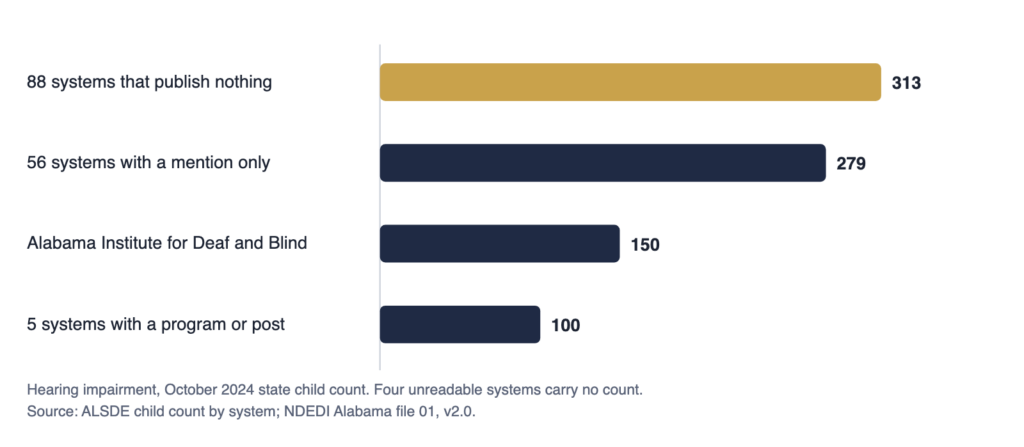
Five systems publish a deaf program or a deaf education post. Mobile County lists the Callahan School for the Deaf and Blind among the schools it operates. Shelby County names a Deaf and Hard of Hearing department. DeKalb, Jackson and Calhoun counties each name a single teacher or specialist for hearing impairment. Together those five systems hold 100 of the 842 students. Fifty-six more systems mention hearing impairment, usually as one line in a list of disability categories, and they hold 279. Eighty-eight systems publish nothing about deaf or hard of hearing students on any page read, and they hold 313. That is more than the Alabama Institute for Deaf and Blind holds, and more than twice what the five publishing systems hold together.
None of the 153 systems names the Institute, the Alabama School for the Deaf or the Institute’s Outreach Instructional Services as its provider. The single exception is Tuscaloosa City, which lists the Institute’s KinderPrep class among its preschool placements. The Institute’s outreach pages say the opposite relationship exists: its providers “travel statewide providing a plethora of services” and attend eligibility and IEP meetings as “a neutral partner.” Both statements can be true. What the public record cannot show is which system’s deaf children those providers actually reach.
**Interpretation, marked as such.** A family in one of the 88 silent systems who goes looking for what their district offers a deaf child will find nothing on the district’s own site, and nothing that points them to the state body that may be serving their child already. “Nothing published” is not “nothing provided.” It is, however, what a parent sees.
One institution, one line for everyone else
The Institute is a body corporate under Title 21 of the Code of Alabama, the state’s official agency for educating deaf and blind children, and it is counted as its own school system, number 600, in the child count. It held 150 of the 842 students in October 2024. Its appropriation in the Education Trust Fund act for fiscal 2027 (HB238, Act 2026-380) is $85,592,459, of which $53,175,088 is Children and Youth Programs, the line that carries the School for the Deaf, the School for the Blind, the Helen Keller School and the outreach service. Alabama families pay no tuition, room or board, and the buses home are free.
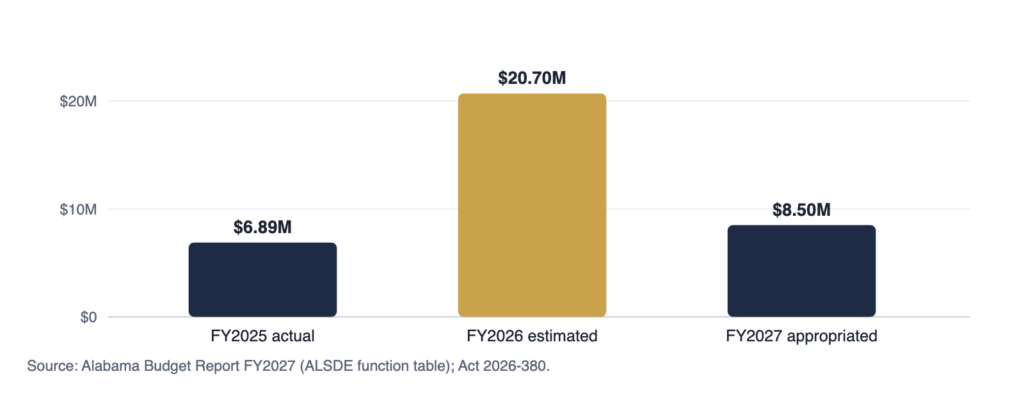
The local systems, which hold the other 692 students, have one deaf-specific line in the same act: “Special Education Licensed Interpreters Deaf/Hard Hearing Teachers,” appropriated at $8,500,000 for fiscal 2026 and again for fiscal 2027. The state’s own Budget Report prints that line three different ways across three years.
The department’s application memo for fiscal 2027, dated 30 July 2026, describes how the money moves. A system must apply, must show it “needs licensed sign language interpreter(s) and/or teachers of deaf/hard of hearing student(s),” and must list by name the students each interpreter and each teacher of the deaf will serve. Each system that applies by the first deadline “will be eligible for at least $55,000.00.” Awards are not renewed automatically. The deadlines for the current year were 21 August and 6 November 2026.
That is a reasonable design. It is also a design whose results are invisible. No page the Index read publishes which systems applied, which were funded, or for how much. At $55,000 a system, $8.5 million reaches at most about 154 awards, or roughly one interpreter or teacher for each of Alabama’s 153 systems if every system applied, and it covers far less than that if any system needs more than one. The federal personnel file counts 92 interpreters working in all of Alabama’s schools in 2023-24. Whether the 88 silent systems are among the applicants is a question the public record cannot answer, and it is the most important one in this file.
Three names in the budget
The Education Trust Fund act names three deaf education bodies outright. The first is the Institute. The second is the Woolley Institute for Spoken Language Education, a private spoken language school, appropriated at $1,000,000 for fiscal 2027 and printed at $1,660,000 actually spent in fiscal 2025. In fiscal 2025 the state spent $6.89 million on interpreters and teachers of the deaf across all of its local systems, and $1.66 million, nearly a quarter as much, on one private program whose work it publishes nothing about.
The third is a line of $198,865 a year for a “Southwest School of Deaf and Blind.” The Index’s v2.0 file recorded it as a body the public record does not identify. Public school directories list a “Southwest Alabama Regional School for the Deaf and Blind” at 3980 Burma Road in Mobile, which is the address of Mobile County’s Sonny Callahan School for the Deaf and Blind, a school the district says serves 46 students. The likeliest reading is that the line funds Callahan under a name the state budget has not updated. The department has not confirmed it, and the Index’s next notice to the department asks it to. If the reading is right, the budget’s naming of a regional school in Mobile is itself a finding: it is the only local deaf program in Alabama with a state line of its own.
A 1931 duty that still sits in the code
Section 21-1-10 of the Code of Alabama, from a 1931 act amended in 2009, places a duty on the parent of any deaf or blind child of compulsory school age who is “unable to make satisfactory progress in the public schools of the community in which such child resides to enroll such child in the Alabama Institute for Deaf and Blind located at Talladega.” The statute assumes a sequence: the local public school first, the Institute when the local school fails. The Institute’s own admissions pages state no such rule and publish no admission criteria beyond the sentence that “All students must meet AIDB admission criteria.”
The federal environments file shows how the sequence plays out in placement. Of 795 school-age students with hearing impairment in fall 2024, 546 were in a regular class for 80 percent or more of the day, 49 were in a separate school and 95 were in a residential facility. The local system is where most deaf children in Alabama go to school. On the evidence of their own websites, most local systems do not say so.
The institution itself is in transition
The Institute’s recent difficulties are on the public record and have been reported. The Examiners of Public Accounts’ report for fiscal 2025 carried four findings, including $264,966.68 in questioned costs on the federal special education cluster and a failure to remit unclaimed property that the auditors had cited in each of the two prior years. In August 2026 the board and President Dennis Gilliam agreed not to renew his contract, and former president John Mascia returned to lead a transition team. Those facts are context, not the subject of this piece. The subject is the 692 deaf children who are not at the Institute, and how little the state’s public record says about them.
What the public record cannot answer
Alabama publishes no newborn hearing screening or loss-to-follow-up figure, and the CDC’s 2022 survey carries no Alabama row. The Institute does not publish enrollment by school, so the Alabama School for the Deaf’s own enrollment is not public. The State Performance Plan reports no outcome for deaf students by category beyond assessment participation. And the allocation of the interpreter and teacher of the deaf line, the one state dollar aimed at deaf children in local schools, is on no page the Index read.
Questions Alabama is positioned to answer
1. Which school systems applied for and received the Special Education Licensed Interpreters and Teachers of the Deaf funds in fiscal 2025 and 2026, and for how much? How many of them are among the 88 systems that publish nothing?
2. What explains the fiscal 2026 estimate of $20,699,904 for a line appropriated at $8,500,000?
3. Is the “Southwest School of Deaf and Blind” line the Callahan School in Mobile? If not, what is it?
4. Which systems does the Institute’s Outreach Instructional Services serve, how many students, and under what agreement?
5. What does the state receive, in program and outcomes, for its appropriation to the Woolley Institute?
The full Alabama file covers every system, charter agency and state body, each row with its source link, retrieval date and method, and is available under the Index’s licensing terms. Corrections are welcome and are published with the next version.
Fontes
Alabama State Department of Education, special education child count by system and exceptionality, October 2024 and October 2025; IDEA Section 618 child count and educational environments, 2024-25, and personnel, 2023-24; State Performance Plan and Annual Performance Report, FFY 2024; Code of Alabama sections 16-39-2 to 16-39-9, 21-1-1 to 21-1-24 and 34-16-5 to 34-16-9; Ala. Admin. Code 290-8-9 and 488-X-1; Education Trust Fund appropriations act for FY2027 (HB238, Act 2026-380); Alabama Executive Budget Office, Budget Report FY2027; ALSDE memorandum FY26-2056, “Fiscal Year (FY) 2027 Special Education Services Application for State Appropriated Financial Assistance,” 30 July 2026; Examiners of Public Accounts, report 26-359 (FY2025); Alabama Institute for Deaf and Blind website, read 6 October 2026; Mobile County Public School System, Callahan School for the Deaf and Blind page; Alabama Political Reporter, 1 July 2026; ABC 33/40, 21 August 2026; The Daily Home, 20 August 2026; National Deaf Education Data Index, Alabama state file 01, v2.0, compiled 6 to 8 October 2026, with its verification trail.
*Heather M. Grizzle is the founder of Novara Consulting Group and principal investigator of the National Deaf Education Data Index. She is DeafBlind.*