
Picture a mother in a small district in west central Minnesota. Her son failed his newborn hearing screen, the audiologist has confirmed it, and he starts kindergarten next fall. One night after the dishes she opens her school district’s website and starts looking for the word deaf. She finds the district’s list of thirteen disability categories, the lunch menu, the bus routes and a notice about interpreters for families who speak another language. She does not find a teacher of the deaf, a program, a phone number, or the name of the cooperative two counties over that will probably end up serving her son.
She is not a real person. She is a composite, and the gap she runs into is the subject of this piece. Minnesota knows how many deaf and hard of hearing children are in its public schools, and it knows how many are in each region of the state. It does not publish how many are in each school district. Set that gap beside what the districts themselves publish, and the state’s regionally organized deaf education system turns out to be very hard for a family to see from the kitchen table.
Where Minnesota’s deaf children are counted
The Minnesota Department of Education’s Data Center publishes the December 1 special education child count by disability, and for deaf and hard of hearing students it is a steady series. The count ran 2,553, 2,544, 2,554, 2,517, 2,492, 2,470, 2,523, 2,552 and 2,623 from December 2017 to December 2025. The deafblind count over the same years ran from 103 to 135. The department’s biennial report to the legislature, Students Who Are Deaf or Hard of Hearing, adds a table of enrollment by region for 2024-25.
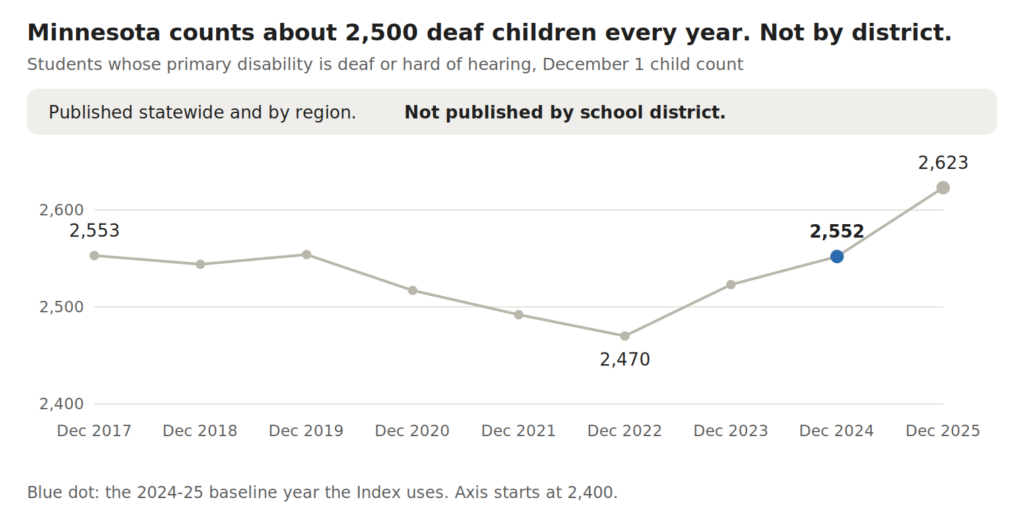
That is where the count stops. Neither the Data Center nor the biennial report carries the December 1 count by school district. The closest thing sits in the back of the 2026 biennial report: for about two dozen larger districts and schools, it prints how many deaf and hard of hearing students took the state’s math and reading tests, such as 31 in Anoka-Hennepin in 2024. That is a floor, not a count. It leaves out preschoolers, students who did not test, and every district with fewer than ten deaf testers, which the report itself says is most districts. In Alabama, which publishes its count by school system, the Index could set each district’s deaf students beside what that district tells families. In Minnesota it cannot. The Index’s measure of publication against identified population, the share of a state’s deaf students who sit in a district that publishes a program, is reported for Minnesota as not computable.
Interpretation, marked as such: the missing number is not missing because the state lacks it. Minnesota pays special education aid to each district partly by multiplying that district’s own December 1 count in each disability area by a fixed dollar amount. To pay the aid, the department works from district counts. It publishes the statewide and regional totals of those counts and stops there.
How the service reaches a child
Minnesota does not run deaf education the way a family might expect, from the district office down. It runs it sideways. The Department of Education’s Workforce and Low Incidence Disabilities unit coordinates eleven regional low incidence projects, and a directory updated in August 2025 names eight facilitators who cover them, each hosted by a different body: the Itasca Area Schools Collaborative in Region 3, Lakes Country Service Cooperative in Region 4, the Zumbro Education District in Region 10, BrightWorks in Region 11, and others. Through those projects run the educational audiologist network, early hearing outreach and the Minnesota DeafBlind Project, which keeps the state’s deafblind census.
Underneath them sit the cooperatives, education districts and intermediate districts that publish most of the state’s deaf and hard of hearing programs, and underneath those sit the districts where children are enrolled. Each layer publishes something, and each publishes less about where deaf children are than the layer above it.
Each layer publishes something, and each publishes less about where deaf children are than the layer above it.
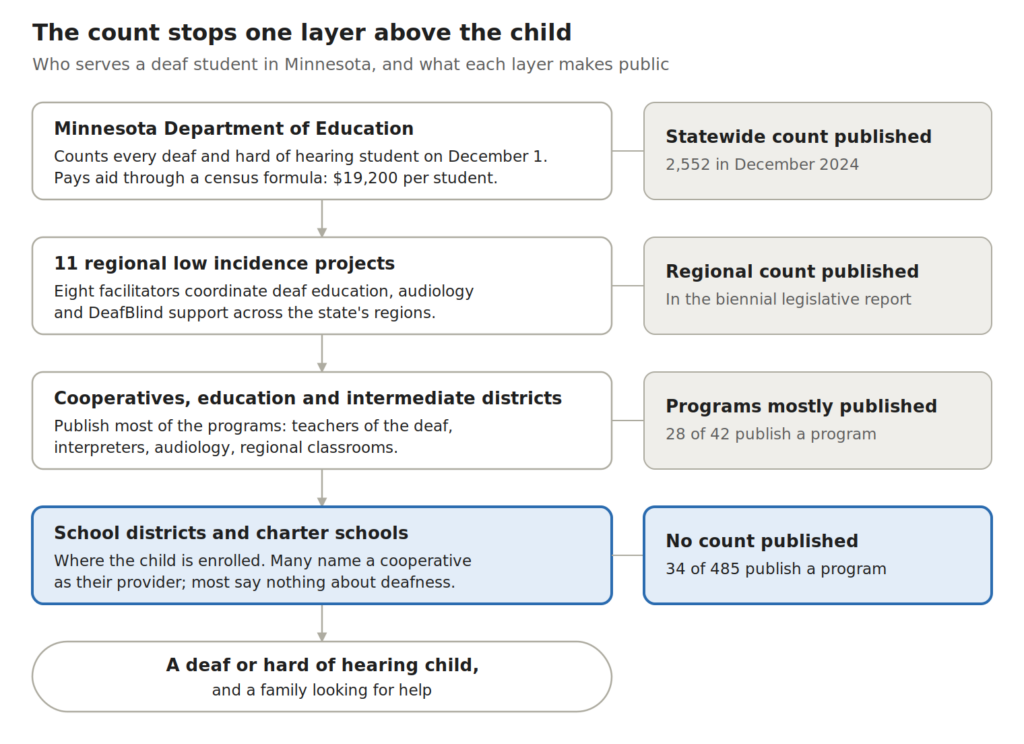
Read from the bottom up, the picture is the one the mother at the kitchen table sees. Her district has no count to publish and, in most cases, no page about deafness. The cooperative that serves her district may publish a full program, but nothing on her district’s site tells her its name.
What 541 units publish
The Index read the public website of every local education agency and cooperative unit in the state in September 2026: 323 independent school districts, 162 charter schools, which Minnesota treats as their own agencies, and the cooperatives, education districts and intermediate districts that serve them. Sixty-five units publish a program, a service or a named deaf education post, 43 of them on the thinner evidence of a named post rather than a described program. Another 121 mention hearing only in a list of disability categories or a screening notice. The other 352 publish nothing on the subject.
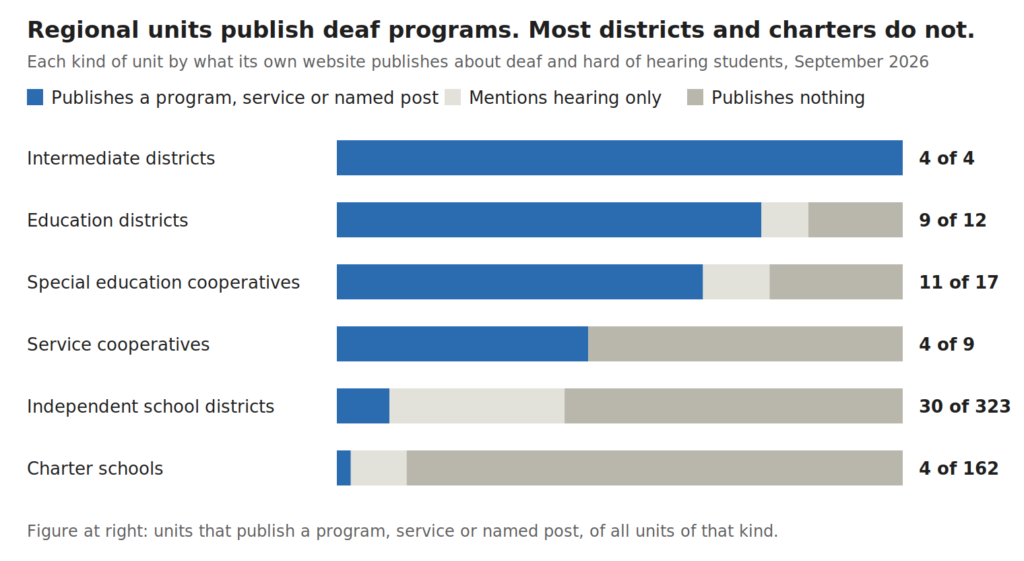
The split by kind of unit is the finding. All four intermediate districts publish a program, and so do most education districts and special education cooperatives. Among independent school districts the share drops to fewer than one in ten, and among charter schools to four of 162, one of them Metro Deaf School. Many districts that publish nothing of their own do name a cooperative or education district as their special education provider, and in Minnesota that provider is where the deaf education service usually lives. A parent reading only the home district’s site will rarely find it.
A program hidden by a dead address
Northeast Metro 916, an intermediate district serving the east metro, runs a full deaf and hard of hearing program. Under its Itinerant and Related Services, at the Quora Education Center in Little Canada, it publishes audiology, an Auditory Oral Program, captionist services, teaching services, sign language interpreter services, signing education assistant services, and after-hours interpreter and intervener services.
The Index nearly coded it as publishing nothing. The website listed for the unit in the state’s own directory no longer resolves, so every automated read came back empty. The program surfaced only when a reader followed the district by hand to its live site at 916schools.org. A family starting from that directory hits the same dead link.
Interpretation, marked as such: in a state that delivers deaf education through regional bodies, a district’s own website is a weak guide to whether a program exists, and a stale address in the state’s directory can hide a strong one. That cuts both ways for the 352 silent units: some are served well through a cooperative they never name, and the public record does not say which.
The money follows a count the public cannot see
Minnesota funds special education partly through a census model. Section 125A.76, subdivision 2a, of the Minnesota Statutes gives each primary disability area a fixed dollar factor and multiplies it by the December 1 child count. That product is not paid out directly: a district’s initial aid is the least of three amounts, and this census calculation, taken at 56 percent and adjusted for program growth, is only one of them. For deaf and hard of hearing students the factor is $19,200, a rate the statute shares with emotional or behavioral disorders. For deafblind students it is $25,200. A House Research guide from November 2025 prints the deaf and hard of hearing factor as $19,100; the statute as served reads $19,200, and the Index records the conflict rather than choosing between them. The 2026 legislature amended the same section at a different subdivision, the homeless pupil aid, and left the census factors as they were.
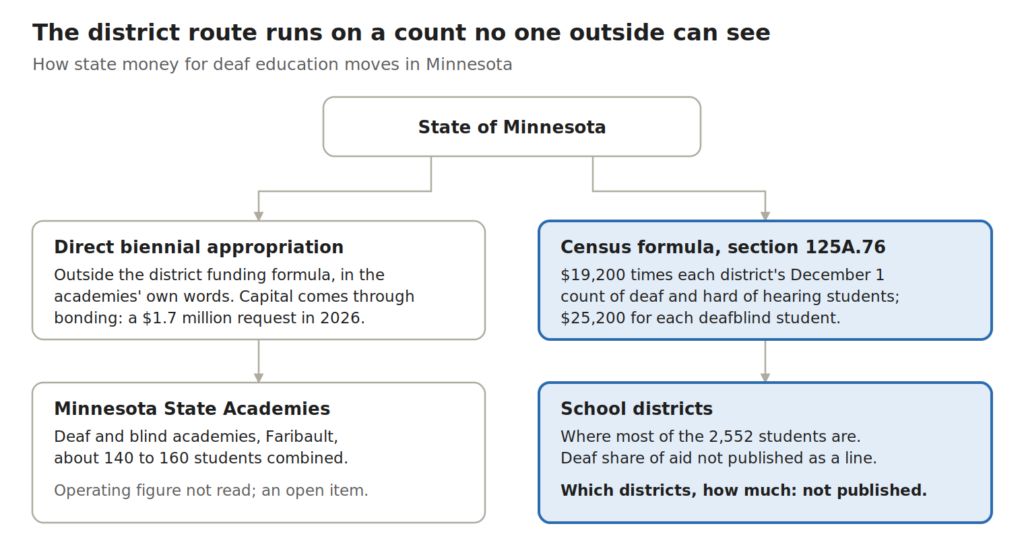
The formula is a reasonable design, and it says something plain: Minnesota attaches a dollar figure to each deaf child, and the figure travels with the child’s district. What it does not produce is a public answer to where that money lands. The deaf and hard of hearing share of total special education aid is not published as its own line, and with no district count published, no outside reader can tie the aid to the districts that receive it. A district that publishes nothing about deaf students may be drawing aid for several of them.
The Minnesota State Academies sit outside that formula altogether. They are funded by a direct biennial appropriation, in the academies’ own words “rather than by the funding formula that is applied to other districts in the state.” The operating figure was not read to a number in this run and is an open item. The commission’s 2026 legislative outcomes list a $1.7 million bonding request for the academies’ campus repairs and accessibility; whether the enacted bonding law carried it is still to be confirmed.
Two schools a family can name
Minnesota decided early that deaf children were the state’s business. In 1858, the year it became a state, the first legislature proposed what the language of the day called a “deaf and dumb asylum” for Faribault. The 1863 legislature authorized it, hired Roswell H. Kinney away from the Ohio school as the first superintendent, and opened classes on the second Wednesday of September 1863, in the middle of the Civil War. The school has been on that Faribault campus ever since.
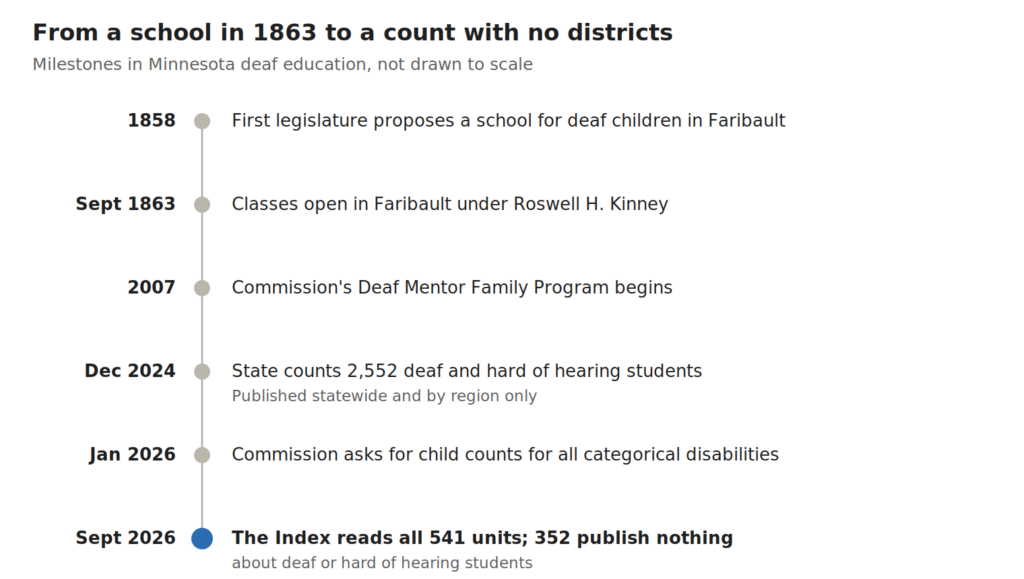
Today it is the Minnesota State Academy for the Deaf, a state agency run with the Minnesota State Academy for the Blind under one seven-member governing board appointed by the governor, with one seat reserved for the Deaf community and one for the blind community. It serves students from birth through age 22 in a signing environment, with a residential program on campus, and placement runs through the home district’s IEP team under section 125A.68, at no charge to the family. The academies publish a combined enrollment of “approximately 140-160 students” in most years. A figure for the deaf academy alone is not on its public pages.
The second is Metro Deaf School in St. Paul, a public charter school authorized by the University of St. Thomas, teaching in American Sign Language and spoken and written English. Its own annual reports put enrollment at 173 in 2024-25 and 176 on 18 September 2025. Its About Us page still listed its charter contract as “Contract 2020-2024” when the Index read it in September 2026.
Together those two schools hold a few hundred of the state’s 2,552 identified students. The rest are in their home districts, or in programs run for those districts by cooperatives and intermediate districts. No state document tells a family how to choose among the academy, a district or regional program, and the charter school. Placement criteria are unpublished in Minnesota, a gap that runs through the Index’s state files.
One or two programs to train the teachers
Minnesota licenses teachers of the deaf on sign language. Minnesota Rules 8710.5200, the Deaf or Hard of Hearing license for birth through age 21, requires American Sign Language proficiency at the Intermediate-Plus level of the Sign Language Proficiency Interview. A companion license at 8710.5250 covers oral and aural deaf education and still requires six ASL credits or a survival-level rating. The department’s biennial report counts 231 teachers of the deaf and hard of hearing and 43 oral and aural teachers in service statewide.
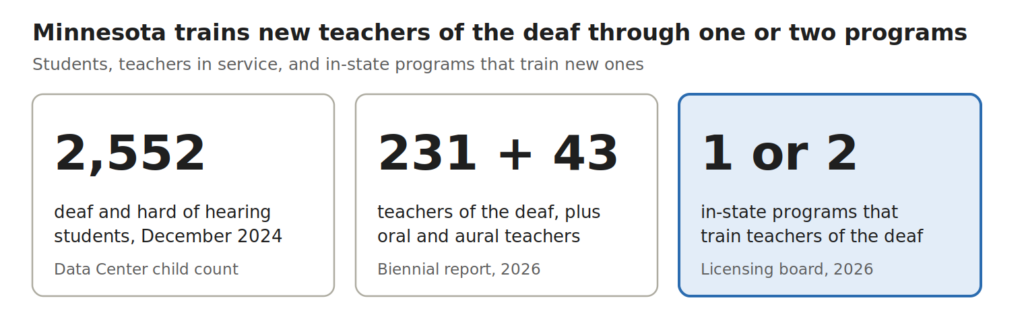
The pipeline behind them is narrow. The Professional Educator Licensing and Standards Board states that Minnesota has “only one or two programs” leading to a deaf and hard of hearing license, and none at all for blind or visually impaired, and it publishes a chart of out-of-state options in their place. The confirmed in-state route is the University of Minnesota’s Master of Education with the B-12 Deaf or Hard of Hearing license. Educational interpreters are held to national certification under section 122A.31. The state’s federal personnel counts for interpreters and audiologists were not read to figures in this run, so the Index computes no ratio and makes no claim about adequacy.
The state’s own commission questions the count itself
The Minnesota Commission of the Deaf, DeafBlind and Hard of Hearing, the statutory body that advises state government under chapter 256C, adopted its 2026 Public Policy Agenda on 16 January 2026. Under education it asks for “Child counts for all categorical disabilities.” Its concern is a different gap from the one this piece describes, and it compounds it. Because each student is counted under a single primary disability, the Commission says, children who have more than one disability may be missing from the deaf and hard of hearing and DeafBlind categories altogether. The statewide count, in other words, is likely low before anyone asks where the children are. The same agenda asks for standardized language assessment for children from birth to age five, and its education pages carry an item for improved education data collection.
The commission’s education pages also describe the Deaf Mentor Family Program, in existence since 2007, which pairs families with Deaf adults who teach American Sign Language and Deaf culture, and which the page says is stretched to support about 100 children and their families across the state. Between the mentors, the regional low incidence facilitators, the cooperatives and the two named schools, Minnesota has built a great deal of deaf education infrastructure. What it lacks is a public map that connects that infrastructure to the children it is built for.
Go back to the mother at the kitchen table. Everything she needs exists somewhere in Minnesota’s public record: a statewide count that says her son is one of about 2,500, a regional facilitator whose name is in a directory she has never heard of, a cooperative that may publish a full program, a state academy with a residential campus, a charter school in St. Paul. What does not exist is the one line that would connect them for her, a district count that says her district has deaf students and a page that says who serves them. The commission has asked for the first half of that.
Questions Minnesota is positioned to answer
- How many students with a primary disability of deaf or hard of hearing, and of deafblind, does each district count on December 1? The census-based aid formula suggests the department already holds them.
- Which districts does each regional low incidence project and each cooperative serve for deaf and hard of hearing students, and how many students in each?
- How many students does the Minnesota State Academy for the Deaf enroll on its own, apart from the blind academy?
- What is the academies’ operating appropriation for the current biennium, and did the 2026 bonding law carry the $1.7 million request?
- Will the department update the directory address that hides Northeast Metro 916’s program, and check the directory’s other listed sites?
- What guidance, if any, does the state give an IEP team or a family choosing among the academy, a district or regional program, and Metro Deaf School?
The full Minnesota file covers every one of the 541 units, each row with its source link, retrieval date and method, and is available under the Index’s licensing terms. Corrections are welcome and are published with the next version.
Heather Grizzle-Odland is the founder of Novara Consulting Group and principal investigator of the National Deaf Education Data Index. She is DeafBlind and lives in Minnesota.