
Sixteen
Eli turned sixteen in October. He is the Deaf, autistic, largely nonspeaking student from part seven whose team has spent years building his communication through a combination of ASL signs, a speech-generating device and pictures, and whose placement part eleven described: the regional deaf and hard of hearing program, with consultation from the autism team.1 His annual review that winter was his first under the federal rule that a student’s IEP must include a transition plan by the time he turns sixteen.
Pine Lake’s platform drafted the transition section the way it had drafted everything else in Eli’s file. It produced three postsecondary goals: “After graduation, Eli will participate in on-the-job training in a community setting. After graduation, Eli will obtain employment in the community with supports. After graduation, Eli will live with family and participate in community activities.” Beneath them, it listed transition services: career exploration, a vocational assessment, instruction in daily living skills and a referral to vocational rehabilitation in his final year. The section cited, as its transition assessment, an online career interest inventory Eli had completed in the fall with a paraprofessional, choosing between pairs of pictures.
None of it was wrong in form. Each goal was measurable in the loose sense transition goals usually are. The services were the services most transition plans list. What the section did not contain was anything Eli wanted, anything about where he could use his language as an adult, or any adult who shared it. His mother read the draft and asked a question no one at the table could answer from the document: what does Eli like to do? The answer, as his teacher of the deaf knew and the platform did not, was sorting and organizing. He had spent two years running the program’s classroom library, signing the categories to the younger children, and he was very good at it.
What the Law Requires at Sixteen
The federal transition requirement is specific. Beginning not later than the first IEP to be in effect when a child turns sixteen, or younger if the team decides, the IEP must include appropriate measurable postsecondary goals based on age-appropriate transition assessments related to training, education, employment and, where appropriate, independent living skills, and the transition services, including courses of study, needed to help the child reach those goals.2 The district must invite the student to any IEP meeting where transition is considered, and if the student does not attend, must take other steps to ensure his preferences and interests are considered.3 With the parent’s consent, or the student’s once he reaches the age of majority, the district must also invite a representative of any agency likely to provide or pay for transition services.3
Two more requirements come at the end. At least a year before the student reaches the age of majority under state law, the IEP must say that he has been informed of the rights that will transfer to him.4 And when a student’s eligibility ends because he graduates with a regular diploma or ages out, the district must give him a summary of his academic achievement and functional performance, with recommendations on how to help him meet his postsecondary goals.5 That summary, usually called the summary of performance, is often the last document a school writes about a student and the first one an adult agency reads.
The emphasis on the student is the point of the rule. A transition plan is the one part of an IEP that is explicitly about what the student wants for his own life, and the law requires the team to ask him. It is also, for that reason, the part of the IEP a generator is least able to write. A generator can write the most common postsecondary goals for a student with Eli’s profile. It cannot ask Eli what he wants, in his language, and listen to the answer.
Where Deaf Graduates Go
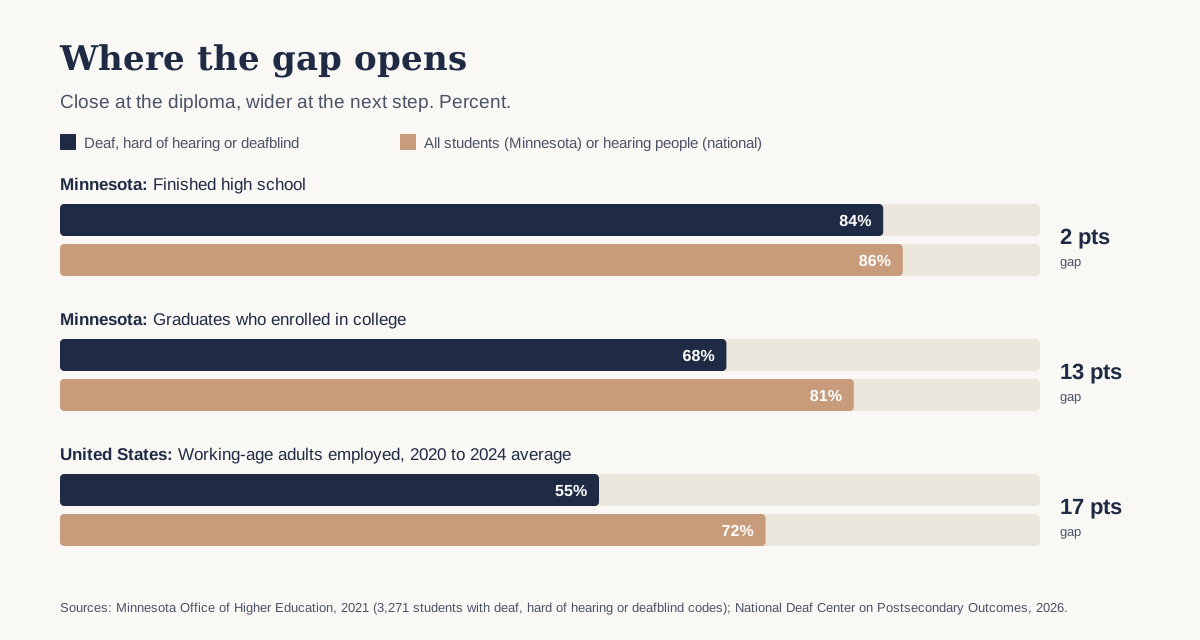
The stakes are visible in the outcomes. The National Deaf Center on Postsecondary Outcomes, analyzing federal census data, reports that about 55 percent of deaf people of working age were employed on average over 2020 to 2024, against about 72 percent of hearing people, and that the deaf employment rate reached a record 58 percent in 2024.6 The Center also reports that deaf employment rates have grown faster than hearing rates over the past decade, that deaf and hearing full-time workers have the same median income, and that employed deaf adults are somewhat more likely than hearing adults to be self-employed, 11 percent against 9.6 The gap is real and it is narrowing, and what happens in the last years of school is one of the few levers a public system has on it.
Minnesota looked at its own students. A 2021 study by the Minnesota Office of Higher Education followed 3,271 students with deaf, hard of hearing or deafblind disability codes through the state’s longitudinal data system. It found that 84 percent completed high school, close to the state’s overall rate of 86 percent, but that 68 percent of those graduates enrolled in postsecondary education, against 81 percent of all Minnesota students. Of those who enrolled, 39 percent earned a credential within the study period, and 17 percent of those credentials were bachelor’s degrees.7 The point at which the numbers diverge most is the step after high school, which is the step a transition plan exists to prepare.
The Generated Transition Plan
The transition section of an IEP is unusually exposed to generation, for two reasons. The first is that it depends on a transition assessment, and the assessments most often used are inventories and questionnaires that produce the kind of structured output a generator reads best: interest areas, preferred work environments, ratings of independent living skills. The second is that postsecondary goals, unlike academic goals, tend to be written in a small number of standard forms: the student will enroll in a two-year or four-year college, will complete a vocational training program, will obtain competitive integrated employment in a field related to his interests, will live independently or with support. A generator given an inventory and a template produces a plausible plan in seconds.
For a deaf student, both reasons cut the wrong way. The inventory is usually completed in written English or, for a student like Eli, through picture choices with an adult who may not sign. It records the student’s answers to questions written by people who did not have him in mind, in a language that may not be his. And the standard goals assume a world in which the student’s language is the one everyone at the training program and the workplace speaks. A plan that says Marcus will complete a vocational training program says nothing about whether the program will have an interpreter. A plan that says Eli will obtain employment in the community with supports says nothing about whether anyone in that community will be able to understand him.
The generated plan is also, in an important sense, the path of least resistance for the systems that will receive the student. A plan that names a referral to vocational rehabilitation in the final year, and nothing more specific, asks nothing of that agency in advance. A plan that names a specific workplace, a specific Deaf mentor, a specific accommodation and a specific agency contact at sixteen asks a great deal, and the asking is the work. A generator does not ask. It describes.
Eli and the Shortest Path
For a student like Eli, the generated plan carries a particular risk. Deaf autistic young adults who communicate through sign and devices have, historically, been among the people most likely to be routed after school into segregated settings: sheltered workshops, day programs and, in many states until recently, work at wages below the federal minimum. Federal law changed in 2014 to slow that route. Section 511 of the Rehabilitation Act, added by the Workforce Innovation and Opportunity Act, bars an employer from paying a worker with a disability aged twenty-four or younger less than the minimum wage unless the young person has first received transition services or pre-employment transition services, applied for vocational rehabilitation, and been given the chance to pursue competitive integrated employment, among other conditions.8 The law exists because the shortest path from a vague transition plan often led somewhere no one had chosen.
“Employment in the community with supports” can mean a job at a real wage alongside coworkers without disabilities, with an interpreter or a job coach who signs. It can also, in practice, mean a placement in whatever program has an opening when the student ages out. The generated goal does not distinguish between them, and the services it listed would not prepare Eli for the first.
His team rewrote the section around what he does well. His postsecondary employment goal became work in inventory, sorting or library and archive settings, the kind of work he already does in his classroom. His transition services became specific: a work-based learning placement in his last two years, first in the school’s own library and then at a county library branch where one staff member signs; instruction in using his device and signs to communicate with coworkers and customers, built around the vocabulary of that work; a Deaf adult mentor through the state’s deaf services division; and an invitation, with his mother’s consent, to a vocational rehabilitation counselor to attend his IEP meeting that spring. His independent living goal named the skills his mother wanted most, and a timeline.
None of that came from the inventory. It came from the people who had watched Eli run a library for two years, and from asking him, in his signs and on his device, what he wanted to do. He chose the library.
Two Cases on the Shortest Path
The risk in a transition plan nobody wrote with the student is not hypothetical, and courts and federal enforcement have both said so. The clearest judicial treatment is a 2016 decision of the Sixth Circuit, Gibson v. Forest Hills Local School District Board of Education.9 Chloe Gibson was a young woman in an Ohio district with a developmental disability that affected her motor skills and caused adaptive and cognitive delays, compounded by a seizure disorder. Her IEPs included transition plans, in the sense that the documents had the sections the regulations required. What they did not have was Chloe. The district never invited her to the IEP meetings where her transition was discussed. It took no meaningful steps to learn what she wanted. And it did not conduct age-appropriate transition assessments until she was nineteen, three years after the federal requirement had begun to run. Her employment goal, written into those plans, was a supportive work environment in noncompetitive work, a goal the court observed effectively ruled out integrated employment before anyone had asked whether she could do it.
The court’s reasoning is worth reading closely, because it separates the procedural failures from the harm. Failing to invite Chloe to her meetings, standing alone, would not have denied her a free appropriate public education. But failing to consider her preferences and failing to assess her did, because those failures cost her a real chance at supported employment in a community setting. The court affirmed that she had been denied an appropriate education on that basis.9 The holding translates directly into the setting of this series. A generated transition plan that cites an inventory as its assessment and lists the standard goals has the form of compliance. Whether it has the substance depends on whether anyone used the assessment to learn what the student wanted, and whether the goals came from that. Chloe’s plans failed on both counts without any software involved. A generator makes the same failure faster, cleaner and easier to sign.
The second case is larger and was brought by the federal government. In 2013 and 2014, the Department of Justice reached agreements with Rhode Island and the City of Providence under the Americans with Disabilities Act and the Supreme Court’s Olmstead decision, which treats unnecessary segregation of people with disabilities as discrimination.10 The investigation began with a single facility-based provider and a sheltered workshop operated inside a Providence high school. It found that students in Rhode Island schools were often not offered meaningful choices about work after school, which placed them at serious risk of placement in segregated workshops, where workers earned an average of $2.21 an hour and often stayed for many years or decades.10 The statewide consent decree announced in April 2014 covered about 3,250 people with intellectual and developmental disabilities: about 2,000 adults in segregated programs, who were to be offered real jobs at competitive wages averaging at least twenty hours a week, and about 1,250 students who over ten years would receive transition services starting at age fourteen, including internships, job site visits and mentoring.10
Neither case involved a deaf student, and neither involved a generator. Both describe, in the record of a court and of a federal investigation, the route a vague transition plan opens: a student whose plan was written around the services available rather than around her, who leaves school into the setting with an opening. The Rhode Island decree’s remedy reads like a list of what Eli’s and Marcus’s rewritten plans asked for. Transition beginning at fourteen. Work experience in real workplaces. Mentors. Its findings read like a description of what happens when no one asks.
Marcus Wants to Be an Electrician
Marcus is seventeen, Deaf, a fluent signer from a Deaf family, and a junior at Pine Lake’s high school. He has an interpreter in his classes and does well in them. He has wanted to be an electrician since he was ten, when he spent a summer helping his uncle, who is Deaf and a licensed electrician in another state.
His generated transition plan said that after graduation Marcus would enroll in a postsecondary education or vocational training program and would obtain competitive integrated employment in a field related to his interests, which the inventory listed as “building and construction.” It recommended career exploration and a vocational assessment.
What Marcus needed, according to Marcus, his parents and his uncle, was concrete. He needed to know whether the electrical apprenticeship programs in his state accept Deaf apprentices and provide interpreters for classroom instruction, and who pays. He needed work-based learning on a job site, with an interpreter, before he graduated, so that he and an employer could both see that it worked. He needed to know what the state’s licensing exam allows by way of accommodations. And he needed to meet Deaf tradespeople in his own state, so that the path his uncle had taken somewhere else was visible to him here.
Every one of those needs is answerable, and almost none of them are answered by a school alone. Under the Americans with Disabilities Act, apprenticeship programs and employers have their own obligations to provide reasonable accommodations, including interpreters, and the adult system Marcus will enter has its own agencies and funds for the purpose. Vocational rehabilitation is the agency whose job is to connect a student like Marcus to those systems before he leaves school. His generated plan referred him to it in his final year. His rewritten plan invited the vocational rehabilitation counselor to his IEP meeting that winter, at seventeen, with a list of questions attached.
The Counselor at the Table
The vocational rehabilitation counselor who came to Marcus’s IEP meeting that winter had read his file before she arrived. She said so, and she said how. Her agency, like a growing number of public agencies, had begun using software to summarize the records that arrive with a referral, so that a counselor with a large caseload can see at a glance what the school has said about a student. The summary of Marcus’s file described a student with a hearing impairment, strong grades, an interest in building and construction and a transition plan calling for career exploration and a vocational assessment. It was an accurate summary of the generated plan. It was not an accurate summary of Marcus.
The counselor’s first question was about the vocational assessment. Her agency could provide one, she said, and the school’s plan seemed to expect it. Marcus’s father, signing through the interpreter, asked what it would assess. Marcus had known what he wanted to do for seven years. He had spent summers on job sites with a licensed electrician. What he did not know was whether the state’s apprenticeship programs would take him, and what he needed was not an assessment of his interests but a meeting with the people who ran them. The counselor agreed, changed her notes and asked the school for something the platform had not produced: a short account, written with Marcus, of what he had already done.
The exchange took ten minutes, and it is the kind of exchange that does not happen when the counselor is first invited in the student’s final semester, or never meets the family at all and works from the record alone. It is also the hinge between this book and the next. A school’s generated plan was read by an agency’s generated summary, and the two together described a student who needed to be assessed. The student in the room needed to be introduced. The only thing that corrected the record was a conversation, held in the student’s language, with the adults who knew him, at a meeting the law permits but does not require to happen early.
Pine Lake asked the counselor afterward whether her agency would accept a student-written profile alongside the school’s records, as a document the student owned. She said she would welcome one, and that she would rather read the student’s own account first and the school’s second. Dana added it to the summary of performance rule: every deaf or hard of hearing student would leave with a profile of a page or two, written by the student, describing what he wanted, what he had done and what he needed, which he could give to any agency, college or employer himself.
Owen at Sixteen
Owen, the hard of hearing seventh grader from parts seven, eight and ten, is four years from his first transition plan, and his story belongs here anyway, because the most important transition skill for him was written into his IEP long before the transition section existed.11 Part ten described the goal his mother asked for and his team added: that Owen would advocate for his own access, telling a new teacher how to use his remote microphone, asking classmates to repeat what he missed, checking captions before videos and reporting equipment problems.
When Owen leaves high school, his IEP ends. If he goes to college, no team will meet to plan his accommodations. He will have rights under the Americans with Disabilities Act and Section 504, and the college will have obligations, but he will have to request his accommodations himself, through the college’s disability services office, with documentation, every term. If he goes to work, the same will be true with his employer. The self-advocacy goal written for him at twelve is, in that light, the most important transition service in his file, and it is the kind of goal part ten showed a generator would never propose, because his data recorded its absence only as a pattern of failures attributed to something else.11
A transition plan for a hard of hearing student who uses spoken English looks different from Marcus’s or Eli’s, and it should. The question the plan must answer is the same: what will this student need to succeed in the place he is going, and who will have taught him to ask for it?
Jordan at Fourteen
Jordan, the DeafBlind student from part seven, is fourteen, and under the rule Pine Lake adopted her transition planning began this year.1 She has Usher syndrome. She was born deaf, signs fluently, and is losing her peripheral vision; her eye doctor expects the loss to continue. Her transition plan therefore has to plan for a body that will not be the same at twenty-four as it is at fourteen, and for a young woman who will need, as an adult, skills she does not yet need as a student: tactile sign, orientation and mobility training, braille or large print, and the confidence to direct a support service provider.
Pine Lake’s platform produced a transition section for Jordan in the same form as Eli’s. It drew on her interest inventory, which she had completed on a tablet with enlarged text, and it proposed goals in postsecondary education and competitive employment, both reasonable for a student of her ability. What it did not do was account for the progression of her vision loss, because her file recorded her current visual acuity and nothing about its trajectory. It proposed a vocational assessment that relied heavily on visual tasks. And it listed none of the specialized resources that exist for DeafBlind young people, including the Helen Keller National Center for DeafBlind Youths and Adults, a federally funded national program, and her state’s deafblind project, which serves children and youth and helps families plan the move to adult services.
Her team, which now includes a teacher of the visually impaired and the state deafblind project’s family specialist, rewrote the plan around the questions Jordan and her mother asked. What will I need to learn now, while I can still see enough to learn it visually, that will help me later? Who are DeafBlind adults doing the work I want to do? What does a college need to know about me, and how do I tell them? Those are transition questions in the fullest sense, and none of them could be answered from a file that described only who Jordan is today.
The Handoff Nobody Owns
Transition is a handoff between systems, and handoffs are where records matter most. When a student leaves school, the IDEA no longer applies to him. The adult systems that may serve him, vocational rehabilitation, postsecondary disability services, state services for deaf and deafblind adults, Social Security, operate under different laws, with different eligibility rules and different documents. The school’s transition plan and summary of performance are the bridge.
Vocational rehabilitation is the most important of those systems for transition, and federal law has tried to bring it into the school years. Each state’s vocational rehabilitation agency must reserve at least 15 percent of its federal allotment for pre-employment transition services for students with disabilities, which can begin while the student is still in school and are available to students who are potentially eligible, not only to those who have applied.12 The law requires five services: job exploration counseling, work-based learning experiences, counseling on opportunities for enrollment in postsecondary education, workplace readiness training, and instruction in self-advocacy.12 Those five are, very nearly, what Eli’s and Marcus’s rewritten plans asked for. Many families of deaf students have never heard of them, and a generated plan that refers the student to vocational rehabilitation in his final year leaves most of the window for them unused.
There is a further reason the handoff matters for this series. When a vocational rehabilitation agency determines whether a person is eligible for its services, it is directed to use existing data, including education records, to the maximum extent appropriate.13 That is sensible: it spares the person repeated evaluations. It also means that the school’s records about a student become the adult system’s first evidence about him. If those records were written by software, from data that described a deaf child in a language she does not use, the adult system inherits the description. Part nine called this “two machines, one child” within a school: an AI-drafted evaluation feeding an AI-drafted IEP.14 At transition, the second machine may belong to another agency entirely.
Rights That Transfer at Eighteen
The last requirement of the transition rule is the one most often reduced to a sentence. At least a year before a student reaches the age of majority, his IEP must state that he has been informed of the rights that will transfer to him when he turns eighteen.4 In most states, unless a court has appointed a guardian, the student then becomes the person who consents to evaluations, attends and directs his own IEP meetings, receives notices and decides whether to challenge them. The rights under the IDEA and under FERPA move from the parent to the student.
Pine Lake’s platform handled the requirement in the way the requirement invites. It inserted a standard statement into the IEP of each student approaching seventeen: the student has been informed of the rights that will transfer at the age of majority. The statement was accurate in form. For Marcus, it was also accurate in fact; his interpreter had translated a conversation with his case manager about it. For Eli, no one could say when or how he had been informed, in what language, or with what understanding. The sentence recorded an event that had not, in any meaningful sense, taken place.
The transfer of rights is, for a student like Eli, the beginning of one of the most consequential decisions his family will make: whether to seek guardianship, to use a less restrictive arrangement such as supported decision-making, which a growing number of states now recognize, or to leave his rights with him and support him in exercising them. That decision should be made with Eli, in his signs and on his device, with time. A generated sentence that says he has been informed lets everyone believe the conversation happened. Pine Lake’s rule became that the statement could not be entered until the case manager recorded the date of the conversation, the language in which it took place and who was present, and for Eli that conversation took three sessions, with his teacher of the deaf and his mother, over a month.
The Summary That Follows Them
The summary of performance is the clearest example. It is required at exit, it is supposed to summarize the student’s academic achievement and functional performance and recommend how to help him reach his postsecondary goals, and it is just the kind of document a platform can assemble from the file in seconds.5 For Nora, had Pine Lake generated one before the hearing in part six, it would have described a student with significant delays in receptive and expressive language, because that is what her file said for three years.15 Every adult agency that read it would have started from that description.
That is the strongest argument in this series for writing the summary of performance by hand, with the student. It is the document that crosses the boundary between the school and everything after it. It will be read by people who have never met the student, who have no access to the school’s drafts or audits, and who have every reason to treat it as the authoritative account of who the student is. A generated summary that carries a mistaken finding into adult life does more damage than any other generated document, because there is no longer an IEP team to catch it.
Pine Lake’s rule became that the summary of performance for every deaf or hard of hearing student would be written by the teacher of the deaf with the student, in the student’s language, and reviewed by the student and the family before it was signed. It includes a section, written in the student’s own words, on what he needs to succeed and how he asks for it. That section is the one adult agencies told Dana they read first.
Miguel Perez, Again
Part eleven told Miguel Perez’s story as a placement case: a deaf student in regular classes for years with aides who were not trained in sign language and were often absent.16 It is also a transition case, and the most painful kind. According to the reporting on the Supreme Court’s decision, Miguel’s grades were As and Bs, and his parents believed he was on track to graduate. Near the end of his last year, they were told he would not receive a diploma.17
A transition plan written with Miguel, in his language, would have had to answer questions his record never answered: what he wanted to do after school, what he would need to get there, and whether he had the skills, in reading and writing and in his own language, that those plans required. Those questions would have brought the gap between his grades and his learning to the surface years before the last semester. The settlement his family reached paid for him to attend the Michigan School for the Deaf, which is to say, to begin again.17 The Supreme Court’s decision let him seek damages under the Americans with Disabilities Act for what had been lost. Neither could give him back the years in which no one asked.
What Pine Lake Changed
Dana’s changes to the transition section were the simplest of the series to describe and the hardest to staff. The platform would not generate postsecondary goals or the summary of performance for any deaf or hard of hearing student. Transition planning would begin at fourteen, not sixteen, for every deaf or hard of hearing student, which the federal rule permits. Every transition meeting would include the student, with an interpreter or in the student’s language, and the team would record the student’s own goals in his own words before any services were planned. A vocational rehabilitation counselor would be invited, with consent, at the first transition meeting, not the last, so that pre-employment transition services could begin while there was time to use them. And each student would be connected, before graduation, with at least one Deaf or hard of hearing adult working in or studying toward the field the student had named.
That last rule was Marcus’s uncle’s idea. He came to Marcus’s IEP meeting by video, from another state, and told the team that the most useful thing anyone had done for him at seventeen was introduce him to a Deaf electrician. No platform would have proposed it. Every team at Pine Lake could do it.
The rules had costs, and Dana was candid about them with the board. Beginning transition at fourteen added a planning section to roughly twice as many IEPs. Writing the summary of performance by hand, with the student, took the teachers of the deaf several hours per graduating student, in the busiest weeks of the year. Inviting a vocational rehabilitation counselor to every first transition meeting meant coordinating with an agency whose counselors carried large caseloads of their own, and some meetings went ahead without one. The connections to Deaf and hard of hearing adults depended on relationships that the district did not have and had to build, county by county, through the state’s deaf services division, a Deaf-led community organization and the families themselves. None of this was paid for by the platform license, which had been sold in part on the time it would save. Dana’s argument to the board was that the time the platform saved on transition sections was time the district had never been entitled to save. The law asks the team to plan with the student. A section that took seconds to generate and minutes to sign was evidence that the planning had not happened, and the district would be the one to answer for it, in a hearing like Chloe Gibson’s or in the outcomes of its graduates. The board approved the staffing. It also asked for something the district had never collected: a follow-up, one year after exit, on where each deaf or hard of hearing graduate was.
The End of Book Two, and What Comes Next
Book One of this series followed one AI-drafted IEP from the draft to a due process hearing and asked whether anyone could tell what a human had done to it. Book Two has followed six deaf and hard of hearing students through every stage of special education where software now writes or decides: the special factors, the screener, the evaluation, the goals, the placement and now the transition plan. At every stage, the finding has been the same. The tools do roughly what they are designed to do, often well. They work from the information in the file. And for a deaf child, the information that matters most, what language she uses, who can talk to her, what she can see and hear, what she wants, is the information least likely to be in the file.
At transition, the file leaves the school. It goes to vocational rehabilitation agencies, to colleges, to state services for deaf and deafblind adults, to employers. Those systems are adopting the same kinds of tools: software that drafts case notes, summarizes records, scores eligibility and recommends services. They will read what the schools wrote. The next volume of this series, AI x VR, follows the file across that line, into the adult systems where the question changes from whether a deaf child gets an appropriate education to whether a deaf adult gets work, and where the records that followed her there were written by people, or by machines, who may never have asked her what she wanted.
The record is not the child. It is not the adult either. And a transition plan nobody asked her about is not a plan for her life.
Questions for Governance Review
These questions are written for school boards, special education directors, state education agencies, vocational rehabilitation agencies, vendors and families. They are meant to be asked with real transition plans and summaries of performance on the table.
- Ask that transition planning begin at fourteen, and that the student lead it in his own language.
- Make sure the student’s own goals are written in the plan in his own words.
- Ask the district to invite a vocational rehabilitation counselor now, with your consent, and ask about pre-employment transition services.
- Ask for work-based learning in the field the student wants, with the communication access he will need there.
- Ask the team to connect the student with a Deaf or hard of hearing adult in that field.
- Ask who will write the summary of performance, and ask to review it with the student before it is signed.
- If the student will go to college, practice requesting accommodations before graduation, because no one will do it for him afterward.