
On Sunday, New Zealand’s sign language authority went on Māori television to warn that AI could harm the language it exists to protect. The warning was the headline. The bigger story is the document behind it: a formal NZSL Board position on AI, with a seven-question checklist for developers, written before the market got there. It is the closest thing to a national sign language AI standard I have seen any government body publish, and it asks almost exactly the questions I have been putting to vendors for months.
A warning on Sunday
The story ran on Te Ao Māori News, the news service of Whakaata Māori, under the reporter Riria Dalton-Reedy. Two women did the talking, and neither of them sounded like someone afraid of technology.
Catherine Greenwood chairs the NZSL Board, which advises New Zealand’s Minister for Disability Issues on the country’s sign language and reports to the minister every year. She named the settings where she sees “very high risk”: health, trials and courts. She asked the two questions every buyer of sign language AI should ask first: “Have Deaf people themselves been involved? Are they using the right signs?” And she raised the one almost nobody in this market raises out loud, which is money. Many Deaf people earn their living teaching NZSL. If an avatar starts teaching it, she asked, what happens to their income? Technology can improve access, she said, “but it’s not a replacement for humans.”
Rāhera Turner chairs Te Rōpū Kaitiaki, the Māori Deaf advisory group to the Board. She has seen AI-generated signing, and her description of it is the one I keep coming back to. It is not natural, she said, and it “doesn’t look like the wairua” that people carry when they sign. Wairua is the Māori word for spirit. She was not describing a technical defect. She was describing the absence of the person. Made-up signs, she said, bring a risk to the community. Then she said the line that should hang over every sign language AI pitch deck in the world: “Ask for our leadership.”
For a Deaf reader, none of that is new. What is new is what sat behind it.
The document behind the warning
The NZSL Board did not go to the press with a feeling. It went with a policy. This month it published a Position Statement on NZSL and AI, in full and summary form, in NZSL video, in Easy Read, and with two working tools attached: a guide for the Deaf community and a checklist for developers. The Board’s page says the position was informed by Te Mana o te Reo Rotarota, an NZSL and AI forum held in Wellington on 3 and 4 June 2026 and hosted by Whaikaha, the Ministry of Disabled People. The forum brought together Deaf community members, Turi Māori, the Board, Te Rōpū Kaitiaki, interpreters, public agencies, academics and technology providers.
Three features make this document different from the AI principles every government now publishes.
First, it is about one language and the people who own it. Second, it is written for the people who spend money. The Board says the statement is for anyone making decisions about “funding, governance, research, procurement, development or use” of AI involving NZSL, in New Zealand or overseas. That is a procurement audience, not a press audience. Third, it refuses to bless anyone. “The Board does not endorse any AI tool, provider, dataset or approach through this position statement.” A standard that names no winners is a standard a buyer can actually apply.
- 1993NZSL accepted in Deaf education
After decades in which it was discouraged in schools.
- 2006NZSL Act
NZSL becomes an official language of New Zealand.
- 2014NZSL Board established
An advisory board reporting to the Minister for Disability Issues.
- Nov 2025NZSL Strategy 2026 to 2036 launched
Five priority areas, including evidence and data and a commitment to explore technology ethically.
- May 2026Real-time AI signing announced
Kara Technologies and Auckland Transport describe live NZSL avatar translation for train, bus and ferry updates.
- 3 to 4 Jun 2026NZSL and AI forum, Wellington
Hosted by Whaikaha. The forum that shaped the Board’s position.
- Jun to Sep 2026Auckland Transport pilot
Three months of AI-signed disruption alerts on the East West Line. Feedback under review; no results published.
- 8 Oct 2026NCG record on Kara Technologies
The Pilot Is Governed, the Product Is Not Yet.
- Oct 2026Board publishes its AI position
Full statement, summary, community guide and developer checklist. Page updated 20 October.
- 25 Oct 2026Te Ao Māori News warning
The Board and Te Rōpū Kaitiaki take the position public.
A language, not a format
The sentence that does the most work in the whole statement is a short one. Work involving NZSL and AI, the Board says, “should recognise and respect NZSL as a language, not simply an accessibility format or technical input.”
That sounds obvious. It is not how the market talks. In the sales material I read, sign language is a feature: a toggle on a kiosk, an output channel on an API, a box on a compliance checklist. A format can be converted. A language has speakers, history, variation, grammar that lives on the face, and a community that decides what is correct. The Board says NZSL has “cultural, linguistic, community and whakapapa value,” and that AI should be developed “with the Deaf community, not simply for the Deaf community.”
It also says what that means for faces. Because NZSL is visual and physical, the Board writes, NZSL data “can include people’s faces, bodies, movement, identity, language variation and cultural knowledge.” That is the argument I made in September, almost word for word, from the other side of the world.
The hands carry the lexicon, but the grammar is distributed across the face: eyebrow position marks questions, mouth patterns disambiguate signs, head tilt and eye gaze establish reference and agreement. A recording of a signer with the face blurred is not a de-identified language sample. It is a corrupted one.
Heather M. Grizzle, The Corpus Question, NCG, 27 September 2026
When a national language authority and an independent evaluator in Minnesota reach the same conclusion without talking to each other, the conclusion is probably not an opinion. It is a property of the language.
Public is not permission
The Board’s data section is where the statement grows teeth. Data sovereignty, it says, “is central to the Board’s position.” NZSL belongs to the Deaf community, including Turi Māori, and decisions about NZSL data should be made by and with that community: collection, storage, access, labelling, use, sharing, commercialisation and consent.
Then come the expectations, and they are specific enough to put in a contract. NZSL data should be held in Aotearoa New Zealand under governance agreed with the community, and any offshore storage or transfer should go through an agreed community process. Organisations should say plainly, upfront and in NZSL when data is being collected and whether it will be used to train, test, improve or commercialise AI. Any of those uses should be agreed through community governance. Data sovereignty includes the ability to “pause work, withdraw participation, remove data, and determine that some uses are not appropriate.” Procurement should avoid dependence on proprietary datasets, platforms, licences and subscriptions.
And then the line Te Ao Māori News led with: “Public visibility does not mean people have consented to their language, image, identity, movement or biometric data being used for AI training, research, testing or commercial purposes.” The Board goes further than most privacy regimes. It notes that a lot of public NZSL content was translated, scripted or produced for a purpose, so it may not even reflect natural signing, and it says agreed governance and consent should apply before public content is copied, scraped, reused, labelled, assessed or commercialised.
A person who uploaded a video to teach a sign consented to being watched. Whether that consent extends to being decomposed into training features for a commercial product is a question the platform’s terms of service answer in the platform’s favour and the person’s own understanding almost certainly does not.
Heather M. Grizzle, The Corpus Question, NCG, 27 September 2026
The New Zealand statement answers that question for NZSL. It answers it in the signer’s favour. That is the first time I have seen a government body do it for any sign language.
Where AI fits, by the Board’s own line
The statement is not anti-AI, and anyone who reads it that way has not read it. The Board says AI could improve access to information and services, increase the visibility of NZSL, and support new ways for Deaf people to reach public services. It then does something procurement guidance almost never does. It tells you where.
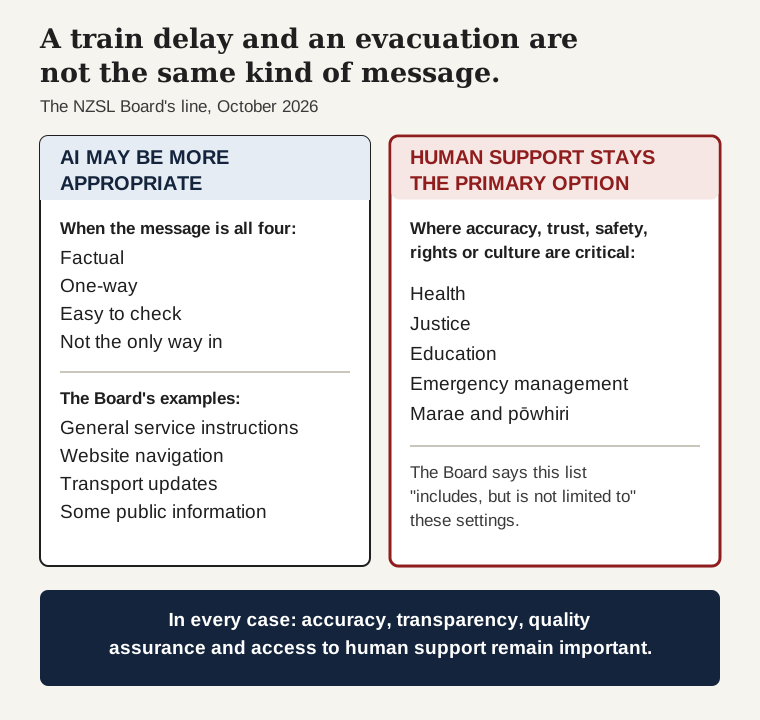
The test has four parts, and a message has to pass all of them: factual, one-way, easy to check, and not the only way to access or understand the service. The Board’s examples of lower-risk use are general service instructions, website navigation, transport updates and some public information. Its high-stakes list names health, justice, education, emergency management and cultural settings such as marae and pōwhiri, and says the list is not exhaustive. Even then, the Board says, “accuracy, transparency, quality assurance and access to human support remain important.” For high-stakes settings, where “accuracy, trust, safety, rights, cultural context or informed decision-making are critical,” appropriate human support stays available “as the primary option.”
Notice what is on the list of examples for lower-risk use: transport updates. Notice what is on the list for human support: emergency management. A train delay and an evacuation order can arrive on the same screen. The Board’s line says they are not the same kind of message. That is exactly the distinction I found blurred in the documents of New Zealand’s own leading vendor.
An emergency instruction is the highest-stakes message a signed language system can carry. A document that rules out high-stakes, medical and educational use cannot be the one governing an emergency alert, a hospital deployment or a school.
Heather M. Grizzle, Kara Technologies: The Pilot Is Governed, the Product Is Not Yet, NCG, 8 October 2026
The checklist, read as a procurement instrument
The developer checklist is one page and seven questions. Before using AI with NZSL, the Board says, “you should be able to answer these seven questions.” I read each one as a buyer would, and set it beside the closest domain in the SLAT Index and beside what the public record showed for Kara Technologies when NCG published its review on 8 October. Kara did not answer the seven questions NCG sent it by the 9 October deadline, so everything in the third column comes from public documents and Auckland Transport’s own pages. The Board does not assess Kara or any other company. The mapping is mine.
| Board question | Closest SLAT domain | Kara’s public record (NCG reading) |
|---|---|---|
| 1. Are Deaf people leading or sharing the main decisions? | Governance Trust | Deaf participation well evidenced; no document gives Deaf people authority to change or stop a release |
| 2. Does the work use NZSL correctly? | Linguistic Trust | Native Deaf signers performed the signs and a named NZSL expert is involved; no published accuracy figures |
| 3. Is NZSL data protected and well controlled? | Governance Trust (data) | Privacy notice routes customer input through six named AI providers without saying which or where; signer agreements not public |
| 4. Have you explored the need and solutions together? | Accessibility Trust | Co-design and testing through Auckland Transport and community consultation in three cities |
| 5. Does AI help people and services rather than replace them? | Deployment Trust | Position statement says no aim to replace interpreters; terms bar high-stakes use while product pages offer emergency updates |
| 6. Has the AI been tested properly? | Linguistic Trust (validated output) | Pilot asked Deaf passengers about accuracy and clarity; no results published |
| 7. Is it clear who is responsible? | Transparency Trust | Pilot feedback address published; no public statement on who answers for a wrong output or how signers withdraw data |
Two things stand out. The first is that Kara does well on the questions about being involved, which are questions four and part of one. The second is that it has no public answer on the questions about power and proof, which are one, three, six and seven. That is not a New Zealand problem. It is the shape of the whole market. Across the vendor records NCG has published this autumn, participation is common and authority is rare, and independent validation of signed output does not exist anywhere I have looked.
Participation is not authority
The checklist’s first and last questions are the ones I would underline. The first asks whether Deaf people are “leading or sharing the main decisions.” The last asks the developer to “let Deaf decision-makers challenge or stop the work.” Not advise. Not review. Stop.
That is the line I have been drawing since June, and it is the line most of the market still will not cross on paper.
Being asked is not the same as being able to say no.
Heather M. Grizzle, Kara Technologies: The Pilot Is Governed, the Product Is Not Yet, NCG, 8 October 2026
The Board adds a sharper edge for Māori. Engagement with Turi Māori “must be representative and appropriate, not a conversation with one person,” and signs for Māori concepts “must not be created, changed, standardised or automated without agreement.” That second sentence matters because New Zealand’s AI signing work has already gone there. In November 2025, 1News reported that Kara’s avatars would include Māori concepts and signs used by Turi Māori, with an NZSL expert and a national Deaf foundation as partners. That may have been done with exactly the agreement the Board describes. The public record does not say who agreed, how, or who can revisit the decision.
In June, writing about what I called the Deaf Halo Effect, I put it this way:
Community trust should open the door to dialogue, not close the door to questions. Cultural legitimacy should inform governance, not replace it.
Heather M. Grizzle, The Fifth Parameter, Issue 005: The Deaf Halo Effect, NCG, 14 June 2026
Rāhera Turner said it in fewer words on Sunday. Ask for our leadership. A vendor that can show a buyer a named Deaf body with a written right to stop output is asking. A vendor that can show a buyer a consultation photo is not.
The pilot that could settle it
New Zealand has something no other country in this debate has: a carefully bounded public pilot with a public authority holding the brake. Auckland Transport ran AI-signed disruption alerts on one train line for three months, from mid-June, with Deaf co-design, a fixed end date and a promise to review before expanding. It asked participants about accuracy, clarity, ease of understanding and usefulness. On 21 September it said the pilot was complete and the feedback was under review.
Kara and its partners, meanwhile, have named buses, ferries, airports, hospitals, supermarkets and doctor’s appointments as places the technology could go next. Under the Board’s line, a train delay might pass the lower-risk test. A doctor’s appointment would not.
If it publishes that analysis, and if the analysis measures whether Tūī’s signing was accurate rather than only whether passengers liked her, it would be the first independent evaluation of deployed sign language AI output that NCG has found anywhere.
Heather M. Grizzle, Kara Technologies: The Pilot Is Governed, the Product Is Not Yet, NCG, 8 October 2026
Three weeks later that is still true. The Board’s statement gives Auckland Transport a reason to publish. Its sixth question asks whether the AI has been “tested properly,” and its answer is to “ask a range of Deaf NZSL users and experts to test as well as advise.” A transport authority that has already run that test is sitting on the evidence the whole field is missing. Publishing it, with its method and its error rate, would do more for Deaf travellers everywhere than any product launch this year.
The livelihood question nobody else asks
Greenwood’s point about income deserves its own section, because it is the one the technology industry treats as somebody else’s problem. Many Deaf people in New Zealand earn their living teaching NZSL. Interpreters, translators, tutors and Deaf-led services are the infrastructure of access, and in a country of about 25,000 NZSL users that infrastructure is thin.
The Board’s statement is direct about it: AI should “support, not replace” interpreters, translators, NZSL teachers and community-led services, and it should avoid “weakening community-led NZSL work.” The NZSL Strategy 2026 to 2036 points the same way, naming the Deaf and NZSL workforce, including Deaf tutors and trilingual and tactile interpreters, as a priority area.
This is where the procurement language and the economic language meet. When a public agency buys an avatar subscription instead of funding interpreters, it does not only change who signs the message. It moves money out of the Deaf community and into a licence, and it creates the “dependence on proprietary datasets, platforms, licences, or subscriptions” the Board tells buyers to avoid. A buyer who is serious about the Board’s position has to count that cost, not just the cost of the contract.
What the United States does not have
ASL has no national language authority. There is no American equivalent of the NZSL Board, no statutory body that advises the government on the language, and no published federal position on how AI should use ASL data, where it may be deployed, or who in the Deaf community decides. What American buyers have instead is civil rights law, applied after the fact, and a trade-association brochure.
I know what after the fact looks like. On 12 October I filed an ADA complaint over AI signing at Cincinnati/Northern Kentucky International Airport, and fourteen days later the airport took it down pending a review that includes Deaf ASL users. On 28 October I wrote about a Toronto startup pitching US airports with human review listed as “optional.” Both stories end in the same place: a Deaf passenger finding the problem on a platform, because nobody upstream had to ask the questions first.
| New Zealand, October 2026 | United States, October 2026 |
|---|---|
| A national sign language authority with a published AI position | No national ASL authority and no federal AI position for ASL |
| Seven questions a developer must answer before using AI with NZSL | Vendor one-pagers that list human review as optional |
| Public content is not consent for AI use | No rule on scraping public ASL video for training |
| AI may fit transport updates; humans stay primary in health and emergencies | Signed announcements deployed first and reviewed after a complaint |
| NZSL data held in Aotearoa under community governance | No requirement on where ASL data is stored or who controls it |
| Deaf decision-makers can challenge or stop the work | Advisory boards with no documented power to stop a release |
None of that requires an act of Congress to fix. A procurement officer can staple the New Zealand checklist to a solicitation tomorrow. Every question on it is answerable, and a vendor that cannot answer it has told the buyer what it needs to know.
What buyers anywhere should take from it
The Board wrote its expectations for NZSL. Read as procurement conditions, they travel. These are the ones I would put in any contract for sign language AI, in any country, adapted from the Board’s statement and checklist.
The provider MUST show that Deaf people, and where relevant Indigenous Deaf people, lead or share the main decisions, and MUST name the body or role with written authority to challenge or stop a release.
The provider MUST publish how accuracy was tested, what sign language expertise was involved, what Deaf-led quality assurance occurred, and who is accountable when an output is wrong, misleading, culturally inappropriate or not understood.
The provider MUST disclose the source of every recording in its training and sign data, the consent behind it, the payment terms, and how a signer withdraws, and MUST NOT treat publicly visible signing as consent to AI use.
The provider MUST state where sign language data and the buyer’s content are stored and processed, which third-party AI services receive them, and whether either is used to train, test or improve any model.
The deployment MUST NOT make AI signing the primary route in health, justice, education, emergency or cultural settings. Human support stays primary there.
Every deployment MUST tell people when they are seeing AI, how to reach a qualified person, and how to report a wrong sign, with a named owner for the report.
The buyer SHOULD structure the contract to avoid dependence on a single proprietary dataset, platform or subscription, and SHOULD count the effect on community-led services and Deaf workers as part of the cost.
Questions readers have asked
Is the NZSL Board against AI?
No. The statement says AI has the potential to improve access to information and services in NZSL and to increase the language’s visibility. It sets conditions for how AI is developed and where it is used. It does not oppose it.
Does the Board name or rate any company?
No. The Board says it does not endorse any AI tool, provider, dataset or approach. The comparison with Kara Technologies in this piece is NCG’s own reading of public documents.
Does the statement apply outside New Zealand?
It applies to anyone using AI with NZSL, NZSL data or NZSL users, whether they are based in New Zealand or overseas. It has no authority over other sign languages, but its questions are not specific to NZSL, and buyers anywhere can use them.
Is it law?
No. The Board says the statement supports decision-making and is not a substitute for legal, privacy, procurement, ethics or technical advice. It sits alongside the NZSL Strategy 2026 to 2036, the New Zealand Disability Strategy 2026 to 2030 and the UN Convention on the Rights of Persons with Disabilities.
How does this relate to the SLAT Index?
The SLAT Index evaluates sign language AI on evidence a buyer can verify. The Board’s seven questions line up closely with its domains, and the two point to the same gaps: Deaf authority over output, consent behind the data, and independent validation of what the system actually signs.
The rules came first
Most of the time, the story of sign language AI runs in one order. A company builds a demo, a buyer deploys it, and a Deaf person finds the error in public. New Zealand has reversed the order, at least on paper. The community met, the Board wrote down the conditions, and the market now has to answer to them.
That will not settle anything by itself. A position statement has no inspectors, and the pilot that could prove the point has not published its results. But it gives every buyer, regulator and journalist in the world a short list of plain questions written by the people whose language is at stake. When the next vendor tells you its avatar was developed with the Deaf community, you do not have to argue about what that means. You can hand it the checklist and ask it to answer all seven.
Sources
All sources were checked on 28 October 2026.
Dalton-Reedy, R. (2026, October 25). Tāngata Turi raise alarms over AI risks to New Zealand Sign Language. Te Ao Māori News.
NZSL Board. (2026, October). NZSL and AI. Position statement page, updated 20 October 2026.
NZSL Board. (2026, October). NZSL Board Position Statement on NZSL and AI. Full statement, PDF.
NZSL Board. (2026, October). NZSL and AI: A checklist for developers. PDF.
NZSL Board. (2026, October). NZSL and AI: Guidance for community. PDF.
NZSL Board. (2025). NZSL Strategy 2026 to 2036: Executive summary. NZSL Board.
NZSL Board. (2025). Priority area: Evidence and data. NZSL Strategy 2026 to 2036.
NZSL Board. (2025). Implementing the refreshed NZSL Strategy. NZSL Strategy 2026 to 2036.
Whaikaha, Ministry of Disabled People. (2025, November 18). New 10-year NZSL strategy launched. Whaikaha.
Office of the Minister for Disability Issues. (2025). New Zealand Sign Language Strategy: Approval to release. Cabinet paper.
Auckland Transport. (2026). NZSL AT Mobile app alerts pilot. Retrieved 28 October 2026.
O’Driscoll, E. (2026, May 8). AI avatars to deliver real-time NZ sign language translations. 1News.
1News, Te Karere. (2025, November 26). Sign language AI avatars to include Māori concepts, signs. 1News.
Grizzle, H. M. (2026, October 8). Kara Technologies: The Pilot Is Governed, the Product Is Not Yet. Novara Consulting Group.
Grizzle, H. M. (2026, September 27). The Corpus Question. Novara Consulting Group.
Grizzle, H. M. (2026, June 14). The Fifth Parameter, Issue 005: The Deaf Halo Effect. Novara Consulting Group.
Grizzle, H. M. (2026, October 28). Consulted, Then Ghosted: How AI Made the Expert Optional. Novara Consulting Group.
Grizzle, H. M. (2026, October 26). I Filed One Complaint. An Airport Took Its AI Signer Down. Novara Consulting Group.
Grizzle, H. M. (2026, October 28). Human Review, Optional: Deaf AI and the Airport Sign Language Pitch. Novara Consulting Group.