

*The agreement that moved special education’s daily work to HHS also covers Gallaudet, NTID and the Helen Keller National Center, and it never says who will keep publishing the numbers*
Every state file in the National Deaf Education Data Index starts in the same place: a school district’s own website, a state agency’s own reports, and a federal spreadsheet. The first two vary wildly. Some states publish a careful count of deaf and hard of hearing students by district every fall; others publish nothing a parent could find. The federal spreadsheet is the constant. When NDEDI built its Nevada file in September, the clearest picture of where deaf and hard of hearing students actually learn came from that federal file: of 518 students aged 5 to 21 served under the hearing impairment category in 2024-25, 307 spent at least 80 percent of their day in a regular classroom, and none were reported in a separate school or residential setting. The state’s own count could be checked against it. Without it, there would have been nothing to check against.
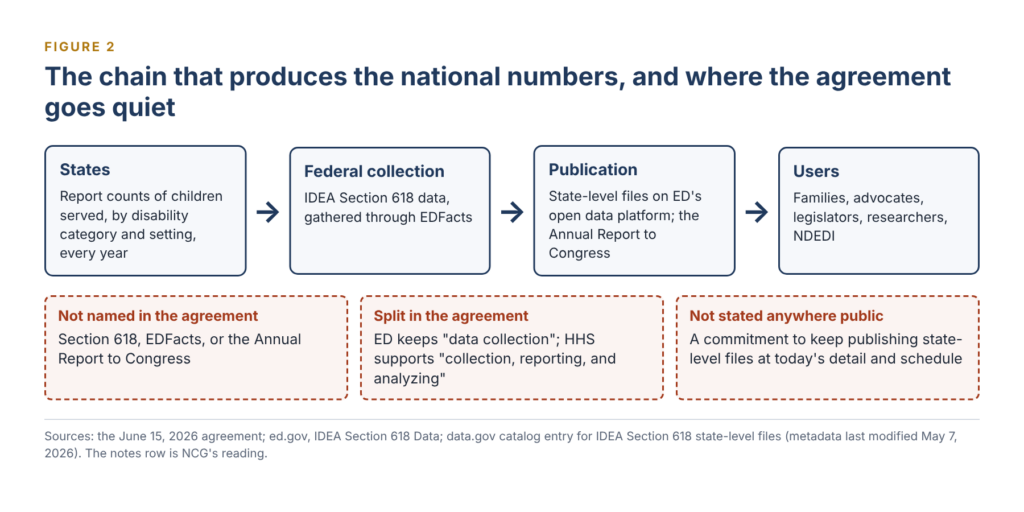
That spreadsheet is part of the IDEA Section 618 data, the counts every state reports to the federal government each year on the children it serves under the Individuals with Disabilities Education Act, by disability category, age, setting and more. States submit it through a federal system called EDFacts. The Education Department publishes it as state-level files on its open data platform and summarizes it in an Annual Report to Congress. For anyone trying to compare how deaf children are educated in Kansas and Kentucky, it is the only source that counts every state the same way.
What changed in June
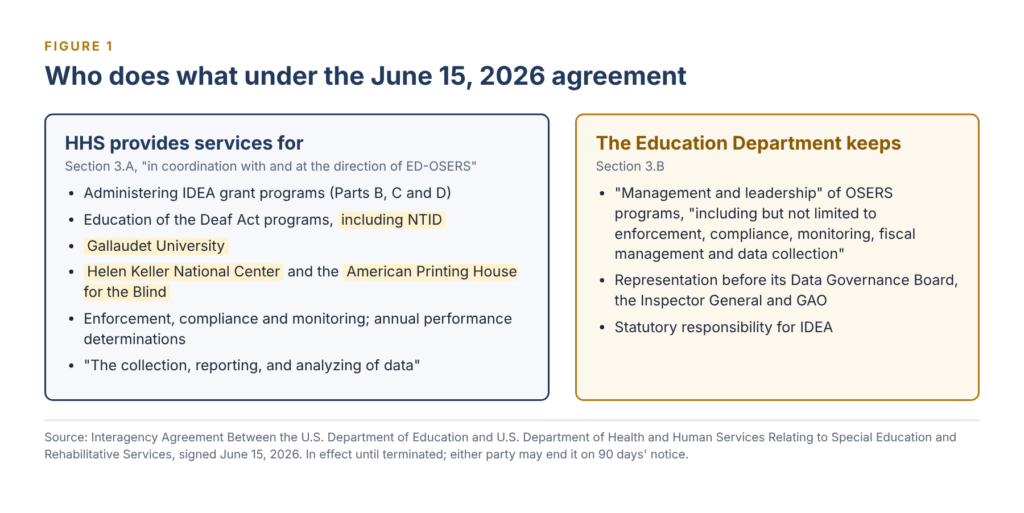
On June 15, 2026, the Education Department and the Department of Health and Human Services signed an interagency agreement on special education and rehabilitative services, announced the next day alongside a separate agreement moving civil rights enforcement to the Justice Department. The agreement is short, eight pages, and plain about what moves. Under section 3.A, HHS commits to provide services, “in coordination with and at the direction of ED-OSERS,” supporting the administration of IDEA’s grant programs under Parts B, C and D; enforcement, compliance and monitoring; the “annual performance determinations” that rate each state; fiscal audits; and “the collection, reporting, and analyzing of data for monitoring compliance with statutory and regulatory requirements and for improving outcomes for infants, toddlers, children, youth, and adults with disabilities.”
The Education Department keeps statutory responsibility for IDEA. Under section 3.B, it retains “Management and leadership of OSERS’ programs and activities,” which the agreement says includes “but not limited to enforcement, compliance, monitoring, fiscal management and data collection,” along with representation before its Data Governance Board, the Inspector General and the Government Accountability Office. The agreement took effect on the date of the last signature, has no end date, and can be terminated by either side on 90 days’ written notice. The contact named for HHS sits in its Administration on Disabilities.
The part of the list Deaf readers should not skip
Most coverage of the agreement has focused, reasonably, on IDEA and on what it means for students’ individualized education programs. Further down the same list are four items that bear directly on Deaf and DeafBlind education. HHS will provide services supporting “the administration of program components authorized under the Education of the Deaf Act of 1986, including the National Technical Institute for the Deaf”; supporting “the administration of Gallaudet University,” described in the agreement as “intended to provide education and training to individuals who are deaf and otherwise to further the education of individuals who are deaf”; supporting the Helen Keller National Center Act programs; and supporting the American Printing House for the Blind.
The agreement does not change what any of these institutions are, and it does not say what “services supporting the administration” of a university means in practice. It does mean that the federal relationship with the two national institutions of Deaf higher education, and with the national center for DeafBlind adults, now runs in part through a health department rather than an education department. In the coverage NCG reviewed, that has drawn far less attention than it deserves.
Where the data goes quiet
Read closely, the agreement splits the data work between the two departments without saying how. The Education Department keeps “data collection” as part of its management and leadership. HHS provides “services to support the collection, reporting, and analyzing of data.” Who designs the collection, who runs EDFacts, who checks the states’ submissions, who publishes the state-level files, and who writes the Annual Report to Congress are not stated. The agreement never uses the words “Section 618,” “EDFacts” or “Annual Report to Congress,” and it contains no commitment to keep publishing the data at its current level of detail or on its current schedule.
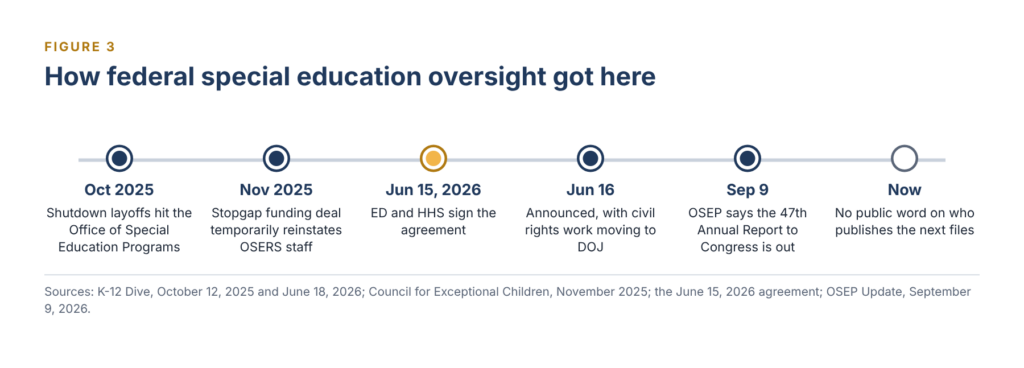
That may simply be how interagency agreements are written. They describe services and funding, not every product. But the gap matters because of what happened before the agreement. In October 2025, during the government shutdown, reduction-in-force notices swept through the Education Department, and K-12 Dive reported that special education association leaders believed most of the Office of Special Education Programs had been laid off. In November, a stopgap funding bill temporarily reinstated the Office of Special Education and Rehabilitative Services staff. Seven months later, the daily work went to HHS. A data system can survive a great deal, but it survives on people who know it, and the public record does not say where those people now sit.
What has come out since
The record since June is mixed, not alarming. The Office of Special Education Programs held its annual conference in August, with sessions on “high-quality section 618 data.” Its September 9 bulletin announced that the 47th Annual Report to Congress on IDEA had been released, with a companion fact sheet, and a panel at the conference said IDEA rights “cannot and will not change through our partnership.” The federal catalog entry for the state-level 618 files was last updated on May 7, 2026, before the agreement was signed. Nothing NCG located says the next files will be late, or thinner, or published somewhere else. Nothing says they won’t be, either. And K-12 Dive’s reading of the agreement in June found that states and districts were still asking which HHS office would oversee the work and who would send them guidance.
Why deaf education feels this first
Every disability category depends on these files, but deaf education depends on them in a particular way. Deaf and hard of hearing students are a low-incidence population, a small share of children spread thinly across many districts, which is exactly the population that state and district reporting tends to drop. Small counts are suppressed for privacy. Districts that serve two deaf students through a cooperative or a regional program often publish nothing at all. In that landscape, the federal file is frequently the only place a statewide number exists, and the only place one state can be compared with another. If the 618 data slips, the students most likely to vanish from the public record are the ones who were hardest to see in the first place.
What should be put in writing
None of this requires anyone to assume bad faith. It requires a few sentences that the agreement does not contain. The Education Department and HHS could settle the question publicly by stating:
– That the IDEA Section 618 collection through EDFacts will continue on its existing schedule, at its existing level of detail, including disability category by state.
– Which department, and which office, publishes the state-level files and the Annual Report to Congress from now on, and where.
– That historical files will stay available at their current addresses.
– Who to contact with questions about the data, now that the HHS contact for the agreement sits in the Administration on Disabilities.
Families, state special education directors, state deaf commissions and legislators can ask for exactly that, in writing, through the Education Department’s Office of Special Education and Rehabilitative Services. NDEDI’s state files cite the federal data by school year and source, so any change in what is published will show up in the record rather than disappearing into it. NDEDI’s state release schedule is at ndedi.org.
Ilaha
– Interagency Agreement Between the U.S. Department of Education and U.S. Department of Health and Human Services Relating to Special Education and Rehabilitative Services, signed June 15, 2026, retrieved October 8, 2026.
– K-12 Dive, “Takeaways from the Ed Dept-HHS special ed agreement,” June 18, 2026.
– K-12 Dive, “RIFs rip through federal Office of Special Education Programs,” October 12, 2025.
– Council for Exceptional Children, “Congress Temporarily Reopens Federal Government, Reinstates OSERS Personnel,” November 14, 2025.
– U.S. Department of Education, OSEP Update, September 2026, September 9, 2026.
– U.S. Department of Education, IDEA Section 618 Data, page last reviewed April 2, 2026.
– Data.gov, IDEA Section 618 State Level Data Files, metadata last modified May 7, 2026, retrieved October 8, 2026.
– National Deaf Education Data Index, Nevada state file, September 2026, using the IDEA Section 618 Part B educational environments file for 2024-25.