
I am Deaf, I sign ASL, and a rare form of retinitis pigmentosa has erased the top of my visual field. I call myself DeafBlind. I also make eye contact, read faces, drive myself to meetings, and prefer email. Here is why none of those facts contradict each other.
The ceiling
The cabinet door gets me every time. Someone in the kitchen leaves it open, I turn from the sink, and the corner of it finds my forehead before I know it exists. It is not clumsiness, and it is not distraction. The door was simply above the line where my world ends. Low branches on a walking path, the edge of a raised trunk lid, a sign hung from the ceiling of a store, a hand that waves at me from above shoulder height: all of it lives in a part of the sky I do not see. I have been walking into the world with the top sliced off for most of my life, and almost nobody around me has ever noticed.
That is the strange thing about my disability. I am Deaf, I sign ASL, and I have a form of retinitis pigmentosa that has taken the upper part of my visual field. I call myself DeafBlind. When I say that, people look at me the way you would look at someone who just told you they were a pilot while standing in line at the DMV. I make eye contact. I read their faces. I drive myself to meetings. I answer email faster than most hearing people I know. Nothing about the way I move through a room says blind, so the word lands like an exaggeration, or worse, like a claim I am making for some advantage. This essay is my attempt to explain what is actually going on, because the gap between what people see and what I live is wide enough that I am tired of falling into it.
What sector RP actually takes
Retinitis pigmentosa is a family of inherited conditions in which the light-sensing cells of the retina slowly die off. Most people who have heard of it picture the classic version: the field closes in from the edges until a person is looking through a straw. Mine is a rarer variant called sector RP, in which the damage stays confined to one or two quadrants of the retina instead of spreading around the whole ring. In most people with sector RP, and in me, the damaged quadrants are in the lower half of the retina. Because the eye’s lens flips the image, damage at the bottom of the retina erases the top of the visual field. Clinical reviews describe exactly this pattern: degeneration along the inferior retina, matching defects in the superior field, and slow progression over years [1].
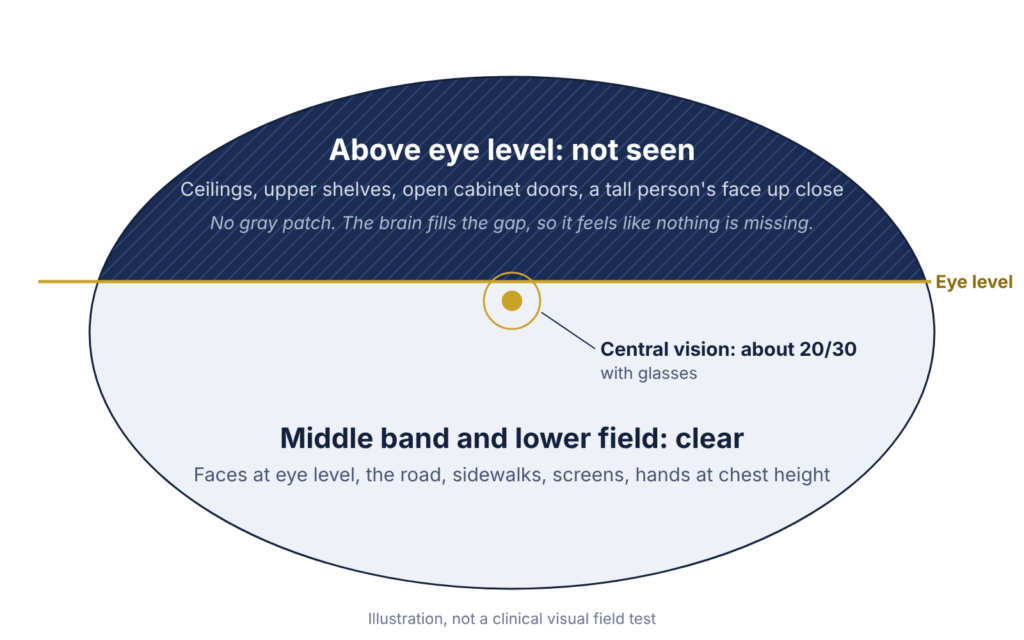
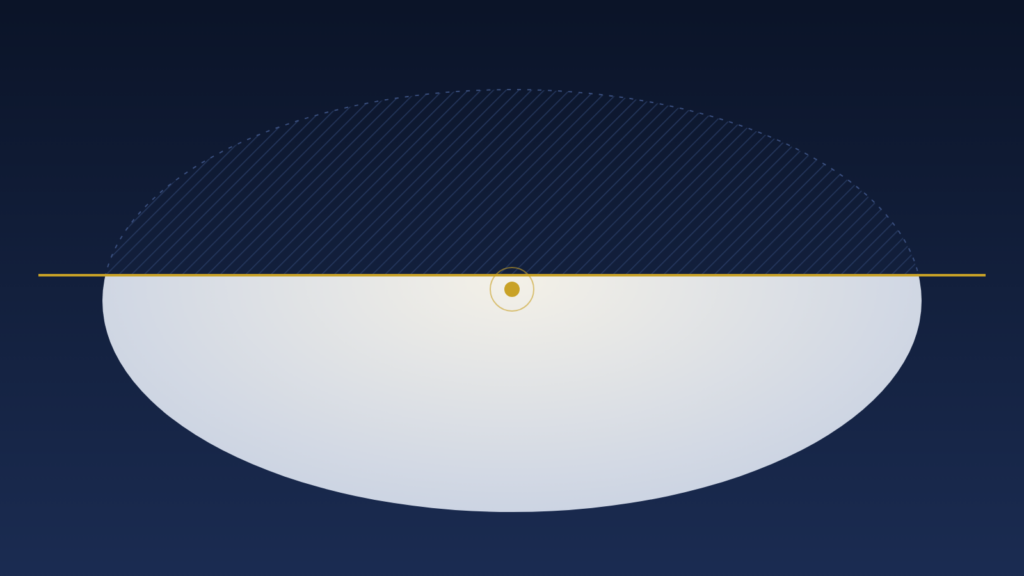
In practical terms, this is what I have. My central vision, the sharp part you use to read and recognize faces, is about 20/30 with glasses, which is better than plenty of people who would never think of themselves as disabled. The middle band of my field and the lower half are clear. What is gone is everything above roughly eye level. If I look straight ahead, there is no ceiling, no top of the doorframe, no upper shelf, no face of a tall person standing close. There is no gray patch where those things should be, either. The brain does not show you the hole; it smooths over it, so the missing part does not feel missing. It feels like nothing. That is why the cabinet door is a surprise every single time. I do not experience a blind spot I can steer around. I experience a complete-looking world that happens to have things in it I cannot see until they hit me.
Why I say DeafBlind
I want to be precise here, because precision is the whole argument. The strictest legal definition of deaf-blindness in the United States, written into the Helen Keller National Center Act, is built on numbers: central acuity of 20/200 or less, or a field no wider than 20 degrees, or a progressive loss headed toward one of those [2]. My numbers are nowhere near that, and I am not going to pretend otherwise. If DeafBlind meant only the people who meet that federal eligibility line, I would not use the word.
A hearing person with mild field loss loses the top of the doorframe. I lose the top of my language.
Heather M. Grizzle
But that is not what the word means to the people who live it. DeafBlind is a spectrum, and the large majority of people on it have some usable vision, some usable hearing, or both. The DeafBlind community has long made a point that the numbers miss: deafblindness is not deafness plus blindness. It is what happens when the two losses remove each other’s backup. A hearing person with my exact eyes would hear the cabinet door creak open. A Deaf person with perfect eyes would see it. I get neither channel for that slice of the world. Every piece of information that reaches me comes through vision, and part of my vision is missing.
| Moment | A hearing person with my eyes | A Deaf person with full vision | Me |
|---|---|---|---|
| A cabinet door swings open above me | Hears it creak | Sees it | Neither |
| Someone calls or waves from a stairway | Hears them | Sees the wave | Neither |
| Hands rise above eye level in a signed conversation | Not relevant | Sees every sign | Loses part of the sentence |
The language piece makes it sharper. ASL is a visual language, and its signing space runs from the top of the head to the waist. A long list of signs is made at the forehead and temple. When someone tall signs to me up close, the top of their signing space can fall into the part of the field I do not have, and I am reconstructing words from context and the bottom half of a handshape. When a group signs across a room, I lose hands that rise.
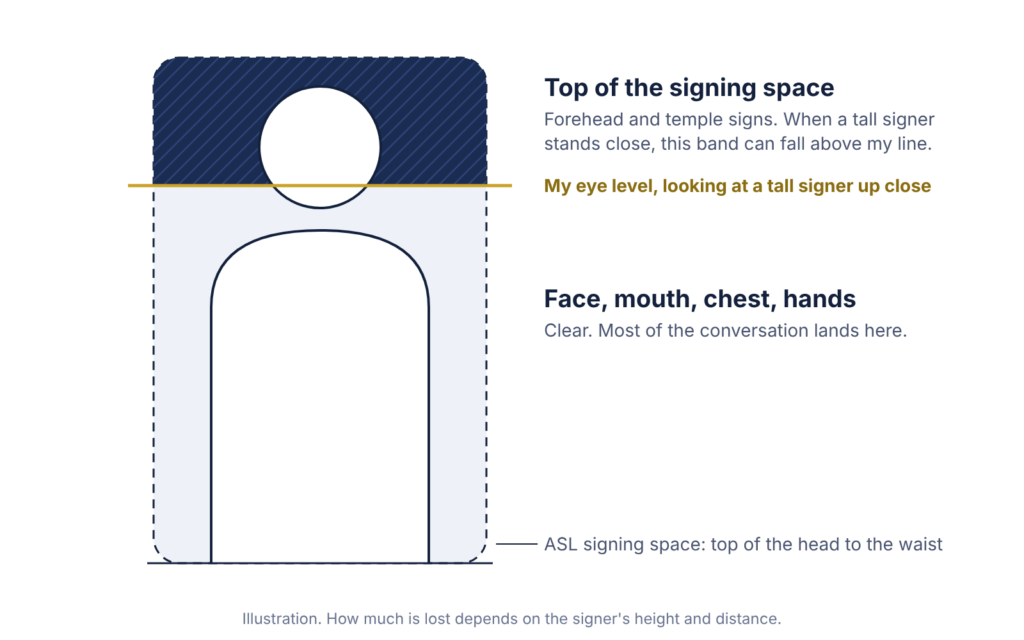
A hearing person with mild field loss loses the top of the doorframe. I lose the top of my language. That is why I say DeafBlind. It is not a claim about how much I cannot see. It is an honest description of what happens when the only sense my world runs on has a piece cut out of it.
Why I drive just fine
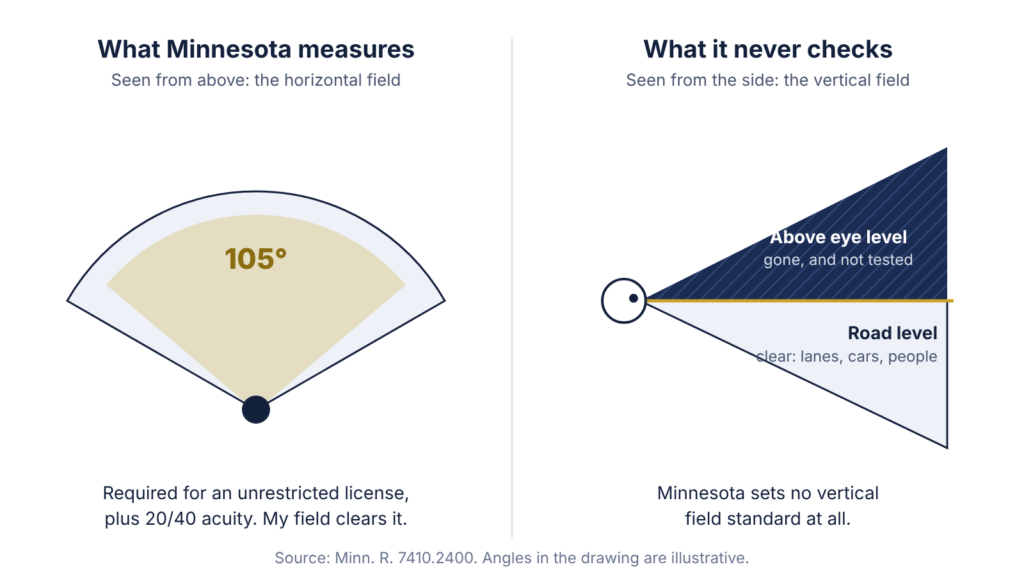
The question I get most, sometimes asked out loud and more often asked with a look, is how a DeafBlind woman has a driver’s license. The answer is that driving happens almost entirely in the part of the world I can see. The road, the lane lines, the car ahead, the pedestrian stepping off a curb, the mirrors, the dashboard: all of it sits in the horizontal band and the lower field, which are clear for me. Minnesota’s licensing rule reflects this. To hold an unrestricted license, a driver needs 20/40 acuity and a field of at least 105 degrees measured across the horizontal diameter [3]. There is no vertical field standard at all.
I meet the standard the state actually uses, with room to spare, because my loss sits in the one direction the test does not measure and the road rarely asks about.
The overhead parts of driving are the parts I have learned to handle on purpose. A traffic light or an overhead highway sign sits near the horizon when it is far away, which is exactly when I need to read it, so I read early. As I pull close to a stop line I lift my chin rather than trusting that the signal is still where I last saw it. None of that is heroic adaptation. It is the same kind of habit every driver builds around their own car’s blind spots. The irony is that driving is one of the places where my disability matters least, and it is the single fact most likely to convince people I do not have one.
Why I prefer email, and why it is not the DeafBlind part
People who know I am DeafBlind and know I prefer email tend to connect the two. It makes a tidy story: she cannot see well, she cannot hear, so of course she writes. The story is wrong, and I would rather correct it than let it stand, because it is unfair to both of the things it confuses. I can sign on a video call. I can read a face on a videophone screen; the person is centered in front of me, at eye level, in exactly the part of my field that works. My preference for email has almost nothing to do with my eyes or my ears. It comes from being AuDHD, autistic and ADHD at the same time.
Live conversation asks for many things at once. I have to take in the language, track the other person’s face and intent, hold my own thoughts in working memory while they keep moving, decide what matters, and answer in real time without the pause that would let me answer well. For my brain, that is not one task; it is five tasks running in parallel, and the cost shows up later as exhaustion and as answers I wish I had given differently. Writing removes the clock. I can read the whole message, let it settle, think it through properly, and send something precise. Many of my best hours of work arrive in deep, focused stretches, and asynchronous exchange lets me meet people inside those stretches instead of being pulled out of them by a call that lands at the wrong moment. Email is not me avoiding people. It is the setting in which I show up as my most competent and most generous self.
Why it stays invisible
All three of my conditions are invisible by default, and they hide each other. Deafness does not show until I start signing. My vision loss does not show at all, because the parts people watch for, eye contact, reading, navigating a sidewalk, are the parts that work. Autism and ADHD show up mostly as preferences that look like personality: the email habit, the directness, the need to understand a plan before I can act on it. Put together, I read to most people as a capable Deaf woman with strong opinions and a slightly odd relationship with cabinet doors. That reading is not entirely wrong. It is just missing the layer that explains why I do what I do.
Most of us are walking around, driving, working, and answering email, with a piece of our world quietly missing.
Heather M. Grizzle
The cost of being misread is not dramatic, which is part of why it is hard to talk about. Nobody offers accommodations for a disability they cannot see, so I either ask and risk sounding like I am inflating something, or I do not ask and absorb the cost quietly. I scan constantly, tilting my head to check the space above me, and that low hum of vigilance is tiring by the end of a day. I miss a wave from someone across a room and come off as cold. A colleague signs to me from a step above, and I lose half of what they said and have to decide whether to ask again or guess. The bruises on my forehead get read as clumsiness. Each of these is small. Together they are the texture of living with a disability that does not look like the picture people carry of it.
And people do carry a picture. Mention DeafBlind and most minds go straight to Helen Keller: total silence, total darkness, a hand on a hand. Some DeafBlind people live close to that, and their lives deserve to be understood on their own terms. Most of us do not, and the single image crowds out everyone else on the spectrum, including the many of us who are walking around, driving, working, and answering email, with a piece of our world quietly missing.
What I am asking for
I am not asking anyone to see what I see. That is not possible, and I do not fully see it myself, because my brain papers over the gap. I am asking for something simpler: when a person tells you how their body works, take the description as information rather than as a claim to be audited against how they look. If I say I am DeafBlind, I am telling you that the top of the world is unreliable for me and that I have no sound to fall back on. If I say I prefer email, I am telling you how my mind does its best work. Neither statement is a request for sympathy, and neither is contradicted by the fact that I can drive to your office.
If you work or sign with me
- Keep your hands and face at my eye level, and do not take it personally if I miss something that happened above it.
- Step into my line of sight instead of waving overhead.
- Write to me when you want my best thinking, and give me time to answer.
And if you meet someone whose disability does not match the picture in your head, consider that the picture may be the thing that is incomplete. Mine certainly was, before I learned to account for the part of the sky I do not see.
References
- Coussa, R. G., Basali, D., Maeda, A., DeBenedictis, M., & Traboulsi, E. I. (2019). Sector retinitis pigmentosa: Report of ten cases and a review of the literature. Molecular Vision, 25, 869–889. https://pmc.ncbi.nlm.nih.gov/articles/PMC6937219/
- Helen Keller National Center Act, 29 U.S.C. § 1905(2) (definition of “individual who is deaf-blind”). https://www.law.cornell.edu/uscode/text/29/1905
- Minnesota Rules, part 7410.2400, Vision. https://www.law.cornell.edu/regulations/minnesota/Minn-R-7410-2400